

Della Nuova Geometria di Franc. Patrici. Libri XV
- Ferrara: Vittorio Baldini, 1587
Ferrara: Vittorio Baldini, 1587. Full Description:
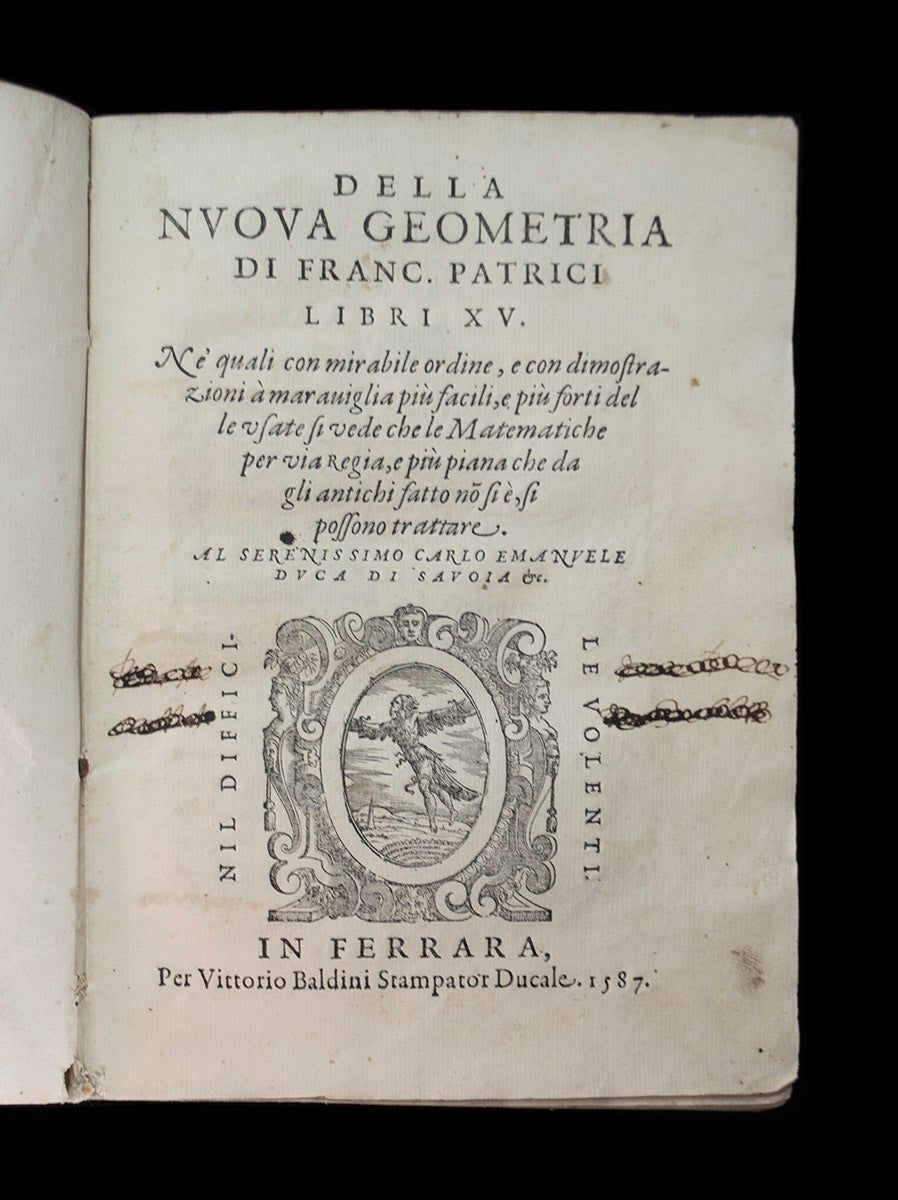
PATRIZI, Francesco. Della Nuova Geometria di Franc. Patrici. Libri XV. Ferrara: Vittorio Baldini, 1587.
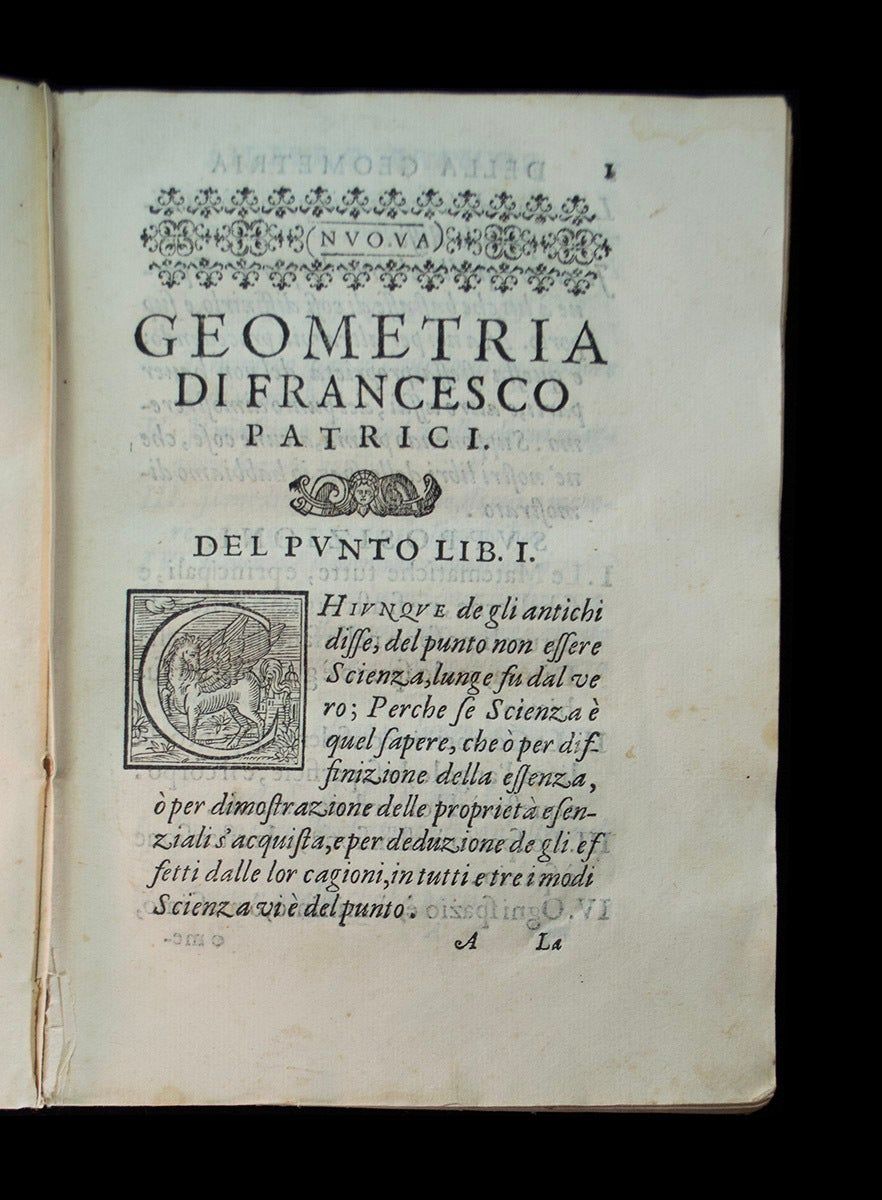
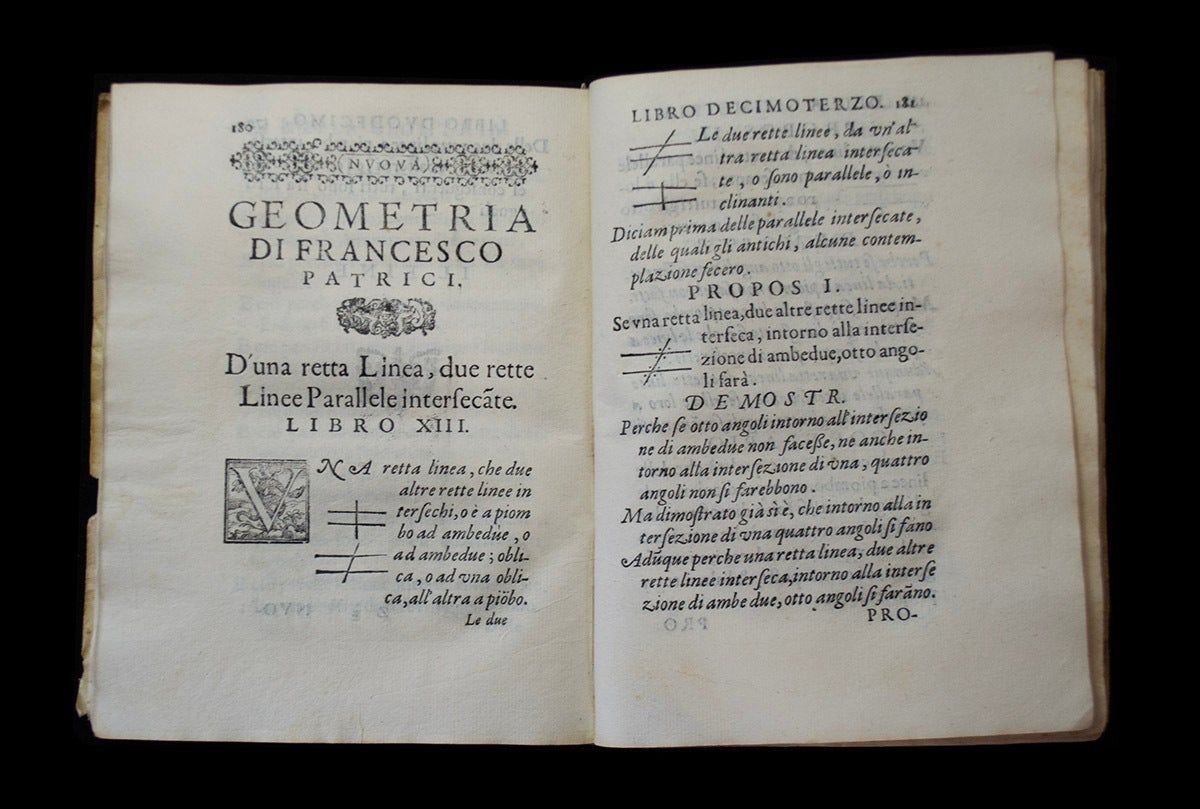
Rare first edition. Small quarto (7 3/4 x 6 inches; 198 x 150 mm). [8], 227, [1, printer's imprint], [1, errata], [3, blank] pp. Woodcut printer's devices on title-page and colophon. Engraved initials and head and tail pieces. Small woodcut diagrams in the text.
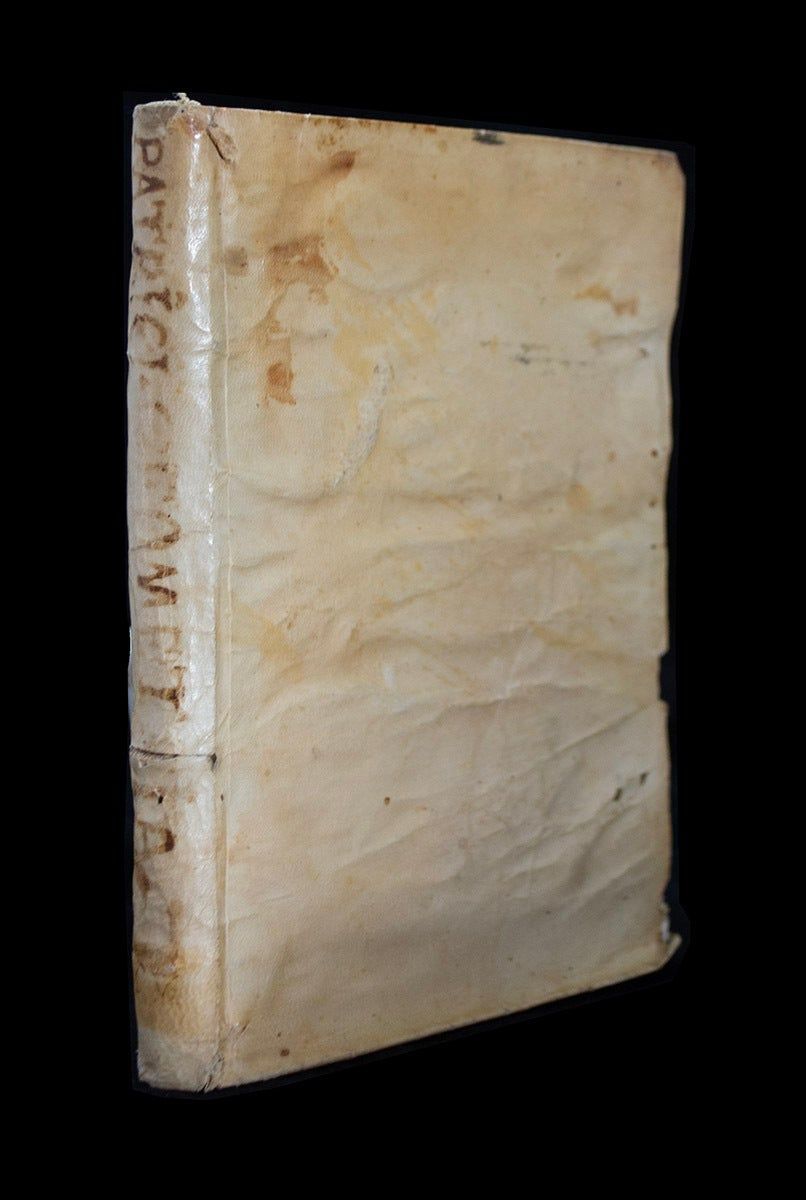
Contemporary full limp vellum. Manuscript title on spine. Some old ink markings to title-page. Vellum a bit soiled and worn with some minor cracking and chipping. Leaf O4 with some old ink markings. Otherwise internally very clean. A very good copy.
"Patrizi's importance in the history of science rests primarily on his highly original views concerning the nature of space, which have striking similarities to those later developed by Henry More and Isaac Newton. His position was first set out in De rerum naturae libri II priores, alter de spacio physico, alter de spacio mathematico (Ferrara, 1587) Rejecting the Aristotelian doctrines of horror vacui and of determinate 'place,' Patrizi argued that the physical existence of a void is possible and that space is a necessary precondition of all that exists in it. Space, for Patrizi, was 'merely the simple capacity (aptitudo) for receiving bodies, and nothing else.' It was no longer a category, as it was for Aristotle, but an indeterminate receptacle of infinite extent. His distinction between 'mathematical' and 'physical' space points the way toward later philosophical and scientific theories. The primacy of space (spazio) in Patrizi's system is also seen in his Della nuova geometria (Ferrara, 1587), the essence of which was later incorporated into the Nova de universis philosophia. In it Patrizi attempted to found a system of geometry in which space was a fundamental, undefined concept that entered into the basic definitions (point, line, angle) of the system. The full impact of Patrizi's works on later thought has yet to be evaluated" (Dictionary of Scientific Biography X, 416).
"In his Nuova geometria Patrizi defines points, lines, angles, surfaces, and solids as the subject matter of the discipline of geometry. He then goes on to argue that every space must have a minimum, maximum and mean. At this point in his explanation, he comes to the conclusion that each space must be one-dimensional (length), two-dimensional (length and breadth), or three-dimensional (length, breadth and depth) ... Patrizi conceives of space as the first and most important undefined geometric concept which is lacking in Euclid's Elements. Points, lines, angles, surfaces, and solids must all be related to space as their founding concept." (Prins, pp. 259-260).
DSB X, 416. Echoes of an Invisible World. Marsilio Ficino and Francesco Patrizi on Cosmic Order and Music Theory.Jacomien Prins.
HBS 69507.
$10,000.
PATRIZI, Francesco. Della Nuova Geometria di Franc. Patrici. Libri XV. Ferrara: Vittorio Baldini, 1587.
Rare first edition. Small quarto (7 3/4 x 6 inches; 198 x 150 mm). [8], 227, [1, printer's imprint], [1, errata], [3, blank] pp. Woodcut printer's devices on title-page and colophon. Engraved initials and head and tail pieces. Small woodcut diagrams in the text.
Contemporary full limp vellum. Manuscript title on spine. Some old ink markings to title-page. Vellum a bit soiled and worn with some minor cracking and chipping. Leaf O4 with some old ink markings. Otherwise internally very clean. A very good copy.
"Patrizi's importance in the history of science rests primarily on his highly original views concerning the nature of space, which have striking similarities to those later developed by Henry More and Isaac Newton. His position was first set out in De rerum naturae libri II priores, alter de spacio physico, alter de spacio mathematico (Ferrara, 1587) Rejecting the Aristotelian doctrines of horror vacui and of determinate 'place,' Patrizi argued that the physical existence of a void is possible and that space is a necessary precondition of all that exists in it. Space, for Patrizi, was 'merely the simple capacity (aptitudo) for receiving bodies, and nothing else.' It was no longer a category, as it was for Aristotle, but an indeterminate receptacle of infinite extent. His distinction between 'mathematical' and 'physical' space points the way toward later philosophical and scientific theories. The primacy of space (spazio) in Patrizi's system is also seen in his Della nuova geometria (Ferrara, 1587), the essence of which was later incorporated into the Nova de universis philosophia. In it Patrizi attempted to found a system of geometry in which space was a fundamental, undefined concept that entered into the basic definitions (point, line, angle) of the system. The full impact of Patrizi's works on later thought has yet to be evaluated" (Dictionary of Scientific Biography X, 416).
"In his Nuova geometria Patrizi defines points, lines, angles, surfaces, and solids as the subject matter of the discipline of geometry. He then goes on to argue that every space must have a minimum, maximum and mean. At this point in his explanation, he comes to the conclusion that each space must be one-dimensional (length), two-dimensional (length and breadth), or three-dimensional (length, breadth and depth) ... Patrizi conceives of space as the first and most important undefined geometric concept which is lacking in Euclid's Elements. Points, lines, angles, surfaces, and solids must all be related to space as their founding concept." (Prins, pp. 259-260).
DSB X, 416. Echoes of an Invisible World. Marsilio Ficino and Francesco Patrizi on Cosmic Order and Music Theory.Jacomien Prins.
HBS 69507.
$10,000.
Details
Title
Della Nuova Geometria di Franc. Patrici. Libri XV
Author
PATRIZI, Francesco
Condition
Unknown
Publisher
Vittorio Baldini: Ferrara
Date
1587