

Circa 1900 – A tribute to missionary nurses
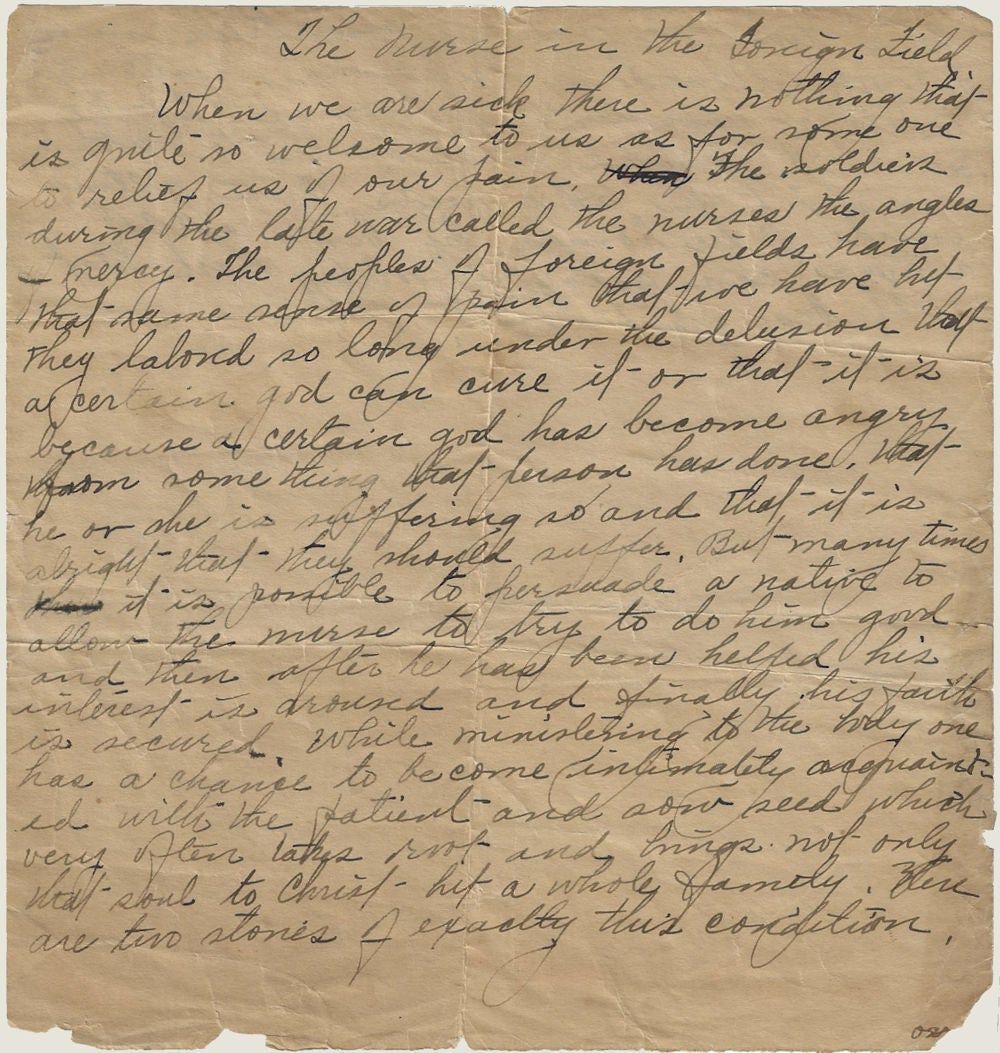
- Unbound
- Unknown , 1900
It reads in total:
“When we are sick there is nothing that is quite so welcome to us as for someone to relief us of our pain. The soldiers during the late war [probably the Spanish-American War] called the nurses the angels of mercy. The peoples of foreign fields have that same sense of pain that we have but they labored so long under the delusion that a certain god can cure it or that it is because a certain god has become angry from some thing that person has done. That he or she is suffering so and that it is alright that they should suffer. But many times it is possible to persuade a native to allow the nurse to try to do him good, and then after he has been helped his interest is aroused and finally his faith is secured. While ministering to the holy one has chance to become intimately acquainted with the patient and sow seeds which very often takes root and brings not only that soul to Christ but a whole family.
“Then two in many countries men are not allowed in the homes, particularly to talk or minister to the women, but the nurse is allowed sometimes to enter to minister to the bodily needs. Once getting inside of the homes by being tactful a nurse can gain a footing there that will bear fruit later.”
. The concept of medical missionary work was first conceived by Western missionaries in China with the support of Canton businessmen who hoped it would help open the country and the East to international trade. Although medical missionaries, i.e., doctors and nurses combined, were small in number (only about 770 of 12,837 total missionaries, their impact was disproportionately larger than their non-medical counterparts. Although many denominations sent missionary nurses overseas, the Presbyterians provided the most, especially to China, Thailand, the Philippines, and Korea.For many women, becoming a nursing missionary was the epitome of womanhood, an opportunity to care for the weak, sick, and helpless. Although they performed traditional nursing roles, they did so in a relatively independent environment, which, for the most part, was unbound by the strictures of the masculine-dominated medical community at home. Moreover, many were motivated by the prevailing societal view that it was a person’s moral, Christian obligation to save souls.
(For more information, see Bartlett’s “Female Medical Missionaries: Using Traditional Roles to Transcend the Status Quo,” available online.)
.Details
Title
Circa 1900 – A tribute to missionary nurses
Author
Unidentified
Binding
Unbound
Condition
Very Good
Publisher
Unknown
Date
1900