

Chuja hakchŏk 朱子學的 [Ch. Zhuzi xuedi; Essence of Master Zhu’s Learning]
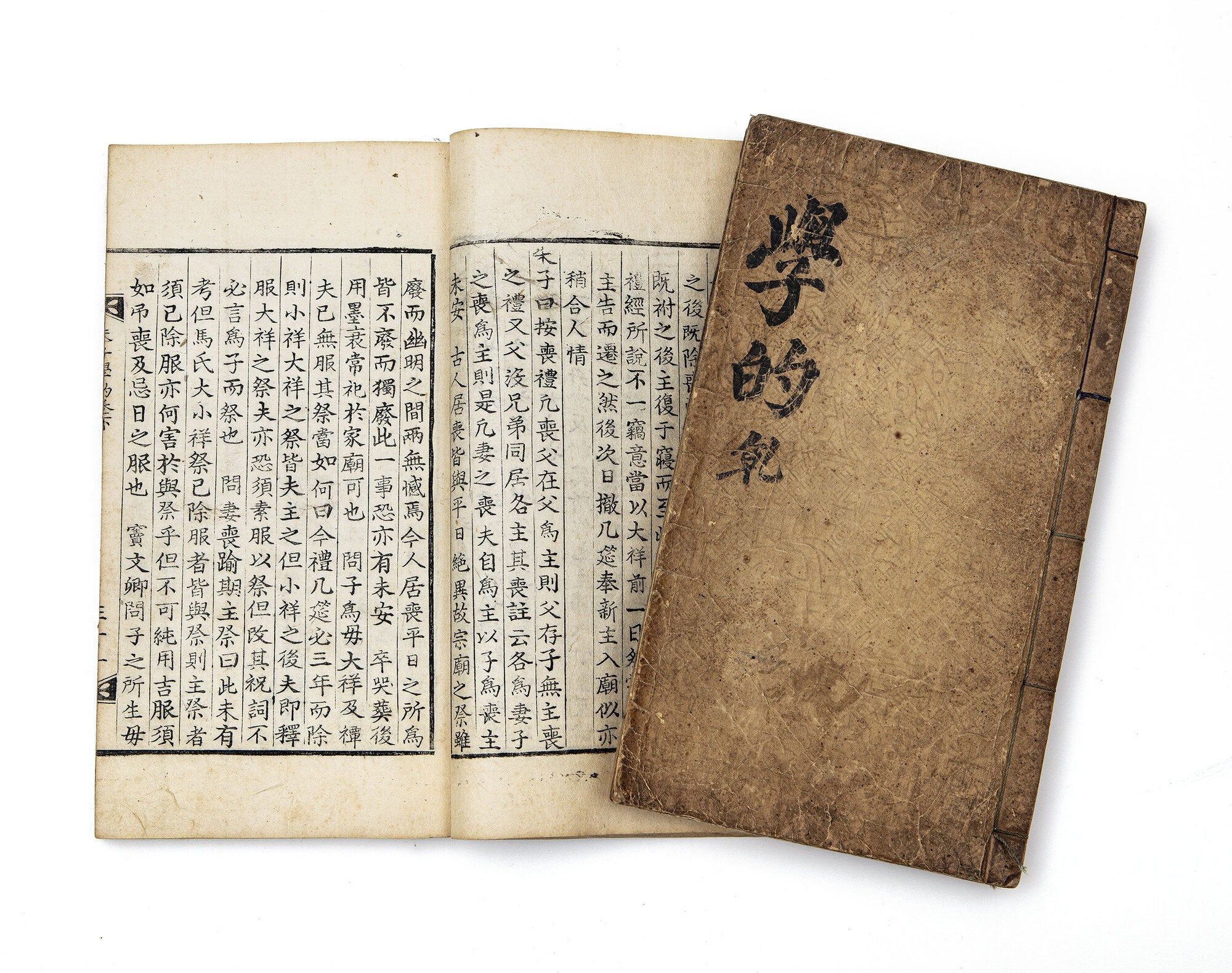
Printed with wooden & metal movable type. 69; 87 folding leaves. Two kwŏn in two volumes. Small folio (295 x 178 mm.), orig. wrappers (wrappers a little stained), handwritten titles in black ink on upper covers, new stitching. [Korea]: [Kyosŏgwan], [before 1748].
A rare movable-type edition of a 15th-century primer on Neo-Confucian philosophy, printed in the first half of the 18th century.
The Chuja hakchŏk — or in Chinese, Zhuzi xuedi — is a thematically organized collection of sayings attributed to the great Neo-Confucian philosopher Zhu Xi 朱熹 (1130-1200), compiled by the eminent scholar-official Qiu Jun (1421-95) and given to Zhu Zhen 朱禎 (fl. 15th century), a ninth-generation descendant of Zhu Xi, during the Zhu Zhen’s visit to the capital. Woodblocks for the work were commissioned by Zhu Zhen’s son, Zhu Pan 朱潘 (fl. ca. 1508), and kept in the family shrine until 100 years later, when they were discovered by Zhu Wubi 朱吾弼 (1559-1629). A new, revised edition was published by Zhang Boxing 張伯行 (1651-1725) in 1709, which formed the basis of this Korean reprint.
Taking inspiration from the Analects, the Chuja hakchŏk is a collection of brief excerpts taken from the vast oeuvre of the 12th-century philosopher, carefully organized into 20 categories from the nature of learning and behavioral guidelines to metaphysical matters and questions of sagehood. The archery metaphor in the title of the work (Ch. di 的) signified the succinctness and precision with which the work introduces the reader into the vast systems of Neo-Confucian thought. The first volume begins with Prefaces by Zhang Boxing dated Kangxi 48 (1709), and by Zhu Wubi dated Wangli bingwu (1606), followed by a list of 70 officials involved in the re-edition. The second volume ends with a colophon by Qiu Jun dated Tianshun guiwei (1463), and another by Guo Lian 郭濂 dated Zhengde 3 (1508).
The body of this Korean edition is printed with what is called the kyosŏgwan p’ilsŏch’eja 校書館筆書體字, the cursive-style wooden movable type of the official printing house of the Chosŏn government. The first Preface, in five half-leaves, however, is printed with a different set of larger, bronze movable type known as musinja 戊申字, so called because it was cast in 1668. Red seals on the first page of both volumes read 禮信文庫 and 鄭彦燮印, the latter being the personal seal of Chŏng Ŏn-sŏp (1684-1748), a high-ranking Korean official.
A nice set of this well-printed book. Very rare outside Korea; we find no copies of this edition in WorldCat. Preserved in a jil.
A rare movable-type edition of a 15th-century primer on Neo-Confucian philosophy, printed in the first half of the 18th century.
The Chuja hakchŏk — or in Chinese, Zhuzi xuedi — is a thematically organized collection of sayings attributed to the great Neo-Confucian philosopher Zhu Xi 朱熹 (1130-1200), compiled by the eminent scholar-official Qiu Jun (1421-95) and given to Zhu Zhen 朱禎 (fl. 15th century), a ninth-generation descendant of Zhu Xi, during the Zhu Zhen’s visit to the capital. Woodblocks for the work were commissioned by Zhu Zhen’s son, Zhu Pan 朱潘 (fl. ca. 1508), and kept in the family shrine until 100 years later, when they were discovered by Zhu Wubi 朱吾弼 (1559-1629). A new, revised edition was published by Zhang Boxing 張伯行 (1651-1725) in 1709, which formed the basis of this Korean reprint.
Taking inspiration from the Analects, the Chuja hakchŏk is a collection of brief excerpts taken from the vast oeuvre of the 12th-century philosopher, carefully organized into 20 categories from the nature of learning and behavioral guidelines to metaphysical matters and questions of sagehood. The archery metaphor in the title of the work (Ch. di 的) signified the succinctness and precision with which the work introduces the reader into the vast systems of Neo-Confucian thought. The first volume begins with Prefaces by Zhang Boxing dated Kangxi 48 (1709), and by Zhu Wubi dated Wangli bingwu (1606), followed by a list of 70 officials involved in the re-edition. The second volume ends with a colophon by Qiu Jun dated Tianshun guiwei (1463), and another by Guo Lian 郭濂 dated Zhengde 3 (1508).
The body of this Korean edition is printed with what is called the kyosŏgwan p’ilsŏch’eja 校書館筆書體字, the cursive-style wooden movable type of the official printing house of the Chosŏn government. The first Preface, in five half-leaves, however, is printed with a different set of larger, bronze movable type known as musinja 戊申字, so called because it was cast in 1668. Red seals on the first page of both volumes read 禮信文庫 and 鄭彦燮印, the latter being the personal seal of Chŏng Ŏn-sŏp (1684-1748), a high-ranking Korean official.
A nice set of this well-printed book. Very rare outside Korea; we find no copies of this edition in WorldCat. Preserved in a jil.
Details
Title
Chuja hakchŏk 朱子學的 [Ch. Zhuzi xuedi; Essence of Master Zhu’s Learning]
Author
QIU, Jun 丘濬
Condition
Unknown