

J: Kōshi seiseki no zu 孔子聖蹟之図 [Pictures of the Sage’s Traces; Ch: Kongzi sheng ji tu 孔子聖蹟圖]
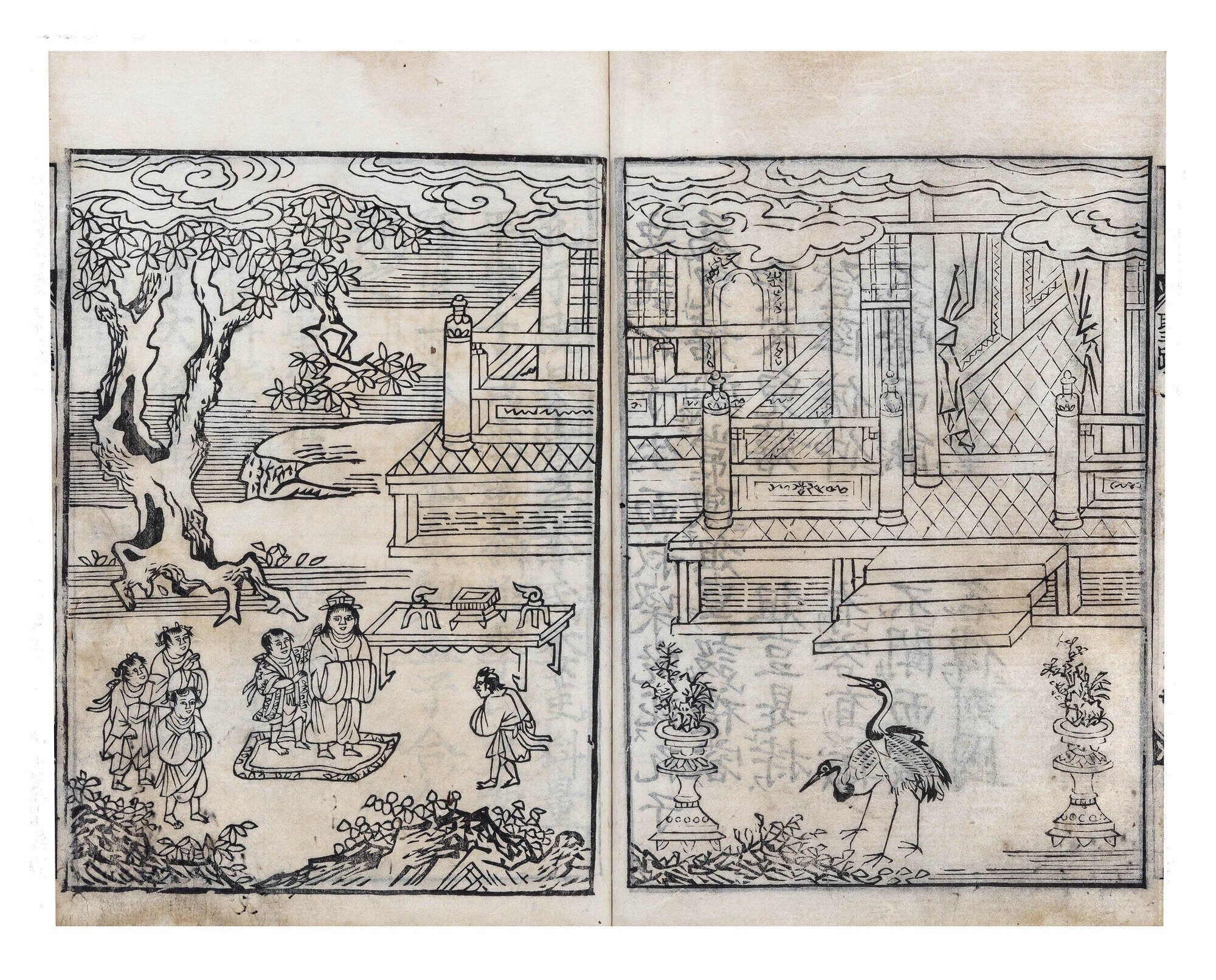
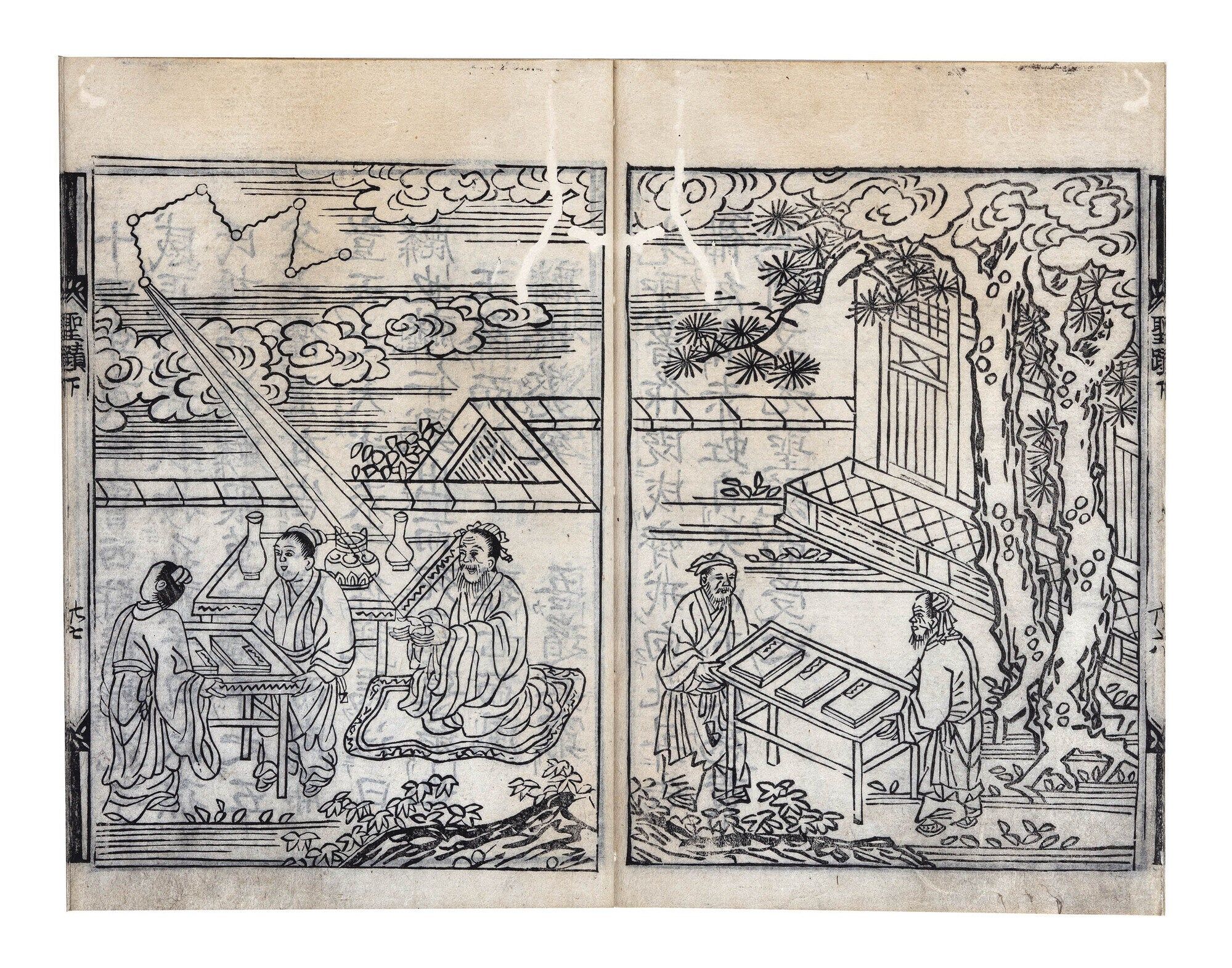
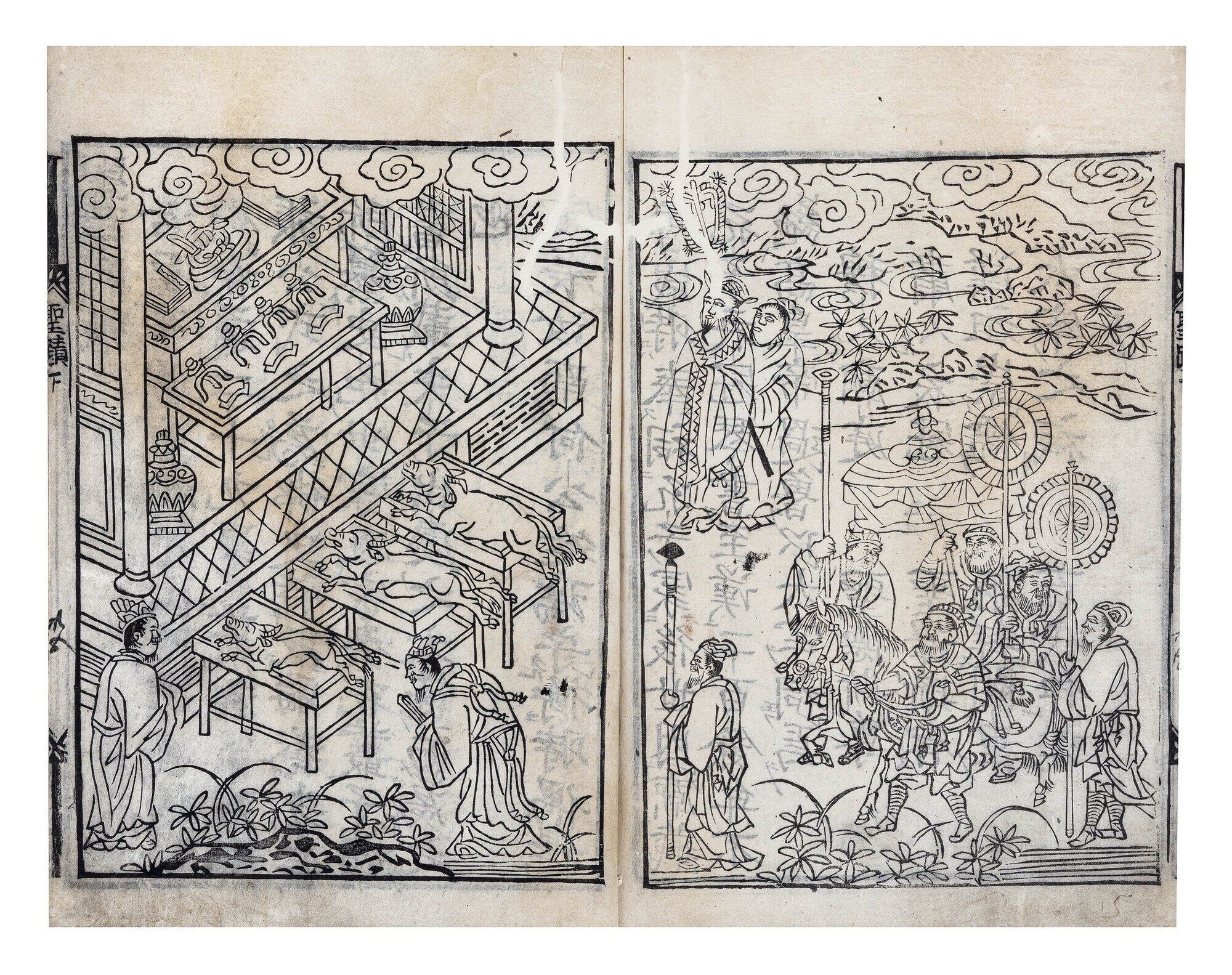
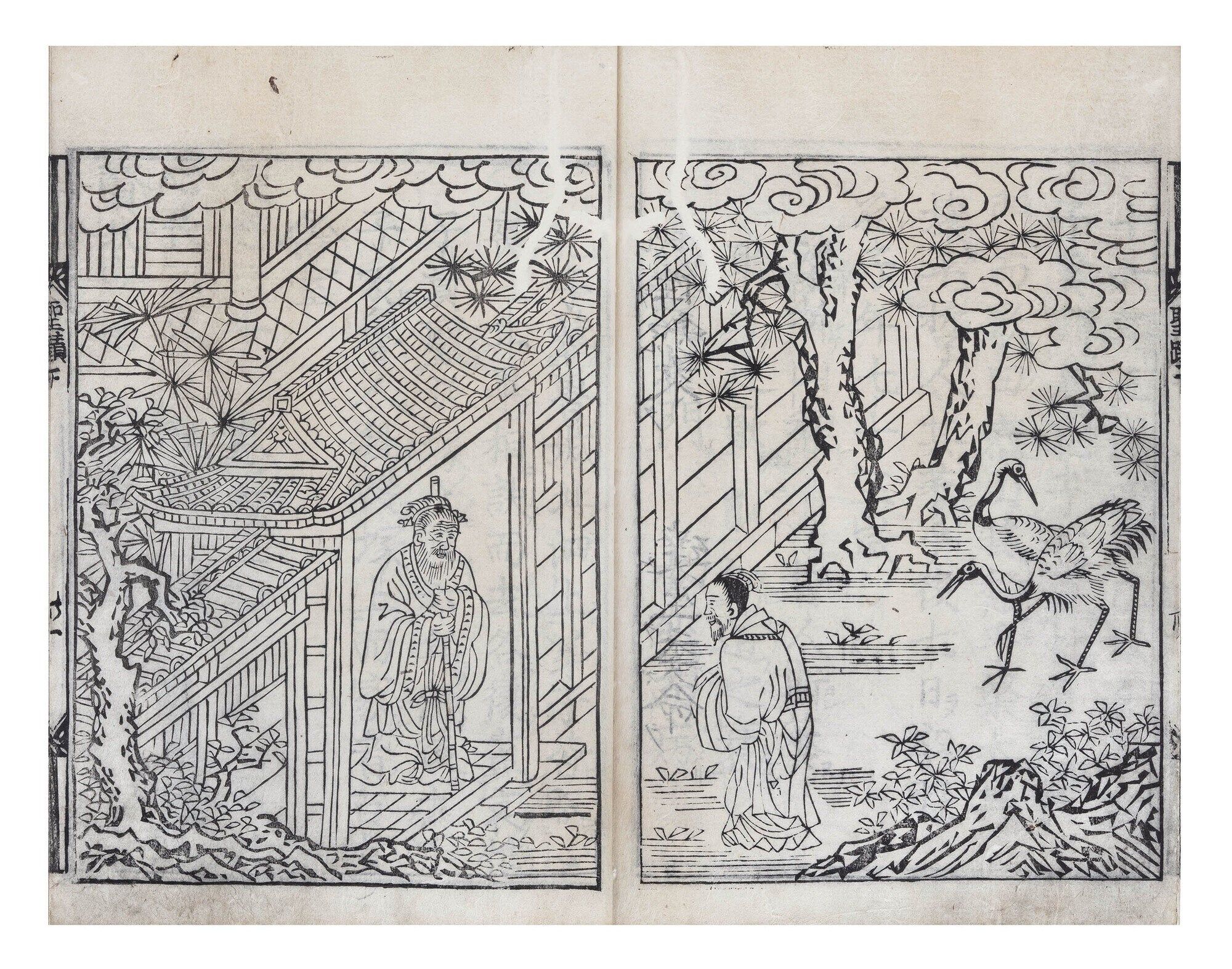
40 double-page woodcuts. 50; 37 folding leaves. Woodblock-printed. Two vols. Large 8vo (276 x 190 mm.), orig. orange wrappers (rubbed), title-slips on upper covers, new stitching. From the final leaf in Vol. 2 (in loose trans.): “Printed in 1628 in Kyoto by Kakyu 嘉休 & distributed in Kumamoto by Nagayama Kisaburō 長山喜三郎.”
SATSUMA BAN: A very rare and finely illustrated Satsuma ban 薩摩版; we find no copy in WorldCat. The printing and numerous double-page woodcuts of this luxurious work were sponsored by the Satsuma fiefdom to inculcate the Confucian philosophy of governance amongst the intelligentsia of Kyushu in order to maintain order and social cohesion. Not yet having the ability to print complex books, the Satsuma fiefdom commissioned works in Kyoto, which were then brought to Kumamoto for distribution throughout the domain on Kyushu Island. These books are known as Satsuma ban.
The rich and powerful Satsuma fiefdom, led at this time by Shimazu Tadastune, or Iehisa 島津家久, (1576-1638, r. 1601-38), was well known for its high educational standards. The Satsunan school — a loosely organized group of Neo-Confucian scholars based in Satsuma province — created an intellectual base for the study of Confucian philosophy. Our edition has a Preface dated 1608 by the domain lord, Iehisa, in which he emphasizes the importance of Confucian virtues and teachings, using the major events of the philosopher’s life. Iehisa, like many Japanese military leaders, had become familiar with Neo-Confucianism during the Korean campaigns, from which Korean Neo-Confucian books were brought back and widely studied. There is also a Postscript of 1557.
ILLUSTRATIONS & THEIR SOURCES: [A] “kind of collection of moral-didactic imagery that had considerable currency in late Ming visual culture was the illustration of events in the life of a single exemplar, above all the sage Confucius (Kongzi). Often called Shengji tu, or some variation of this title, illustrated narratives of the life of Confucius were made in the form of printed books and albums, incised stone tablets (from which rubbings could be made) and painted albums and handscrolls…Depending on its particular setting, the Shengji tu could serve as a vehicle of argument, instruction, pious affirmation, or even entertainment…
“The earliest pictorial account of Confucius’s life was created by the censor Zhang Kai (1398-1460), who selected some thirty episodes from Confucius’s biography in Sima Qian’s Shiji (Records of the Grand Historian), composed poetic eulogies (zan) for them, and had an anonymous artist illustrate them [in 1444; no longer extant]. Zhang presented Confucius as a man of virtue and integrity who devoted his energies to writing and teaching when unable to serve a worthy ruler, and who lived the moral ideals professed by scholar-officials…Wanting to redress what he considered serious omissions in Zhang Kai’s account, He Tingrui [fl. late 15th century] chose the woodblock medium in order to promote a more hagiographic conception of Confucius’s life that included additional episodes involving supernatural phenomena and powers [which appeared in 1497 and, apparently, no long extant]. Over the course of the sixteenth and early seventeenth century, many reprints and new editions of this expanded Shengji tu appeared…By the late sixteenth century, some versions of the Shengji tu in circulation included many more illustrations, and competing editions differed considerably in the scenes they included.”–Julia K. Murray, “Didactic Illustrations in Printed Books” in Brokaw & Chow, Printing and Book Culture in Late Imperial China (Berkeley: 2005), pp. 433-41.
Our Satsuma ban is a beautifully illustrated narrative of the life of Confucius and most likely follows the scholarly Kongsheng jiayu tu (Illustrated Family Sayings of the Sage Confucius), privately published in Hangzhou in 1589 by the aspiring scholar Wu Jiamo. Like ours, it had 40 woodcut scenes of high artistic quality. Commercial publishers quickly pirated the Chinese edition and made it widely available in several editions of varying quality. No doubt a copy of one of these editions found its way to Japan and served as the model for our book.
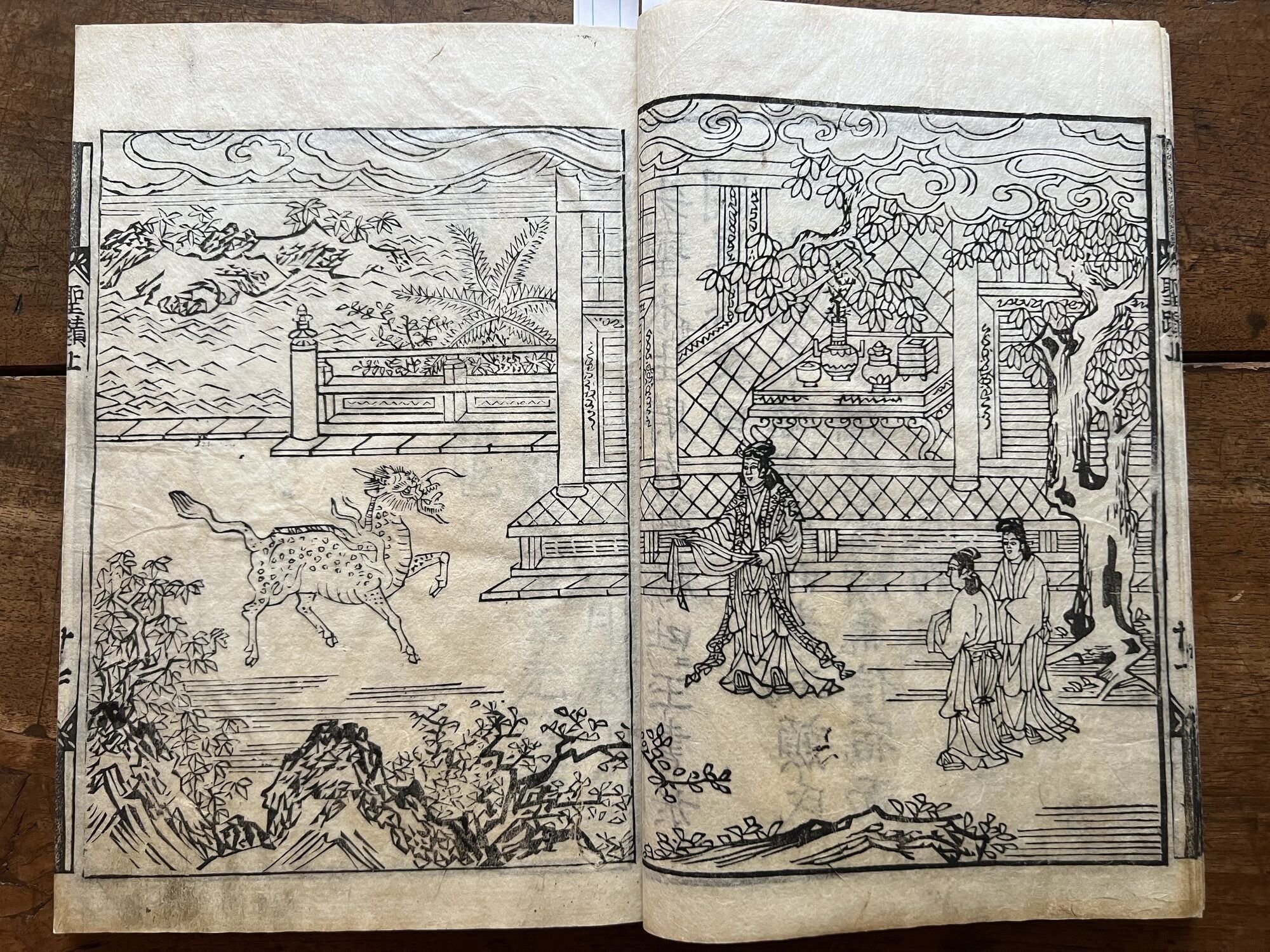
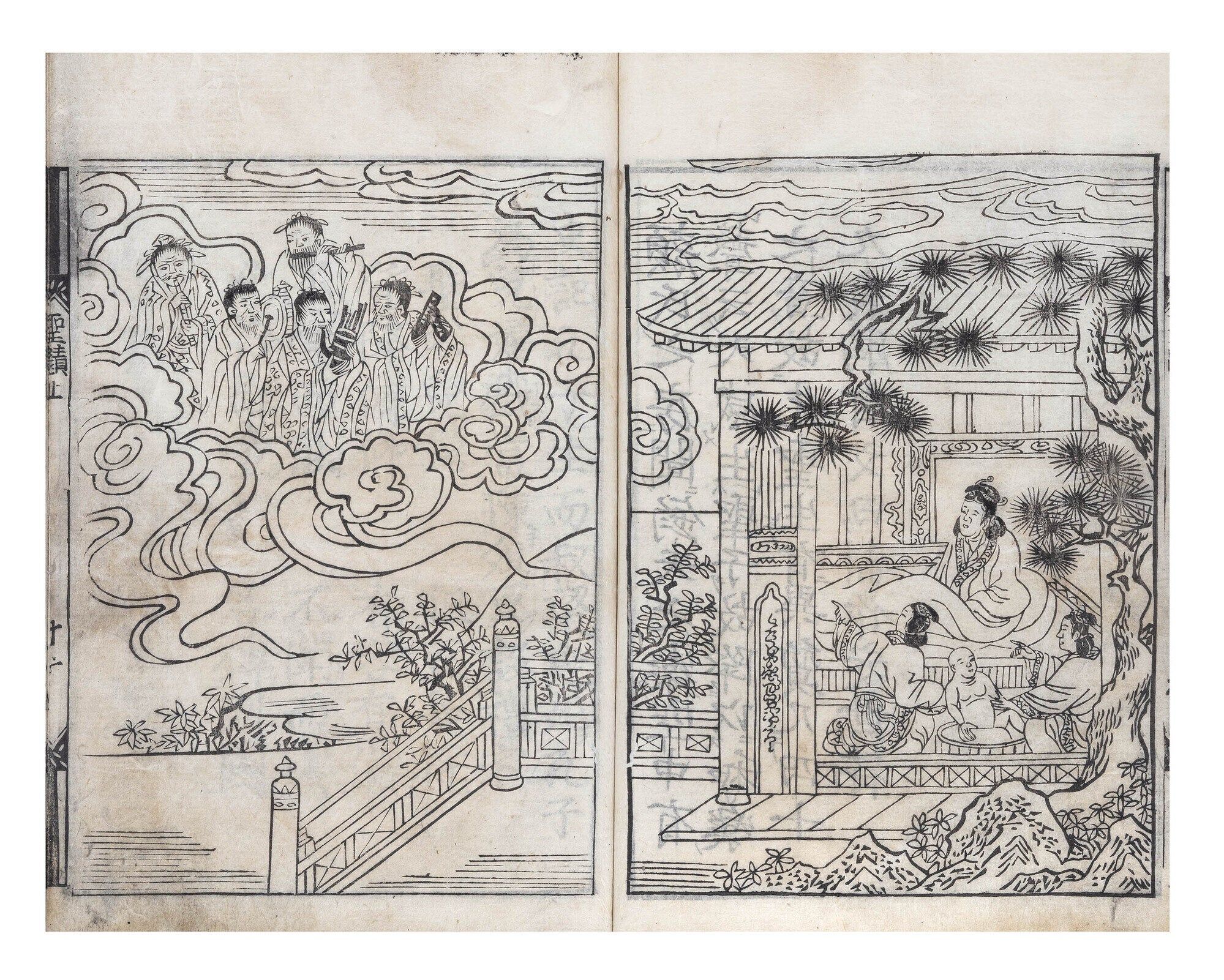
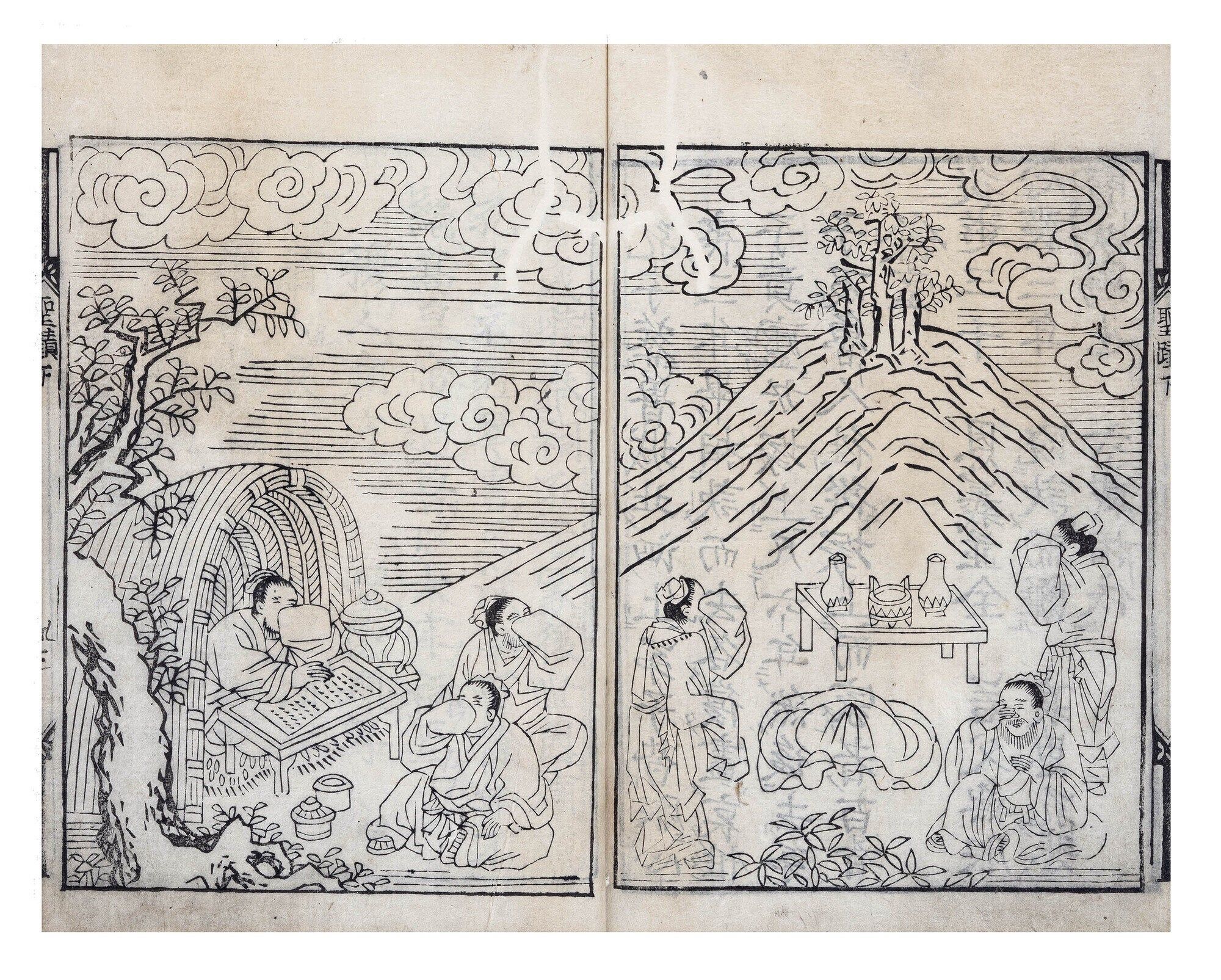
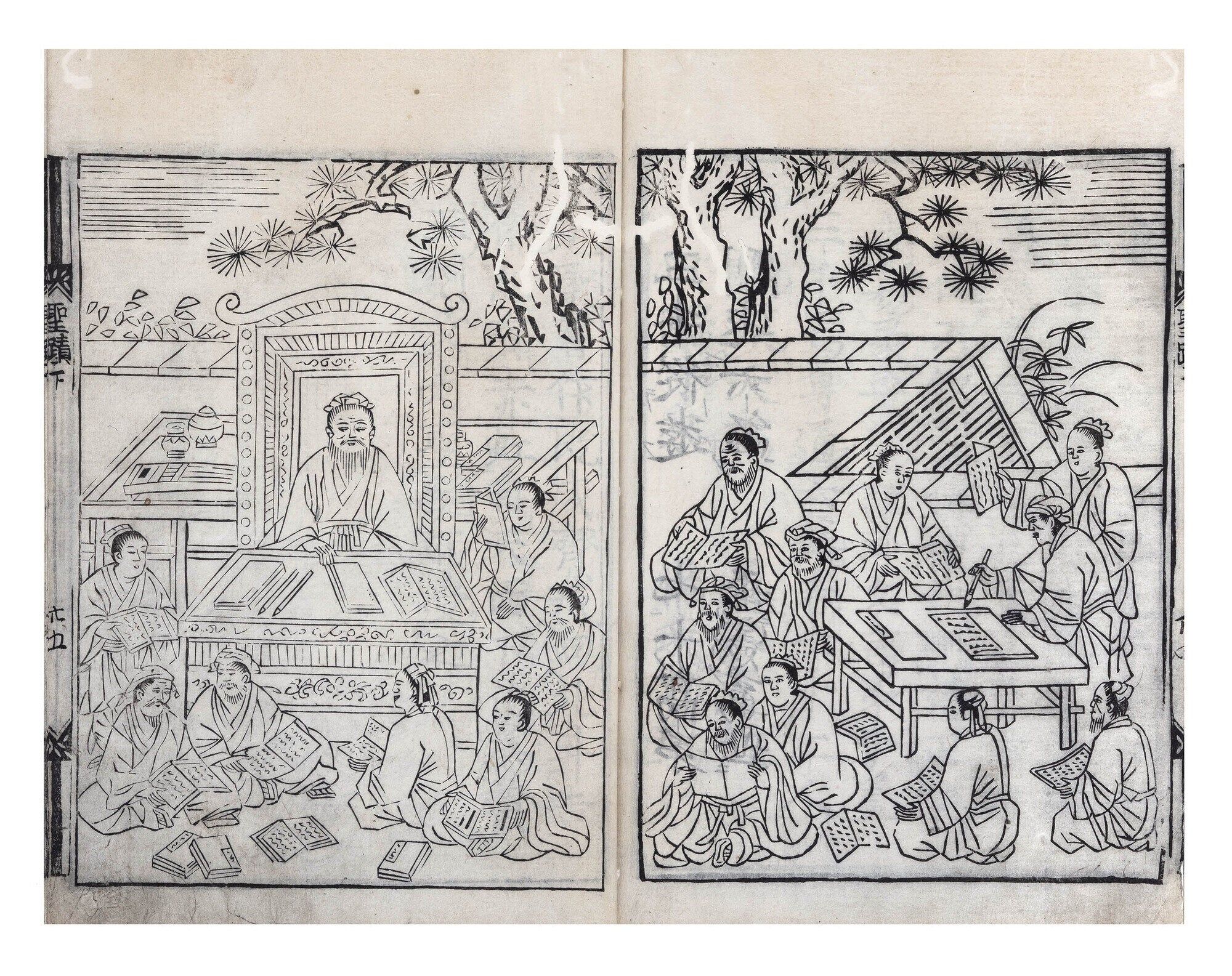
This is an uncommonly early Japanese book to be so richly illustrated. The scenes begin with Confucius’s mother offering a sacrifice on Mount Ni to obtain a son, and go on to depict the major events in the life of Confucius: as a baby and young boy playing at performing rites, visiting Laozi, as the local administrator in service to a variety of local rulers, travelling between states in an ox-drawn cart, kneeling to acknowledge the rainbow from the Big Dipper (suggesting that the Heavens approved of Confucius’s compilation and editing of the wisdom of ancient sages), entertaining his parents at a feast, mourning the dead qilin, as a retired scholar surrounded by books and disciples, to his final days as an old and sick man with cane in hand telling his disciple Zigong that he had dreamed of his own funeral, to posthumous scenes with disciples mourning at his grave and the sacrifice by the Han emperor Gaozu (r. 206-195 BCE) at what had become a temple to Confucius.
The expressive woodcuts are finely printed in excellent impressions.
Fine set. Each volume has some expertly restored worming touching some images. Minor browning. Preserved in a chitsu.
❧ See also Prof. Murray’s “Varied Views of the Sage. Illustrated Narratives of the Life of Confucius” in On Sacred Grounds. Culture, Society, Politics, and the Formation of the Cult of Confucius (Thomas A. Wilson, ed., Harvard: 2002), Chap. 5.
SATSUMA BAN: A very rare and finely illustrated Satsuma ban 薩摩版; we find no copy in WorldCat. The printing and numerous double-page woodcuts of this luxurious work were sponsored by the Satsuma fiefdom to inculcate the Confucian philosophy of governance amongst the intelligentsia of Kyushu in order to maintain order and social cohesion. Not yet having the ability to print complex books, the Satsuma fiefdom commissioned works in Kyoto, which were then brought to Kumamoto for distribution throughout the domain on Kyushu Island. These books are known as Satsuma ban.
The rich and powerful Satsuma fiefdom, led at this time by Shimazu Tadastune, or Iehisa 島津家久, (1576-1638, r. 1601-38), was well known for its high educational standards. The Satsunan school — a loosely organized group of Neo-Confucian scholars based in Satsuma province — created an intellectual base for the study of Confucian philosophy. Our edition has a Preface dated 1608 by the domain lord, Iehisa, in which he emphasizes the importance of Confucian virtues and teachings, using the major events of the philosopher’s life. Iehisa, like many Japanese military leaders, had become familiar with Neo-Confucianism during the Korean campaigns, from which Korean Neo-Confucian books were brought back and widely studied. There is also a Postscript of 1557.
ILLUSTRATIONS & THEIR SOURCES: [A] “kind of collection of moral-didactic imagery that had considerable currency in late Ming visual culture was the illustration of events in the life of a single exemplar, above all the sage Confucius (Kongzi). Often called Shengji tu, or some variation of this title, illustrated narratives of the life of Confucius were made in the form of printed books and albums, incised stone tablets (from which rubbings could be made) and painted albums and handscrolls…Depending on its particular setting, the Shengji tu could serve as a vehicle of argument, instruction, pious affirmation, or even entertainment…
“The earliest pictorial account of Confucius’s life was created by the censor Zhang Kai (1398-1460), who selected some thirty episodes from Confucius’s biography in Sima Qian’s Shiji (Records of the Grand Historian), composed poetic eulogies (zan) for them, and had an anonymous artist illustrate them [in 1444; no longer extant]. Zhang presented Confucius as a man of virtue and integrity who devoted his energies to writing and teaching when unable to serve a worthy ruler, and who lived the moral ideals professed by scholar-officials…Wanting to redress what he considered serious omissions in Zhang Kai’s account, He Tingrui [fl. late 15th century] chose the woodblock medium in order to promote a more hagiographic conception of Confucius’s life that included additional episodes involving supernatural phenomena and powers [which appeared in 1497 and, apparently, no long extant]. Over the course of the sixteenth and early seventeenth century, many reprints and new editions of this expanded Shengji tu appeared…By the late sixteenth century, some versions of the Shengji tu in circulation included many more illustrations, and competing editions differed considerably in the scenes they included.”–Julia K. Murray, “Didactic Illustrations in Printed Books” in Brokaw & Chow, Printing and Book Culture in Late Imperial China (Berkeley: 2005), pp. 433-41.
Our Satsuma ban is a beautifully illustrated narrative of the life of Confucius and most likely follows the scholarly Kongsheng jiayu tu (Illustrated Family Sayings of the Sage Confucius), privately published in Hangzhou in 1589 by the aspiring scholar Wu Jiamo. Like ours, it had 40 woodcut scenes of high artistic quality. Commercial publishers quickly pirated the Chinese edition and made it widely available in several editions of varying quality. No doubt a copy of one of these editions found its way to Japan and served as the model for our book.
This is an uncommonly early Japanese book to be so richly illustrated. The scenes begin with Confucius’s mother offering a sacrifice on Mount Ni to obtain a son, and go on to depict the major events in the life of Confucius: as a baby and young boy playing at performing rites, visiting Laozi, as the local administrator in service to a variety of local rulers, travelling between states in an ox-drawn cart, kneeling to acknowledge the rainbow from the Big Dipper (suggesting that the Heavens approved of Confucius’s compilation and editing of the wisdom of ancient sages), entertaining his parents at a feast, mourning the dead qilin, as a retired scholar surrounded by books and disciples, to his final days as an old and sick man with cane in hand telling his disciple Zigong that he had dreamed of his own funeral, to posthumous scenes with disciples mourning at his grave and the sacrifice by the Han emperor Gaozu (r. 206-195 BCE) at what had become a temple to Confucius.
The expressive woodcuts are finely printed in excellent impressions.
Fine set. Each volume has some expertly restored worming touching some images. Minor browning. Preserved in a chitsu.
❧ See also Prof. Murray’s “Varied Views of the Sage. Illustrated Narratives of the Life of Confucius” in On Sacred Grounds. Culture, Society, Politics, and the Formation of the Cult of Confucius (Thomas A. Wilson, ed., Harvard: 2002), Chap. 5.
Details
Title
J: Kōshi seiseki no zu 孔子聖蹟之図 [Pictures of the Sage’s Traces; Ch: Kongzi sheng ji tu 孔子聖蹟圖]
Author
ZHANG, Kai 張楷
Condition
Unknown