

Karye chŭnghae 家禮增解 [Family Rituals with Expanded Explanations]
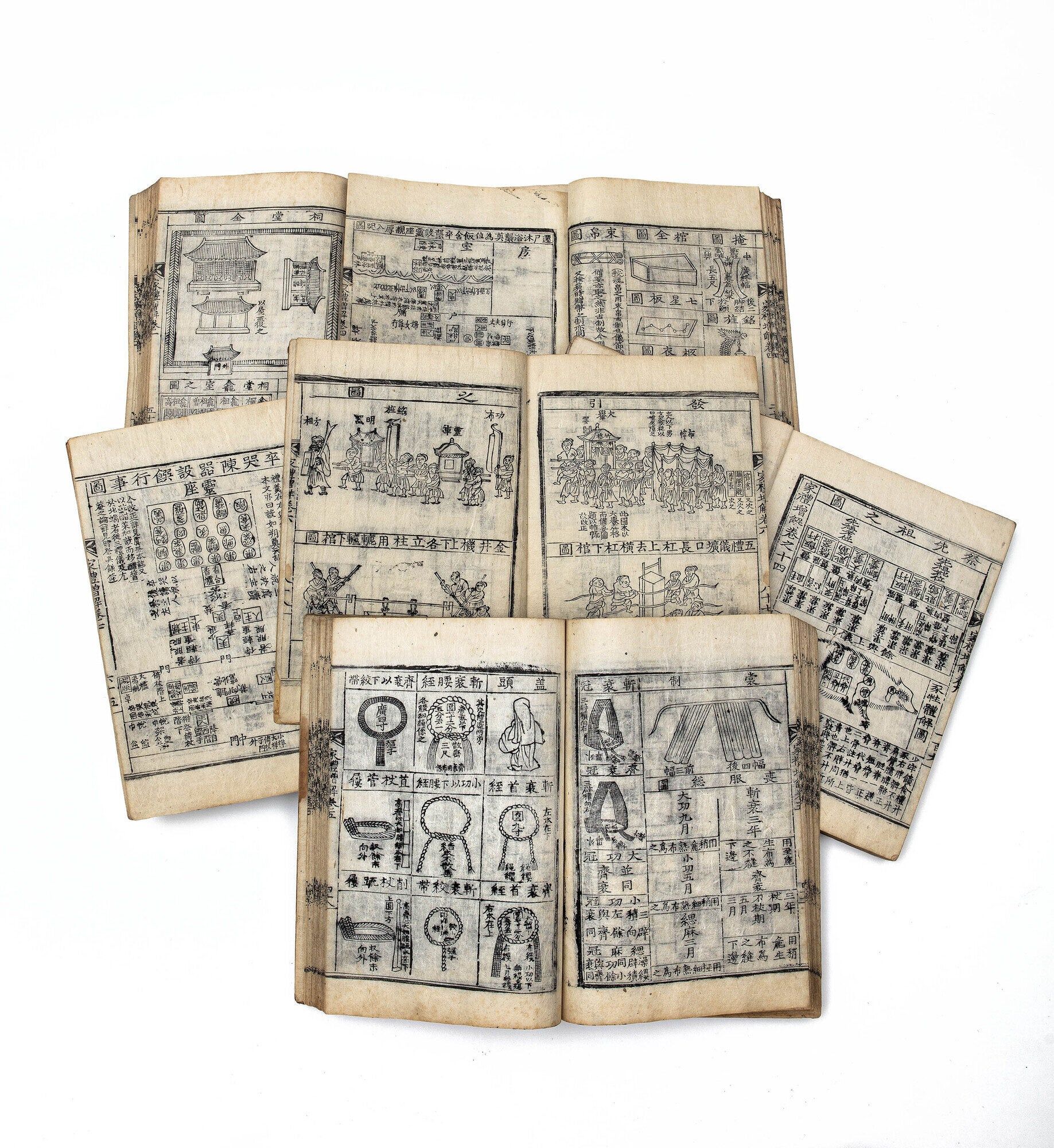
Many woodcut illus. Mongnok in one kwŏn & 14 numbered kwŏn, in ten volumes. Small folio (300 x 223 mm.), orig. wrappers (wrappers a little soiled & stained), handwritten title & kwŏn numbers in black ink on each upper cover, new stitching. [Chirye, Kyŏngsang-do]: [Kyŏngho yŏngdang], [Postscript dated 1824].
Possibly the first edition (see below) of this illustrated compendium of the Family Rituals (Ch. Jiali 家禮), popular in 19th-century Korea. Integrating a large number of earlier Chinese and Korean works on the subject, this compendium is one of the most comprehensive of its kind.
The Family Rituals, a collection of ritual prescriptions compiled by the great Neo-Confucian philosopher Zhu Xi 朱熹 (1130-1200), was one of the most influential ritual texts in Chŏson Korea, more widely read, studied, adapted, reprinted, and circulated than the earlier and more canonical Classic of Ritual (Ch. Liji 禮記) itself. This popularity of the Family Rituals was likely driven by the social influence of Confucian academies (K. sŏwŏn 書院), local educational institutions that rendered Confucian learning available and accessible to aspiring scholars. As Martin Gehlmann observes in “Ritual and Confucian Academies in Korea” (in All About Rites, Collège de France, 2023), the Family Rituals figured largely in classroom curricula and was well represented in the library holdings of the academies, to a large degree because it was “eas[ier] to digest” than the “bulky classic” of rituals (p. 16). Furthermore, the practical and accessible nature of the Family Rituals lent itself to local adaptations by Korean scholars, as “many scholars continued to produce ritual works based on the Family Rit[uals] in order to simplify or recontextualize its concepts for the Korean readership” (p. 14). “Written by Korean authors with knowledge of local needs,” these “partial derivatives” of the Family Rituals are best understood as reflections of the indigenization and vernacularization of Confucian knowledge systems in the Korean context, their humble self-designations as “commentaries,” “summaries,” or “explanations” of Chinese texts notwithstanding.
The Family Rituals with Expanded Explanations, compiled by Yi Ŭi-jo (1727-1805, courtesy name Maeng-jong 孟宗), is a summa of Korean family ritual texts available in the 18th century, particularly comprehensive in its inclusion of works from the noron 老論 faction of the sŏin 西人 group of scholars. Its bibliography in the mongnok volume contains no fewer than 29 Chinese titles and 49 Korean titles, and the compilation reportedly took Yi decades to complete. The work, in 14 kwŏn, teaches the ritually proper handling of every aspect of domestic life, from the designs of family shrines and everyday headwear to the processions of marriage and funerary rites. Drawing from vernacular ritual manuals, the work provides a number of illustrations (most but not all at the end of each volume) on the spatial arrangements of ritual grounds and objects, architectural diagrams of shrines, designs of everyday and ritual attires for men and women, and — in the volume on sacrificial rites — an illustrated guide for animal sacrifice.
The Preface by Song Hwan-gi 宋煥箕 (1728-1807) in the first kwŏn, dated 1792 (崇禎後三壬子, the third imja after the [late Ming emperor] Chongzhen), was composed when Yi showed him a completed copy of the work. But it is unclear if the woodblocks for the work had been carved at this point; in fact, Song laments how beneficial it would be to the world if this book were to put to print. Yi’s own Preface follows and is undated. At the end of the last volume is a postscript composed by Chang Man-sŏk 鄭晩錫 in 1824 (崇禎四甲申, the fourth kapsin after Chongzhen, upon being shown the original draft (pon’go 本藁) of the work.
The exact date when the woodblocks for this work were carved, traditionally held to be 1792 based on the first Preface, has been a topic of some scholarly debate in Korea. Kim Chong-su, for example, has pointed to a letter by Yi’s disciple that suggests the work was still being revised in 1797 (see the 2021 article 경호(鏡湖) 이의조(李宜朝)의 생애와 학문적 성향, 한국전통문화연구 28, 00. 7-44). The Encyclopedia of Korean Culture entry for this work acknowledges the lack of clarity regarding the publication date and suggests that the work was not printed until 1824, the date of the Postscript. We have consulted multiple digitized copies held in Korean collections, and they all appear to be printed from the same set of woodblocks. Some copies — but not ours — have an additional colophon, 板本在慶尙道知禮鏡湖影堂, stating that the woodblocks were held in Chirye, Kyŏngsang-do.
The 475 woodblocks carved for this work are still kept today in the city of Gimcheon, North Gyeongsang province, where it is registered as an item of provincial cultural heritage. A translation of this work into modern Korean was published in 2011.
Very nice set, preserved in a jil.
Possibly the first edition (see below) of this illustrated compendium of the Family Rituals (Ch. Jiali 家禮), popular in 19th-century Korea. Integrating a large number of earlier Chinese and Korean works on the subject, this compendium is one of the most comprehensive of its kind.
The Family Rituals, a collection of ritual prescriptions compiled by the great Neo-Confucian philosopher Zhu Xi 朱熹 (1130-1200), was one of the most influential ritual texts in Chŏson Korea, more widely read, studied, adapted, reprinted, and circulated than the earlier and more canonical Classic of Ritual (Ch. Liji 禮記) itself. This popularity of the Family Rituals was likely driven by the social influence of Confucian academies (K. sŏwŏn 書院), local educational institutions that rendered Confucian learning available and accessible to aspiring scholars. As Martin Gehlmann observes in “Ritual and Confucian Academies in Korea” (in All About Rites, Collège de France, 2023), the Family Rituals figured largely in classroom curricula and was well represented in the library holdings of the academies, to a large degree because it was “eas[ier] to digest” than the “bulky classic” of rituals (p. 16). Furthermore, the practical and accessible nature of the Family Rituals lent itself to local adaptations by Korean scholars, as “many scholars continued to produce ritual works based on the Family Rit[uals] in order to simplify or recontextualize its concepts for the Korean readership” (p. 14). “Written by Korean authors with knowledge of local needs,” these “partial derivatives” of the Family Rituals are best understood as reflections of the indigenization and vernacularization of Confucian knowledge systems in the Korean context, their humble self-designations as “commentaries,” “summaries,” or “explanations” of Chinese texts notwithstanding.
The Family Rituals with Expanded Explanations, compiled by Yi Ŭi-jo (1727-1805, courtesy name Maeng-jong 孟宗), is a summa of Korean family ritual texts available in the 18th century, particularly comprehensive in its inclusion of works from the noron 老論 faction of the sŏin 西人 group of scholars. Its bibliography in the mongnok volume contains no fewer than 29 Chinese titles and 49 Korean titles, and the compilation reportedly took Yi decades to complete. The work, in 14 kwŏn, teaches the ritually proper handling of every aspect of domestic life, from the designs of family shrines and everyday headwear to the processions of marriage and funerary rites. Drawing from vernacular ritual manuals, the work provides a number of illustrations (most but not all at the end of each volume) on the spatial arrangements of ritual grounds and objects, architectural diagrams of shrines, designs of everyday and ritual attires for men and women, and — in the volume on sacrificial rites — an illustrated guide for animal sacrifice.
The Preface by Song Hwan-gi 宋煥箕 (1728-1807) in the first kwŏn, dated 1792 (崇禎後三壬子, the third imja after the [late Ming emperor] Chongzhen), was composed when Yi showed him a completed copy of the work. But it is unclear if the woodblocks for the work had been carved at this point; in fact, Song laments how beneficial it would be to the world if this book were to put to print. Yi’s own Preface follows and is undated. At the end of the last volume is a postscript composed by Chang Man-sŏk 鄭晩錫 in 1824 (崇禎四甲申, the fourth kapsin after Chongzhen, upon being shown the original draft (pon’go 本藁) of the work.
The exact date when the woodblocks for this work were carved, traditionally held to be 1792 based on the first Preface, has been a topic of some scholarly debate in Korea. Kim Chong-su, for example, has pointed to a letter by Yi’s disciple that suggests the work was still being revised in 1797 (see the 2021 article 경호(鏡湖) 이의조(李宜朝)의 생애와 학문적 성향, 한국전통문화연구 28, 00. 7-44). The Encyclopedia of Korean Culture entry for this work acknowledges the lack of clarity regarding the publication date and suggests that the work was not printed until 1824, the date of the Postscript. We have consulted multiple digitized copies held in Korean collections, and they all appear to be printed from the same set of woodblocks. Some copies — but not ours — have an additional colophon, 板本在慶尙道知禮鏡湖影堂, stating that the woodblocks were held in Chirye, Kyŏngsang-do.
The 475 woodblocks carved for this work are still kept today in the city of Gimcheon, North Gyeongsang province, where it is registered as an item of provincial cultural heritage. A translation of this work into modern Korean was published in 2011.
Very nice set, preserved in a jil.
Details
Title
Karye chŭnghae 家禮增解 [Family Rituals with Expanded Explanations]
Author
ZHU, Xi 朱熹 & YI, Ŭi-jo 李宜朝
Condition
Unknown