

Ŏjŏng chusŏ paeksŏn 御定朱書百選 [Royal Edition of a Hundred Selected Letters of Zhu]
]. 1 p.l., 4, 25, 34, 29; 37, 30, 28 folding leaves. Six kwŏn in two volumes. Small folio (360 x 223 mm.), orig. wrappers (some wear & rubbing), handwritten title on covers, orig. stitching. [Hansŏng]: Kyujanggak, [ca. 1799].
A royal gift, presented by the king of Korea. In 1794, King Chŏngjo (1752-1800) of the Chŏson dynasty compiled and had printed a collection of the letters of the great Neo-Confucian philosopher Zhu Xi 朱熹 (1130-1200) to be disseminated throughout his kingdom. As King Chŏngjo wrote on this occasion, “the learning of Master Zhu, in its expansive and oceanic plentitude, is best represented by his collected writings; the writings of Master Zhu, in their utmost subtlety and precision, are best represented by his personal correspondences” (“Chusŏ paeksŏn yukkwŏn” 朱書百選六卷, in Hongjae chŏnsŏ 弘齋全書 [Collected Writings of King Chŏngjo], kwŏn 180). Drawing from a number of established collections, he selected 100 letters and carefully arranged them, “beginning with the letter to Yanping 延平 [i.e., Li Tong 李侗, 1093-1163, Zhu Xi’s teacher] to pronounce his lineage of instruction, and ending with the letter to Zhiqing 直卿 [i.e., Huang Gan 黃干, 1152-1221, Zhu Xi’s disciple] to demonstrate the bestowment of teachings.”
That 1794 edition, with moderate marginal annotations on “personal and place names, as well as philological glosses and references,” was sent to be printed with the chŏngyuja 丁酉字 metal type, cast in the year 1777. Printed copies were sent to various official printing houses throughout the kingdom and used as models to carve woodblocks for a xylographic edition (ibid.). Sometime around 1799, realizing that in the capital only metal type copies of the book remained, the king ordered woodblocks to be made locally as well for the work so that more copies could be printed and distributed (Chŏngjo, “Sinin ogyŏng…” 新印五經…, in Hongjae chŏnsŏ, kwŏn 36).
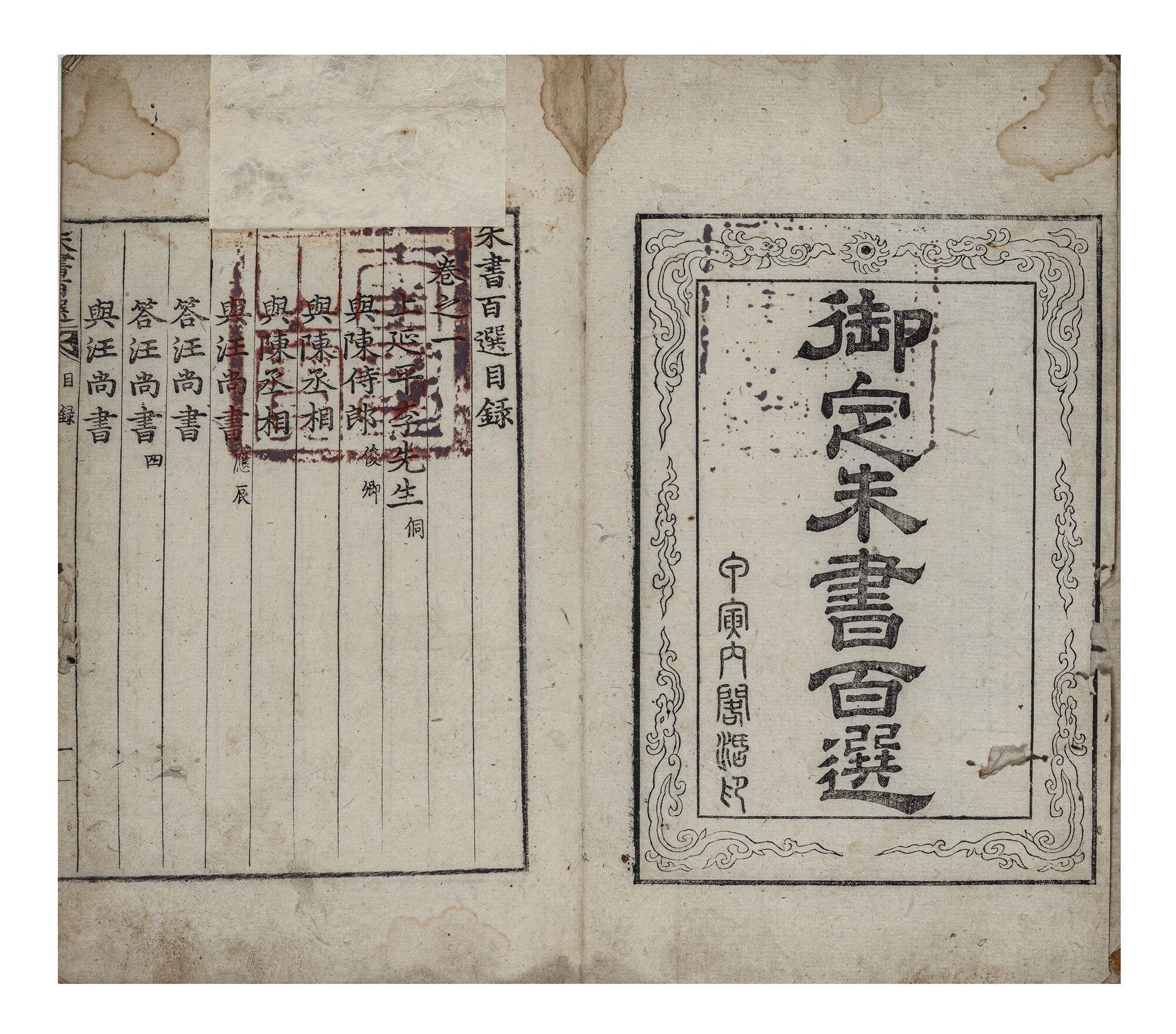
Most woodblock re-editions of this work retain the original title-page, which contains not only the title Royal Edition of a Hundred Selected Letters of Zhu (K. Ŏjŏng chusŏ paeksŏn 御定朱書百選) but also the inscription in seal script that reads 甲寅內閣活印 — “palace edition, printed with movable type in the kabin year [1794].” This title-page, compounded with the absence of any additional paratextual information, likely resulted in the description of these woodblock re-editions as the original metal type 1794 edition, in spite of lacking the features of metal typography.
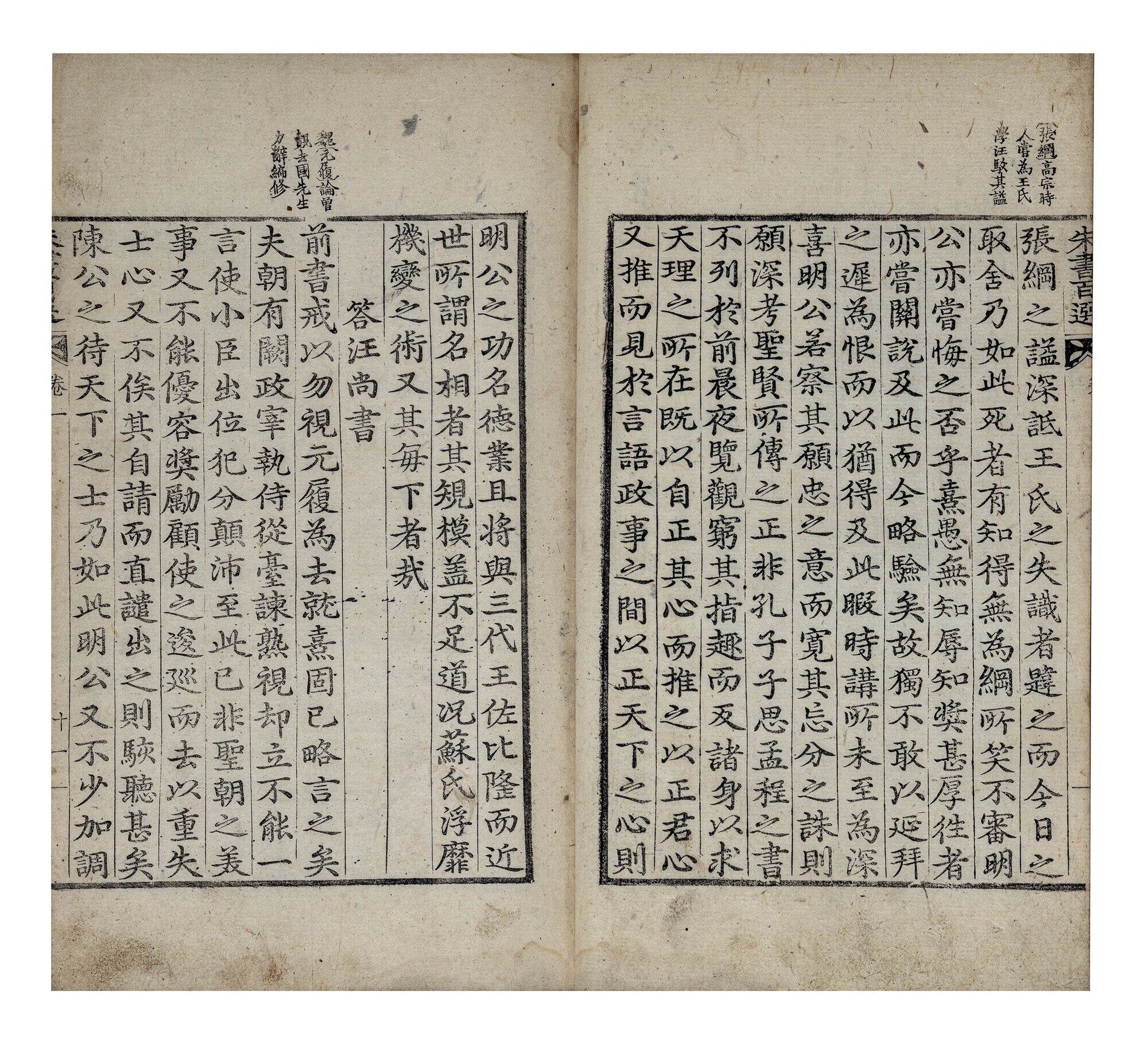
We have carefully examined our copy and found that it was likely printed with the woodblocks carved around 1799 (undoubtedly through the cannibalization of a typographic copy) and kept within the royal library. Certain qualities of our copy make it distinctive: not only are the cursive characters rendered with impressive clarity, the marginal annotations mentioned in King Chŏngjo’s edict are also preserved in faux-manuscript style — a feature absent in some other copies we have consulted (erroneously described as the 1794 edition).
The best evidence that our copy was printed by the royal library (K. kyujanggak 奎章閣), of course, is the fact that it was a royal gift (K. naesabon 內賜本), presented by the king himself to notable officials or individuals, in this case an examinee from Suwŏnbu 水原府. The “Record of Presentation” (K. naesagi 內賜記) is handwritten on the front endpaper of the first volume as usual and is dated to the second month of Xianfeng 5 (1855). However, both the name of the recipient and the official responsible for the Record have been obscured. A name, Im Hŭi-ji 林熙之, is written next to the name of the recipient, but in a clearly different hand and ink. Records of the Royal Secretariat (K. Sŭngjŏngwŏn ilgi 承政院日記) states that on the 29th day of this month, copies of the Hundred Selected Letters were indeed bestowed to six examinees, but all their names are not given.
On the first leaf of the table of contents and facing the title-page is the Seal of Presentation (K. naesa’in 內賜印), which reads 奎章之宝 [Treasure of the Kyujanggak]. This seal was used for presentation copies roughly between 1782 and 1894, as shown by Lee & Song in “A Study on Naesabon Preserved in Kyujanggak” (in Journal of Korean Library and Information Science Society 43, no. 2).
This book is rare outside of East Asia. We find three copies under WorldCat 35891835 (with a misspelled title and described as the 1794 edition on account of the aforementioned title-page, which our copy also possesses). None of them is described as a presentation copy.
Very good set. Some occasional soiling and dampstaining. Unimportant worming, mostly marginal.
❧ King Chŏngjo, Hongjae chŏnsŏ 弘齋全書, in Han’guk munjip ch’onggan 韓國文集叢刊, digital access via krpia.co.kr.
A royal gift, presented by the king of Korea. In 1794, King Chŏngjo (1752-1800) of the Chŏson dynasty compiled and had printed a collection of the letters of the great Neo-Confucian philosopher Zhu Xi 朱熹 (1130-1200) to be disseminated throughout his kingdom. As King Chŏngjo wrote on this occasion, “the learning of Master Zhu, in its expansive and oceanic plentitude, is best represented by his collected writings; the writings of Master Zhu, in their utmost subtlety and precision, are best represented by his personal correspondences” (“Chusŏ paeksŏn yukkwŏn” 朱書百選六卷, in Hongjae chŏnsŏ 弘齋全書 [Collected Writings of King Chŏngjo], kwŏn 180). Drawing from a number of established collections, he selected 100 letters and carefully arranged them, “beginning with the letter to Yanping 延平 [i.e., Li Tong 李侗, 1093-1163, Zhu Xi’s teacher] to pronounce his lineage of instruction, and ending with the letter to Zhiqing 直卿 [i.e., Huang Gan 黃干, 1152-1221, Zhu Xi’s disciple] to demonstrate the bestowment of teachings.”
That 1794 edition, with moderate marginal annotations on “personal and place names, as well as philological glosses and references,” was sent to be printed with the chŏngyuja 丁酉字 metal type, cast in the year 1777. Printed copies were sent to various official printing houses throughout the kingdom and used as models to carve woodblocks for a xylographic edition (ibid.). Sometime around 1799, realizing that in the capital only metal type copies of the book remained, the king ordered woodblocks to be made locally as well for the work so that more copies could be printed and distributed (Chŏngjo, “Sinin ogyŏng…” 新印五經…, in Hongjae chŏnsŏ, kwŏn 36).
Most woodblock re-editions of this work retain the original title-page, which contains not only the title Royal Edition of a Hundred Selected Letters of Zhu (K. Ŏjŏng chusŏ paeksŏn 御定朱書百選) but also the inscription in seal script that reads 甲寅內閣活印 — “palace edition, printed with movable type in the kabin year [1794].” This title-page, compounded with the absence of any additional paratextual information, likely resulted in the description of these woodblock re-editions as the original metal type 1794 edition, in spite of lacking the features of metal typography.
We have carefully examined our copy and found that it was likely printed with the woodblocks carved around 1799 (undoubtedly through the cannibalization of a typographic copy) and kept within the royal library. Certain qualities of our copy make it distinctive: not only are the cursive characters rendered with impressive clarity, the marginal annotations mentioned in King Chŏngjo’s edict are also preserved in faux-manuscript style — a feature absent in some other copies we have consulted (erroneously described as the 1794 edition).
The best evidence that our copy was printed by the royal library (K. kyujanggak 奎章閣), of course, is the fact that it was a royal gift (K. naesabon 內賜本), presented by the king himself to notable officials or individuals, in this case an examinee from Suwŏnbu 水原府. The “Record of Presentation” (K. naesagi 內賜記) is handwritten on the front endpaper of the first volume as usual and is dated to the second month of Xianfeng 5 (1855). However, both the name of the recipient and the official responsible for the Record have been obscured. A name, Im Hŭi-ji 林熙之, is written next to the name of the recipient, but in a clearly different hand and ink. Records of the Royal Secretariat (K. Sŭngjŏngwŏn ilgi 承政院日記) states that on the 29th day of this month, copies of the Hundred Selected Letters were indeed bestowed to six examinees, but all their names are not given.
On the first leaf of the table of contents and facing the title-page is the Seal of Presentation (K. naesa’in 內賜印), which reads 奎章之宝 [Treasure of the Kyujanggak]. This seal was used for presentation copies roughly between 1782 and 1894, as shown by Lee & Song in “A Study on Naesabon Preserved in Kyujanggak” (in Journal of Korean Library and Information Science Society 43, no. 2).
This book is rare outside of East Asia. We find three copies under WorldCat 35891835 (with a misspelled title and described as the 1794 edition on account of the aforementioned title-page, which our copy also possesses). None of them is described as a presentation copy.
Very good set. Some occasional soiling and dampstaining. Unimportant worming, mostly marginal.
❧ King Chŏngjo, Hongjae chŏnsŏ 弘齋全書, in Han’guk munjip ch’onggan 韓國文集叢刊, digital access via krpia.co.kr.
Details
Title
Ŏjŏng chusŏ paeksŏn 御定朱書百選 [Royal Edition of a Hundred Selected Letters of Zhu]
Author
ZHU, Xi 朱熹, author, & CHŎNGJO 正祖, King of Korea, editor
Condition
Unknown