

Cold War Missile Engineering and Rocket Testing Archive Redstone Arsenal and White Sands Missile Range Archive, 1950s-70s
- SIGNED
- 1950
1950. This exceptionally dense technical archive documents U.S. Army rocket and missile development during the height of the Cold War and Vietnam War, originating from the estate of a retired aerospace engineer, Thomas T. Howell, affiliated with the U.S. Army Missile Command, with direct work conducted at Redstone Arsenal, Alabama, and White Sands Missile Range, New Mexico. The materials capture the applied, test-driven reality of American rocketry at the moment when battlefield rocket systems, solid-fuel propulsion, and rapid-deployment tactical missiles became central to U.S. military doctrine. Of particular importance is the archive's sustained focus on field testing, propulsion diagnostics, firing mechanisms, and structural integrity analysis, with repeated references to multi-stage motors, booster threads, nozzle pressure profiles, thrust measurement, strain-gauge instrumentation, and dynamic propulsion testing under operational conditions. The presence of Vietnam-era documentation situates this archive squarely within the escalation of U.S. missile and rocket deployment in Southeast Asia, when systems such as the Little John rocket and related short-range artillery rockets were actively refined, tested, and evaluated for combat reliability.
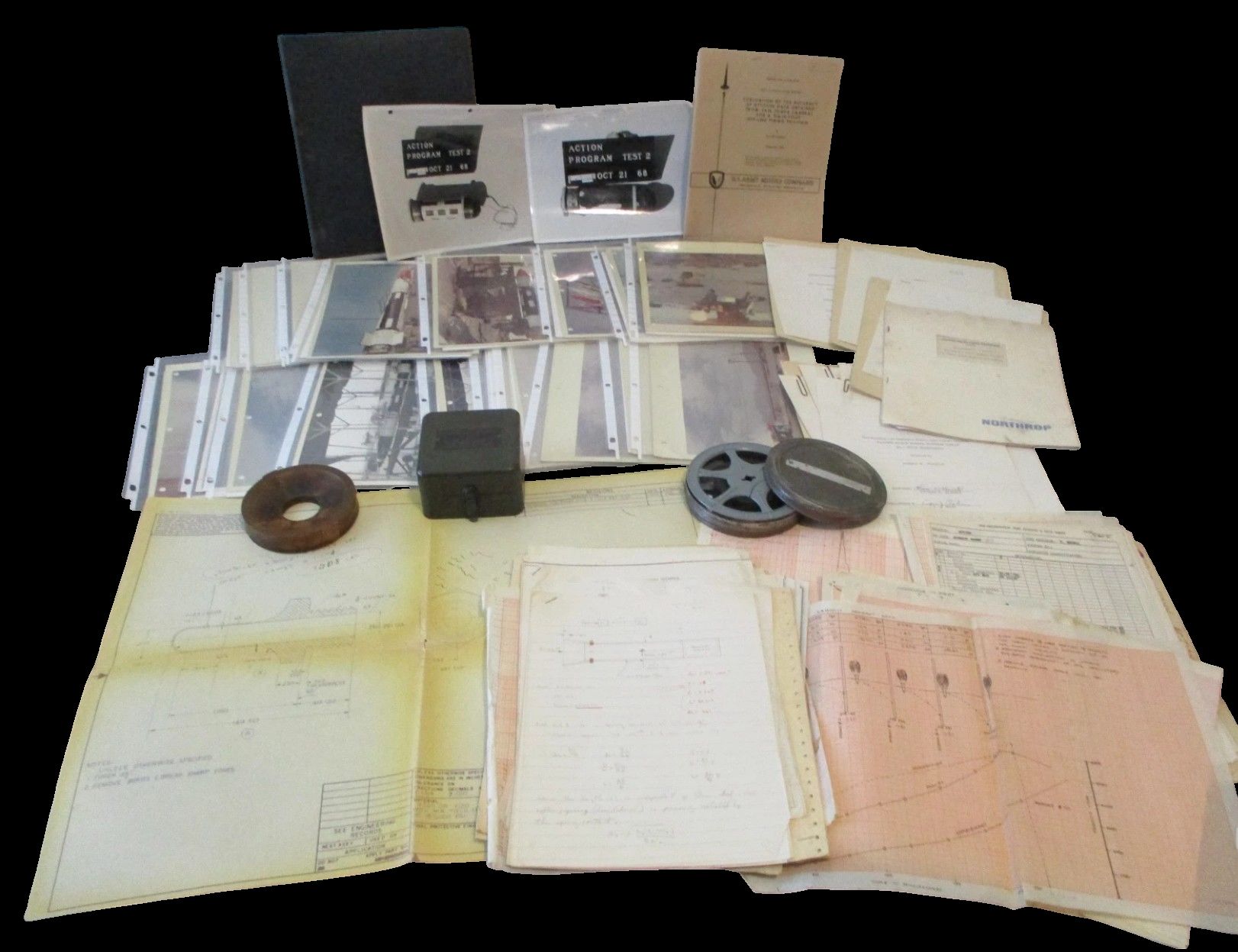
Collection includes; 2 original testing mechanisms; a 16mm film roll documenting a test launch; over 40 original photographs showcasing different testing sites and rocket units; over 40 hand drafted graphs on red paper; several hand written pages of calculations with formulas and schematics; several signed printed documents signed regarding the procedures for assembly static test flight weight booster motor components all dated in the summer of 1969; and a heavily annotated blueprint.
Redstone Arsenal, established in the early Cold War and shaped by the integration of German rocket scientists after World War II, became the intellectual and engineering hub of U.S. Army missile work, where propulsion systems, launch mechanisms, instrumentation, and tactical doctrines were conceived, refined, and standardized. White Sands Missile Range, by contrast, functioned as the proving ground where theory met reality. This Redstone-White Sands pipeline allowed the United States to move rapidly from concept to deployable weapon. The archive comprises a combination of original testing hardware, primary testing documentation, photographic evidence, and engineering drawings and graphs, offering a nearly end-to-end view of the rocket development and validation process. Included is an original Electrical Output Firing Mechanism Tester for rocket launchers, which is distinctly labeled for testing electrical firing mechanisms with milliwatt-second measurements, a piece of surviving test equipment seldom encountered outside institutional collections; a rubber ring with conductive instrumentation in the interior, a ring-type electromagnetic integrator or pickup coil used to measure missile velocity by electrically integrating acceleration over time with the central aperture allowed a magnetic core, conductor, or shaft associated with missile motion to pass through; extensive hand-plotted K&E bar graphs, trajectory charts, acceleration and velocity curves, displacement diagrams, and launch-segment data sheets, many executed on period engineering graph paper with handwritten annotations calculating thrust, pressure, acceleration (in g's), and burnout timing; a substantial group of typed Army test procedures and data-requirement documents, several signed and approved by supervising engineers, details assembly procedures, static and dynamic propulsion tests, booster motor configurations which include tapered buttress threads and pin joints, strain-gauge placement, chamber pressure measurement, and photographic documentation protocols; and a blueprint with extensive handwritten calculations in areas surrounding schematic drawings titled "Revisions -- Body, Pressure Transducer" dated 1969. The calculations mention error rates "at 0.4% to 0.6% due to boost acceleration." These documents reveal the rigor of U.S. Army missile testing culture, where every firing was instrumented, recorded, and analyzed as part of an iterative engineering feedback loop.
A binder containing over 40 original photographs, many stamped on the verso identifying the various locations and rockets such as "LITTLE JOHN" and "WHITE SANDS" on glossy photo paper, shows test stands, firing sequences, hardware setups, and missile components in both black-and-white and color. These images provide rare, ground-level views of rocket testing infrastructure and procedures at one of the most historically significant U.S. missile ranges. Also present is 16mm film, apparently documenting test-stand or firing activity; the film appears physically intact and represents a rare moving-image record of Army missile testing during the era. Completing the archive are large-format blueprints and technical drawings, including a detailed pressure-transducer body schematic bearing U.S. Army Materiel Command identifiers, Redstone Arsenal attribution, and extensive handwritten calculations, direct evidence of hands-on analytical work by an engineer engaged in real-time problem solving under Cold War weapons development pressures.
Materials show expected handling and working-archive wear consistent with active engineering use: edge wear, folds, staple and paper-clip rust, toning, and some stains to paper; handwritten calculations and annotations throughout; photographs generally well preserved with strong contrast; hardware tester shows surface wear and oxidation consistent with age and field use; 16mm film appears physically sound but untested. Overall very good condition. This archive represents a rare primary source for the study of U.S. Army rocketry, missile engineering, and weapons testing during the Vietnam War and late Cold War period. Its combination of original equipment, signed technical procedures, analytical charts, photographs, and film makes it especially valuable for institutional collections focused on military technology, Cold War science, aerospace engineering history, and the material culture of U.S. weapons development.
Collection includes; 2 original testing mechanisms; a 16mm film roll documenting a test launch; over 40 original photographs showcasing different testing sites and rocket units; over 40 hand drafted graphs on red paper; several hand written pages of calculations with formulas and schematics; several signed printed documents signed regarding the procedures for assembly static test flight weight booster motor components all dated in the summer of 1969; and a heavily annotated blueprint.
Redstone Arsenal, established in the early Cold War and shaped by the integration of German rocket scientists after World War II, became the intellectual and engineering hub of U.S. Army missile work, where propulsion systems, launch mechanisms, instrumentation, and tactical doctrines were conceived, refined, and standardized. White Sands Missile Range, by contrast, functioned as the proving ground where theory met reality. This Redstone-White Sands pipeline allowed the United States to move rapidly from concept to deployable weapon. The archive comprises a combination of original testing hardware, primary testing documentation, photographic evidence, and engineering drawings and graphs, offering a nearly end-to-end view of the rocket development and validation process. Included is an original Electrical Output Firing Mechanism Tester for rocket launchers, which is distinctly labeled for testing electrical firing mechanisms with milliwatt-second measurements, a piece of surviving test equipment seldom encountered outside institutional collections; a rubber ring with conductive instrumentation in the interior, a ring-type electromagnetic integrator or pickup coil used to measure missile velocity by electrically integrating acceleration over time with the central aperture allowed a magnetic core, conductor, or shaft associated with missile motion to pass through; extensive hand-plotted K&E bar graphs, trajectory charts, acceleration and velocity curves, displacement diagrams, and launch-segment data sheets, many executed on period engineering graph paper with handwritten annotations calculating thrust, pressure, acceleration (in g's), and burnout timing; a substantial group of typed Army test procedures and data-requirement documents, several signed and approved by supervising engineers, details assembly procedures, static and dynamic propulsion tests, booster motor configurations which include tapered buttress threads and pin joints, strain-gauge placement, chamber pressure measurement, and photographic documentation protocols; and a blueprint with extensive handwritten calculations in areas surrounding schematic drawings titled "Revisions -- Body, Pressure Transducer" dated 1969. The calculations mention error rates "at 0.4% to 0.6% due to boost acceleration." These documents reveal the rigor of U.S. Army missile testing culture, where every firing was instrumented, recorded, and analyzed as part of an iterative engineering feedback loop.
A binder containing over 40 original photographs, many stamped on the verso identifying the various locations and rockets such as "LITTLE JOHN" and "WHITE SANDS" on glossy photo paper, shows test stands, firing sequences, hardware setups, and missile components in both black-and-white and color. These images provide rare, ground-level views of rocket testing infrastructure and procedures at one of the most historically significant U.S. missile ranges. Also present is 16mm film, apparently documenting test-stand or firing activity; the film appears physically intact and represents a rare moving-image record of Army missile testing during the era. Completing the archive are large-format blueprints and technical drawings, including a detailed pressure-transducer body schematic bearing U.S. Army Materiel Command identifiers, Redstone Arsenal attribution, and extensive handwritten calculations, direct evidence of hands-on analytical work by an engineer engaged in real-time problem solving under Cold War weapons development pressures.
Materials show expected handling and working-archive wear consistent with active engineering use: edge wear, folds, staple and paper-clip rust, toning, and some stains to paper; handwritten calculations and annotations throughout; photographs generally well preserved with strong contrast; hardware tester shows surface wear and oxidation consistent with age and field use; 16mm film appears physically sound but untested. Overall very good condition. This archive represents a rare primary source for the study of U.S. Army rocketry, missile engineering, and weapons testing during the Vietnam War and late Cold War period. Its combination of original equipment, signed technical procedures, analytical charts, photographs, and film makes it especially valuable for institutional collections focused on military technology, Cold War science, aerospace engineering history, and the material culture of U.S. weapons development.
Details
Title
Cold War Missile Engineering and Rocket Testing Archive Redstone Arsenal and White Sands Missile Range Archive, 1950s-70s
Author
U.S. Army Missile Testing Redstone Arsenal/ White Sands
Condition
Unknown
Date
1950