

[POST-INCUNABLE / MASTER E.S.] Clavis theologiae sive repertorium [...] in summam doctoris irrefragabilis Alexander de Hales
![[POST-INCUNABLE / MASTER E.S.] Clavis theologiae s](https://d3525k1ryd2155.cloudfront.net/h/339/291/1729291339.0.x.jpg)
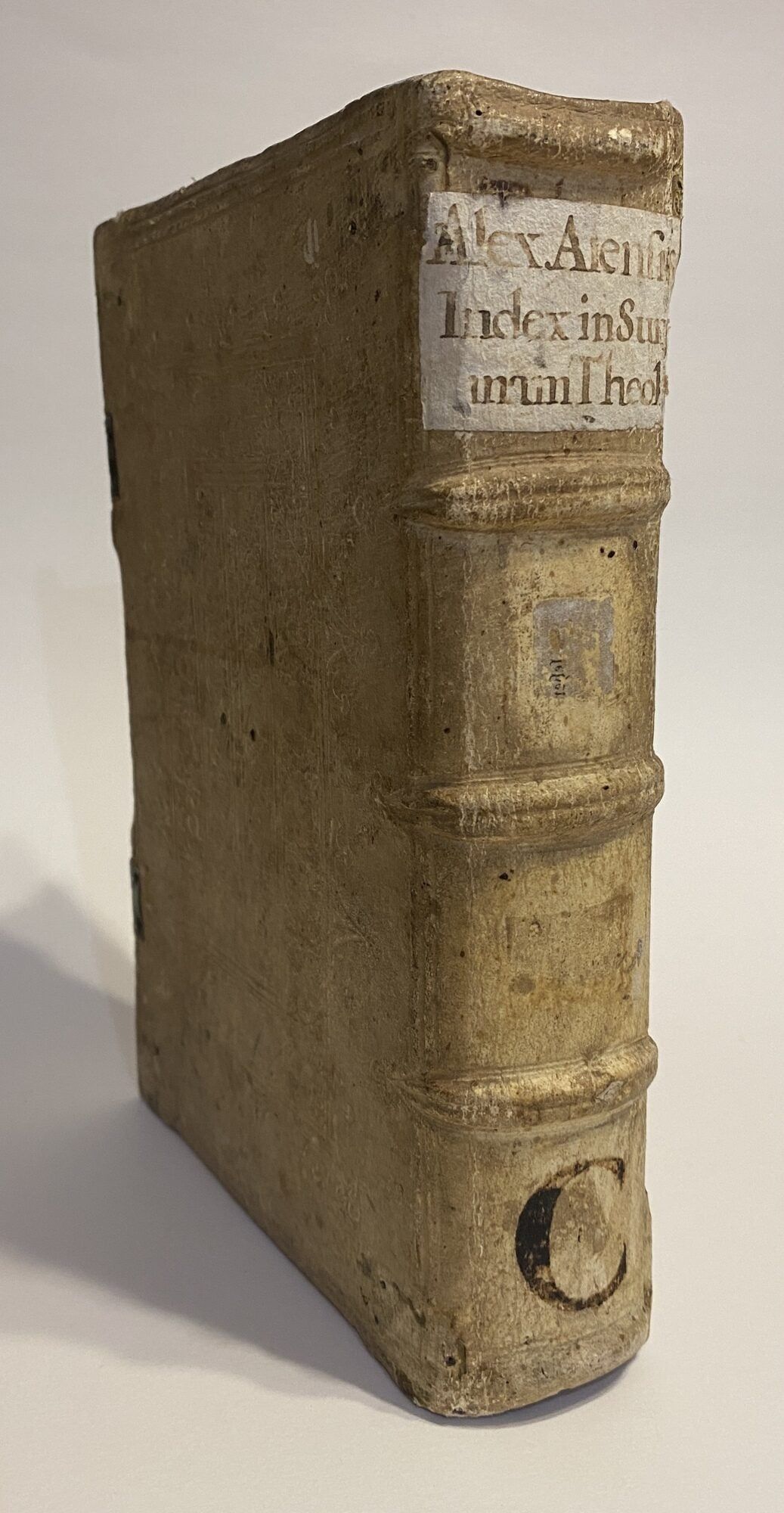
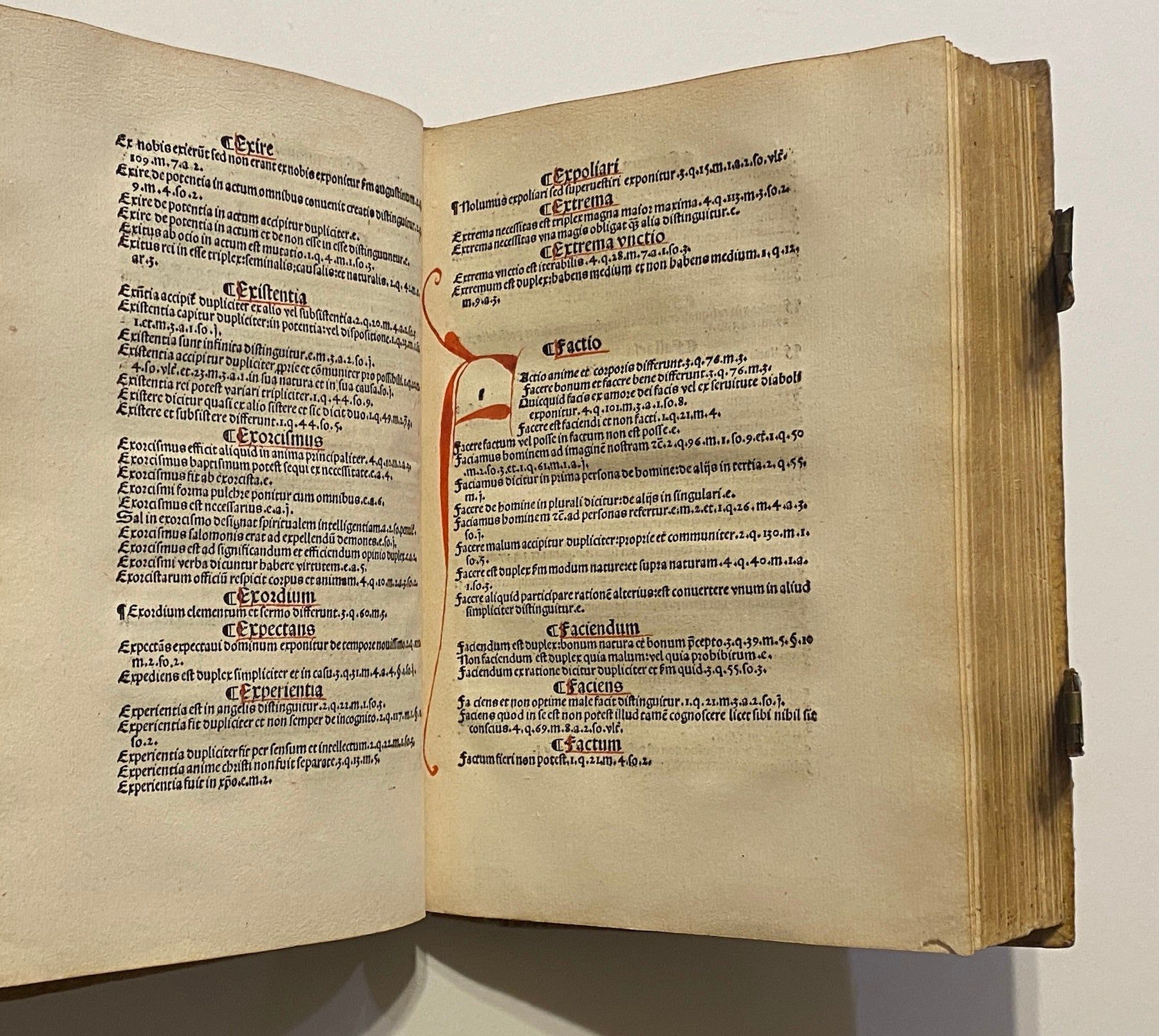
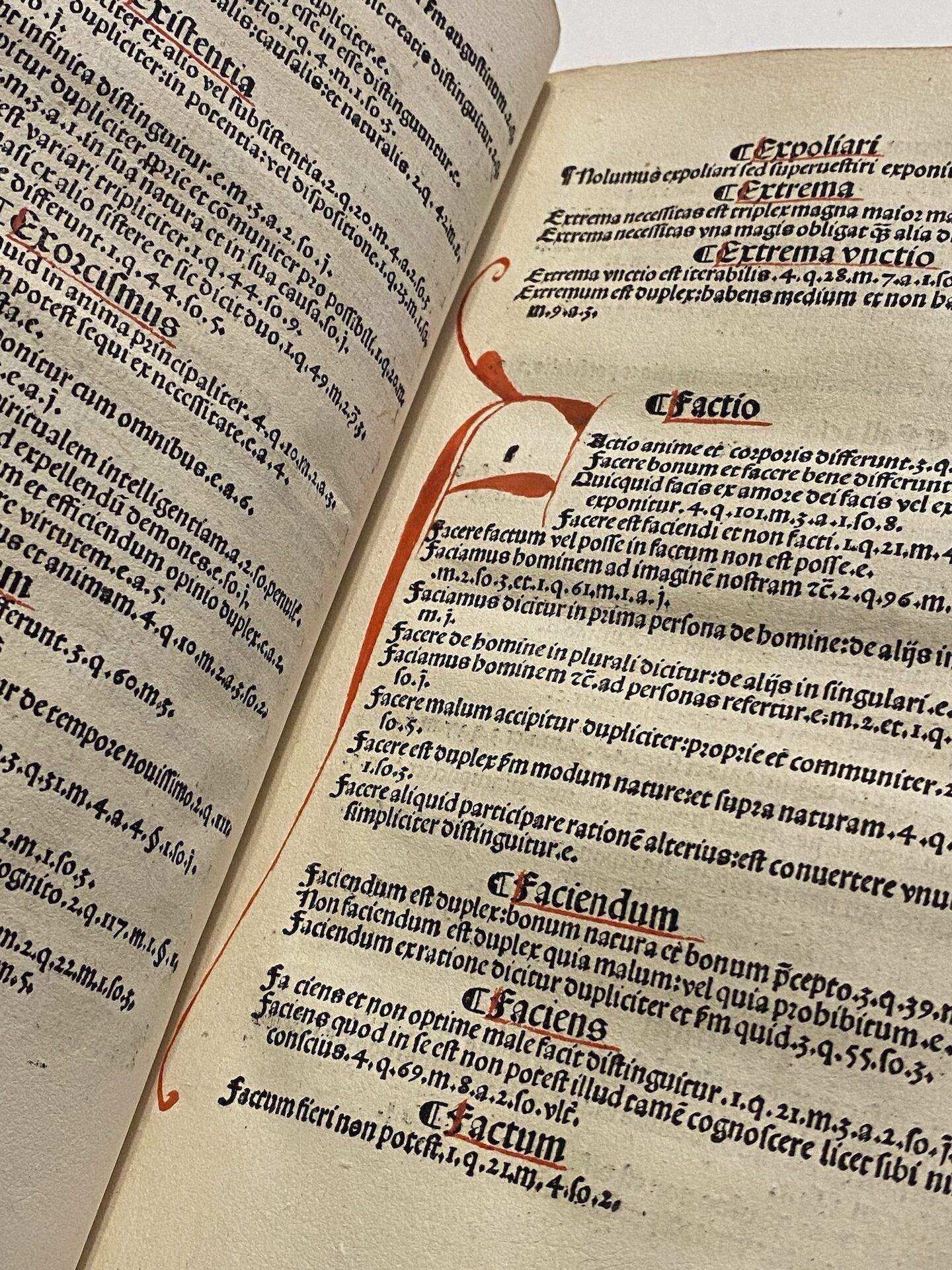
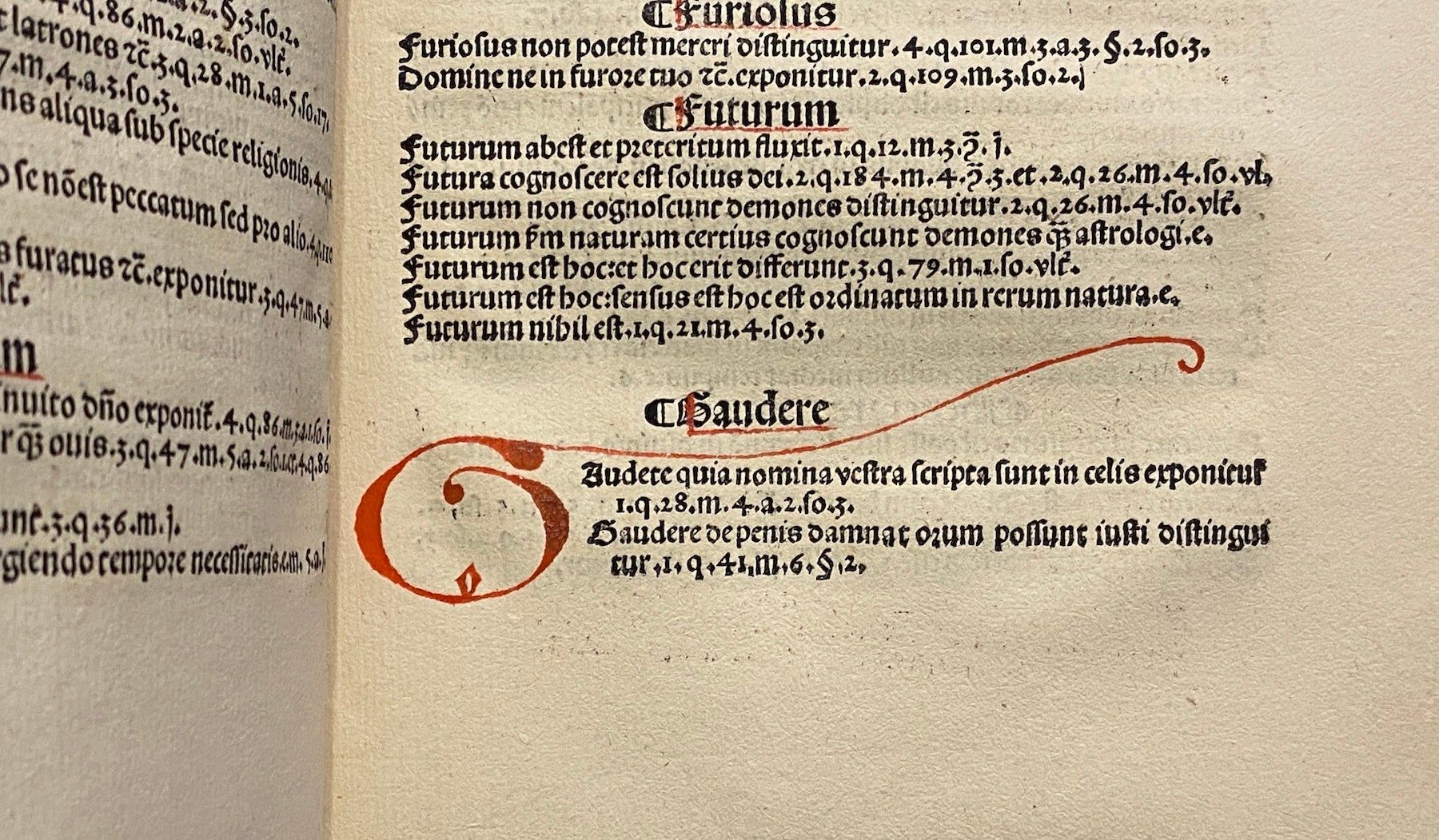
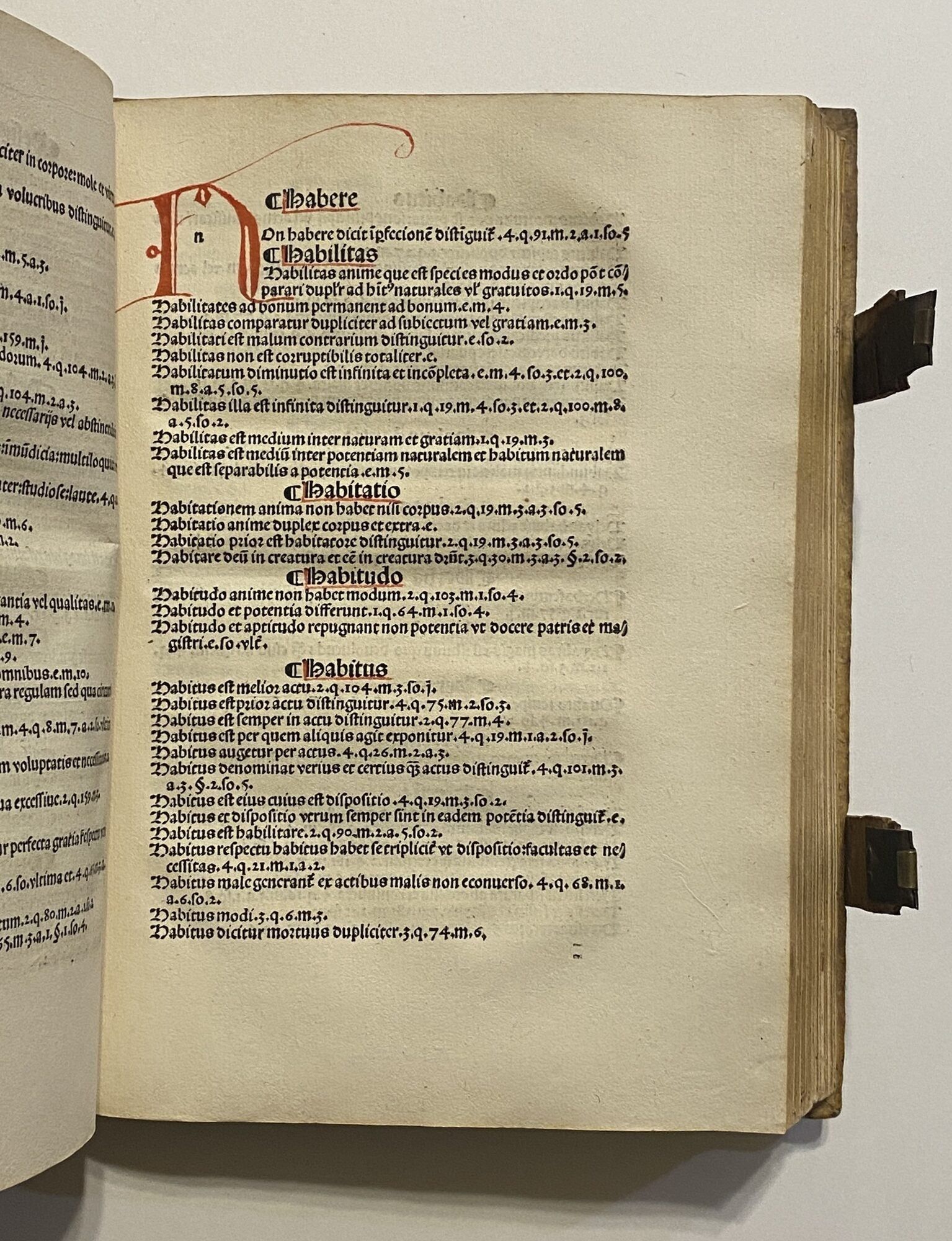
- Basel: Nicolaus Kessler, 1502
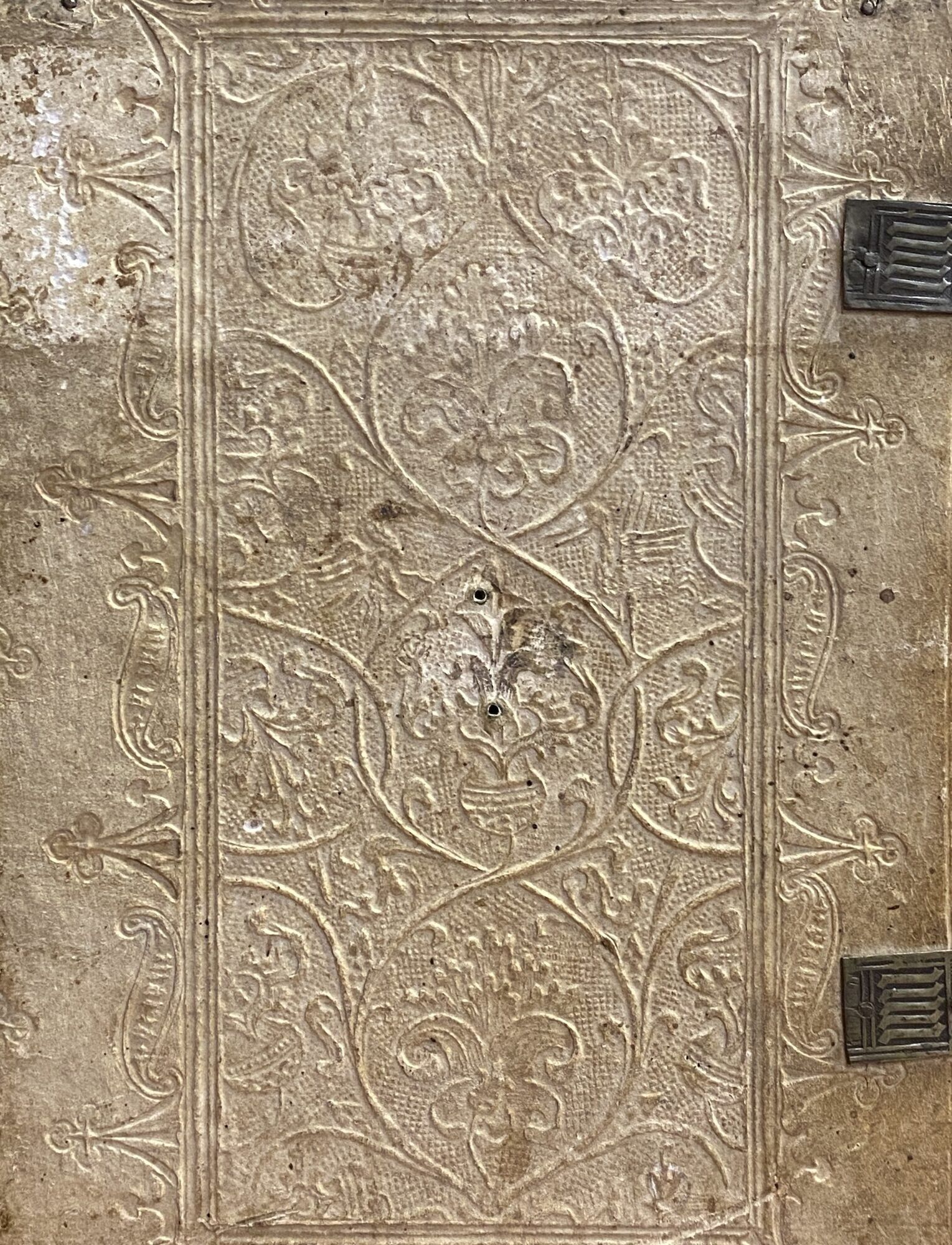
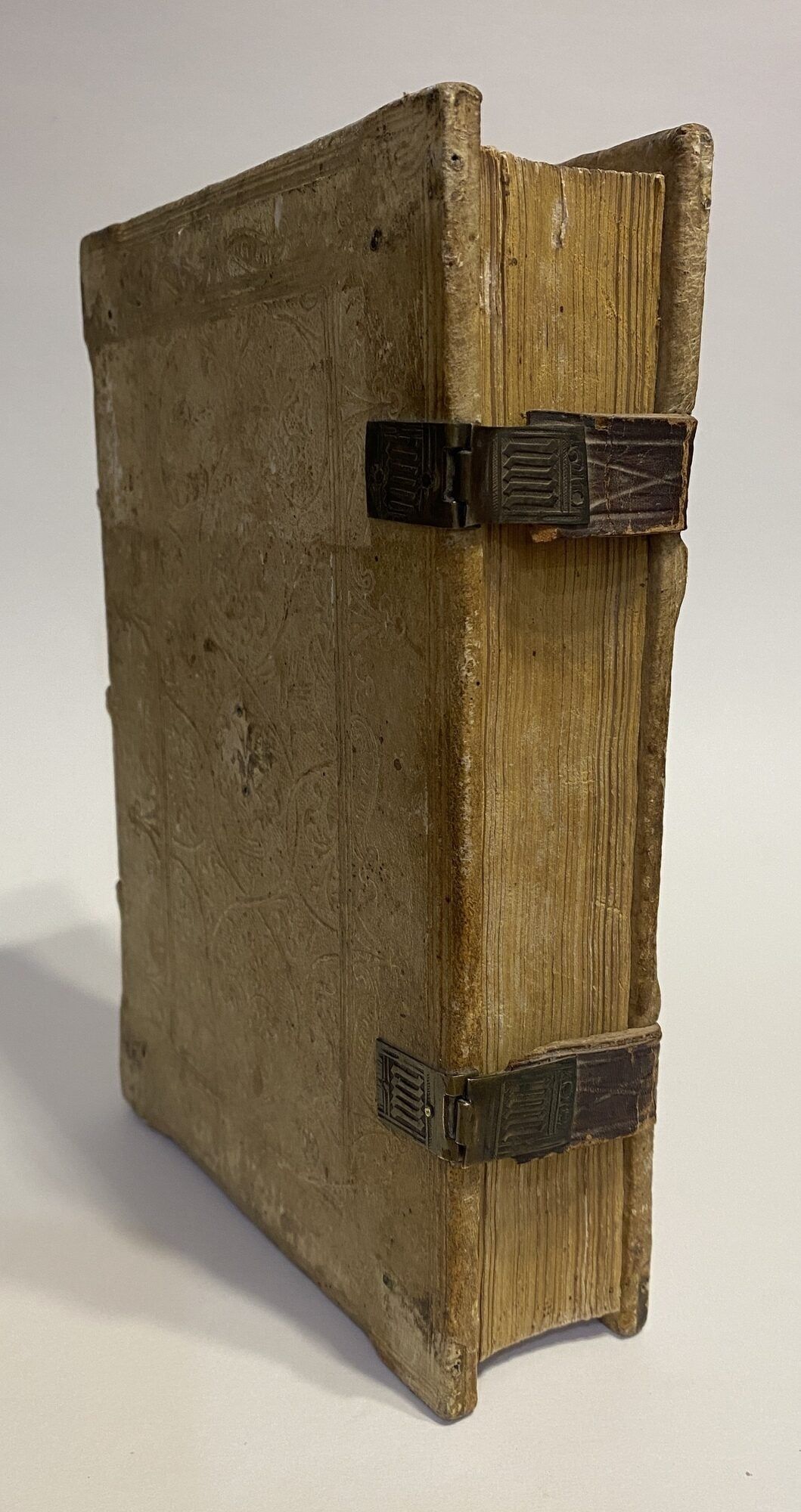
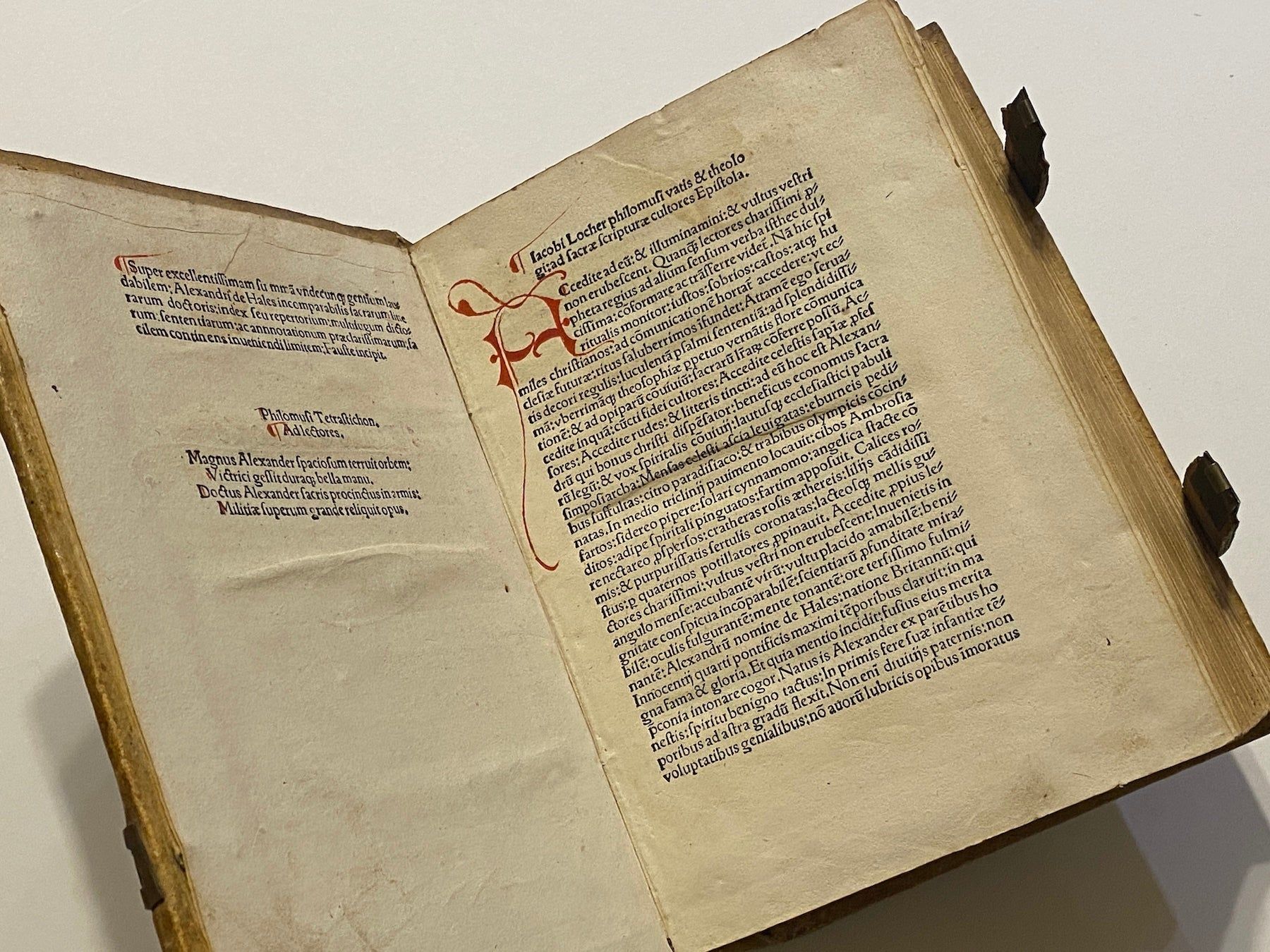
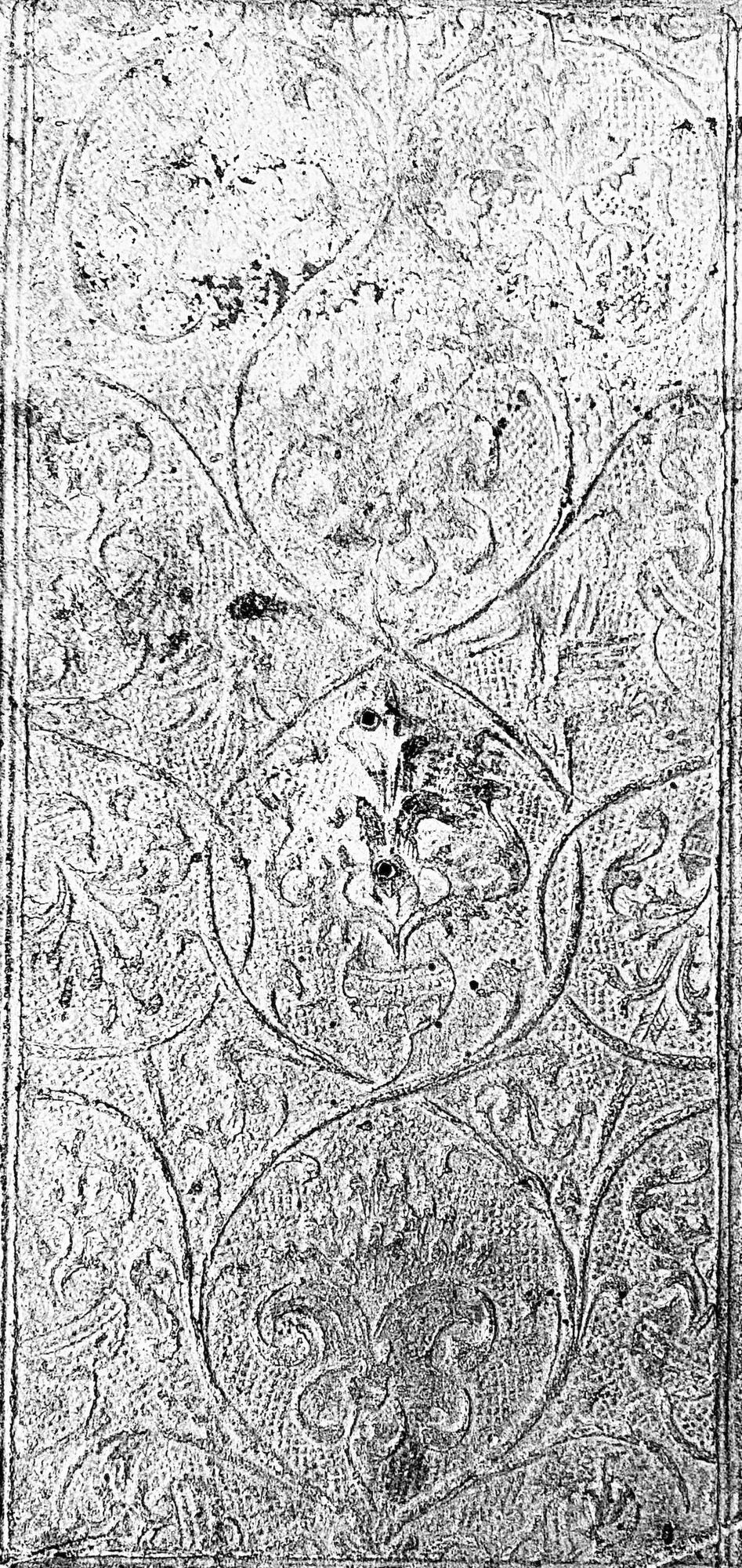
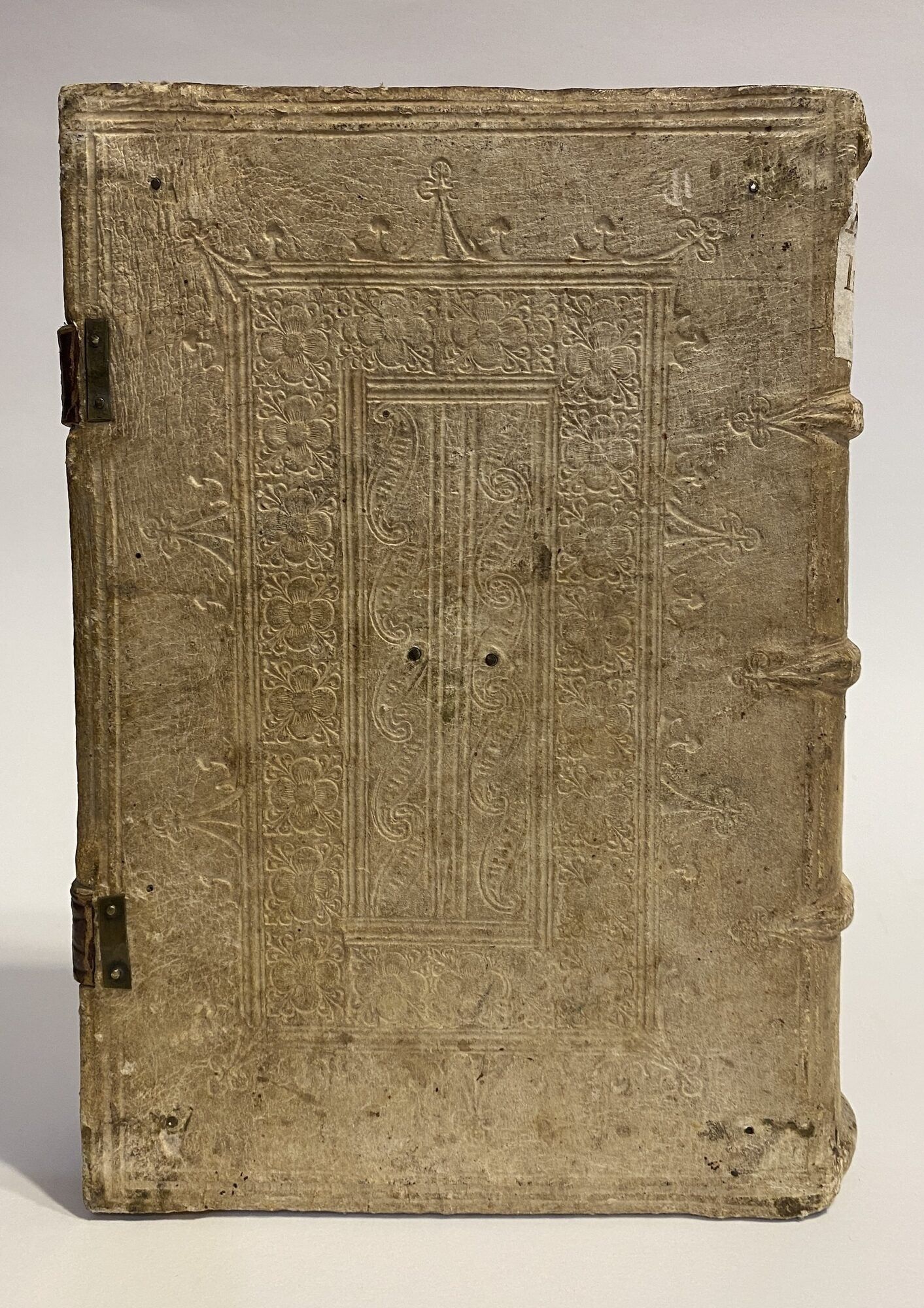
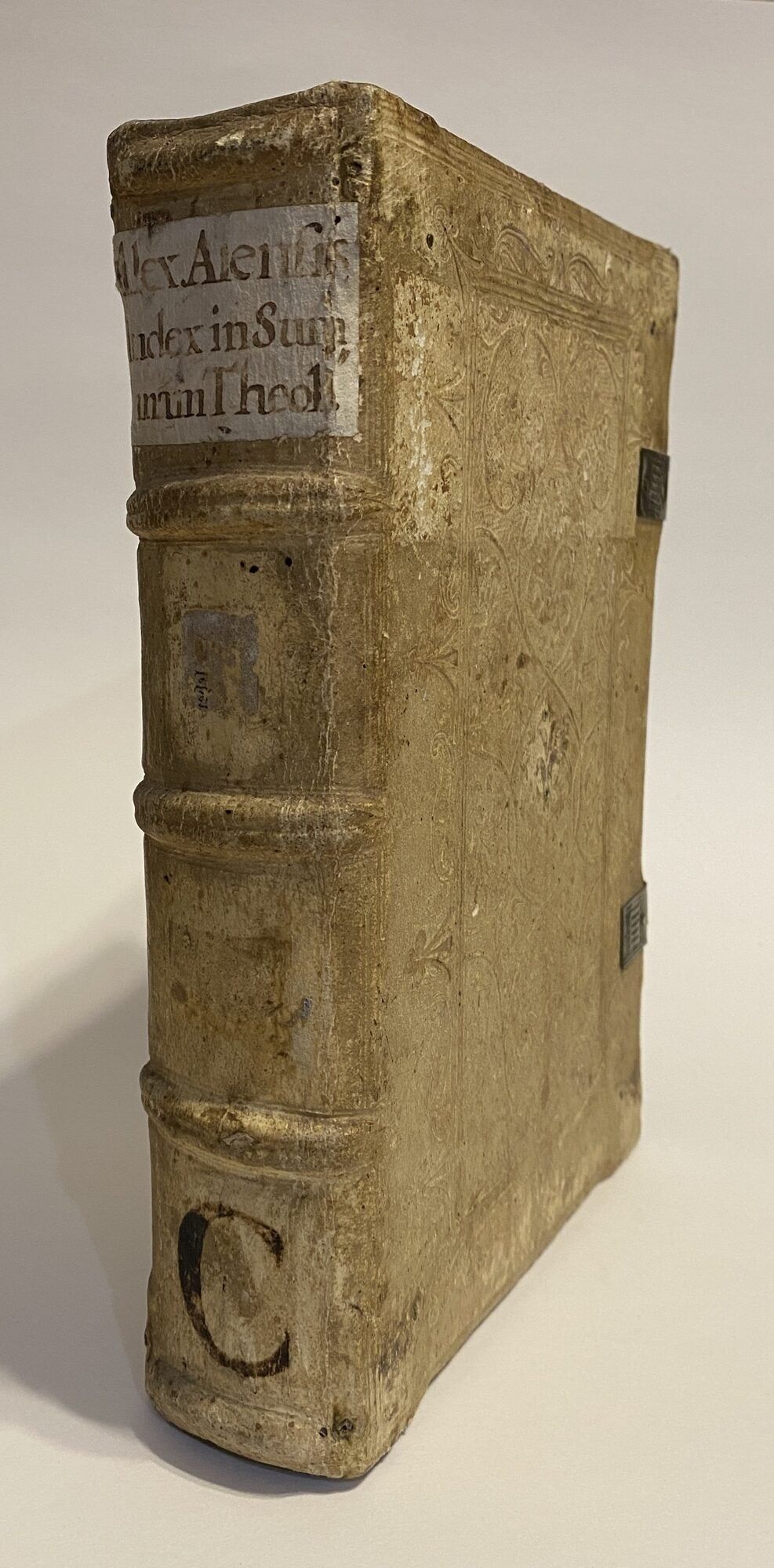
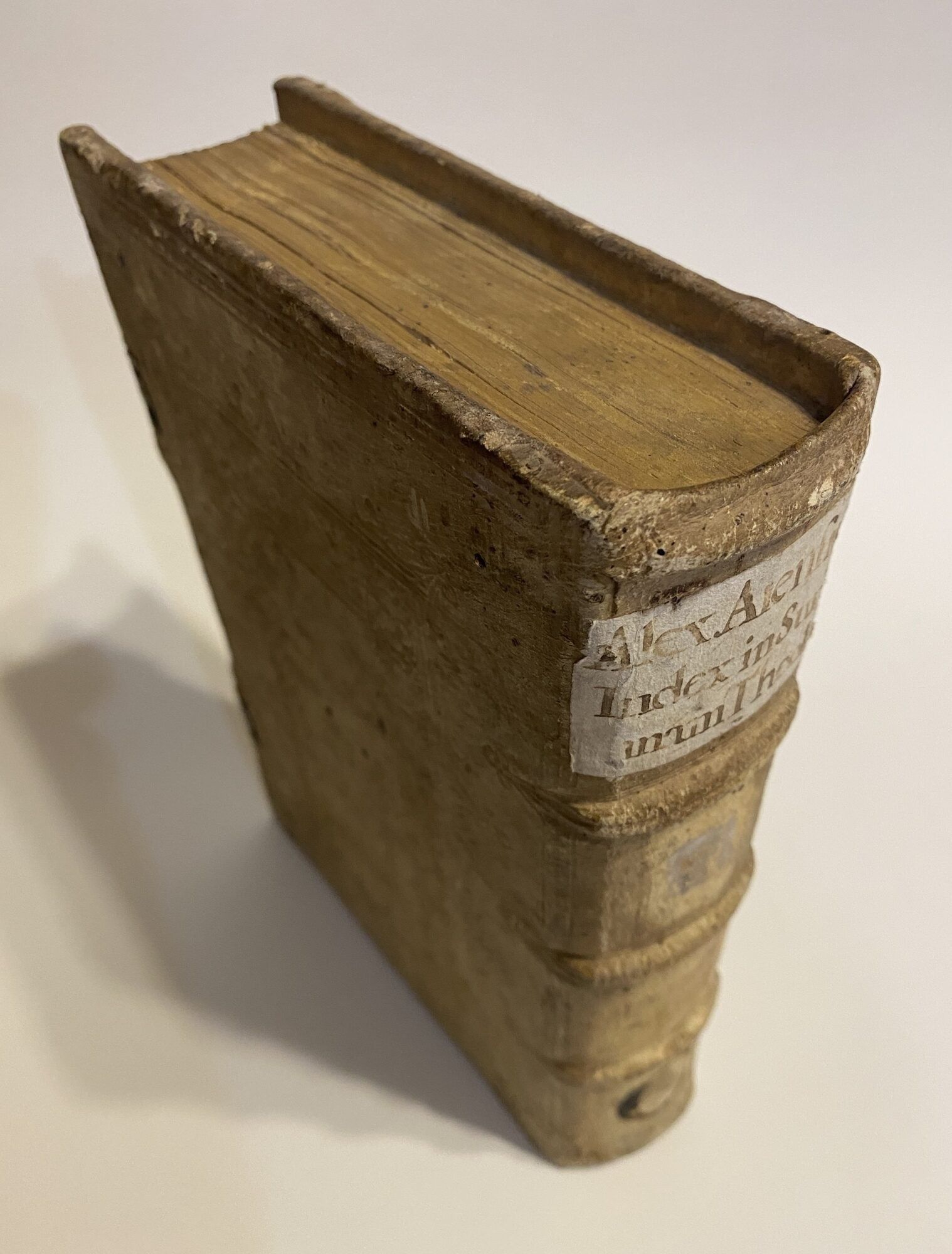
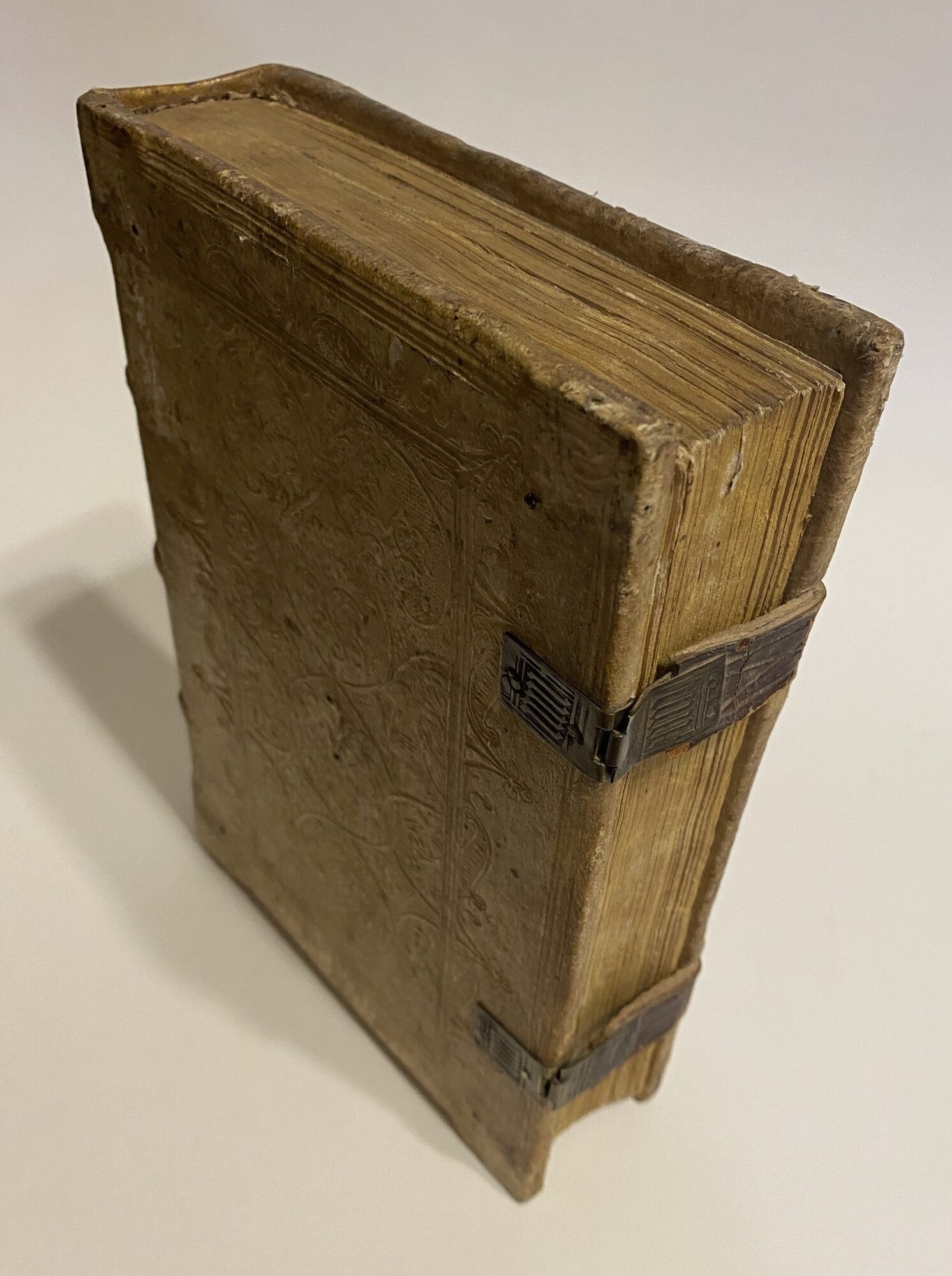
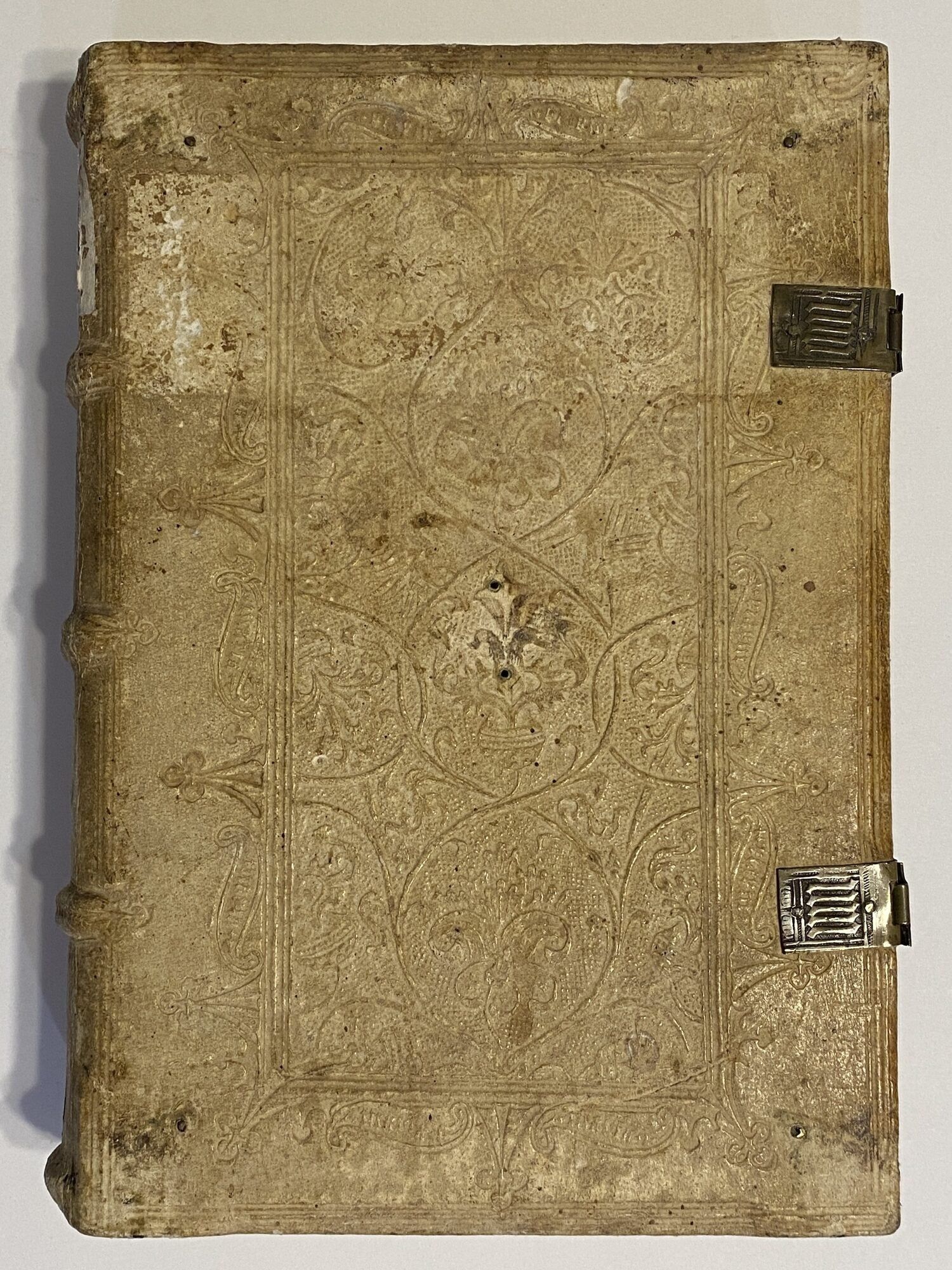
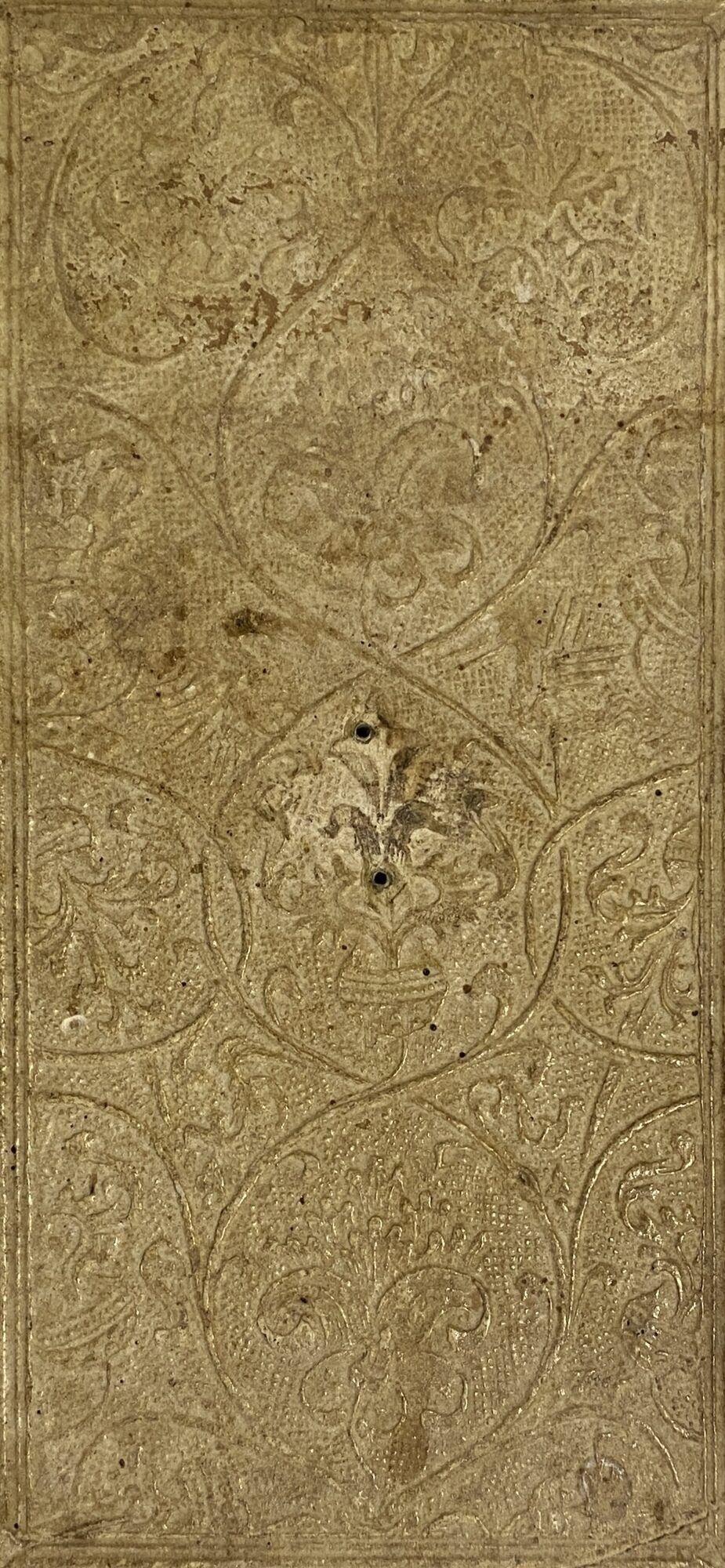
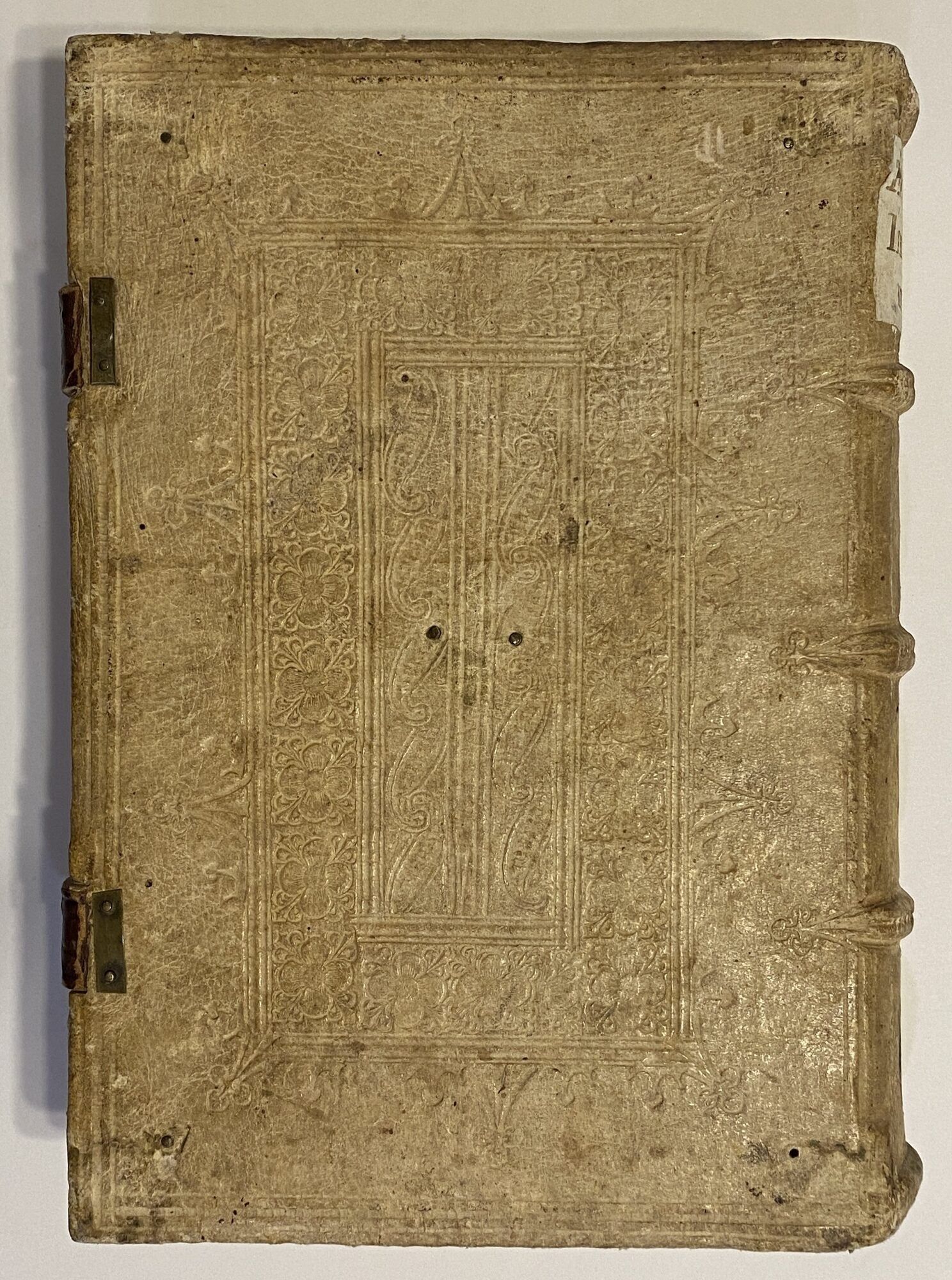
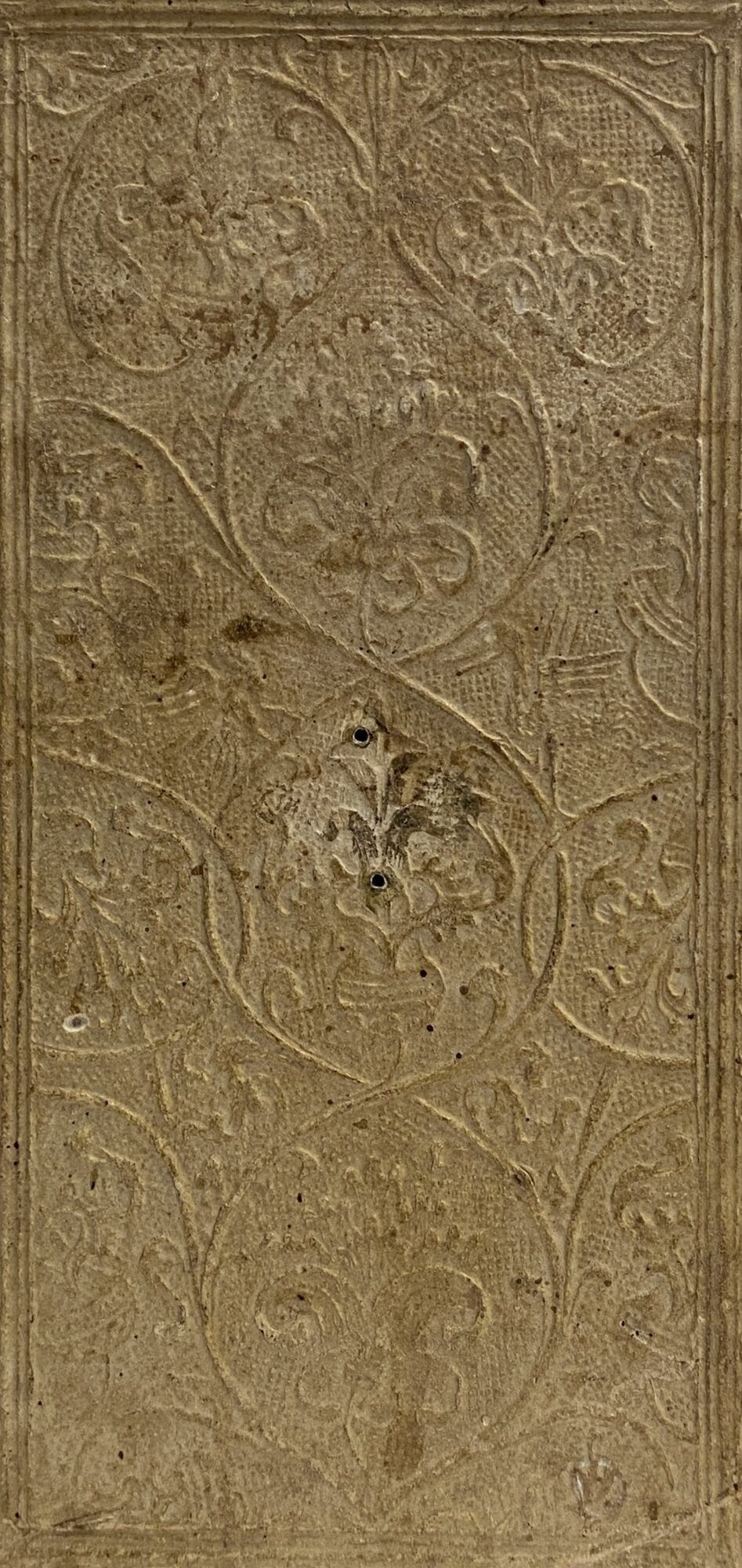
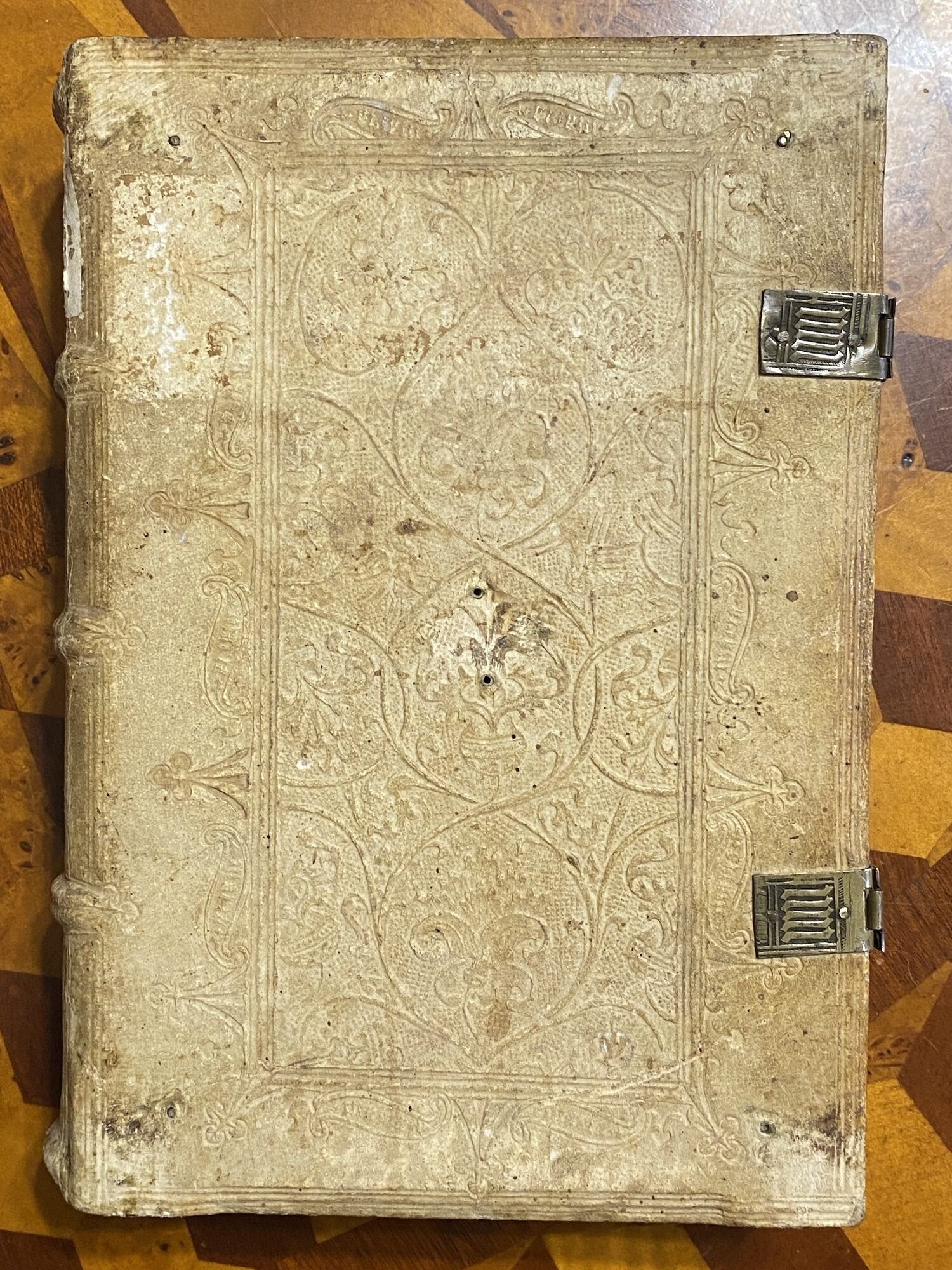
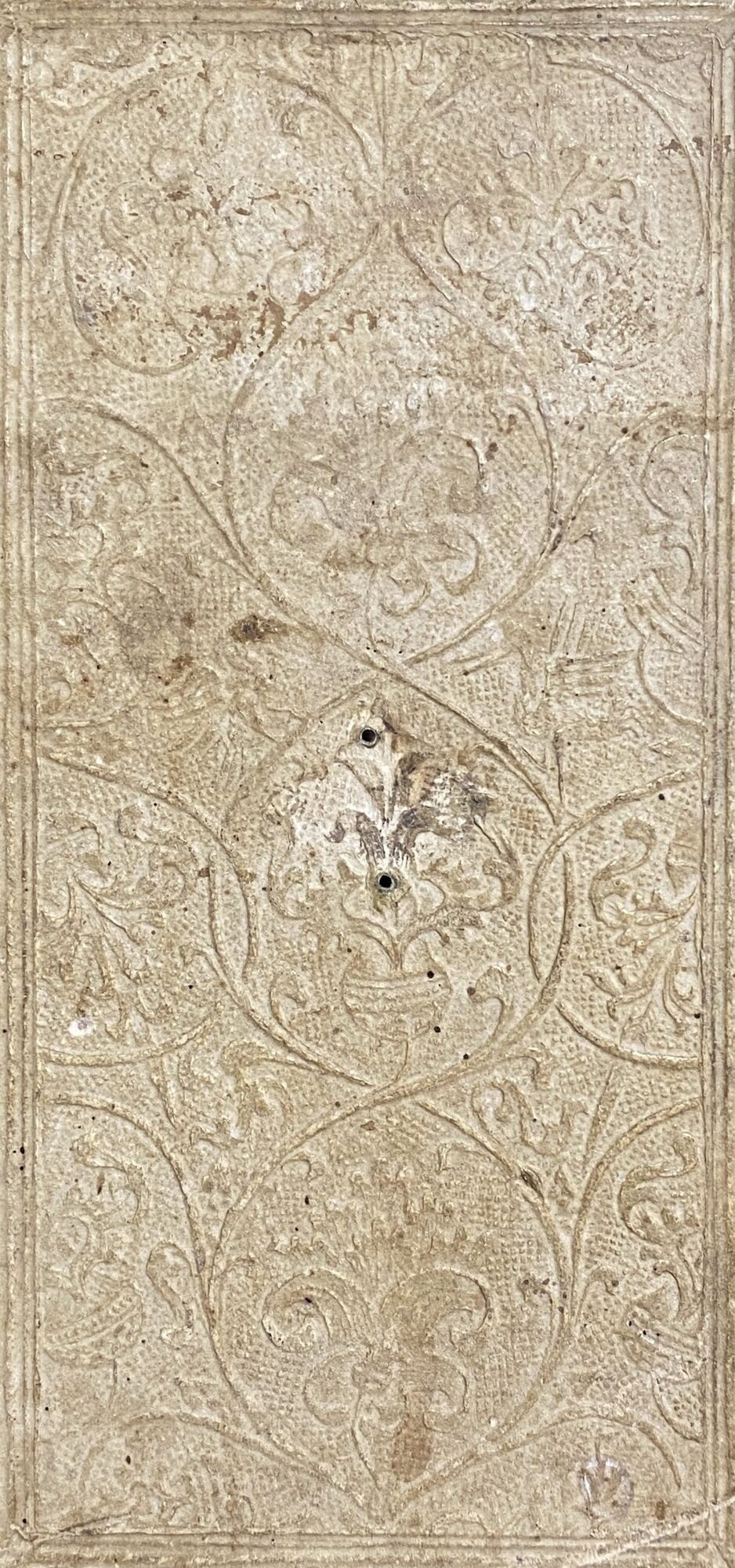
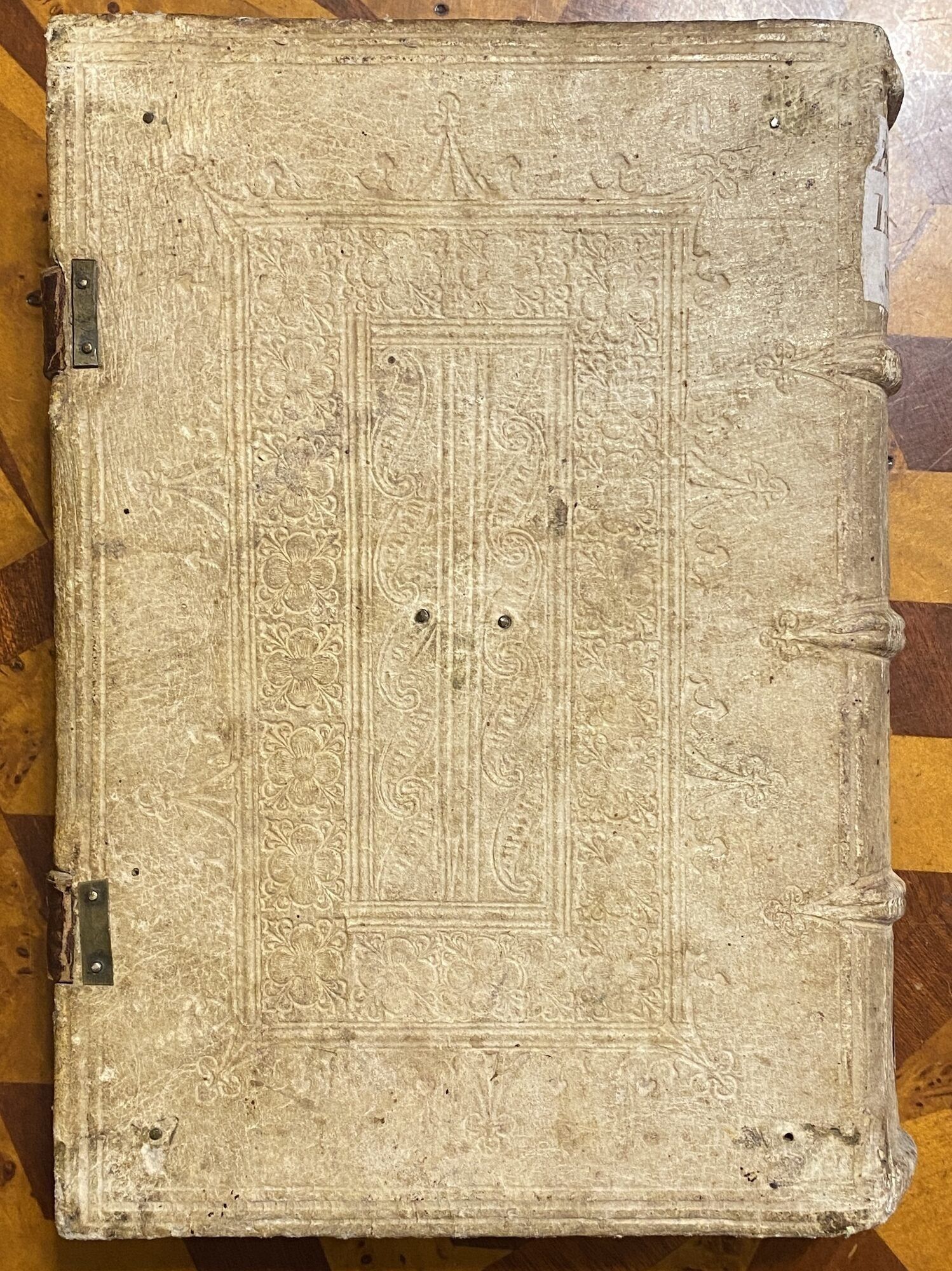
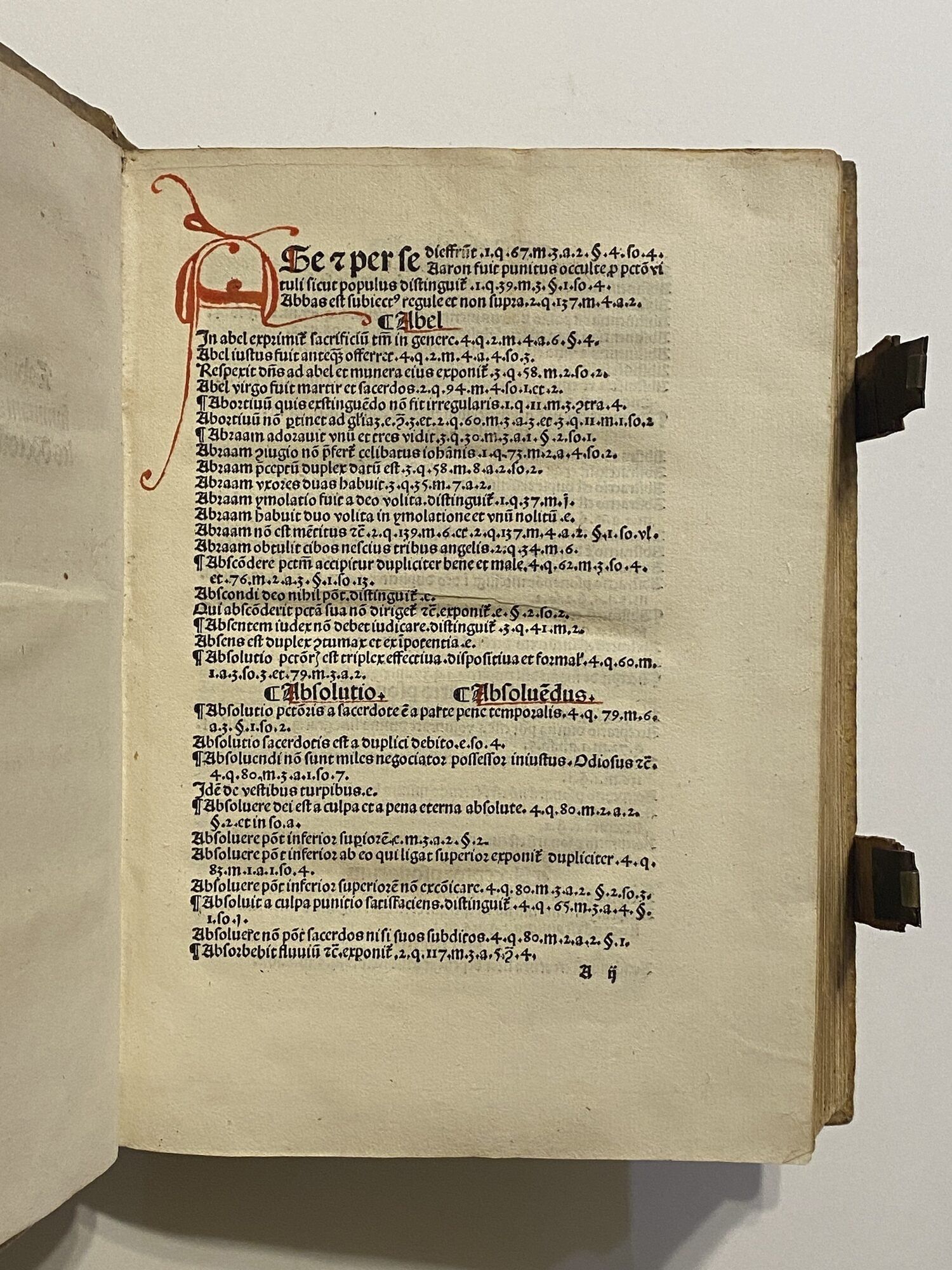
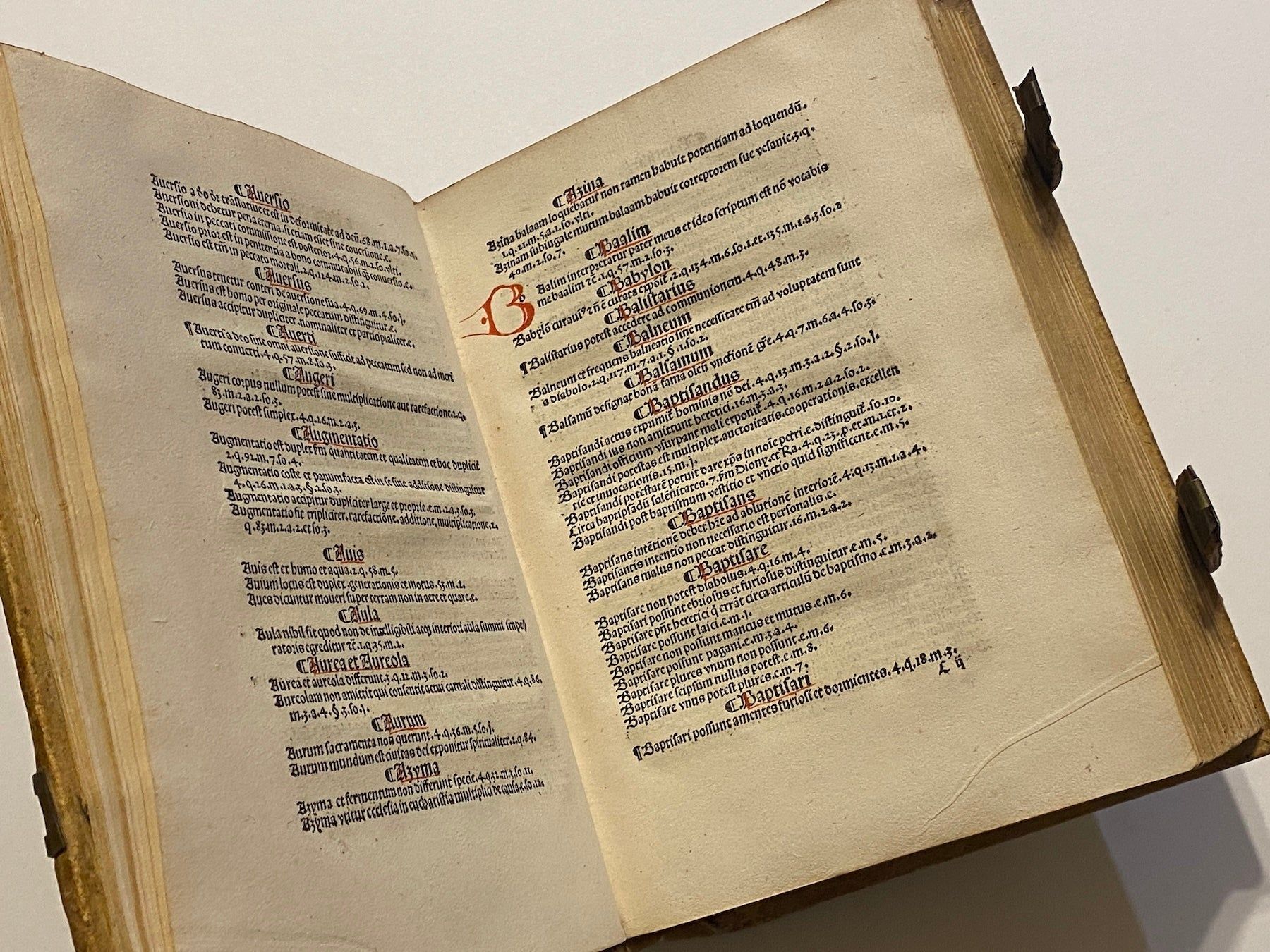
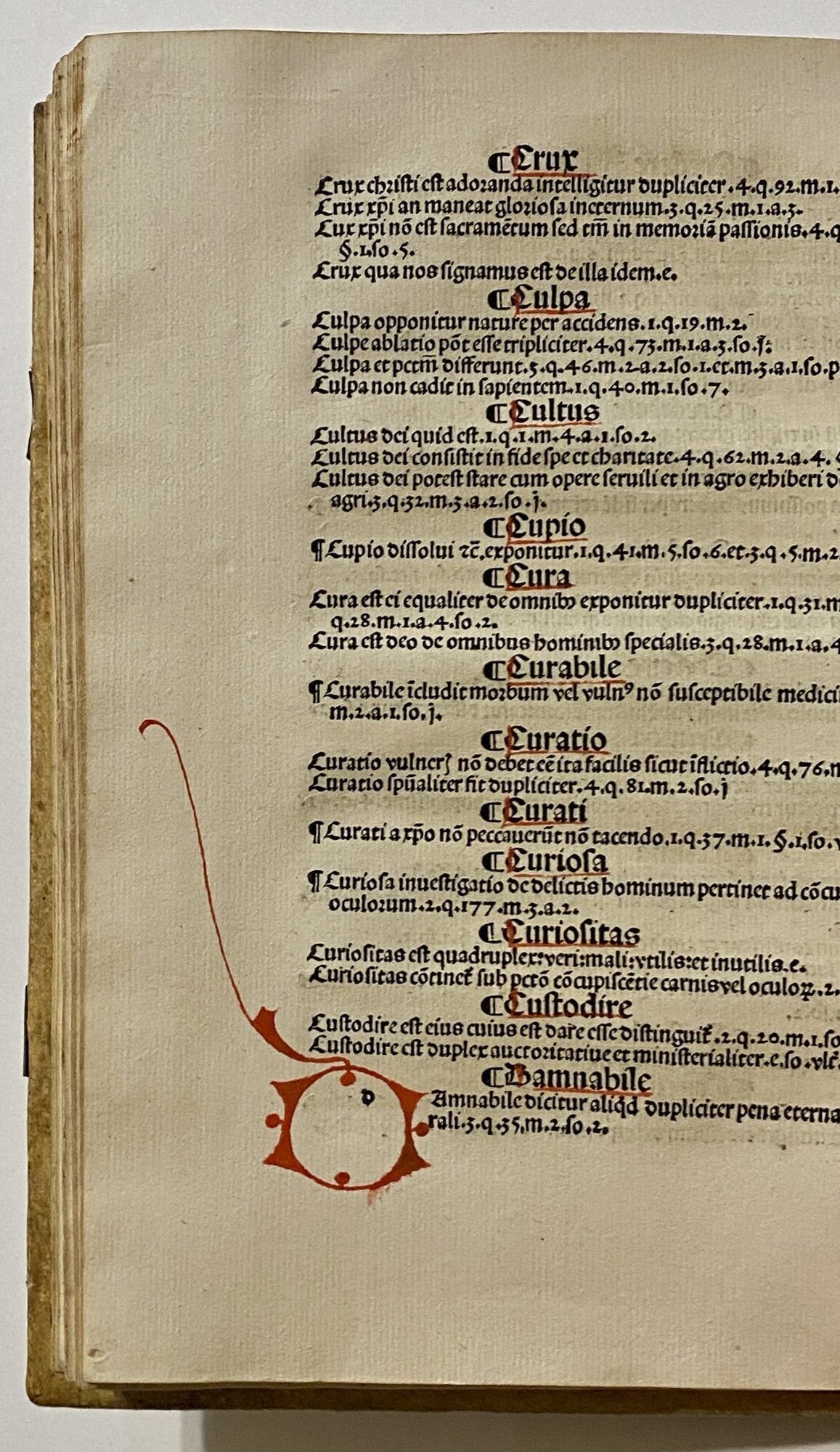
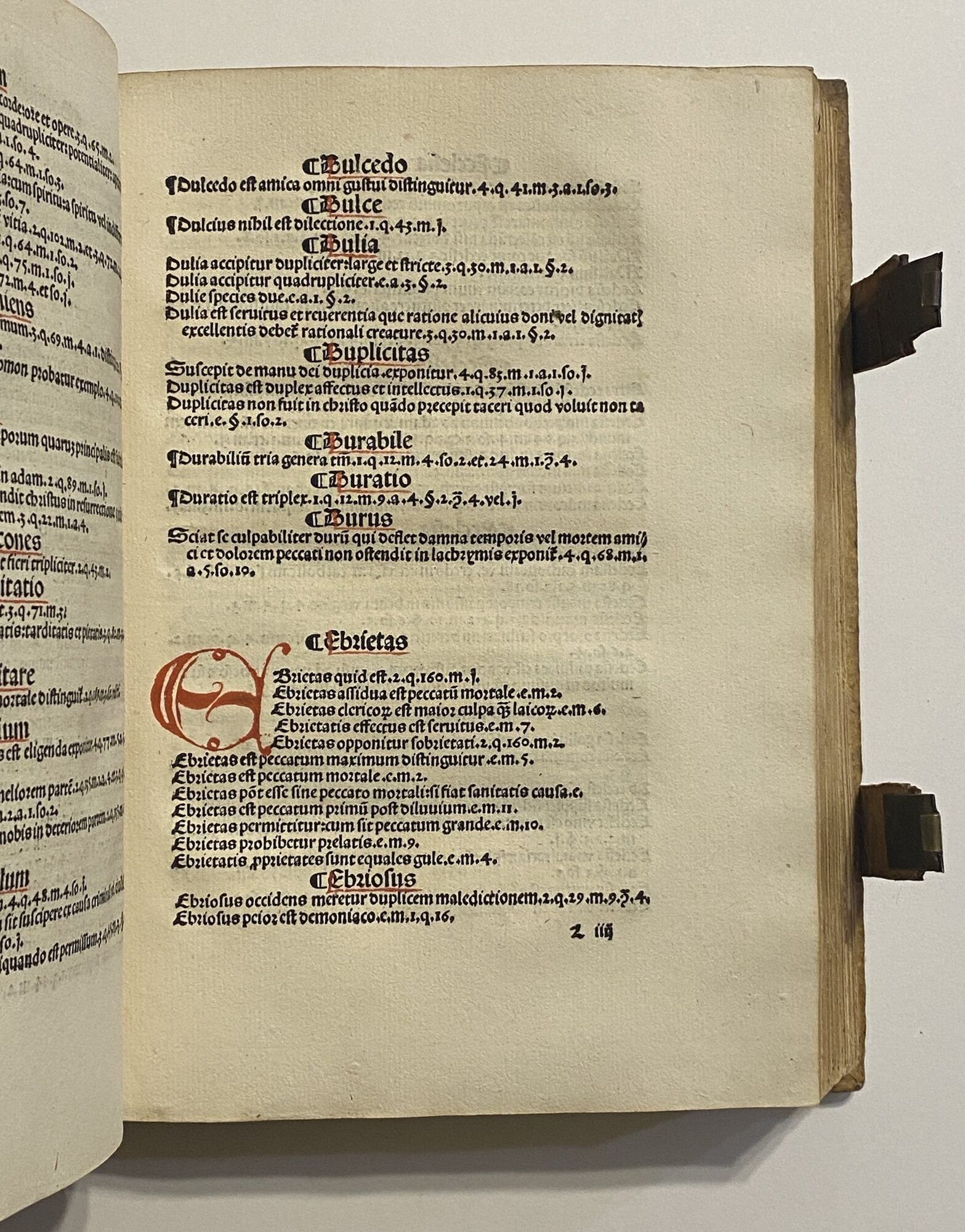
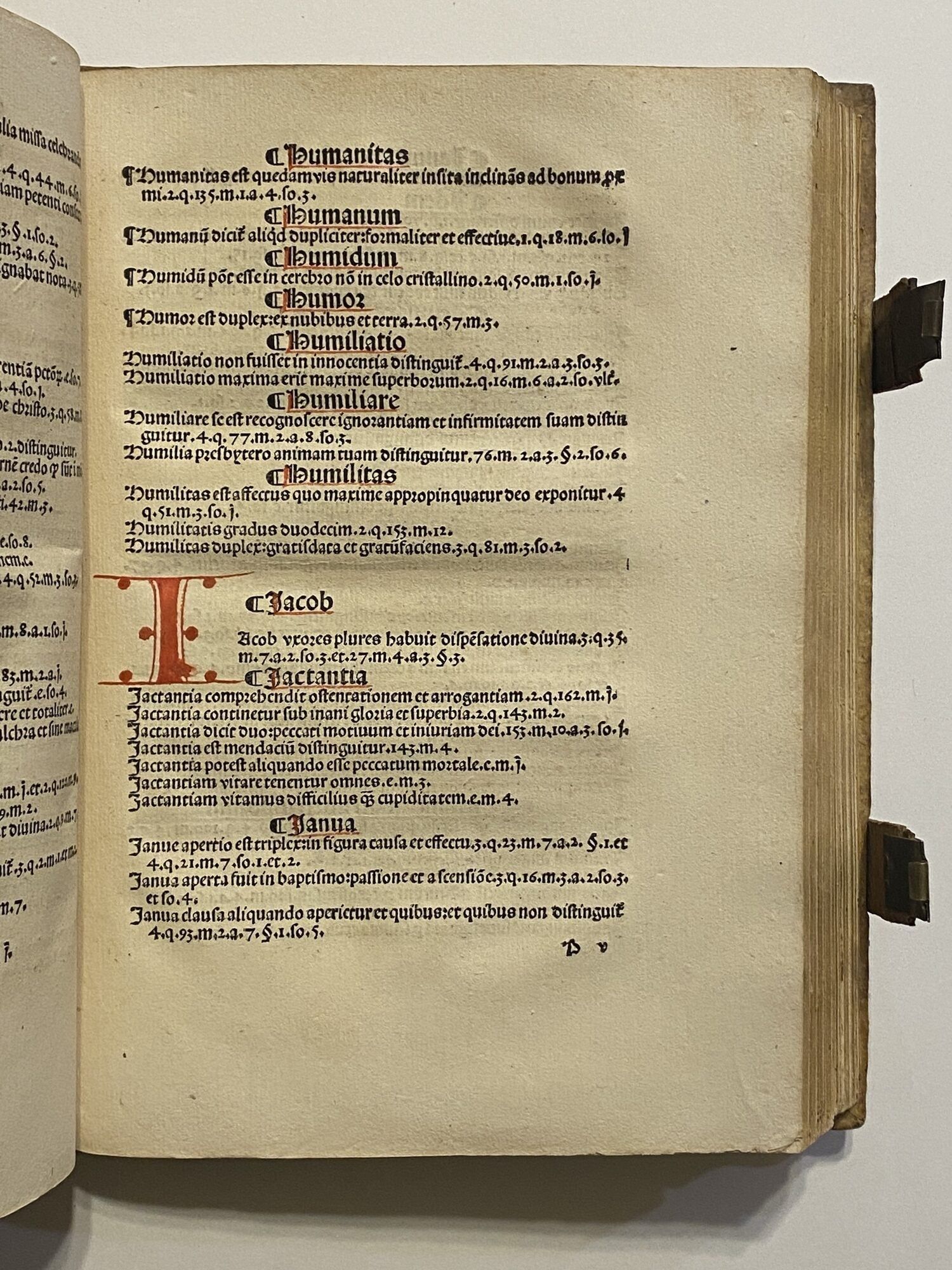
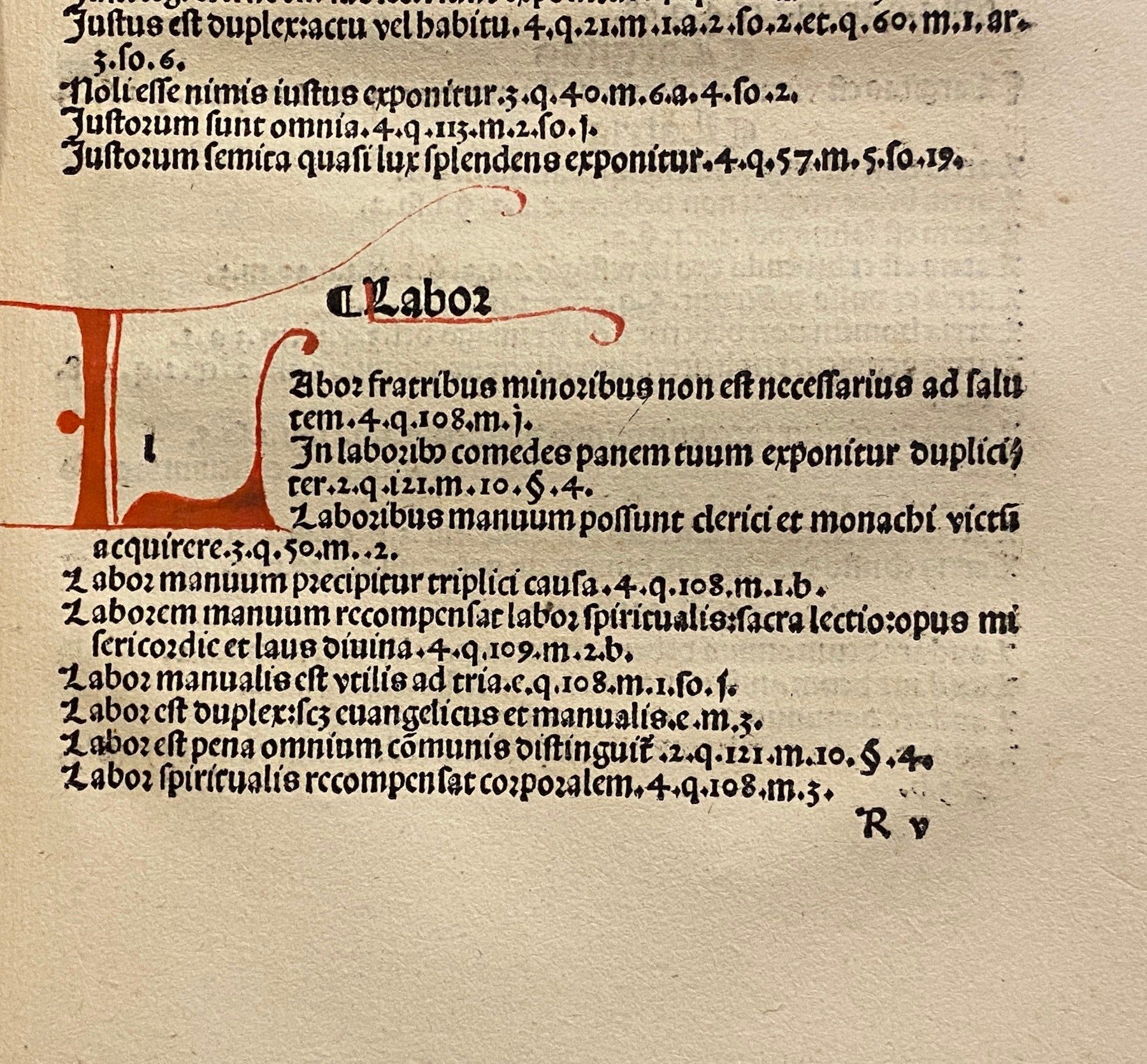
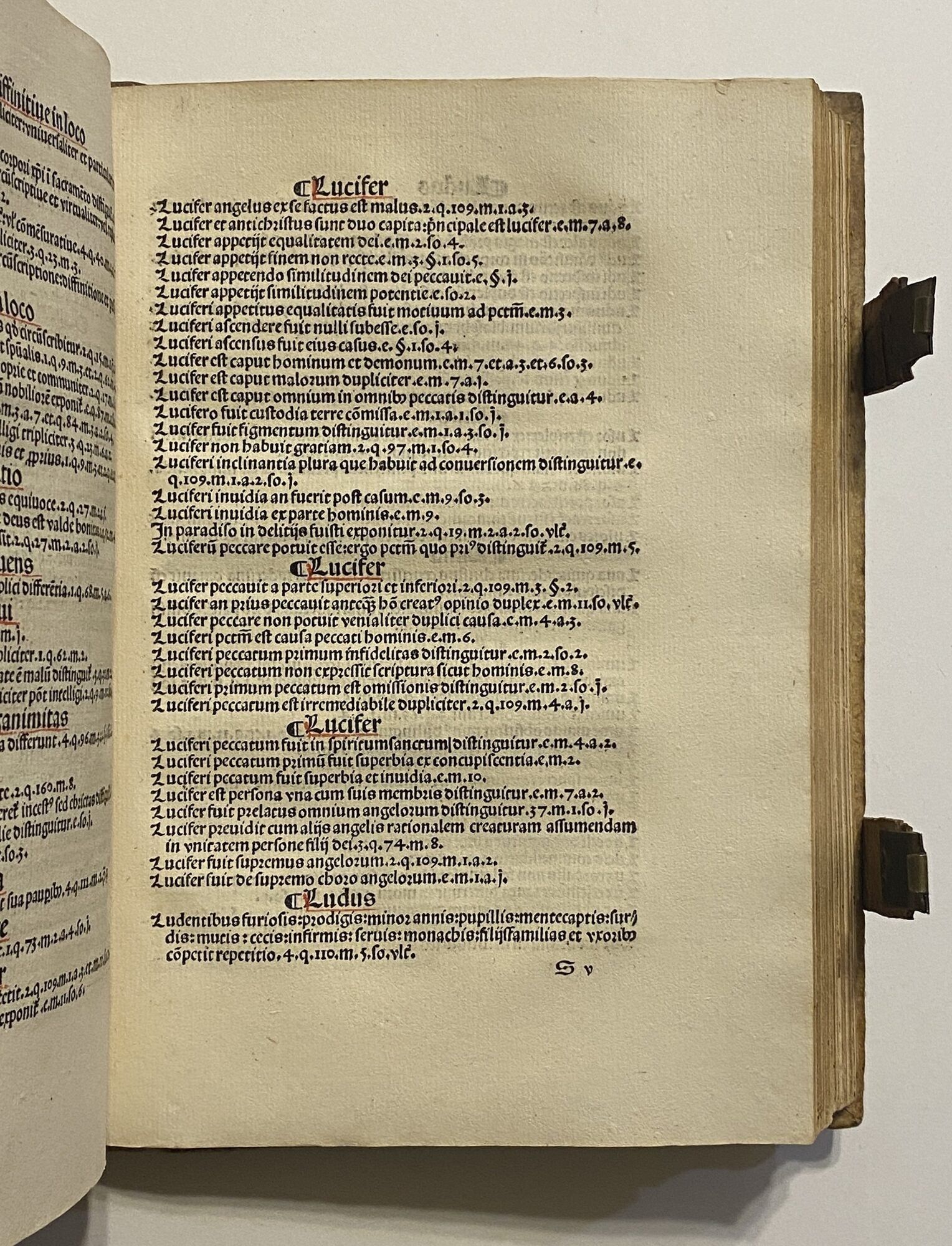
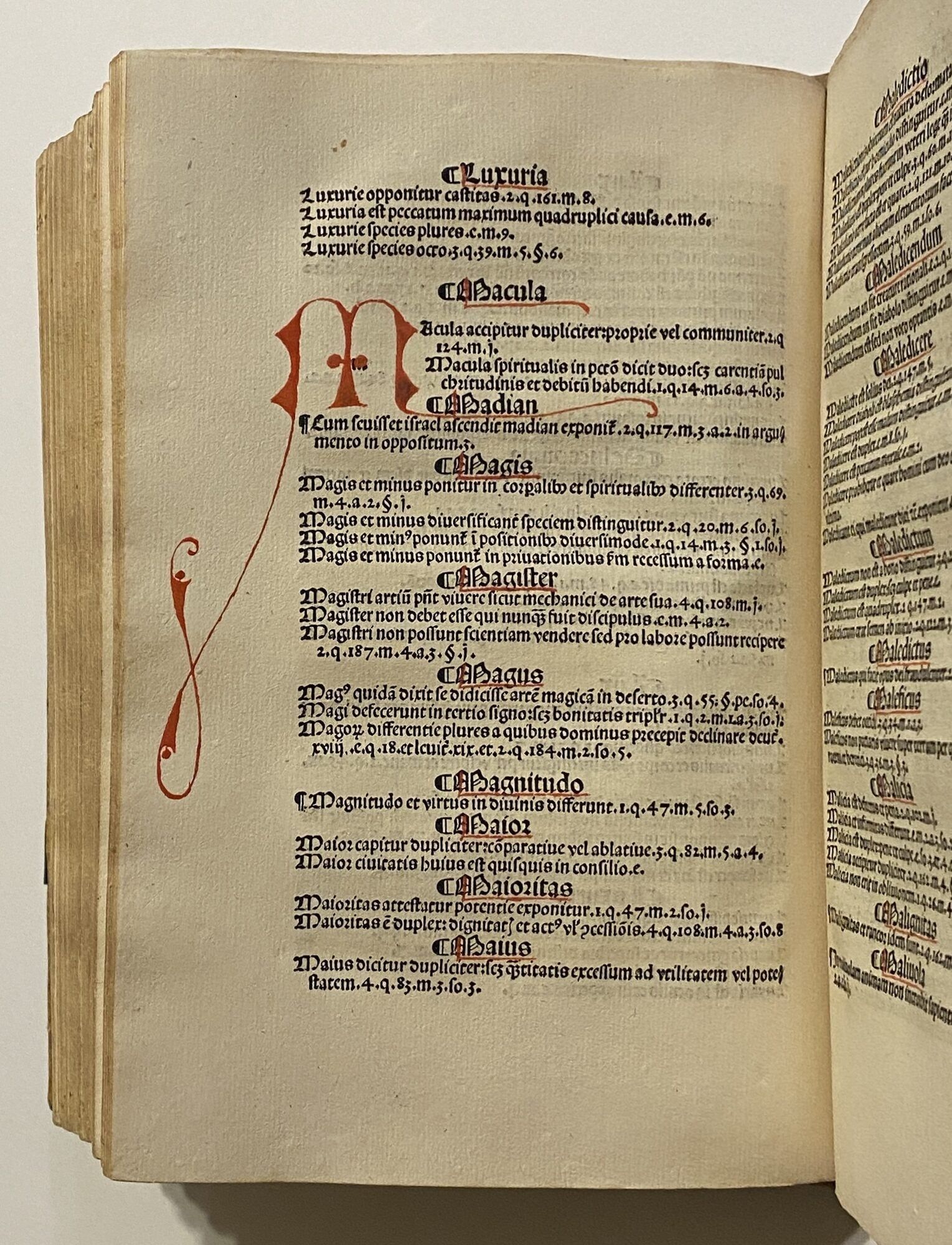
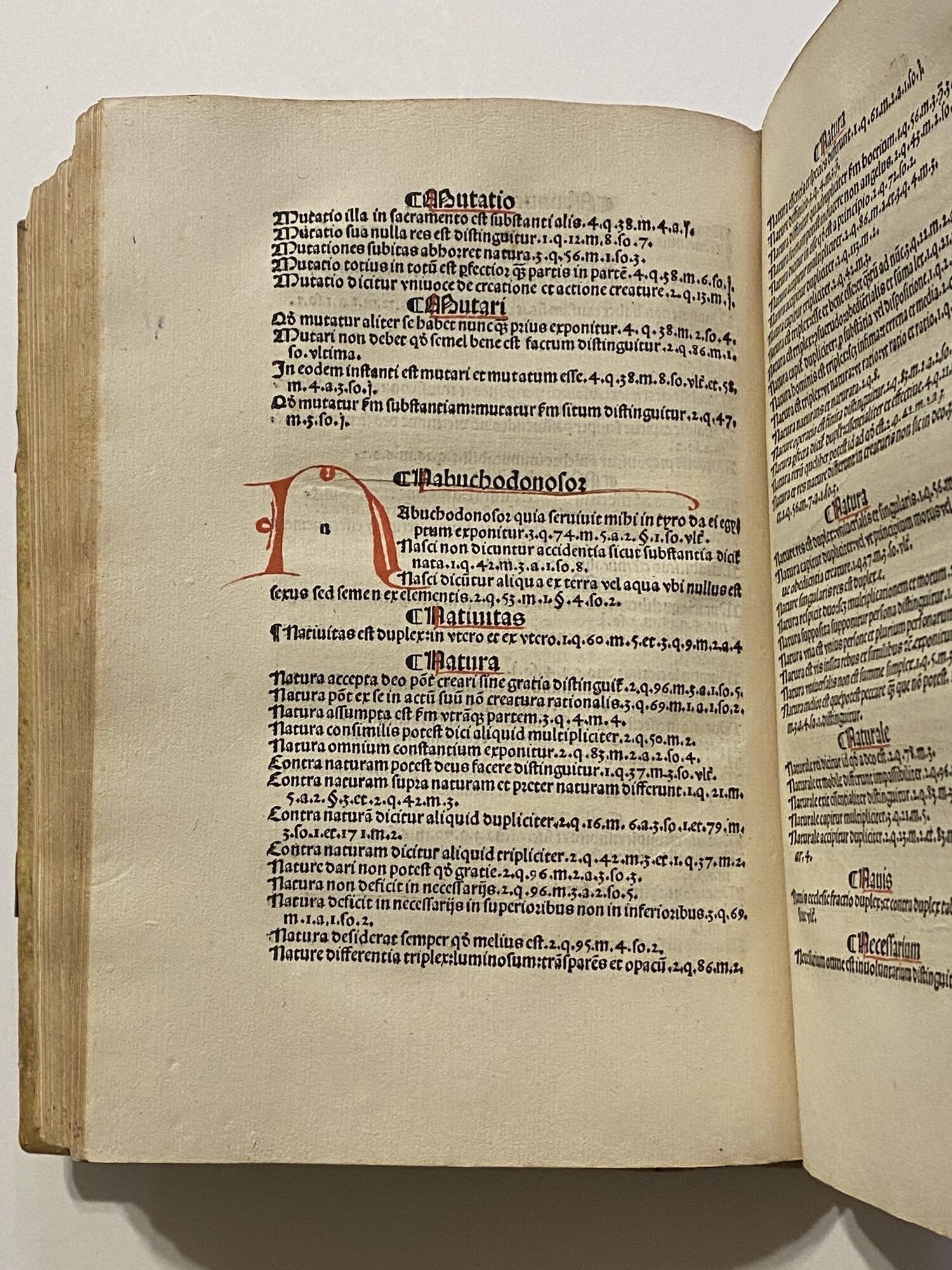
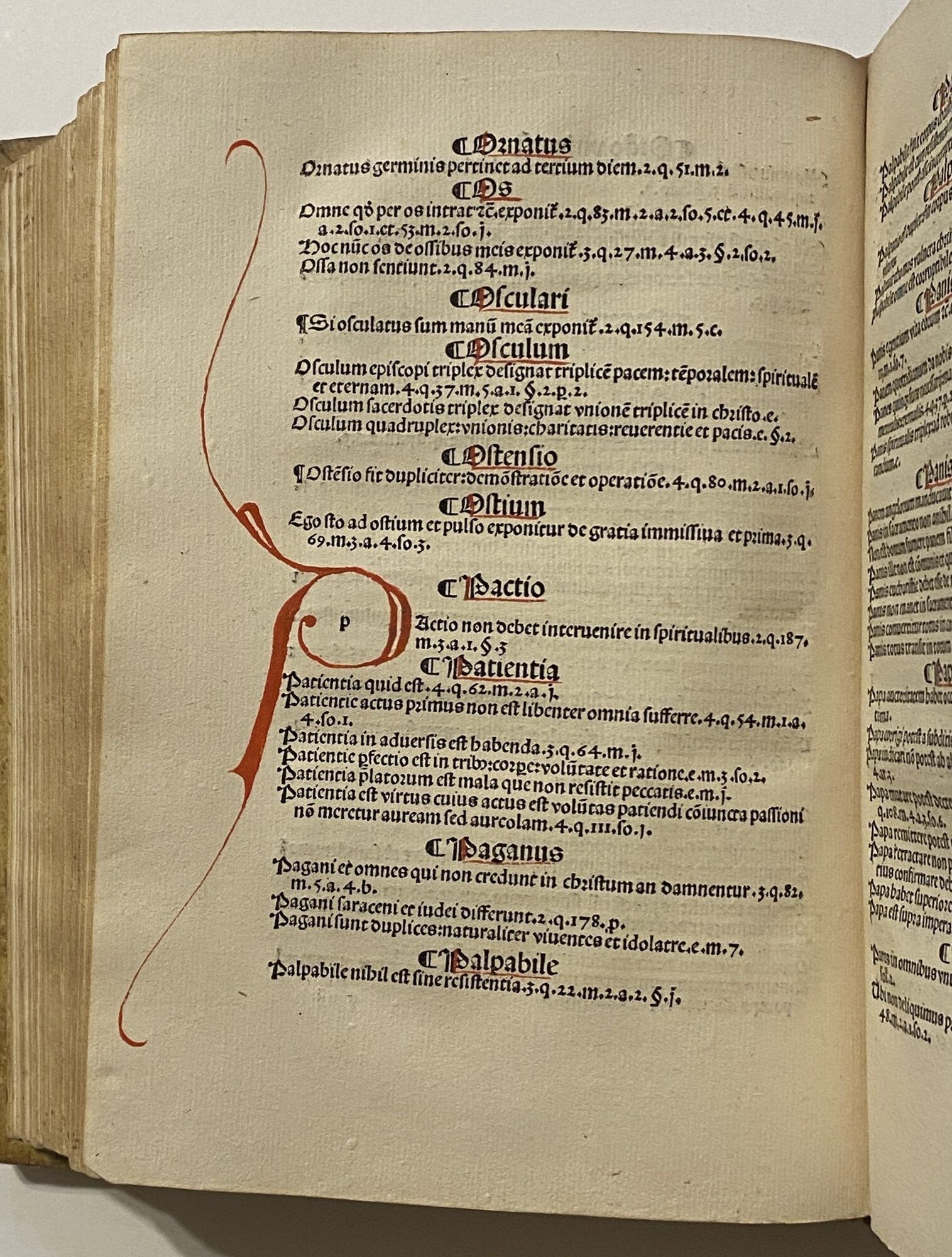
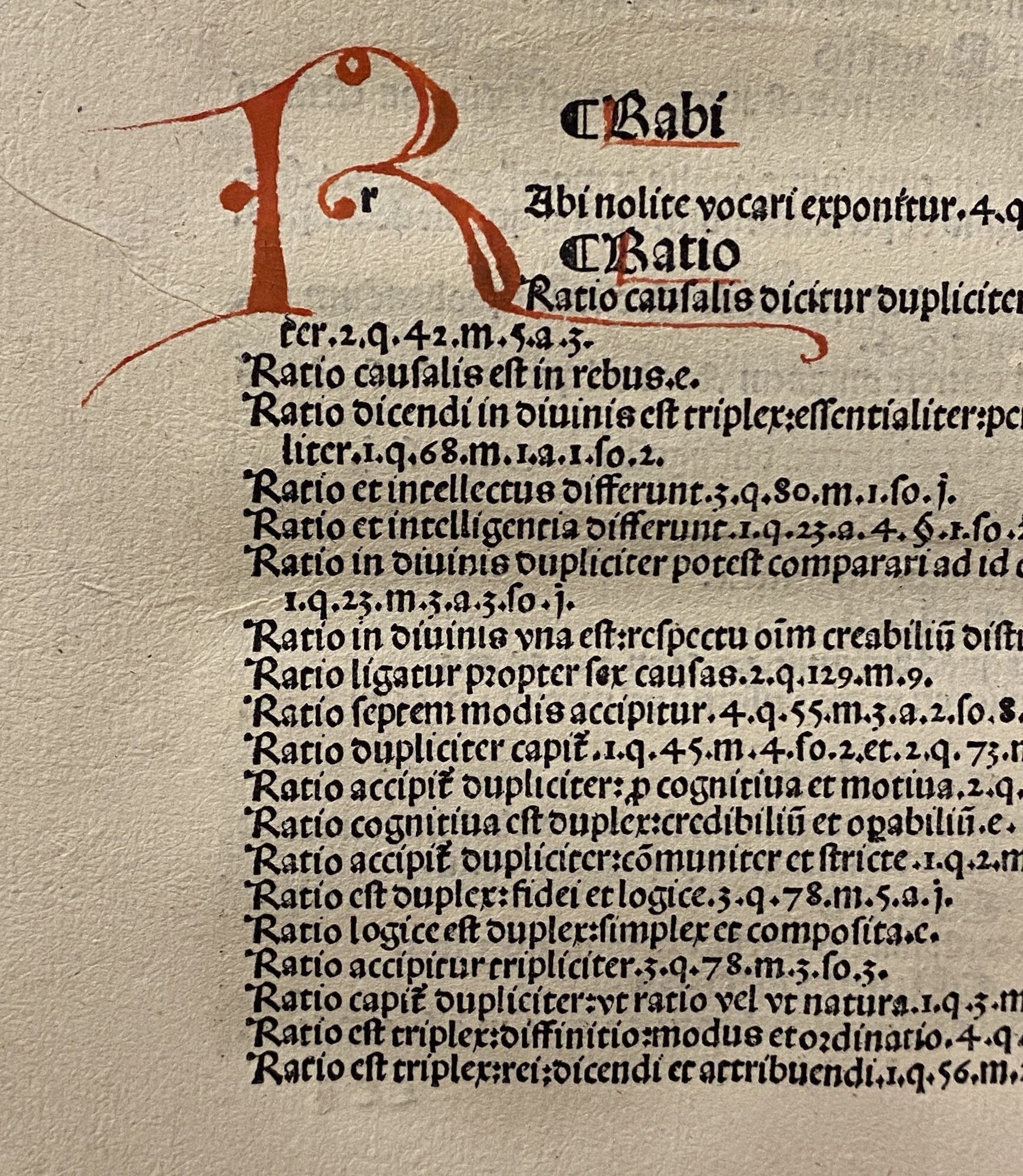
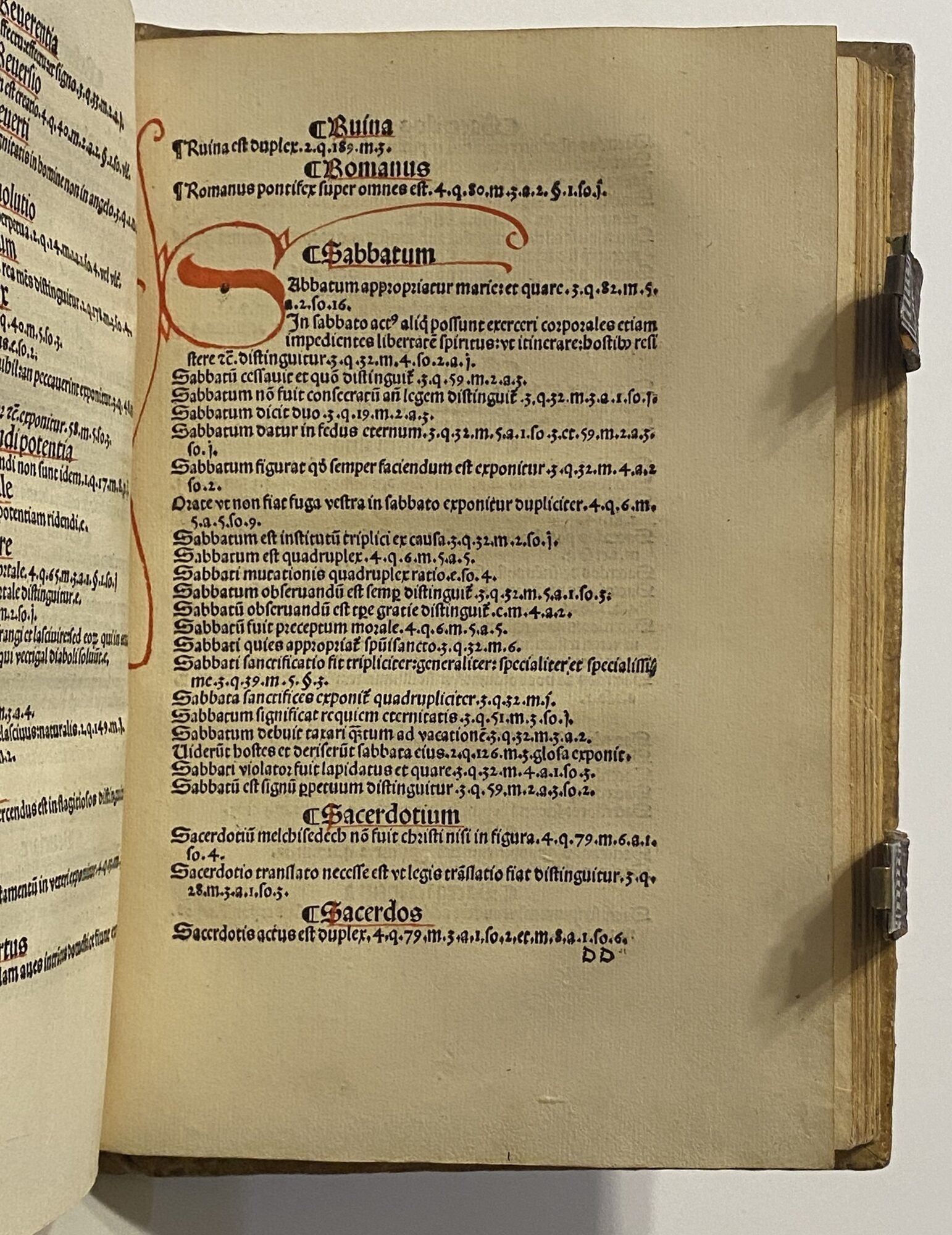
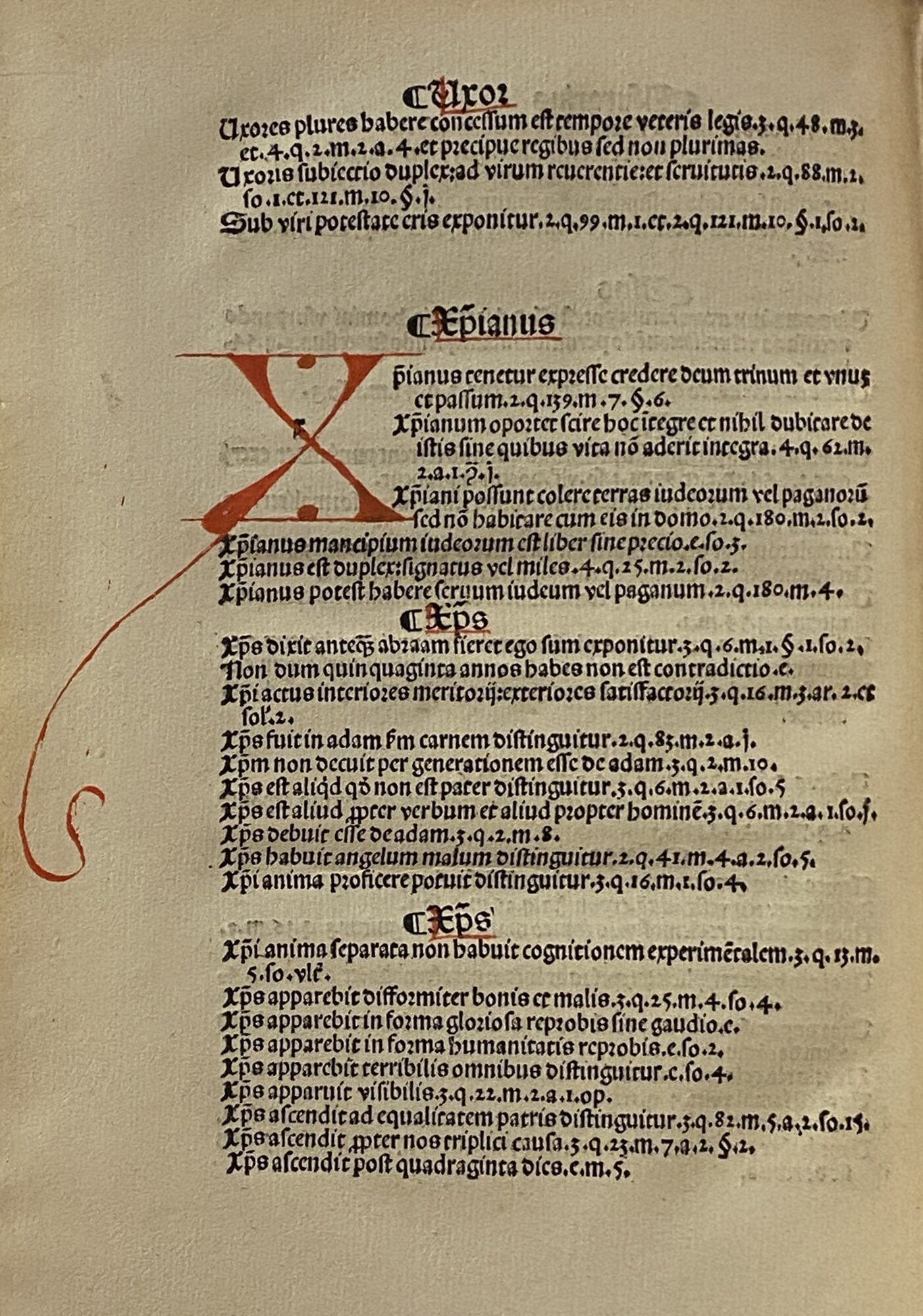
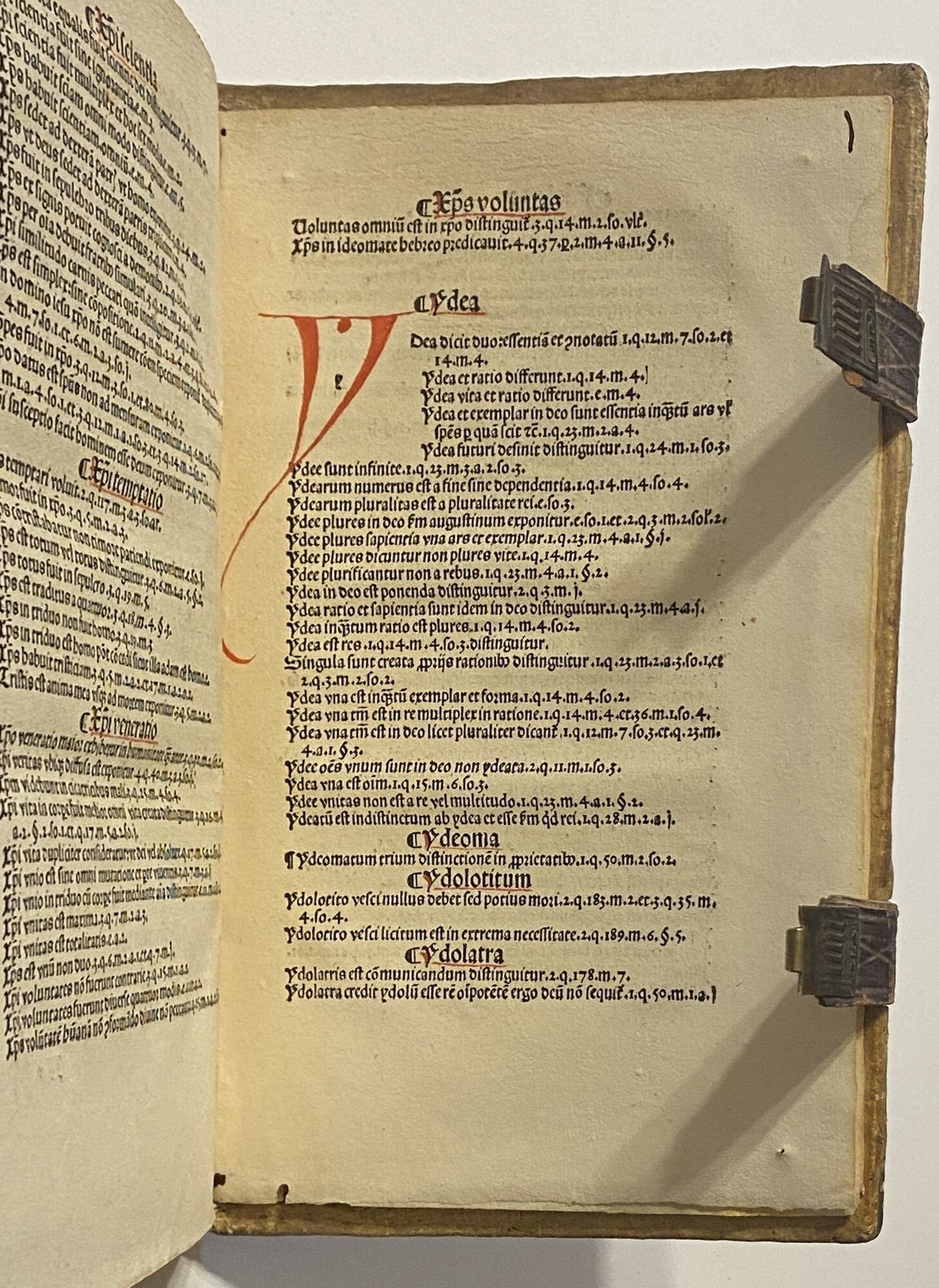
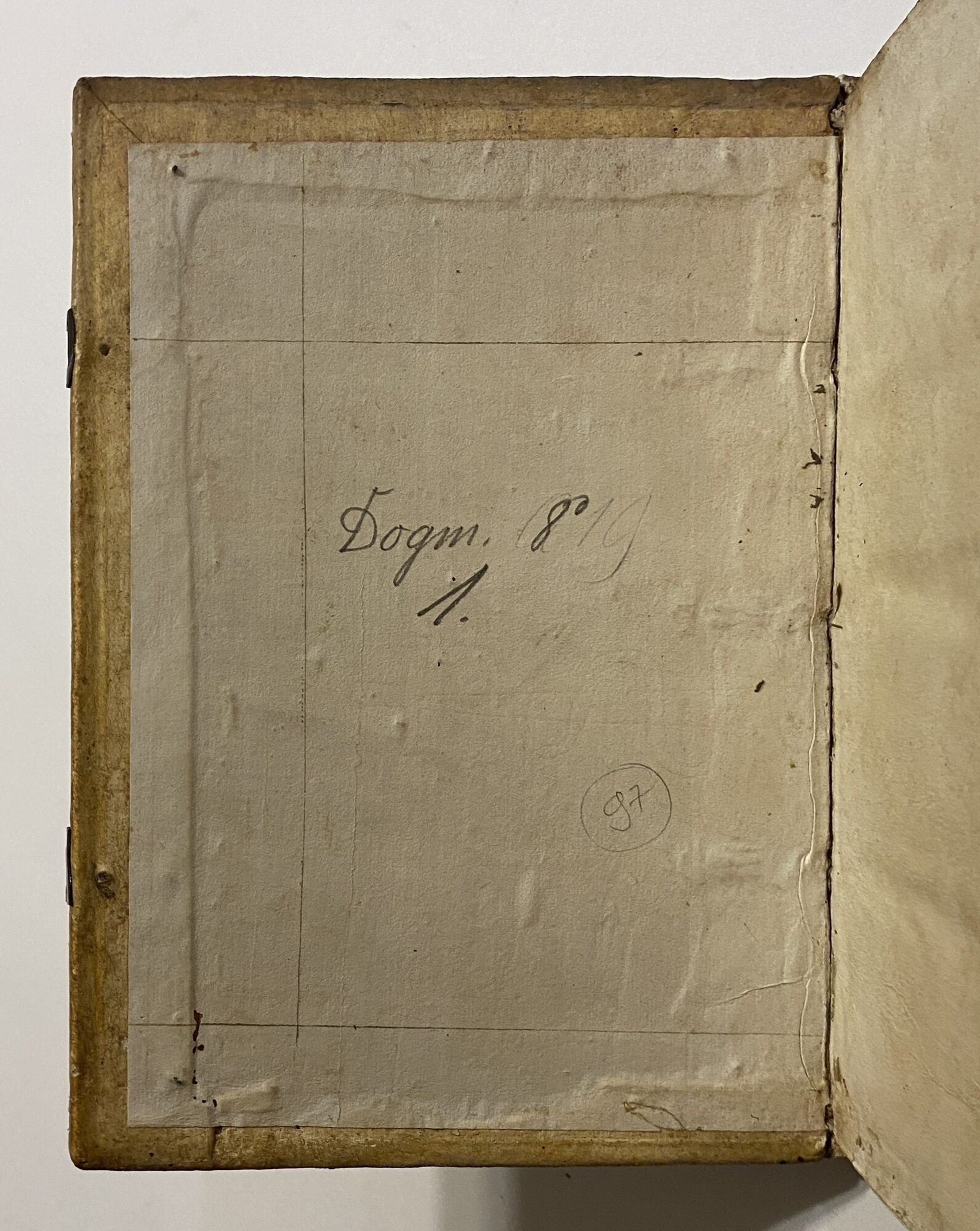
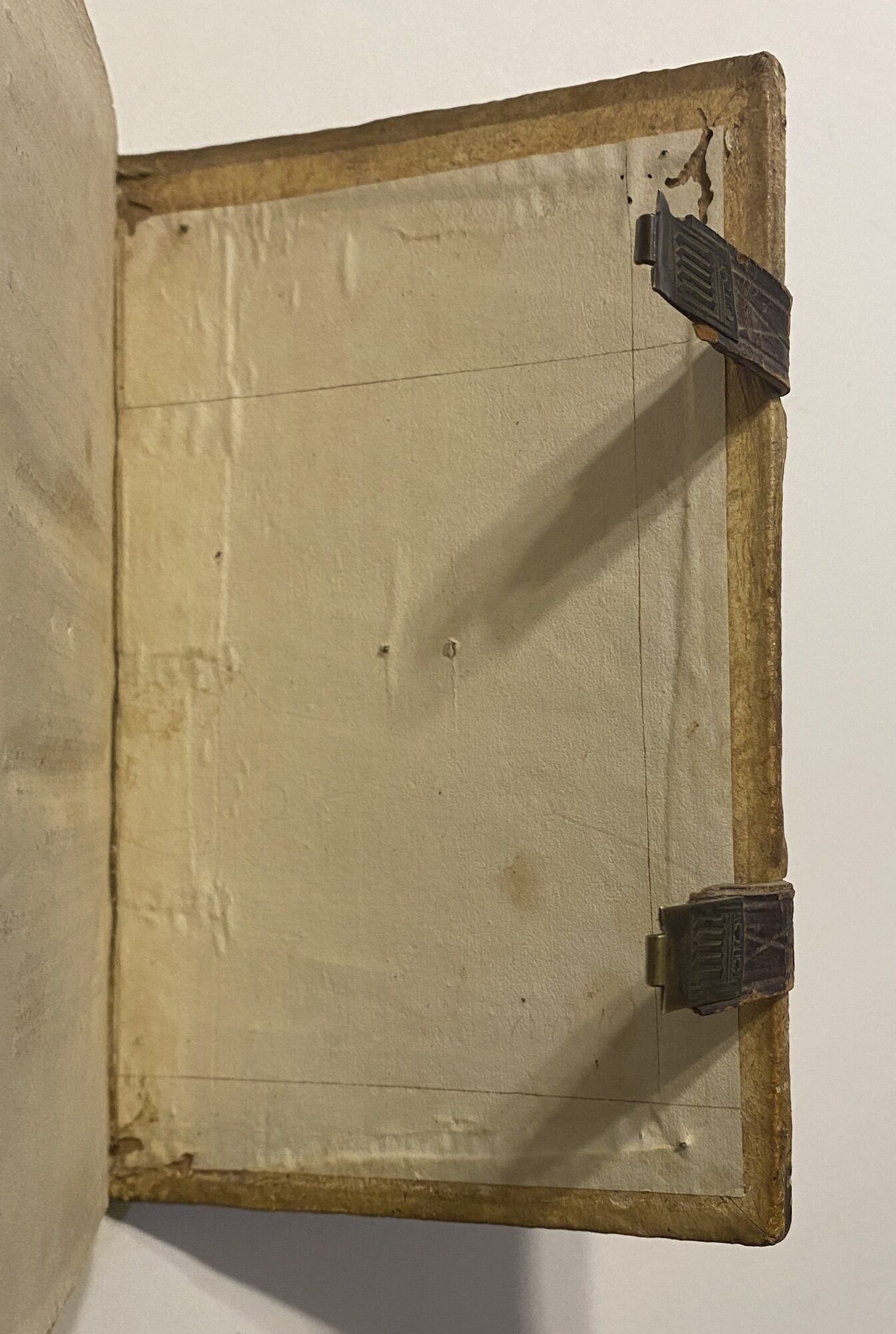
Basel: Nicolaus Kessler, 1502. Very good. 4to (235 x 160 mm). 260 ff., COMPLETE. Lovely flourished Lombard initials rubricated throughout (some quite large), headings rubricated and underlined (some insignificant thumbing to first leaves, slight marginal worming to last 8 ff., unimportant spotting here and there). Contemporary Bamberg blind-tooled pigskin binding over bevelled wooden boards (some wear), front cover with a large central panel-stamp modelled after a design by Master E.S. surrounded by stamps of Maria in banderolle, Kopfelstempel and finials, on the verso a large frame composed by multiple impressions of a four-petalled flower, likewise surrounded by the same tools, evidence of paper (?) label on the front cover, center- and cornerpieces no longer present. Structurally interesting: Vellum flyleaf at front wrapped serving also as quire guard around first gathering [pi]4 with assocated (conjugate) stub between [pi]4 and a1, vellum quire guard visible between between penultimate and final gathering. Finely written paper spine label (one small label missing), large painted "C" in lower compartment. Two working catches and clasps, pigskin straps covered with tooled leather. In excellent condition, highly suitable for exhibition and study. AN IMPORTANT DISCOVERY: AN UNRECORDED BAMBERG BINDING BEARING A PANEL STAMP WHICH - ACCORDING TO NONE OTHER THAN ERNST KYRISS - WAS INSPIRED BY A DESIGN BY "MASTER E.S.," A MEDIEVAL ARTIST OF SUPREME TALENT AND ORIGINALITY. MASTER E.S. REMAINS ONE OF THE MOST IMPORTANT ENGRAVERS OF THE LATE GOTHIC ERA, ALONGSIDE THE "MASTER OF THE PLAYING CARDS" AND MARTIN SCHONGAUER. ONLY TEN PANEL STAMPS BY THIS "FOLLOWER OF MASTER E.S." ARE KNOWN. OURS IS THE ONLY BINDING OF ITS KIND IN PRIVATE OWNERSHIP.
SINCE 1502, THE PROVENANCE OF THIS BEAUTIFUL POST-INCUNABLE HAS REMAINED UNBROKEN. IT AFFORDS MANY OPPORTUNITIES FOR RESEARCH IN MEDIEVAL ART HISTORY AND MEDIEVAL BOOK PRODUCTION.
¶ THE ARTIST:
Holm Bevers writes: "The Master E.S. (active from 1445/50 until 1467) may be called a key figure in the history of early printmaking, Chronologically placed between the Master of the Playing Cards (active from 1430 until 1450) and Martin Schongauer (1445/50-91), both like him working in the Upper Rhine region, he was the first to develop the syntax of line engraving with a systematic use of burin lines, cross-hatchings and small dots, which was perfected only some years later by Schongauer. A group of engravings with fine parallel hatchings that resemble the tonal effects of late Gothic metalpoint drawings are nearer to the prints by the Master of the Playing Cards and seem to be his earliest. Master E.S. thus may have begun his work around 1450. He was the first Northern engraver who put dates and initials on some of his plates: fourteen are dated 1466 or 1467, and eighteen (among which are the fourteen dated) bear the monogram E or ES in small letters or in capitals. Max Geisberg and Max Lehrs, the two pioneers in the research of early printmaking, collated the work of the artist. Today 318 prints are universally accepted by scholars. This vast oeuvre, only surpassed in size by that of Israhel van Meckenem [SEE BELOW], shows a remarkable diversity of subjects, both religious and secular. In spite of his great importance, the identity of the Master E.S. remains a mystery. All we know is that he must have worked in the Upper Rhine region, perhaps at Strasburg, its most influential and advanced artistic centre. The mystery is all the more remarkable because the Master E.S. may be called the first great exponent in the history of printmaking." (Bevers, Review of Markus Nass, Meister E.S.: Studien zu Werk und Wirkang, Frankfurt, 1994, in: Print Quarterly, vol. 13, no. 3 [September 1996] p. 316).
Of the complete works of Master E.S., 318 copper engravings attributed to him have survived to this day, to which have been added two drawings. Master E.S. signed 18 of these engravings with his initials; four with the date 1466; and ten with the date 1467. Art historians of the early twentieth century gave him the sobriquet "The Master of 1466."
Revisions and copies of his work were executed by his gifted successor Israhel von Meckenem the Younger (signed with his initials "I.M.") or that of Martin Schongauer ("M.S."). It has been deduced that Master E.S. may have created approximately 200 further engravings that are now lost. Master E.S. may have been influenced by the so-called Master of the Playing Cards, in addition to Rogier van der Weyden and Konrad Witz. Master E. S.'s compositions were also influenced by the models of illuminated manuscripts, although his graphic technique, into which he incorporated countless minute lines, was entirely new. Among the most famous works by Master E.S. are his Ars Moriendi series (based on an illuminated MS dating from 1430), his Large and Small Card Games, his amazing figurative Alphabets, and the so-called Templates for Goldsmiths.
Kurz explains that Master E.S. was apparently the first artist who produced engravings for the sole purpose of providing his less inventive fellow-artists with ideas, or "patterns," which they could copy. Even his playing cards seem to have been regarded by his contemporaries principally as a pattern-book, and only secondly as a pack of cards. "The later division between 'design' and actual execution, between 'invenit' and 'fecit,' goes ultimately back to him. His engravings, be they religious, secular, or ornamental, were copied innumerable times by painters, sculptors, book-illuminators, embroiderers, potters, and craftsmen in every imaginable medium ranging from mother-of-pearl to leather." SOURCE: Otto Kurz, "A Copy after the Master E. S. on a Jewish Bookbinding" in: Record of the Art Museum, Princeton University , 1965, Vol. 24, No. 1 (1965), pp. 3-11.
¶ IDENTIFICATION OF THE "MASTER E.S. PANEL STAMP" BY ERNST KYRISS:
Ernst Kyriss (1881-1974) was the foremost authority on Gothic and Renaissance bookbindings and it has been estimated that he personally examined more than 50,000 of them. Certainly his archive of more than 20,000 *sheets* of rubbings (now in the Stuttgart Landesbibliothek) is unsurpassable.
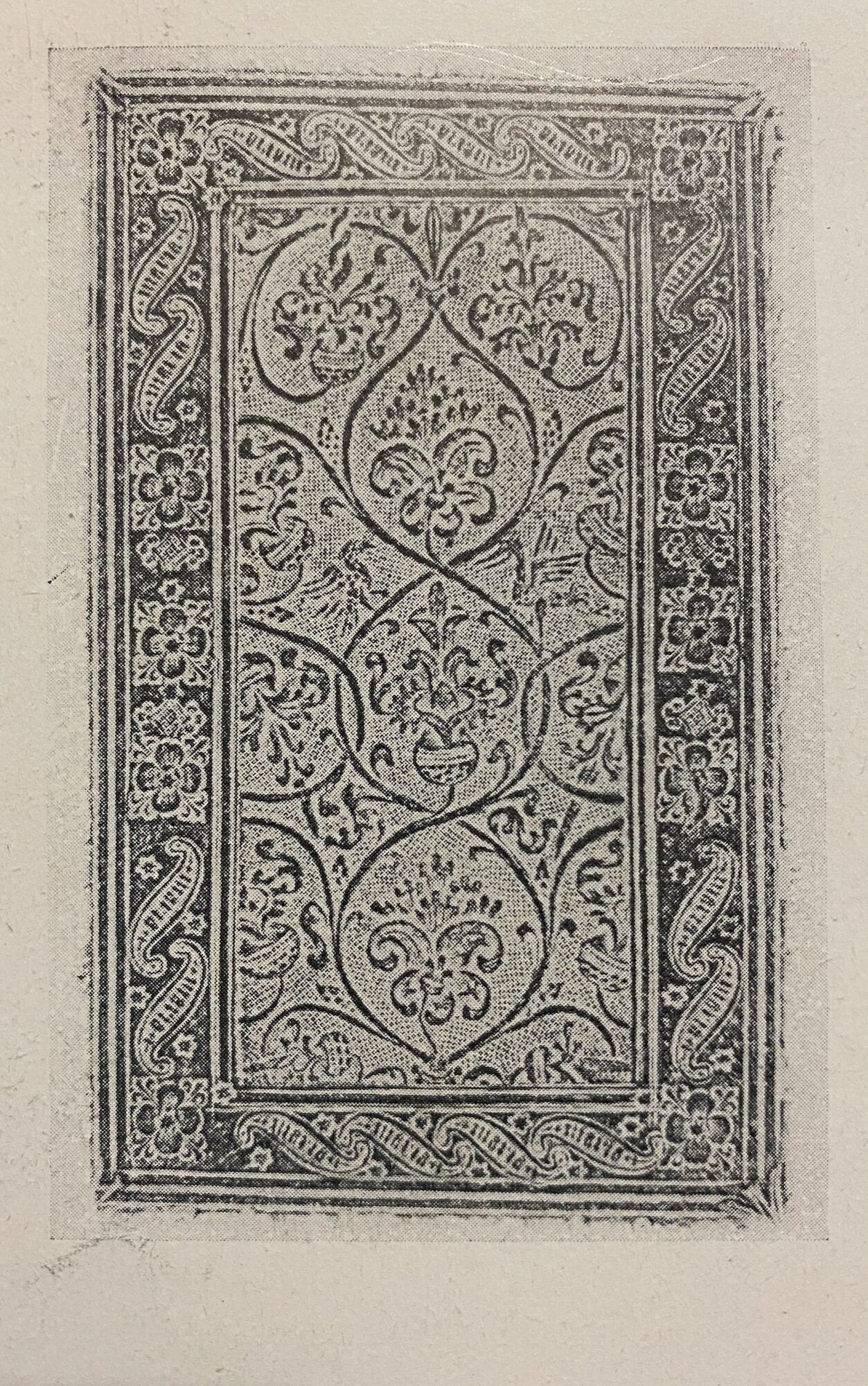
The panel stamp on the present binding is identical to Kyriss's Abb. 5 which appears in his penetrating but little known WWII article "Einbande des 15. Jahrhunderts mit Plattenstempeln nach Meister E.S." (in: Buch und Schrift, 1943, vol. 5/6, pp. 52-82, with 9 illustrations on 4 plates). In it, Kyriss identified ten late Gothic panel-stamps that were modeled after engravings by Master E.S. Five of these were designed in the Ulm workshop of Johannes Hagmayer, the other five in the monastery of the Bamberg Minorites. Of the Ulm group, Kyriss located just ten bindings with panel stamps by the Follower of Master E.S. (including the one at the Morgan Library for which see below). Of the Bamberg group, Kyriss located twelve such bindings, all in the Bamberg Staatsbibliothek, to which we add ours and one other that we just discovered at Harvard (see below).
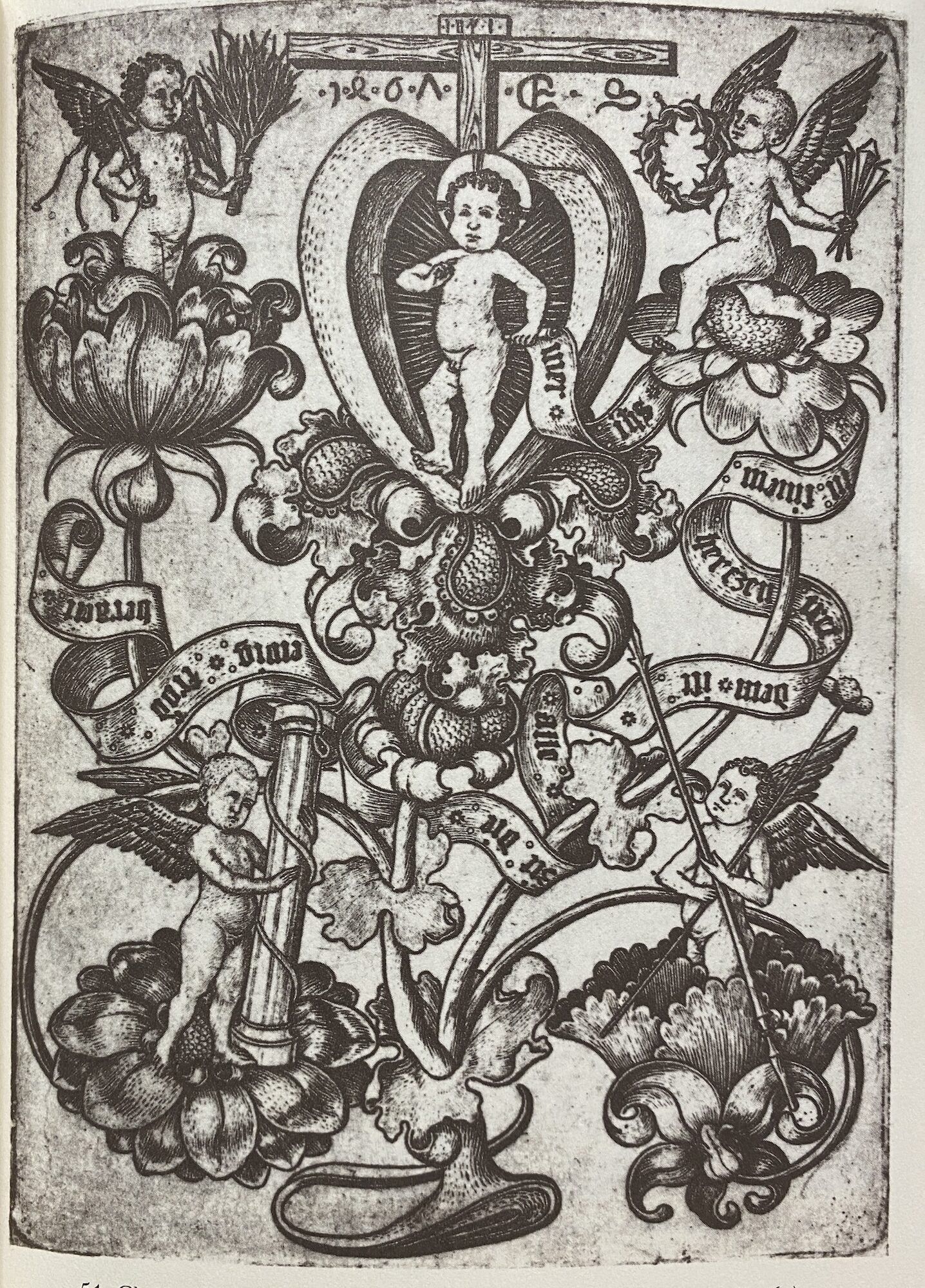
Our panel belongs to Kyriss Ulm Group no. 1 (see his pp. 72-73). Here Kyriss drew special attention the flowers within the pointed ovals of the panel stamp, claiming that they are "identical" to unmistakable flower in the lower right of the famous signed "Christkind im Herzen" engraving by Master E.S. (Lehrs 51), one of the few that is actually signed ("E.S.") and dated ("1467"). Kyriss goes so far as to state that the bespoke design on our panel was "transferred from the engraving." Of the five Bamberg Master E.S. panel stamps, ours is the only one with birds (there are two).
Kyriss (p. 81) emphasizes that "A flower from Bamberg Panel I [i.e. the present panel] is accurately reproduced from Master E.S.'s engraving 'Christkind im Herzen.' Of all the other flowers, however, only a few details were found in his Small Playing Cards and in a lost [Master E.S.] engraving preserved only in a re-engraving by Israhel van Meckenem."
On p. 63 Kyriss makes an important clarification, stating that although "direct transfers from the engravings of Master E.S. or his followers could not be demonstrated (unlike Plates I and II), it is likely that the preliminary drawings of the flowers go back to engravings that are no longer extant." Concerning the continuous spiral tendrils on the Bamberg panels, Kyriss (p. 57) again references the "Christkind im Herzen" engraving, as well as engravings by Israhel van Meckenem, Monogrammist AG, the Dutch "Monogrammist F. v. B.," and Martin Schongauer.
In addition to the Bamberg Follower of Master E.S. panel stamp reproduced by Kyriss, our binding is adorned with tools that were demonstrably used by the Bamberg Minorites, namely: Einbanddatenbank s005932 (finial), s005933 (Kopfelstempel), s005957 (Maria in banderolle) and s005960 (quatrefoil), the latter two tools being reproduced by Kyriss (Bamberg SB Inc.Q.XVIII.7).
Seven of the panel stamps designed by the Follower of Master E.S. (including ours) were effectively imitations of the cuir-cisele (cut-leather) bookbinding technique, here ingeniously accomplished by means of a single impression in a strong press, instead of laboring for hours (or days) at the bench. Cuir-cisele decoration is achieved by scoring dampened leather and then using a pointed tool to depress the area around it, bringing the design into relief against the textured background. The background may be described as a "inverted pointille" in which the dotting is not impressed but raised. It is very possible that Johannes Hagmayer of Ulm was the first to develop and employ this technology, followed shortly thereafter by the Bamberg Minorites. It is not without interest that at least a dozen "true" cuir-cisele bindings from the late 15th century are known to have been decorated after designs by Master E.S. (see Kurz, supra; Schmidt-Kunsemuller, Corpus der gotischen Lederschnitteinbande p. 290, reproduces 11 such bindings, and tentatively assigns four others to this group).
¶ EARLY RESEARCH ON PANEL STAMPS EXECUTED AFTER DESIGNS BY MASTER E.S.:
As stated above, the number of bookbindings with panel-stamps designed after the work by Master E.S. are extremely few, and yet their importance has been known to specialists for more than 135 years. The first published reference to the Follower of Master E.S. bindings was made in the 1889 Katalog der im germanischen Museum vorhandenen interessanten Bucheinbande (no. 15) which was accompanied by a large drawing (see Kyriss Ulm Group Panel-Stamp 2). A full-page photograph of a related Master E.S. panel-stamp was published by W.Y. Fletcher in his 1896 Catalogue of Foreign Bookbindings in the British Museum. Fletcher, following J. Weale's 1894 Bindings and Rubbings of Bindings in the Victoria and Albert Museum (Catalogue p. 242, no. 618) correctly named the binder as Johann Hagmeyer of Ulm, designed after an engraving by Master E.S.
¶ A SECOND NEWLY DISCOVERED BAMBERG BINDING WITH A "FOLLOWER OF MASTER E.S." PANEL STAMP:
In response to our inquiry about Bamberg Minorite bindings, Scott Husby consulted his "Bookbindings on Incunables in American Library Collections" database, and together we are able to bring to light another other example of the "Master E.S." panel stamp, namely on the 2-vol. Bonaventure [Strasbourg: Printer of the 1483 Jordanus de Quedlinburg (Georg Husner), 1495] in the Houghton Library at Harvard (GEN Inc 639 14.4 = Goff B-928 = Walsh 258; the panel stamp remained unidentified by him). Images of the covers of the Houghton example can be seen online https://iiif.lib.harvard.edu/manifests/view/drs:25585131$1i - notably, the Houghton binding is soiled; ours is not. It is not without interest that the Harvard example was in Boston at a very early date, as we learn from the following presentation inscription in it: "King's Chapel to Harv[ard] Univ: by F.W.P. Greenwood. 1835." As far as we have been able to determine, ours and the Harvard specimen are the only two Bamberg "Master E.S." bindings in America. It is possible that the Harvard example was once part of the collection of theological books given by William III to Boston's King's Chapel in 1698. Some, but by no means all, of the library of King's Chapel was given to the Boston Athenaeum, for which see Greenwood's own History of King's Chapel in Boston (Boston, 1833).
¶ CONCERNING ISHRAHEL VAN MECKENEM:
One wonders if the entire design of our panel panel stamp was copied from a now-lost engraving by Israhel van Meckenem, who worked was the first assistant to Master E.S. until the latter's death ca. 1468. Van Meckenem was born in Germany in the Lower Rhine around 1445. Following the death of Master E.S., ca. 1470, he actually resided in BAMBERG for about TEN YEARS, until ca. 1480, after which time he is found in Bocholt, in North Rhine-Westphalia on the Netherlandish border, where he lived until his death in 1503. Van Meckenem was the most prolific engraver of the 15th century, accounting for nearly ONE FIFTH of all print production in Northern Europe at this time. Most of the surviving works by him were copies of other prints. Indeed, van Meckenem acquired and reworked at least 41 of the metal plates engraved by Master E.S., and another 200 of van Meckenem's "own" prints were in fact copies of Master E.S. engravings.
The possibility that van Meckenem was in some way associated with the Master E.S. Bamberg panels was not lost on Ernst Kyriss. He wrote: "It is conceivable that [van Meckenem] had connections to the Franciscan monastery in Bamberg during his time there. Perhaps, however, these connections consisted only of the monks becoming acquainted with his graphic works. It is unlikely that the design of the plate originated with Meckenem, as it cannot be compared with his other works. Furthermore, the two bindings decorated with this [Bamberg Panel V] stamp enclose books from the late 15th and early 16th centuries, and were thus produced at least twenty-five years after Meckenem's presence in the city. The attribution [of this particular panel] to the Bamberg group is firmly established by the identical individual stamps used in the frame of the central field, which were found on all twelve books [of the Bamberg group]."
¶ THE TEXT:
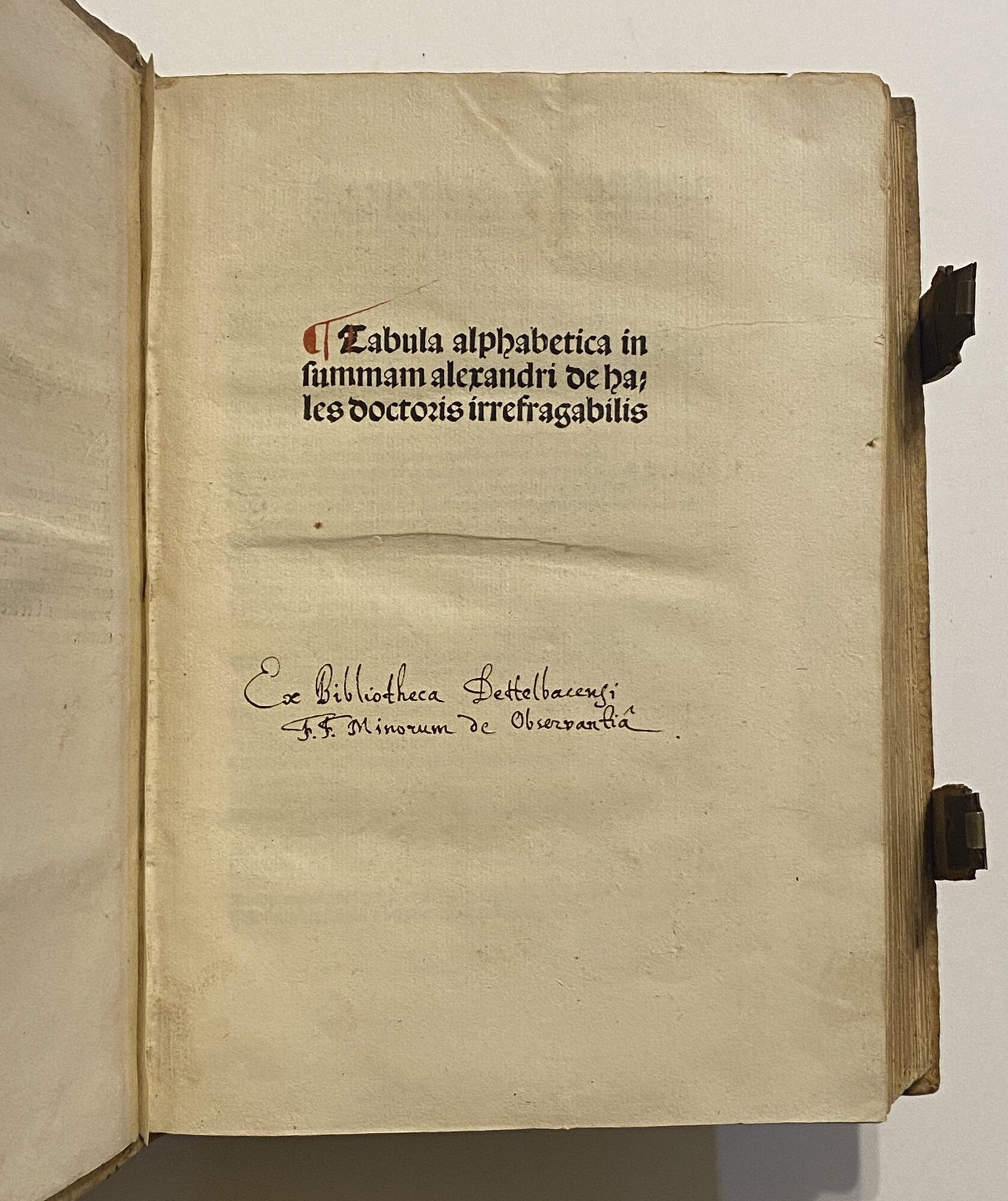
The "Clavis" is a subject index; our index pertains to Alexander of Hales's great "Summa." It was written by the Franciscan Petrus de Keschinger of Ingolstadt and contains a preface by the humanist Jakob Locher. The paper stock in our copy is clean and crisp, the rubricated alphabetical Lombard initials a joy to behold.
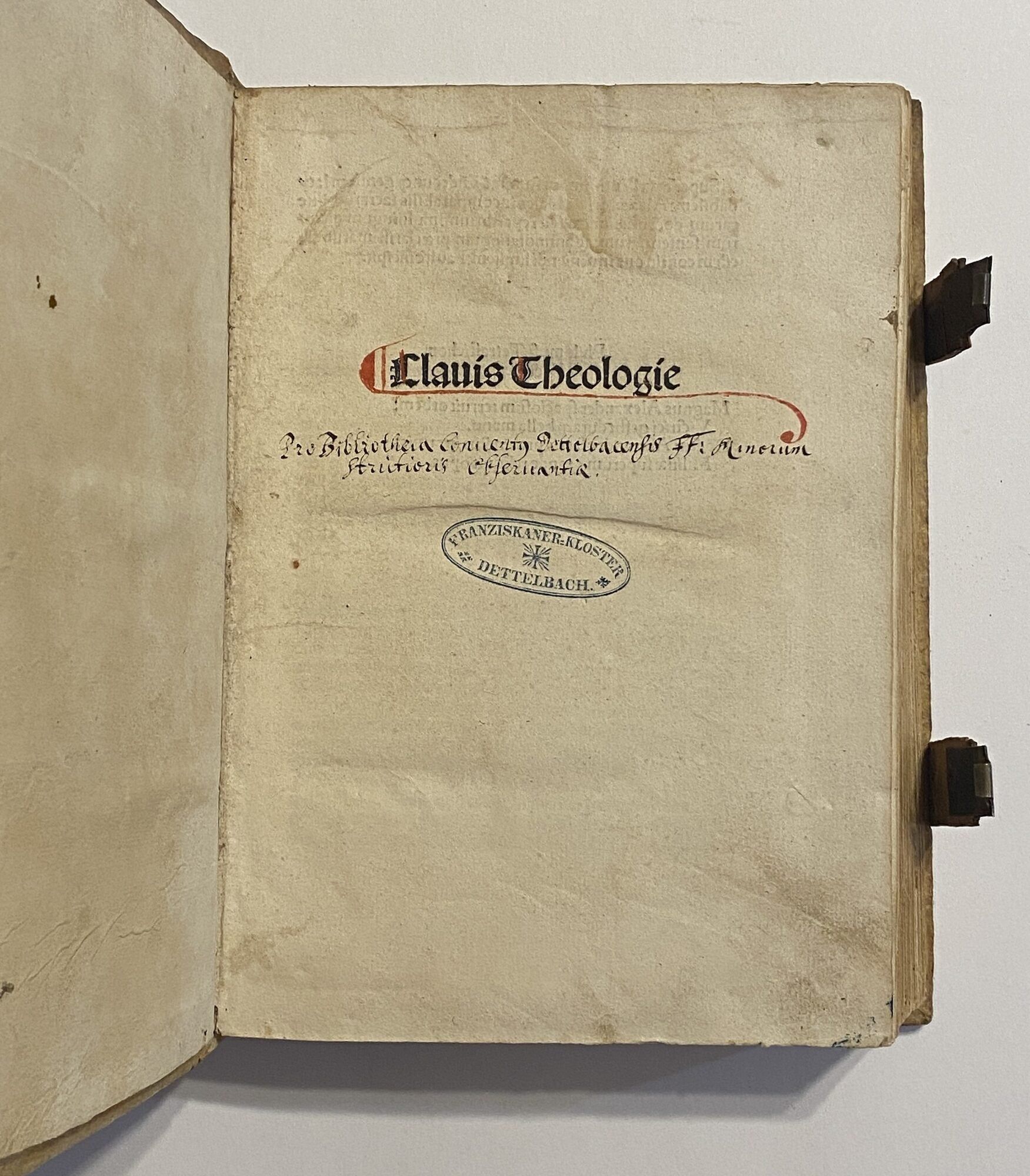
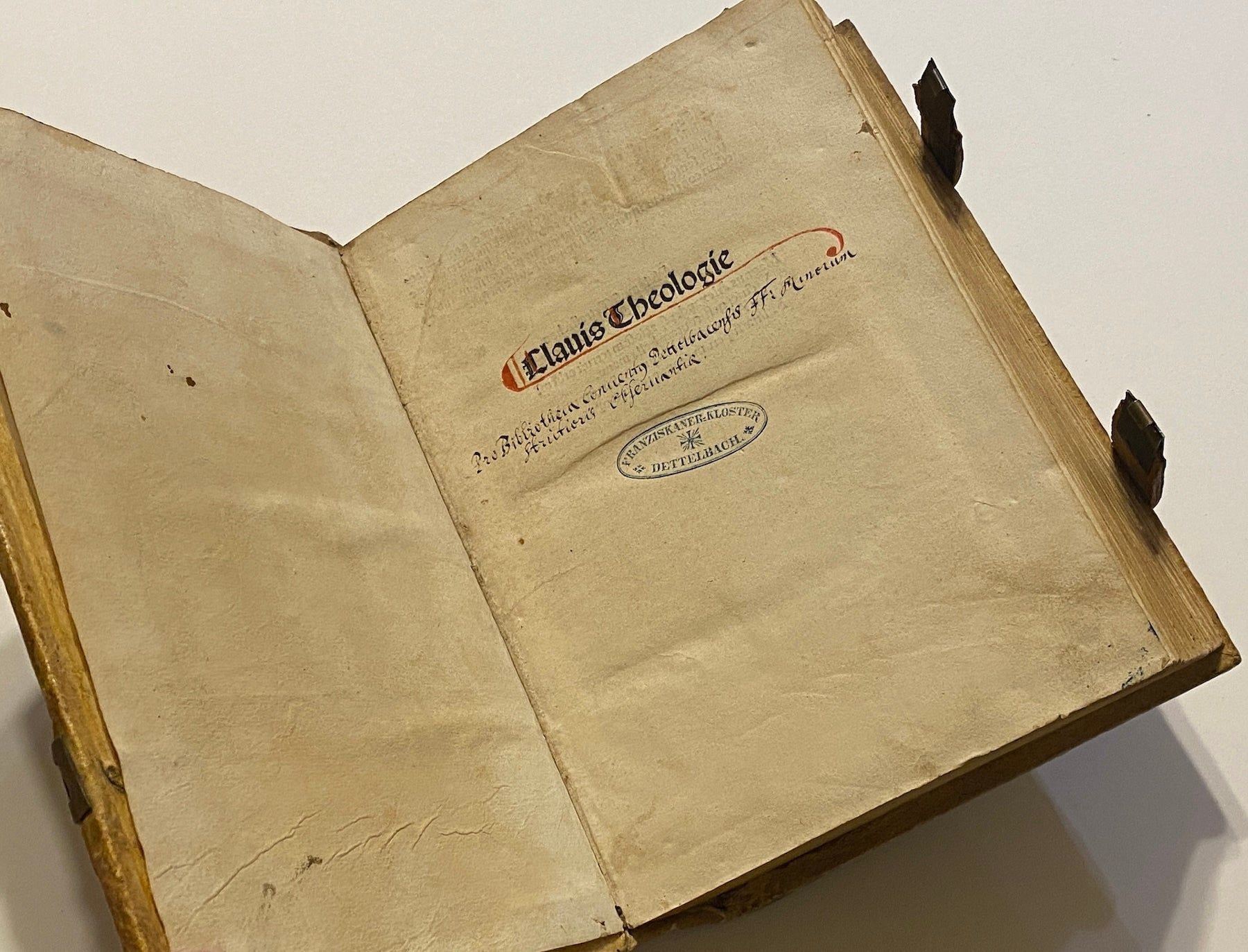
¶ PROVENANCE: Bamberg Franciscan monastery (binding). The widespread practice of sending books from one established monastery to help form the library of a newly established house is well known; presumably our volume was given by the Bamberg Franciscans to: --> the Dettelbach Franciscan monastery (manuscript inscription on title page: "Biblioteca Conventus Dettelbacensis F.F. Minorum strictioris observantiae" and the later ink stamp on title page: "Franziskaner-Kloster Dettelbach." The Bavarian monastery of the Dettelbach Franciscans was established in 1616 and was dissolved in 2017; by order of the Diocese of Wurzburg the building was sold (it is now the Akzent Hotel Franziskaner) and the library dispersed, likely through the agency of --> Bookfarm of Lobnitz, about 30 km north of Leipzig, to whom was sold by private treaty most of the vast Dettelbach monastic library and several other dissolved German monastic libraries. Sold through --> Reiss & Sohn Auction 200 (20 Oct. 2020) lot 97 (panel stamp not identified). Purchased by --> Maggs Bros. Ltd. Catalogue 1514: "Continental Books & Manuscripts 1400-1913" (2021) no. 15 (panel stamp not identified). Purchased in 2025 by --> Michael Laird Rare Books.
§ SELECTED LITERATURE: Max Lehrs, "Meister E. S." in: Geschichte und kritischer Katalog des deutschen, niederländischen und französischen Kupferstiches im 15. Jahrhundert. Band 2, Vienna, 1910 (318 designs identified). Max Geisberg, Die Kupferstiche des Meisters E. S. Cassirer, Berlin 1924 (320 designs identified). Kyriss, Verzierte gotische Einbande im alten Deutschen Sprachgebiet, no. 6 (text volume pp. 12-13). Konrad von Rabenau, Schwenke-Sammlung II (1996) p. 26 ("Minoriten ad annam") failed to note Kyriss's important article, as did the editors of the Einbanddatenbank. See also Paul Needham, Twelve Centuries of Bookbinding 400-1600, no. 23 (with further references).
CATALOGUER'S NOTE: We are most grateful to Bettina Wagner, Bibliotheksdirektorin, SB Bamberg, and Scott Husby for their kind efforts on our behalf.
SINCE 1502, THE PROVENANCE OF THIS BEAUTIFUL POST-INCUNABLE HAS REMAINED UNBROKEN. IT AFFORDS MANY OPPORTUNITIES FOR RESEARCH IN MEDIEVAL ART HISTORY AND MEDIEVAL BOOK PRODUCTION.
¶ THE ARTIST:
Holm Bevers writes: "The Master E.S. (active from 1445/50 until 1467) may be called a key figure in the history of early printmaking, Chronologically placed between the Master of the Playing Cards (active from 1430 until 1450) and Martin Schongauer (1445/50-91), both like him working in the Upper Rhine region, he was the first to develop the syntax of line engraving with a systematic use of burin lines, cross-hatchings and small dots, which was perfected only some years later by Schongauer. A group of engravings with fine parallel hatchings that resemble the tonal effects of late Gothic metalpoint drawings are nearer to the prints by the Master of the Playing Cards and seem to be his earliest. Master E.S. thus may have begun his work around 1450. He was the first Northern engraver who put dates and initials on some of his plates: fourteen are dated 1466 or 1467, and eighteen (among which are the fourteen dated) bear the monogram E or ES in small letters or in capitals. Max Geisberg and Max Lehrs, the two pioneers in the research of early printmaking, collated the work of the artist. Today 318 prints are universally accepted by scholars. This vast oeuvre, only surpassed in size by that of Israhel van Meckenem [SEE BELOW], shows a remarkable diversity of subjects, both religious and secular. In spite of his great importance, the identity of the Master E.S. remains a mystery. All we know is that he must have worked in the Upper Rhine region, perhaps at Strasburg, its most influential and advanced artistic centre. The mystery is all the more remarkable because the Master E.S. may be called the first great exponent in the history of printmaking." (Bevers, Review of Markus Nass, Meister E.S.: Studien zu Werk und Wirkang, Frankfurt, 1994, in: Print Quarterly, vol. 13, no. 3 [September 1996] p. 316).
Of the complete works of Master E.S., 318 copper engravings attributed to him have survived to this day, to which have been added two drawings. Master E.S. signed 18 of these engravings with his initials; four with the date 1466; and ten with the date 1467. Art historians of the early twentieth century gave him the sobriquet "The Master of 1466."
Revisions and copies of his work were executed by his gifted successor Israhel von Meckenem the Younger (signed with his initials "I.M.") or that of Martin Schongauer ("M.S."). It has been deduced that Master E.S. may have created approximately 200 further engravings that are now lost. Master E.S. may have been influenced by the so-called Master of the Playing Cards, in addition to Rogier van der Weyden and Konrad Witz. Master E. S.'s compositions were also influenced by the models of illuminated manuscripts, although his graphic technique, into which he incorporated countless minute lines, was entirely new. Among the most famous works by Master E.S. are his Ars Moriendi series (based on an illuminated MS dating from 1430), his Large and Small Card Games, his amazing figurative Alphabets, and the so-called Templates for Goldsmiths.
Kurz explains that Master E.S. was apparently the first artist who produced engravings for the sole purpose of providing his less inventive fellow-artists with ideas, or "patterns," which they could copy. Even his playing cards seem to have been regarded by his contemporaries principally as a pattern-book, and only secondly as a pack of cards. "The later division between 'design' and actual execution, between 'invenit' and 'fecit,' goes ultimately back to him. His engravings, be they religious, secular, or ornamental, were copied innumerable times by painters, sculptors, book-illuminators, embroiderers, potters, and craftsmen in every imaginable medium ranging from mother-of-pearl to leather." SOURCE: Otto Kurz, "A Copy after the Master E. S. on a Jewish Bookbinding" in: Record of the Art Museum, Princeton University , 1965, Vol. 24, No. 1 (1965), pp. 3-11.
¶ IDENTIFICATION OF THE "MASTER E.S. PANEL STAMP" BY ERNST KYRISS:
Ernst Kyriss (1881-1974) was the foremost authority on Gothic and Renaissance bookbindings and it has been estimated that he personally examined more than 50,000 of them. Certainly his archive of more than 20,000 *sheets* of rubbings (now in the Stuttgart Landesbibliothek) is unsurpassable.
The panel stamp on the present binding is identical to Kyriss's Abb. 5 which appears in his penetrating but little known WWII article "Einbande des 15. Jahrhunderts mit Plattenstempeln nach Meister E.S." (in: Buch und Schrift, 1943, vol. 5/6, pp. 52-82, with 9 illustrations on 4 plates). In it, Kyriss identified ten late Gothic panel-stamps that were modeled after engravings by Master E.S. Five of these were designed in the Ulm workshop of Johannes Hagmayer, the other five in the monastery of the Bamberg Minorites. Of the Ulm group, Kyriss located just ten bindings with panel stamps by the Follower of Master E.S. (including the one at the Morgan Library for which see below). Of the Bamberg group, Kyriss located twelve such bindings, all in the Bamberg Staatsbibliothek, to which we add ours and one other that we just discovered at Harvard (see below).
Our panel belongs to Kyriss Ulm Group no. 1 (see his pp. 72-73). Here Kyriss drew special attention the flowers within the pointed ovals of the panel stamp, claiming that they are "identical" to unmistakable flower in the lower right of the famous signed "Christkind im Herzen" engraving by Master E.S. (Lehrs 51), one of the few that is actually signed ("E.S.") and dated ("1467"). Kyriss goes so far as to state that the bespoke design on our panel was "transferred from the engraving." Of the five Bamberg Master E.S. panel stamps, ours is the only one with birds (there are two).
Kyriss (p. 81) emphasizes that "A flower from Bamberg Panel I [i.e. the present panel] is accurately reproduced from Master E.S.'s engraving 'Christkind im Herzen.' Of all the other flowers, however, only a few details were found in his Small Playing Cards and in a lost [Master E.S.] engraving preserved only in a re-engraving by Israhel van Meckenem."
On p. 63 Kyriss makes an important clarification, stating that although "direct transfers from the engravings of Master E.S. or his followers could not be demonstrated (unlike Plates I and II), it is likely that the preliminary drawings of the flowers go back to engravings that are no longer extant." Concerning the continuous spiral tendrils on the Bamberg panels, Kyriss (p. 57) again references the "Christkind im Herzen" engraving, as well as engravings by Israhel van Meckenem, Monogrammist AG, the Dutch "Monogrammist F. v. B.," and Martin Schongauer.
In addition to the Bamberg Follower of Master E.S. panel stamp reproduced by Kyriss, our binding is adorned with tools that were demonstrably used by the Bamberg Minorites, namely: Einbanddatenbank s005932 (finial), s005933 (Kopfelstempel), s005957 (Maria in banderolle) and s005960 (quatrefoil), the latter two tools being reproduced by Kyriss (Bamberg SB Inc.Q.XVIII.7).
Seven of the panel stamps designed by the Follower of Master E.S. (including ours) were effectively imitations of the cuir-cisele (cut-leather) bookbinding technique, here ingeniously accomplished by means of a single impression in a strong press, instead of laboring for hours (or days) at the bench. Cuir-cisele decoration is achieved by scoring dampened leather and then using a pointed tool to depress the area around it, bringing the design into relief against the textured background. The background may be described as a "inverted pointille" in which the dotting is not impressed but raised. It is very possible that Johannes Hagmayer of Ulm was the first to develop and employ this technology, followed shortly thereafter by the Bamberg Minorites. It is not without interest that at least a dozen "true" cuir-cisele bindings from the late 15th century are known to have been decorated after designs by Master E.S. (see Kurz, supra; Schmidt-Kunsemuller, Corpus der gotischen Lederschnitteinbande p. 290, reproduces 11 such bindings, and tentatively assigns four others to this group).
¶ EARLY RESEARCH ON PANEL STAMPS EXECUTED AFTER DESIGNS BY MASTER E.S.:
As stated above, the number of bookbindings with panel-stamps designed after the work by Master E.S. are extremely few, and yet their importance has been known to specialists for more than 135 years. The first published reference to the Follower of Master E.S. bindings was made in the 1889 Katalog der im germanischen Museum vorhandenen interessanten Bucheinbande (no. 15) which was accompanied by a large drawing (see Kyriss Ulm Group Panel-Stamp 2). A full-page photograph of a related Master E.S. panel-stamp was published by W.Y. Fletcher in his 1896 Catalogue of Foreign Bookbindings in the British Museum. Fletcher, following J. Weale's 1894 Bindings and Rubbings of Bindings in the Victoria and Albert Museum (Catalogue p. 242, no. 618) correctly named the binder as Johann Hagmeyer of Ulm, designed after an engraving by Master E.S.
¶ A SECOND NEWLY DISCOVERED BAMBERG BINDING WITH A "FOLLOWER OF MASTER E.S." PANEL STAMP:
In response to our inquiry about Bamberg Minorite bindings, Scott Husby consulted his "Bookbindings on Incunables in American Library Collections" database, and together we are able to bring to light another other example of the "Master E.S." panel stamp, namely on the 2-vol. Bonaventure [Strasbourg: Printer of the 1483 Jordanus de Quedlinburg (Georg Husner), 1495] in the Houghton Library at Harvard (GEN Inc 639 14.4 = Goff B-928 = Walsh 258; the panel stamp remained unidentified by him). Images of the covers of the Houghton example can be seen online https://iiif.lib.harvard.edu/manifests/view/drs:25585131$1i - notably, the Houghton binding is soiled; ours is not. It is not without interest that the Harvard example was in Boston at a very early date, as we learn from the following presentation inscription in it: "King's Chapel to Harv[ard] Univ: by F.W.P. Greenwood. 1835." As far as we have been able to determine, ours and the Harvard specimen are the only two Bamberg "Master E.S." bindings in America. It is possible that the Harvard example was once part of the collection of theological books given by William III to Boston's King's Chapel in 1698. Some, but by no means all, of the library of King's Chapel was given to the Boston Athenaeum, for which see Greenwood's own History of King's Chapel in Boston (Boston, 1833).
¶ CONCERNING ISHRAHEL VAN MECKENEM:
One wonders if the entire design of our panel panel stamp was copied from a now-lost engraving by Israhel van Meckenem, who worked was the first assistant to Master E.S. until the latter's death ca. 1468. Van Meckenem was born in Germany in the Lower Rhine around 1445. Following the death of Master E.S., ca. 1470, he actually resided in BAMBERG for about TEN YEARS, until ca. 1480, after which time he is found in Bocholt, in North Rhine-Westphalia on the Netherlandish border, where he lived until his death in 1503. Van Meckenem was the most prolific engraver of the 15th century, accounting for nearly ONE FIFTH of all print production in Northern Europe at this time. Most of the surviving works by him were copies of other prints. Indeed, van Meckenem acquired and reworked at least 41 of the metal plates engraved by Master E.S., and another 200 of van Meckenem's "own" prints were in fact copies of Master E.S. engravings.
The possibility that van Meckenem was in some way associated with the Master E.S. Bamberg panels was not lost on Ernst Kyriss. He wrote: "It is conceivable that [van Meckenem] had connections to the Franciscan monastery in Bamberg during his time there. Perhaps, however, these connections consisted only of the monks becoming acquainted with his graphic works. It is unlikely that the design of the plate originated with Meckenem, as it cannot be compared with his other works. Furthermore, the two bindings decorated with this [Bamberg Panel V] stamp enclose books from the late 15th and early 16th centuries, and were thus produced at least twenty-five years after Meckenem's presence in the city. The attribution [of this particular panel] to the Bamberg group is firmly established by the identical individual stamps used in the frame of the central field, which were found on all twelve books [of the Bamberg group]."
¶ THE TEXT:
The "Clavis" is a subject index; our index pertains to Alexander of Hales's great "Summa." It was written by the Franciscan Petrus de Keschinger of Ingolstadt and contains a preface by the humanist Jakob Locher. The paper stock in our copy is clean and crisp, the rubricated alphabetical Lombard initials a joy to behold.
¶ PROVENANCE: Bamberg Franciscan monastery (binding). The widespread practice of sending books from one established monastery to help form the library of a newly established house is well known; presumably our volume was given by the Bamberg Franciscans to: --> the Dettelbach Franciscan monastery (manuscript inscription on title page: "Biblioteca Conventus Dettelbacensis F.F. Minorum strictioris observantiae" and the later ink stamp on title page: "Franziskaner-Kloster Dettelbach." The Bavarian monastery of the Dettelbach Franciscans was established in 1616 and was dissolved in 2017; by order of the Diocese of Wurzburg the building was sold (it is now the Akzent Hotel Franziskaner) and the library dispersed, likely through the agency of --> Bookfarm of Lobnitz, about 30 km north of Leipzig, to whom was sold by private treaty most of the vast Dettelbach monastic library and several other dissolved German monastic libraries. Sold through --> Reiss & Sohn Auction 200 (20 Oct. 2020) lot 97 (panel stamp not identified). Purchased by --> Maggs Bros. Ltd. Catalogue 1514: "Continental Books & Manuscripts 1400-1913" (2021) no. 15 (panel stamp not identified). Purchased in 2025 by --> Michael Laird Rare Books.
§ SELECTED LITERATURE: Max Lehrs, "Meister E. S." in: Geschichte und kritischer Katalog des deutschen, niederländischen und französischen Kupferstiches im 15. Jahrhundert. Band 2, Vienna, 1910 (318 designs identified). Max Geisberg, Die Kupferstiche des Meisters E. S. Cassirer, Berlin 1924 (320 designs identified). Kyriss, Verzierte gotische Einbande im alten Deutschen Sprachgebiet, no. 6 (text volume pp. 12-13). Konrad von Rabenau, Schwenke-Sammlung II (1996) p. 26 ("Minoriten ad annam") failed to note Kyriss's important article, as did the editors of the Einbanddatenbank. See also Paul Needham, Twelve Centuries of Bookbinding 400-1600, no. 23 (with further references).
CATALOGUER'S NOTE: We are most grateful to Bettina Wagner, Bibliotheksdirektorin, SB Bamberg, and Scott Husby for their kind efforts on our behalf.
Details
Title
[POST-INCUNABLE / MASTER E.S.] Clavis theologiae sive repertorium [...] in summam doctoris irrefragabilis Alexander de Hales
Author
Keschinger, Petrus de
Condition
Very Good
Publisher
Nicolaus Kessler: Basel
Date
1502