

Portrait of Michelangelo Buonarroti
- Hardcover
- No place: no printer, no date, after, 1564
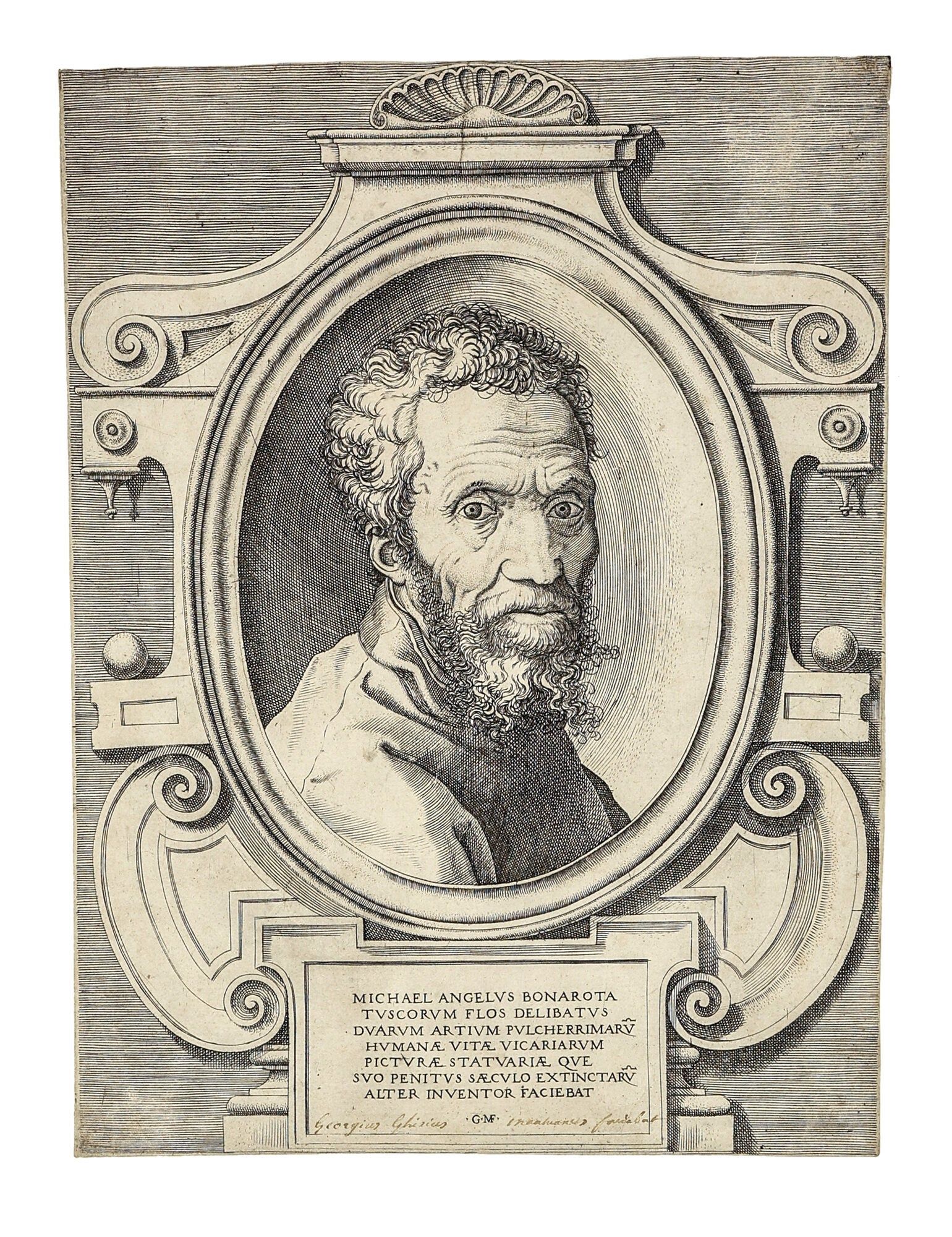
No place: no printer, no date, after, 1564. SOLE STATE. Hardcover. Fine. Watermark unidentified (partly obscured by the image). A good impression, trimmed just within the image, “Georgius Mantovanus Fecit” lightly written in ink next to Ghisi’s monogram. Verso soiled, early crease visible on verso only. With stippling still visible in the face but no visible ruling in the inscription. Early impressions are rich with sharp contrasts, much stippling on the face, and ruled guidelines for the letters of the inscription below. In late impressions, the stippling has disappeared and the ruled lines are no longer visible. While partly obscured, the watermark does not correspond to any of the three described and illustrated by Boorsch et al., p. 139. In the tablet beneath the portrait:
"MICHAEL ANGELVS BONAROTA/ TVSCORVM FLOS DELIBATVS/ DVARVM ARTIVM PVLCHERRIMARV[M]/ HVMANAE VITAE VICARIARVM/PICTVRAE STATVARIAE QVE/ SVO PENITVS SAECVLO EXTINCTARV[M] / ALTER INVENTOR FACIEBAT"
Trans. “Michelangelo Buonarroti, the picked flower of the Tuscans in the two most beautiful imitative arts of human life, painting and sculpture, which perished altogether with his age. Another artist made it).” Below this is Ghisi’s monogram G[eorgius].M[antovanus].F[ecit].
“Only a few actual portraits were made of the great sculptor, painter, and architect Michelangelo (1475-1564). Ghisi's engraving is based on Marcello Venusti's version of a portrait painted by Jacopino del Conte. Both the original painting (now in Casa Buonarroti, Florence) and Venusti's version of it (Capitoline Museum, Rome) were made about 1545.
“Ghisi's print shows Michelangelo at about seventy, when the paintings of the Sistine Ceiling were more than thirty years behind him. He had recently finished The Last Judgment, and he had accepted, at the insistence of Pope Paul III, the post of chief architect of St. Peter's. How Ghisi saw Venusti's portrait, or a drawing after it, is unknown, but as Venusti had strong ties with Mantua and as Ghisi had probably used a drawing by Venusti for his engraving of The Last Judgment, we can assume that there was an avenue of communication between the two artists. The ornamental frame in the print may well reproduce the one that held the painting.
“Because the Rossi in the seventeenth century and then later the Calcografia Nazionale issued impressions from this plate with impressions from The Last Judgment, d' Arco and subsequent Italian writers up to Massari have stated that the portrait is the frontispiece for The Last Judgment. Furthermore, Pittaluga, Rotili, and Perina say that both the portrait and The Last Judgment were made in 1556.
“The Last Judgment, however, is certainly earlier, and the inscription on the plate of the Portrait seems to indicate that Michelangelo was dead when the engraving was made. His death occurred on February 18, 1564. Further, the style of this engraving supports the hypothesis that it was made in the mid-156os; certainly, Ghisi's technique and style here are far more developed than in The Last Judgment. Finally, the watermarks show that the paper on which the earliest impressions were printed was made in the north. In fact, early impressions have the same watermarks as are found on early impressions of the engravings based on the ceiling paintings by Primaticcio. Like the plates for those engravings, the plate for the Portrait of Michelangelo traveled to Italy, and later impressions were printed on Italian paper. The plate itself never received a publisher's address, although it is clear it was in the hands of the Rossi family before it passed to the Calcografia Nazionale.”(Boorsch, Lewis, and Lewis, The Engravings of Giorgio Ghisi, no. 39, p. 139-141).
"MICHAEL ANGELVS BONAROTA/ TVSCORVM FLOS DELIBATVS/ DVARVM ARTIVM PVLCHERRIMARV[M]/ HVMANAE VITAE VICARIARVM/PICTVRAE STATVARIAE QVE/ SVO PENITVS SAECVLO EXTINCTARV[M] / ALTER INVENTOR FACIEBAT"
Trans. “Michelangelo Buonarroti, the picked flower of the Tuscans in the two most beautiful imitative arts of human life, painting and sculpture, which perished altogether with his age. Another artist made it).” Below this is Ghisi’s monogram G[eorgius].M[antovanus].F[ecit].
“Only a few actual portraits were made of the great sculptor, painter, and architect Michelangelo (1475-1564). Ghisi's engraving is based on Marcello Venusti's version of a portrait painted by Jacopino del Conte. Both the original painting (now in Casa Buonarroti, Florence) and Venusti's version of it (Capitoline Museum, Rome) were made about 1545.
“Ghisi's print shows Michelangelo at about seventy, when the paintings of the Sistine Ceiling were more than thirty years behind him. He had recently finished The Last Judgment, and he had accepted, at the insistence of Pope Paul III, the post of chief architect of St. Peter's. How Ghisi saw Venusti's portrait, or a drawing after it, is unknown, but as Venusti had strong ties with Mantua and as Ghisi had probably used a drawing by Venusti for his engraving of The Last Judgment, we can assume that there was an avenue of communication between the two artists. The ornamental frame in the print may well reproduce the one that held the painting.
“Because the Rossi in the seventeenth century and then later the Calcografia Nazionale issued impressions from this plate with impressions from The Last Judgment, d' Arco and subsequent Italian writers up to Massari have stated that the portrait is the frontispiece for The Last Judgment. Furthermore, Pittaluga, Rotili, and Perina say that both the portrait and The Last Judgment were made in 1556.
“The Last Judgment, however, is certainly earlier, and the inscription on the plate of the Portrait seems to indicate that Michelangelo was dead when the engraving was made. His death occurred on February 18, 1564. Further, the style of this engraving supports the hypothesis that it was made in the mid-156os; certainly, Ghisi's technique and style here are far more developed than in The Last Judgment. Finally, the watermarks show that the paper on which the earliest impressions were printed was made in the north. In fact, early impressions have the same watermarks as are found on early impressions of the engravings based on the ceiling paintings by Primaticcio. Like the plates for those engravings, the plate for the Portrait of Michelangelo traveled to Italy, and later impressions were printed on Italian paper. The plate itself never received a publisher's address, although it is clear it was in the hands of the Rossi family before it passed to the Calcografia Nazionale.”(Boorsch, Lewis, and Lewis, The Engravings of Giorgio Ghisi, no. 39, p. 139-141).
Details
Title
Portrait of Michelangelo Buonarroti
Author
MICHELANGELO. Ghisi, Giorgio (1520-1582), after Marcello Venusti (ca. 1512-1579)
Binding
Hardcover
Condition
Fine
Publisher
no printer, no date, after: No place
Date
1564
Edition
SOLE STATE