

Antibarbarorum ... liber unus
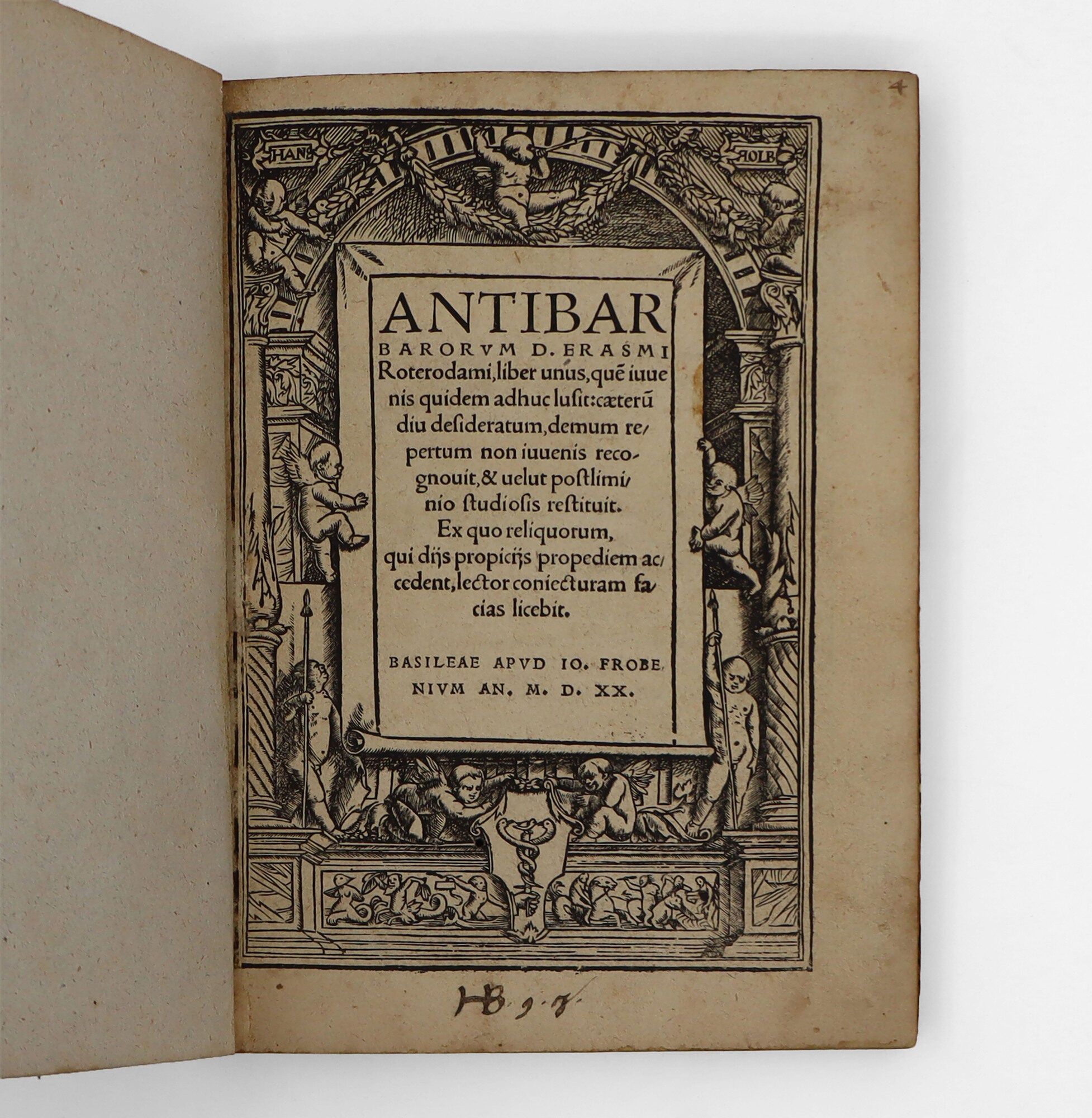
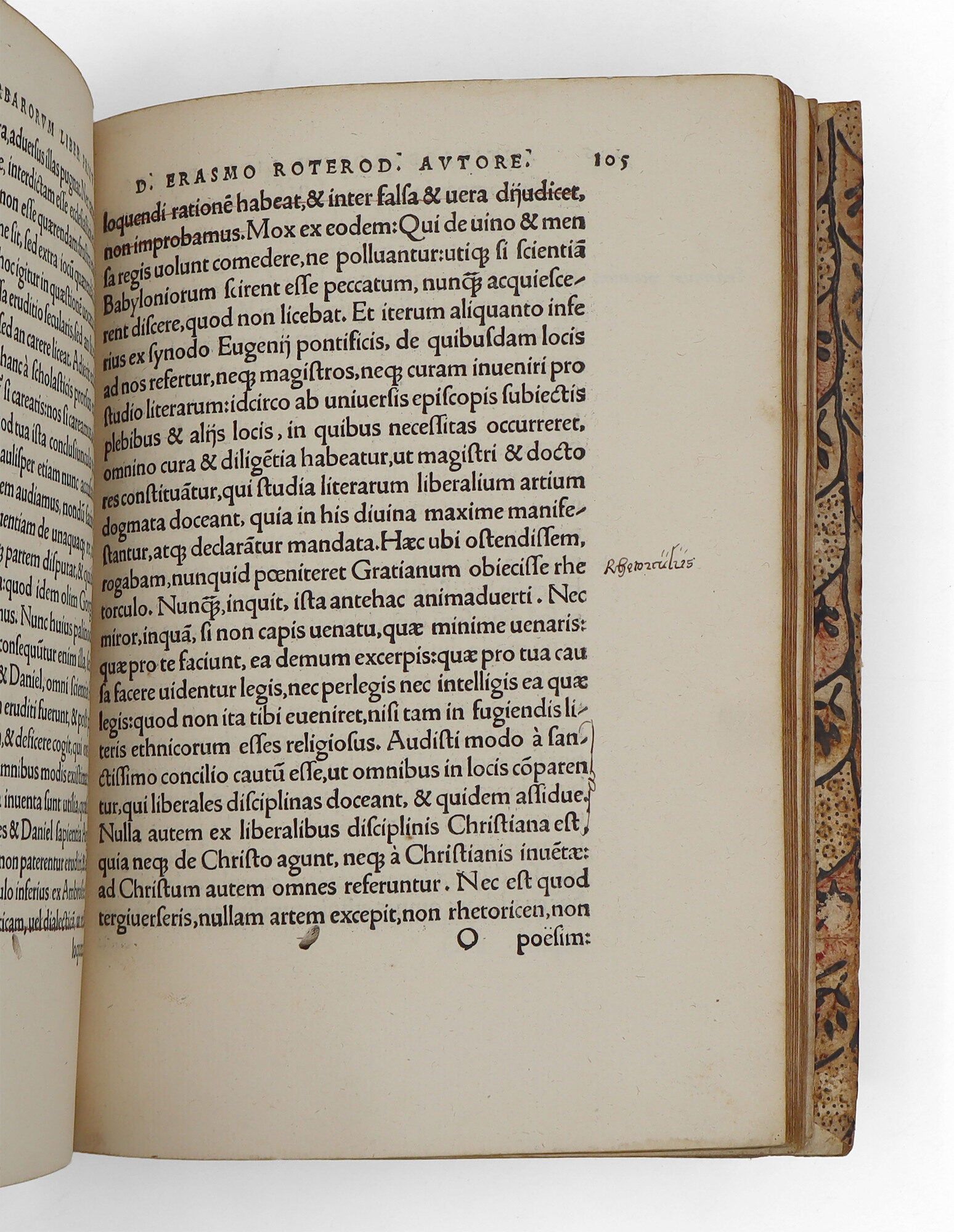
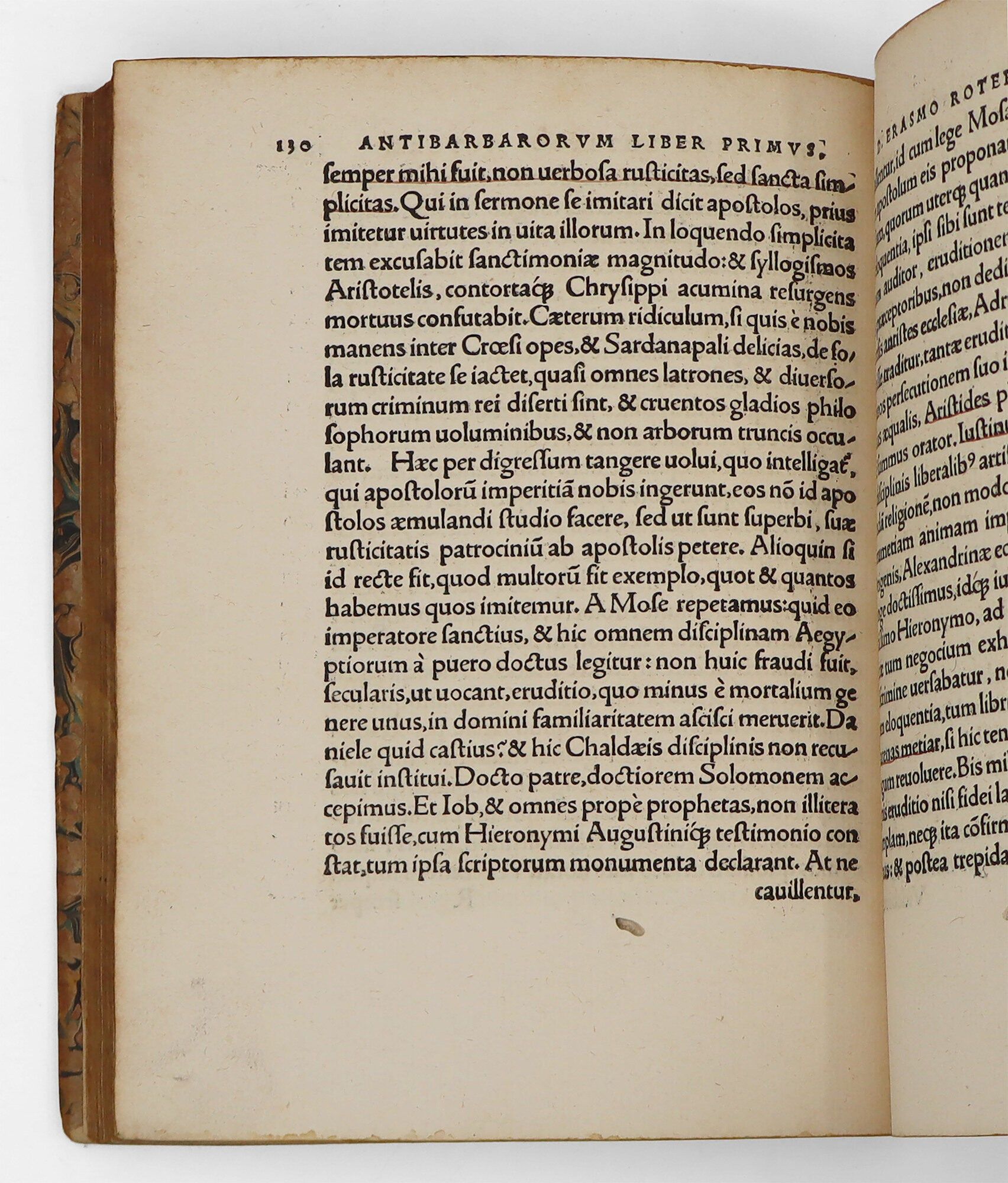
- Woodcut borders to title leaf and dedication by Hans Holbein, printer's device on last page. 150, [2, imprint] pp. 4to
- Basel: Froben, 1520
Basel: Froben, 1520. First edition, printed in May. Woodcut borders to title leaf and dedication by Hans Holbein, printer's device on last page. 150, [2, imprint] pp. 4to. Eighteenth-century marbled boards, ink label. Some toning to spine. Very good, fresh copy. First edition, printed in May. Woodcut borders to title leaf and dedication by Hans Holbein, printer's device on last page. 150, [2, imprint] pp. 4to. Ignorantiam esse superbiae matrem. Eruditionem contra modestiam parere.
[Ignorance is the mother of pride; it is from learning, on the contrary, that modesty is born.]
First edition of Antibarbari, Erasmus' manifesto "defending the arts against the scruples of the barbarians" (Tracy). Erasmus argues for the primacy of poetry among the liberal arts, for the importance of critical understanding of the writers of classical antiquity, and for appropriating what is good in their work. He is also scornful of rote learning and blind repetition of earlier scholarship, where "cuckoo calls to cuckoo".
In Petro summus erat ardor fidei, in Hieronymino summa doctrina: alterius animum, alterius studia imitar. [In Peter there was the ardour of faith at its highest; in Jeronme there was learning at its best. It is for you to imitate the spirit if the one and the scholarship of the other.]
This was a work of very long ripening. Erasmus began the earliest version circa 1490, when he was a newly ordained monk, but that manuscript was left behind in his wanderings. Decades later, when he came across his earlier work, he was at the center of intellectual controversy following publication of of his edition of the New Testament. He revised his Antibarbari to assert the humanist position, and Froben published it in May 1520. There were six editions of the work in the early 1520s (Froben himself published another edition later the same year), and ten editions in his lifetime.
"it is ignorance rather than erudtion which makes men insolent"
FIRST EDITION OF A KEY WORK BY ERASMUS. VD16 E1997; Valentina Sebastiani, Johann Froben, Printer of Basel 170; Bibliotheca Erasmiana p. 9; Adams E-463; Bezzel 157. The standard modern text iwith translation by Margaret Mann Phillips,˜The Antibarbarians", is in the Toronto Collected Works, vol. 23 (1978)
[Ignorance is the mother of pride; it is from learning, on the contrary, that modesty is born.]
First edition of Antibarbari, Erasmus' manifesto "defending the arts against the scruples of the barbarians" (Tracy). Erasmus argues for the primacy of poetry among the liberal arts, for the importance of critical understanding of the writers of classical antiquity, and for appropriating what is good in their work. He is also scornful of rote learning and blind repetition of earlier scholarship, where "cuckoo calls to cuckoo".
In Petro summus erat ardor fidei, in Hieronymino summa doctrina: alterius animum, alterius studia imitar. [In Peter there was the ardour of faith at its highest; in Jeronme there was learning at its best. It is for you to imitate the spirit if the one and the scholarship of the other.]
This was a work of very long ripening. Erasmus began the earliest version circa 1490, when he was a newly ordained monk, but that manuscript was left behind in his wanderings. Decades later, when he came across his earlier work, he was at the center of intellectual controversy following publication of of his edition of the New Testament. He revised his Antibarbari to assert the humanist position, and Froben published it in May 1520. There were six editions of the work in the early 1520s (Froben himself published another edition later the same year), and ten editions in his lifetime.
"it is ignorance rather than erudtion which makes men insolent"
FIRST EDITION OF A KEY WORK BY ERASMUS. VD16 E1997; Valentina Sebastiani, Johann Froben, Printer of Basel 170; Bibliotheca Erasmiana p. 9; Adams E-463; Bezzel 157. The standard modern text iwith translation by Margaret Mann Phillips,˜The Antibarbarians", is in the Toronto Collected Works, vol. 23 (1978)
Details
Title
Antibarbarorum ... liber unus
Author
(Antibarbari) Erasmus, Desiderius
Binding
Woodcut borders to title leaf and dedication by Hans Holbein, printer's device on last page. 150, [2, imprint] pp. 4to
Condition
Very Good
Publisher
Froben: Basel
Date
1520
Edition
First edition, printed in May