

1884 Letter from an American in Cannstatt, Germany, Discussing Fashion, Student Culture, and Emigration of the Poor who “hardly know what butter is”
- Single eight-page letter measuring 8 x 10 ½ inches. Quite delicate with tears at some folds, often intersecting with text. Slig
- Cannstatt, German Empire , 1884
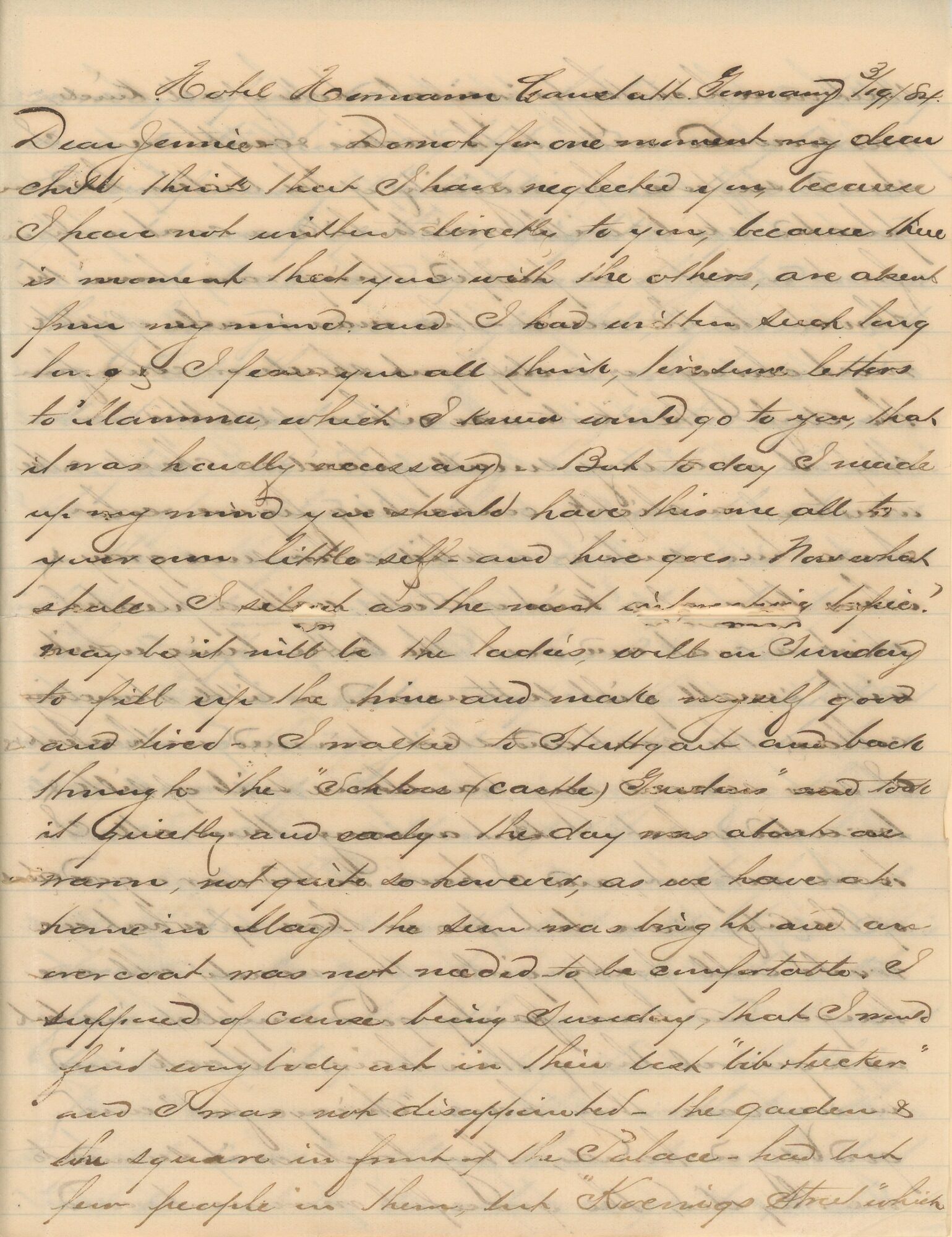
Cannstatt, German Empire, 1884. Single eight-page letter measuring 8 x 10 ½ inches. Quite delicate with tears at some folds, often intersecting with text. Slight odor. Good to very good.. A letter from a man to his daughter Jennie, written from the Hotel Hermann in Cannstatt in 1884. Cannstatt was founded around 90 CE, and is now a borough of the city of Stuttgart in Baden-Württemberg. It is not clear who the writer is, nor does he discuss the capacity in which he is visiting, though he mentions having previously been in Russia and Hamburg. Rather, he describes for his daughter the residents of Cannstatt, starting with the ladies’ fashion:
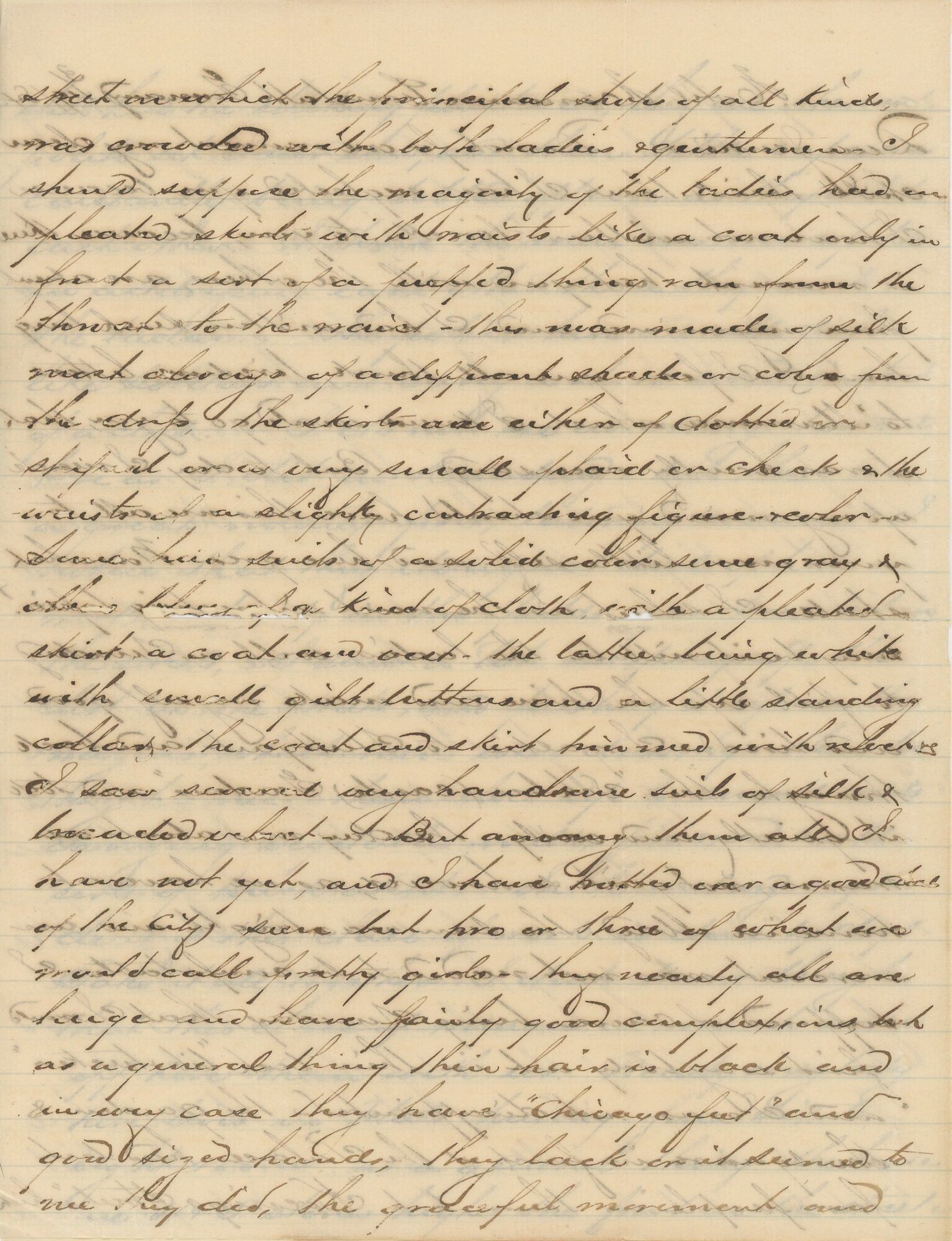
“I should suppose the majority of the ladies had on pleated skirts with waists like a coat only in front a sort of a puffed thing ran from the throat to the waist – this was made of silk most always of a different shade or color from the dress, the skirts are [...] striped or as very small plaid or check & the waists of a slightly contrasting figure & color. [Others wear] suits of a solid color some gray & others [missing] kind of cloth, with a pleated skirt, a coat and vest – the latter being white with severall gilt buttons and a little standing collar. The coat and skirt pinned with velvet &c. I saw several very handsome suits of silk & beaded velvet. But among them all I have not yet, and I have trotted over a good area of the city, seen but two or three of what we would call pretty girls –”
Next he turns to the dress of soldiers and students:
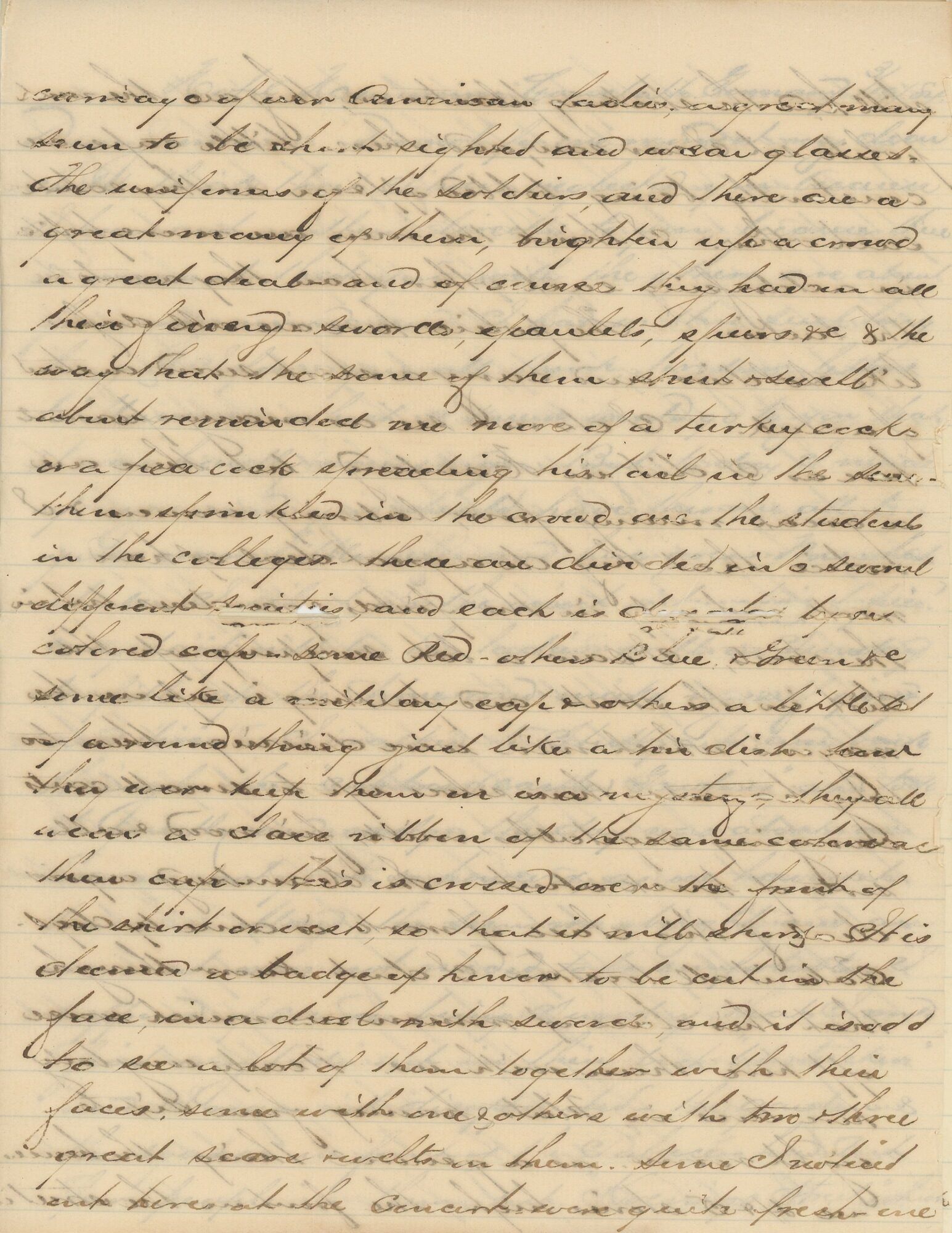
“The uniforms of the soldiers, and there are a great many of them, brighten up a crowd a great deal – and of course they had in all their finery swords, epaulets, spears &c & the way that the some of them sprint & swell about reminded me more of a turkey cock or a pea cock spreading his tail in the [missing.] Then sprinkled in the crowd are the students in the colleges, these are divided into several different societies, and each is [identified] by a colored cape – some Red – others Blue & Green &c some like a [missing] cape & others a little bit of a round thing just like a dish how they ever keep them on is a mystery, they all wear a class ribbon of the same color as their cape – this is crossed over the front of the shirt or vest, so that it will show.”
The students’ societies, or fraternities, are called Studentenverbindung; the ribbon and cape are part of the couleur, used to indicate membership in a particular fraternity. These groups were known for their practice of Mensur, or academic fencing, which shocked some foreign visitors:
“It is decreed a badge of honor to be cut in the face in a duel with swords, and it is odd to see a lot of them together with their faces, some with one & others with two & three great scars & welts on them. Since I noticed out here at the [?] were quite fresh – one still had the slicking plaster on”.
The Mensur swords were quite sharp and protective gear minimal; a scar, or Schmiss, indicated honor and upper-class status. Academic fencing is still practiced by many Studentenverbindung, though it is less popular and uses more safety equipment than before.
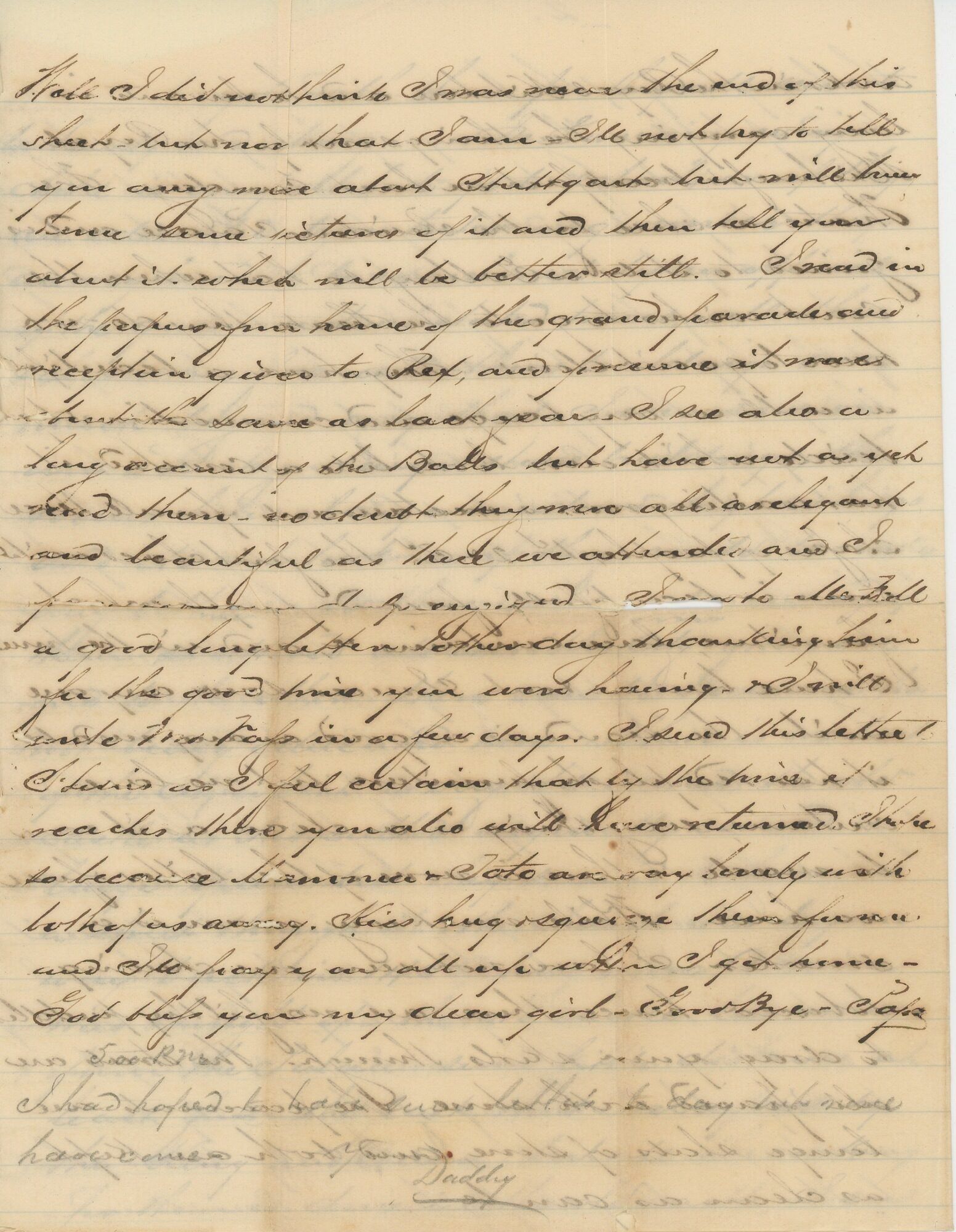
In contrast to the students are the “great many poor, laboring women” who “do a great deal of hard work not only in the fields and gardens but in the streets” sweeping up dirt and pulling carts of goods to sell. The author remarks that “Taken all together I dont know though that this class of women are much worse off here than with us.” At the time, Germany was experiencing political, religious, and economic unrest, leading to a boom in immigration mainly to the US; the author notes in particular that “labor is so cheap here, I dont see how they get along [...] many of them only have meat once a week – and hardly know what butter is – they chiefly live on Beer or Bread –”. Nonetheless, as he describes, the shops “are handsome & have beautiful things in them”, and all the children are educated, as not only was schooling free and compulsory but any private schooling would be “examined by an official of the government”.
Of interest for its detailed descriptions of the people and fashions of 1880s Cannstatt.
“I should suppose the majority of the ladies had on pleated skirts with waists like a coat only in front a sort of a puffed thing ran from the throat to the waist – this was made of silk most always of a different shade or color from the dress, the skirts are [...] striped or as very small plaid or check & the waists of a slightly contrasting figure & color. [Others wear] suits of a solid color some gray & others [missing] kind of cloth, with a pleated skirt, a coat and vest – the latter being white with severall gilt buttons and a little standing collar. The coat and skirt pinned with velvet &c. I saw several very handsome suits of silk & beaded velvet. But among them all I have not yet, and I have trotted over a good area of the city, seen but two or three of what we would call pretty girls –”
Next he turns to the dress of soldiers and students:
“The uniforms of the soldiers, and there are a great many of them, brighten up a crowd a great deal – and of course they had in all their finery swords, epaulets, spears &c & the way that the some of them sprint & swell about reminded me more of a turkey cock or a pea cock spreading his tail in the [missing.] Then sprinkled in the crowd are the students in the colleges, these are divided into several different societies, and each is [identified] by a colored cape – some Red – others Blue & Green &c some like a [missing] cape & others a little bit of a round thing just like a dish how they ever keep them on is a mystery, they all wear a class ribbon of the same color as their cape – this is crossed over the front of the shirt or vest, so that it will show.”
The students’ societies, or fraternities, are called Studentenverbindung; the ribbon and cape are part of the couleur, used to indicate membership in a particular fraternity. These groups were known for their practice of Mensur, or academic fencing, which shocked some foreign visitors:
“It is decreed a badge of honor to be cut in the face in a duel with swords, and it is odd to see a lot of them together with their faces, some with one & others with two & three great scars & welts on them. Since I noticed out here at the [?] were quite fresh – one still had the slicking plaster on”.
The Mensur swords were quite sharp and protective gear minimal; a scar, or Schmiss, indicated honor and upper-class status. Academic fencing is still practiced by many Studentenverbindung, though it is less popular and uses more safety equipment than before.
In contrast to the students are the “great many poor, laboring women” who “do a great deal of hard work not only in the fields and gardens but in the streets” sweeping up dirt and pulling carts of goods to sell. The author remarks that “Taken all together I dont know though that this class of women are much worse off here than with us.” At the time, Germany was experiencing political, religious, and economic unrest, leading to a boom in immigration mainly to the US; the author notes in particular that “labor is so cheap here, I dont see how they get along [...] many of them only have meat once a week – and hardly know what butter is – they chiefly live on Beer or Bread –”. Nonetheless, as he describes, the shops “are handsome & have beautiful things in them”, and all the children are educated, as not only was schooling free and compulsory but any private schooling would be “examined by an official of the government”.
Of interest for its detailed descriptions of the people and fashions of 1880s Cannstatt.
Details
Title
1884 Letter from an American in Cannstatt, Germany, Discussing Fashion, Student Culture, and Emigration of the Poor who “hardly know what butter is”
Author
[Americans Abroad – German Empire] Unknown Author
Binding
Single eight-page letter measuring 8 x 10 ½ inches. Quite delicate with tears at some folds, often intersecting with text. Slig
Condition
Good
Publisher
Cannstatt, German Empire
Date
1884