

Ganshō sai fukushinroku 含章斎腹診録 [Ganshō’s Diagnosis of Abdomen Treatments, Listed]
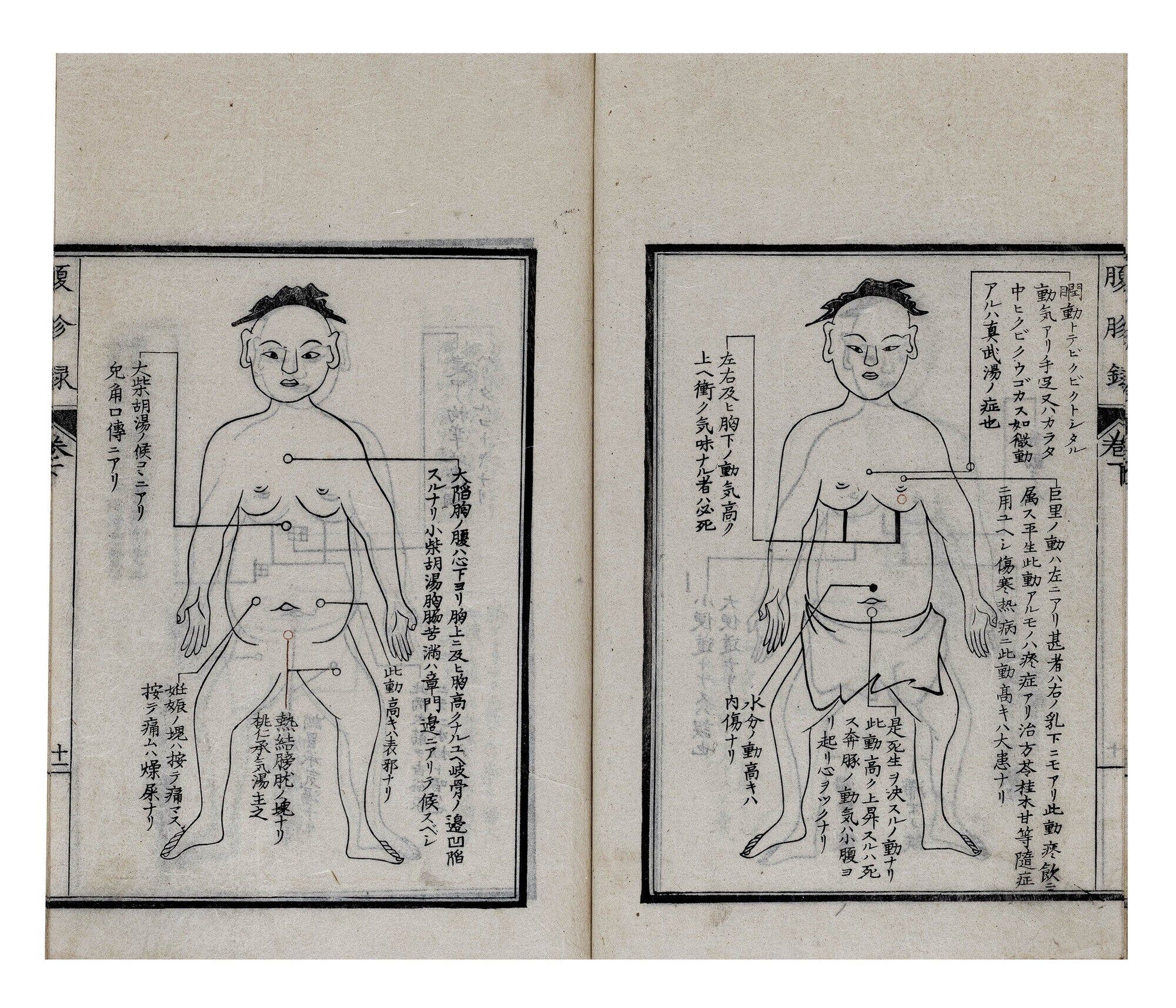
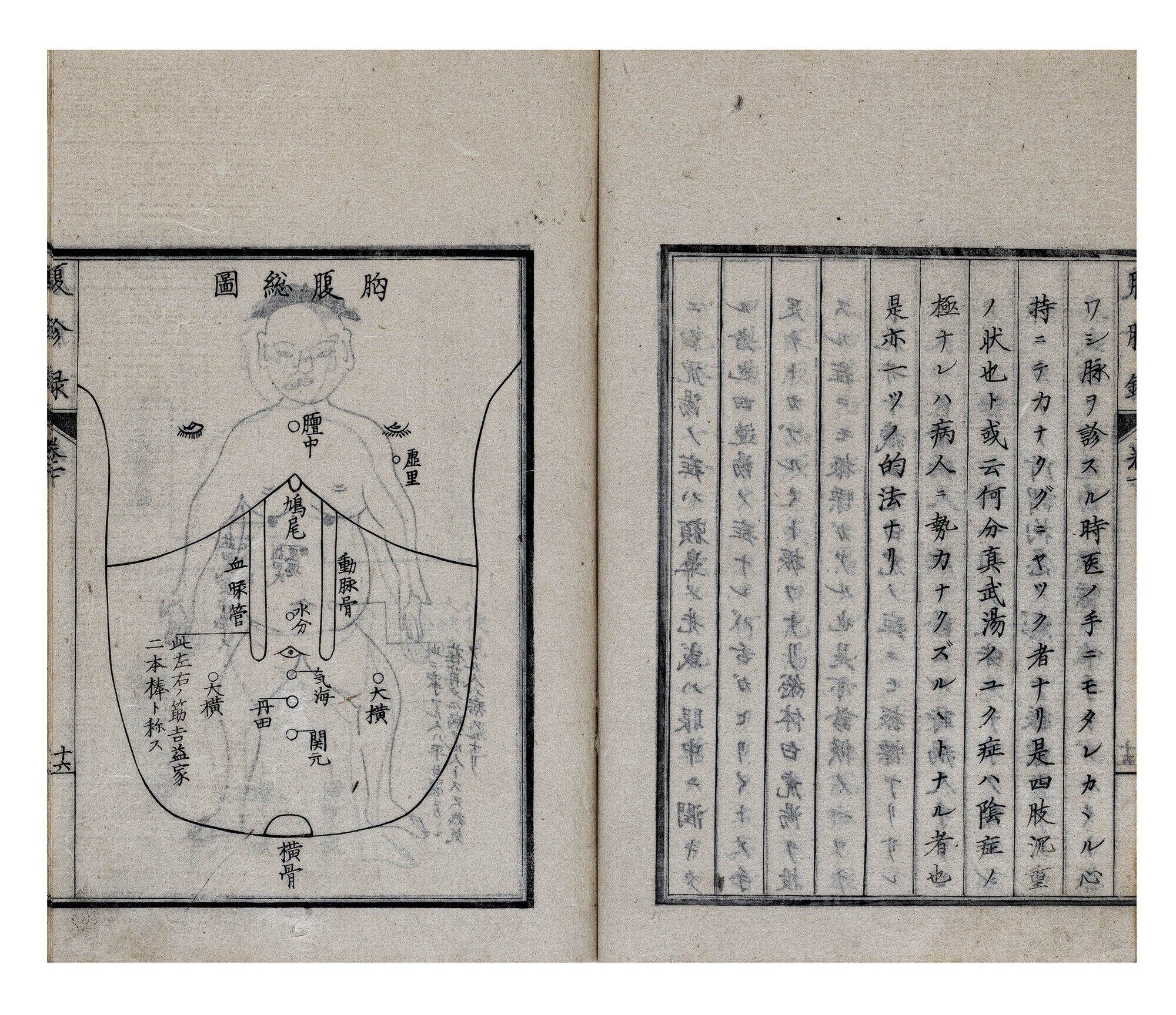
14 full-page woodcuts. 50; 44.5 folding leaves. Two vols. 8vo, orig. semi-stiff patterned wrappers, title-slips on upper covers, new stitching. Kyoto & other cities: Hayashi Yoshibei 林芳兵衛 et al., 1850.
First edition and rare; we find no copy outside of Japan. Published posthumously by disciples of Wada (1744-1803), who was the physician to a number of aristocrats. His teacher was Yoshimasu Tōdō 吉益東洞 (1702-73), head of the Yoshimasu school of surgery, one of the institutes most closely aligned with Dutch influences after their first contacts in about 1600. Tōdō is considered to be the most innovative and influential figure in the development of kampo (Chinese medicine and materia medica adapted to Japanese culture and needs). He believed that any effective technique, regardless of philosophical tradition, was acceptable and should be based on experiment and observation.
As part of kampo (traditional Japanese herbal medicine), fukushin 腹診 (the abdominal exam by percussion) is one of the most important diagnostic procedures. Derived from the traditional Chinese medicine writings of Zhang Zhongjing (ca. 150-219 CE), fukushin was fully developed and systematized in Japan and is still widely practiced. Palpation is structured to assess thickness, tension, resistance, tenderness, and masses.
The 14 attractive full-page woodcuts depict the areas of the abdomen suitable for palpation. The accompanying notes correct or confirm other doctors’ theories regarding the indications gained from palpation of each section. Much of the text in the first volume is given to recipes for the preparation of medicines to cure a wide range of diseases. Vol. 2 contains case histories.
Fine fresh copy.
First edition and rare; we find no copy outside of Japan. Published posthumously by disciples of Wada (1744-1803), who was the physician to a number of aristocrats. His teacher was Yoshimasu Tōdō 吉益東洞 (1702-73), head of the Yoshimasu school of surgery, one of the institutes most closely aligned with Dutch influences after their first contacts in about 1600. Tōdō is considered to be the most innovative and influential figure in the development of kampo (Chinese medicine and materia medica adapted to Japanese culture and needs). He believed that any effective technique, regardless of philosophical tradition, was acceptable and should be based on experiment and observation.
As part of kampo (traditional Japanese herbal medicine), fukushin 腹診 (the abdominal exam by percussion) is one of the most important diagnostic procedures. Derived from the traditional Chinese medicine writings of Zhang Zhongjing (ca. 150-219 CE), fukushin was fully developed and systematized in Japan and is still widely practiced. Palpation is structured to assess thickness, tension, resistance, tenderness, and masses.
The 14 attractive full-page woodcuts depict the areas of the abdomen suitable for palpation. The accompanying notes correct or confirm other doctors’ theories regarding the indications gained from palpation of each section. Much of the text in the first volume is given to recipes for the preparation of medicines to cure a wide range of diseases. Vol. 2 contains case histories.
Fine fresh copy.
Details
Title
Ganshō sai fukushinroku 含章斎腹診録 [Ganshō’s Diagnosis of Abdomen Treatments, Listed]
Author
WADA, Tōkaku 和田東郭
Condition
Unknown