

Dissertações philosophico-politicas sobre o trato das sedas na comarca de Moncorvo
- Lisbon: press of the Royal Academy of Sciences, 1787
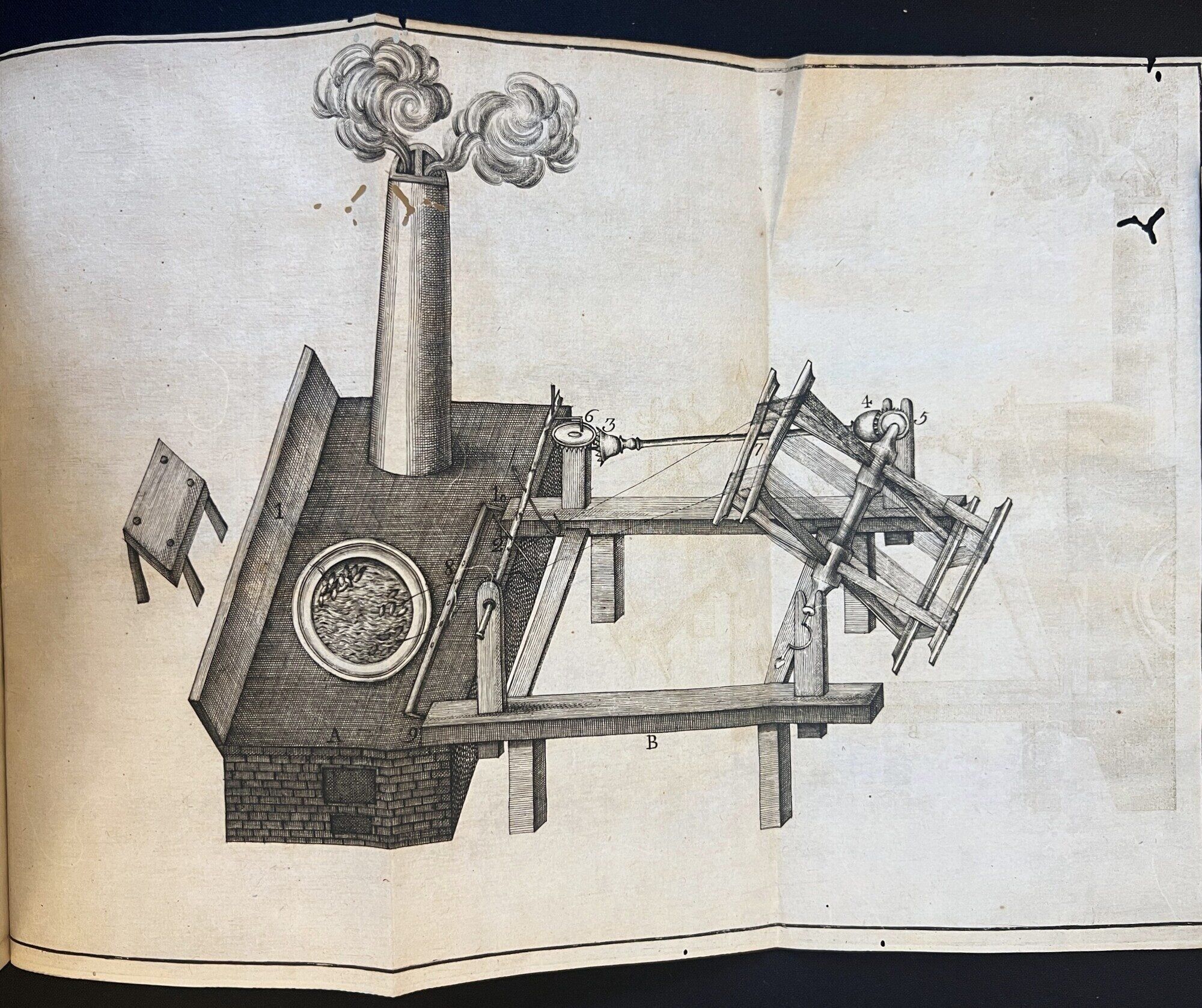
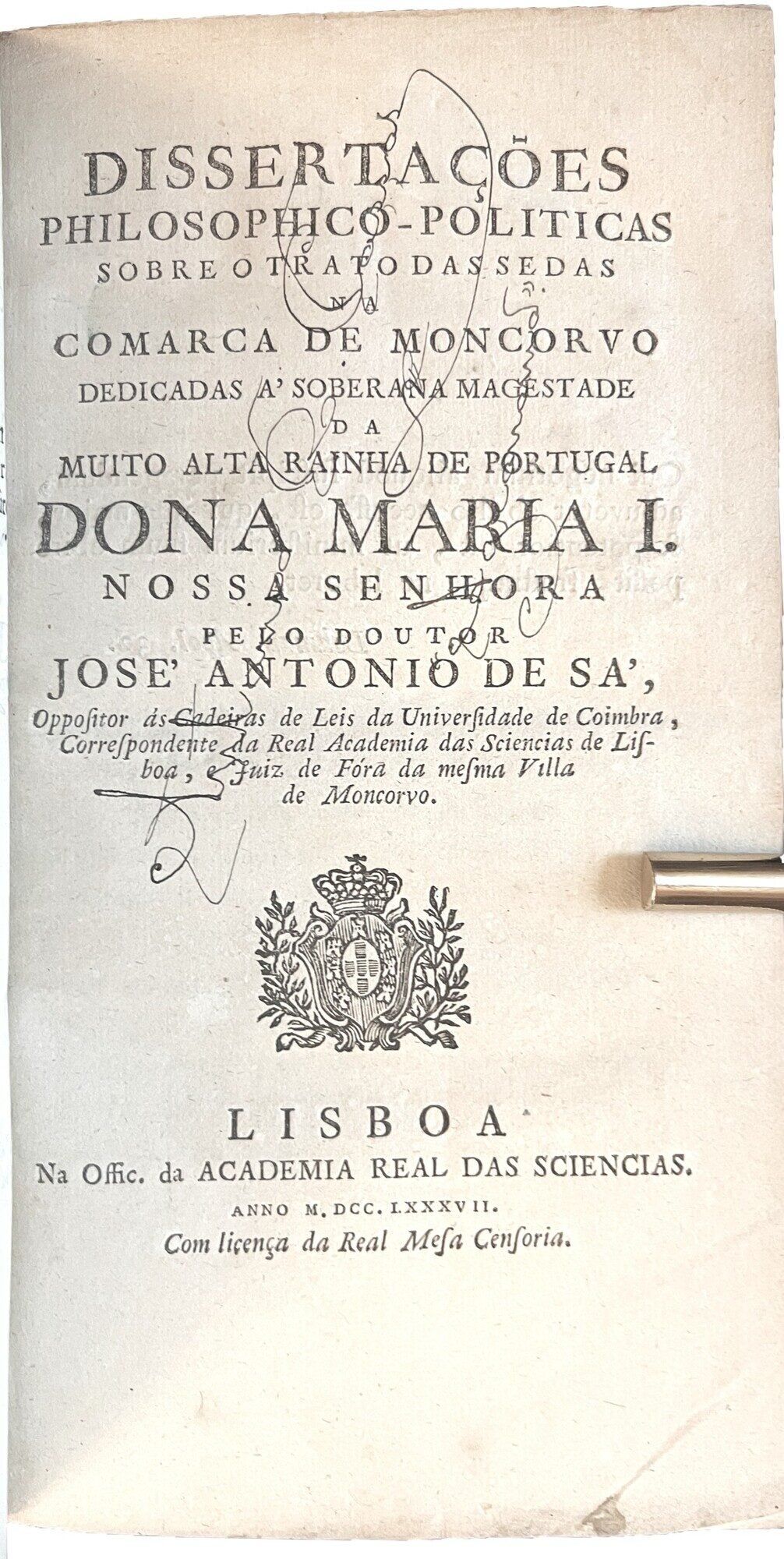
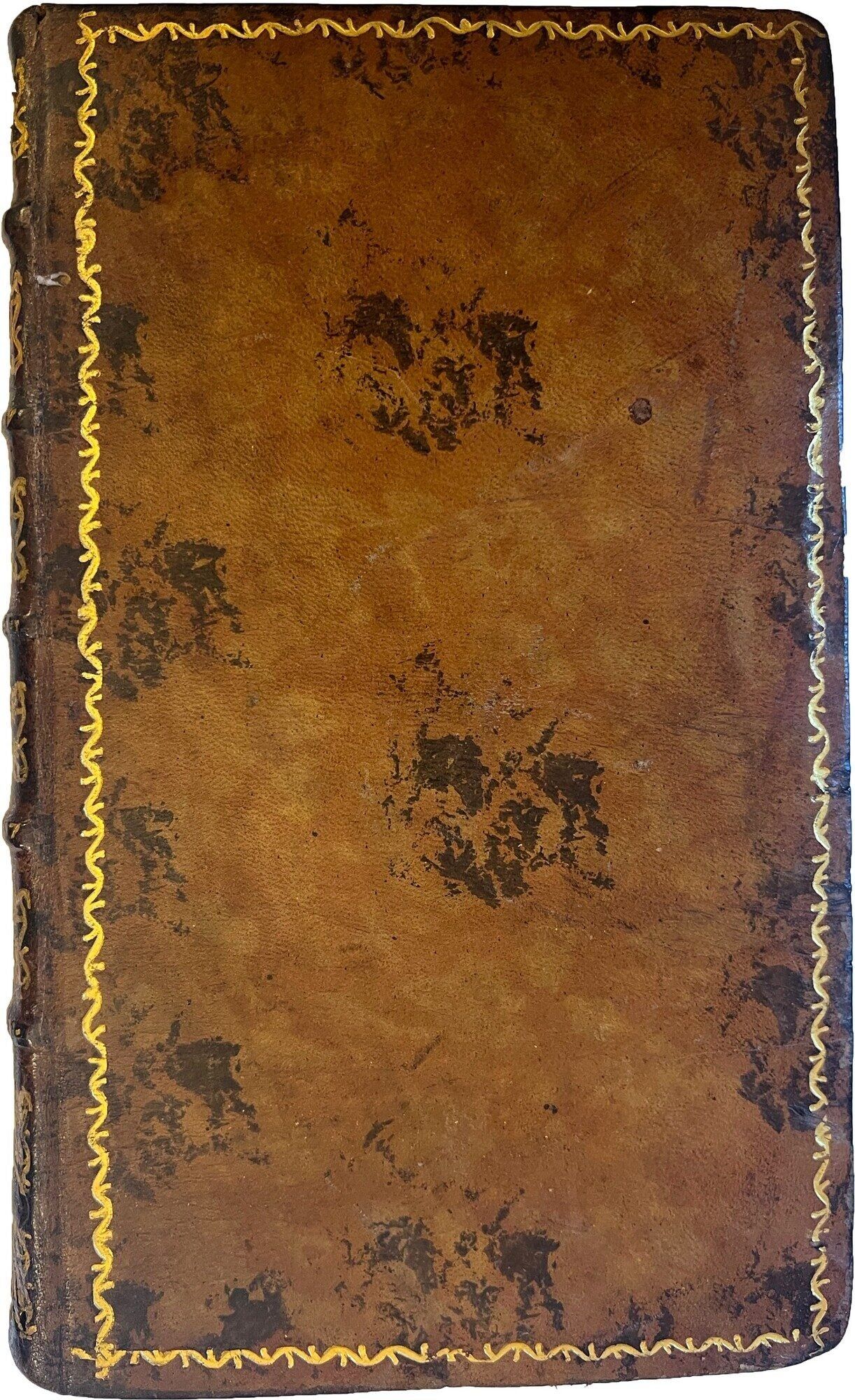
Lisbon: press of the Royal Academy of Sciences, 1787. Narrow 4to (209 x 118 mm). [8], xiii, [3], 175 pages. Title-leaf (fol. [*2]) present in duplicate. Folding engraved plate of a mechanical silk loom; titles with woodcut arms of the Portuguese Royal Academy of Sciences, woodcut and typographic headpieces (occasional slight discoloration, small wormtrack in the folding plate). Contemporary cat’s-paw polished sheep, covers with gilt border, spine in six gold-tooled compartments, the second gilt lettered, edges gilt and gauffered (recased, endpapers renewed, defect in top spine compartment, a dozen small wormholes). Provenance: António Romão dos Passos (1866-1951), signature in ink (Antonio Passos / agronomo or Anto R. Passos) scrawled across both titles, the first with price note, and on six text leaves. ***
Only edition of a comprehensive overview of the Portuguese silk industry, by the judicial magistrate of the Moncorvo district and author of several works on political economy and history of law. José Antonio de Sá (d. 1819), a native of Bragança, was an important proponent of modernization of the industry, and later served as director of the Royal Silk Factory (Real Fábrica das Sedas), founded in 1802 in Lisbon. He was one of the earliest members of the Academia Real das Sciencias of Lisbon.
Silkworms were raised in Portugal as early as the 13th century. Sericulture and silk production were concentrated in the northeastern province of Trás-os-Montes, its largest center being the city of Bragança, which from the 15th to 17th century was known throughout Europe for its luxurious velvets. Because of the lack of government support for industry, frequent wars, and above all the persecutions of the Inquisition, which decimated an industry in all sectors of which Jews or converted Jews (cristãos-novos) played a major role, Portuguese silk production suffered from intermittent crises and was even periodically decimated. Starting in the 1770s, efforts to revive the industry began to have an effect:
“By the end of the 18th century, the Trás-os-Montes silk industry had dragged itself out of the crisis that had begun in 1750-1755, coinciding with the last incursion of the Inquisition into Bragança, and embarked upon a period of great development, accompanying the industrial expansion that was then taking place, not only in that particular region, but throughout the Portuguese kingdom. After the Inquisition’s systematic persecution of businessmen, weavers and throwers had finally come to an end, the continuity and expansion of the silk industry seemed to be a viable prospect. In the last two decades of the 18th century, a remarkable process of modernization took place thanks to the efforts of the businessmen involved in this economic activity, such as António José Lopes Fernandes, who installed 200 silk looms in Bragança, magistrates such as José António de Sá and Pereira de Barros, and politicians such as Martinho de Melo e Castro and Rodrigo de Sousa Coutinho, the latter being the Portuguese ambassador to Piedmont, Italy. These efforts included the adoption of Piedmontese methods and techniques (namely the organzine mill and the spinning-jenny), the most advanced ones at that time in Europe, in an operation led by experts coming to Portugal from that Italian region.” (Sousa, p. 6)
Sá’s work is in three parts. The first part comprises an overview of the history of silk production, starting with Antiquity, and summaries of the industry and government policies toward it in other countries, followed by a detailed recommendation, with responses to projected objections, that the Portuguese government undertake a campaign to plant mulberry trees and promote the industry generally. Part two is a treatise on the silkworm, and part three a technical survey of “the art of silk spinning.” Explained in the text (pp. 142-148) is the letter- and number-keyed engraving of a rather fanciful machine, showing a vat for softening the cocoons heating on the left, from which a thread-unwinding mechanism feeds a loom on the right.
The reason for the duplicated title-leaf in this copy is not clear. Perhaps one functioned as an upper wrapper — but as both titles are preceded by a half-title that appears unlikely. The book collector Antonio Romão dos Passos (b. February 28, 1866) was an engineer and agronomist. Other books from his library, all on practical subjects, are recorded; four are digitized by the Biblioteca Nacional Digital de Portugal. One, a treatise on hemp, has a similar indelicately scrawled signature across the title.
OCLC gives six US locations. Innocencio, Diccionario bibliographico portuguez IV: 246, no. 2658; Kress, Luso-Brazilian Economic Literature Before 1850, p. 4. Cf. F. Sousa, “The Silk Industry In Trás-Os-Montes During The Ancient Regime,” E Journal of Portuguese History, Vol. 3, no. 2, Winter 2005 (digitized).
Only edition of a comprehensive overview of the Portuguese silk industry, by the judicial magistrate of the Moncorvo district and author of several works on political economy and history of law. José Antonio de Sá (d. 1819), a native of Bragança, was an important proponent of modernization of the industry, and later served as director of the Royal Silk Factory (Real Fábrica das Sedas), founded in 1802 in Lisbon. He was one of the earliest members of the Academia Real das Sciencias of Lisbon.
Silkworms were raised in Portugal as early as the 13th century. Sericulture and silk production were concentrated in the northeastern province of Trás-os-Montes, its largest center being the city of Bragança, which from the 15th to 17th century was known throughout Europe for its luxurious velvets. Because of the lack of government support for industry, frequent wars, and above all the persecutions of the Inquisition, which decimated an industry in all sectors of which Jews or converted Jews (cristãos-novos) played a major role, Portuguese silk production suffered from intermittent crises and was even periodically decimated. Starting in the 1770s, efforts to revive the industry began to have an effect:
“By the end of the 18th century, the Trás-os-Montes silk industry had dragged itself out of the crisis that had begun in 1750-1755, coinciding with the last incursion of the Inquisition into Bragança, and embarked upon a period of great development, accompanying the industrial expansion that was then taking place, not only in that particular region, but throughout the Portuguese kingdom. After the Inquisition’s systematic persecution of businessmen, weavers and throwers had finally come to an end, the continuity and expansion of the silk industry seemed to be a viable prospect. In the last two decades of the 18th century, a remarkable process of modernization took place thanks to the efforts of the businessmen involved in this economic activity, such as António José Lopes Fernandes, who installed 200 silk looms in Bragança, magistrates such as José António de Sá and Pereira de Barros, and politicians such as Martinho de Melo e Castro and Rodrigo de Sousa Coutinho, the latter being the Portuguese ambassador to Piedmont, Italy. These efforts included the adoption of Piedmontese methods and techniques (namely the organzine mill and the spinning-jenny), the most advanced ones at that time in Europe, in an operation led by experts coming to Portugal from that Italian region.” (Sousa, p. 6)
Sá’s work is in three parts. The first part comprises an overview of the history of silk production, starting with Antiquity, and summaries of the industry and government policies toward it in other countries, followed by a detailed recommendation, with responses to projected objections, that the Portuguese government undertake a campaign to plant mulberry trees and promote the industry generally. Part two is a treatise on the silkworm, and part three a technical survey of “the art of silk spinning.” Explained in the text (pp. 142-148) is the letter- and number-keyed engraving of a rather fanciful machine, showing a vat for softening the cocoons heating on the left, from which a thread-unwinding mechanism feeds a loom on the right.
The reason for the duplicated title-leaf in this copy is not clear. Perhaps one functioned as an upper wrapper — but as both titles are preceded by a half-title that appears unlikely. The book collector Antonio Romão dos Passos (b. February 28, 1866) was an engineer and agronomist. Other books from his library, all on practical subjects, are recorded; four are digitized by the Biblioteca Nacional Digital de Portugal. One, a treatise on hemp, has a similar indelicately scrawled signature across the title.
OCLC gives six US locations. Innocencio, Diccionario bibliographico portuguez IV: 246, no. 2658; Kress, Luso-Brazilian Economic Literature Before 1850, p. 4. Cf. F. Sousa, “The Silk Industry In Trás-Os-Montes During The Ancient Regime,” E Journal of Portuguese History, Vol. 3, no. 2, Winter 2005 (digitized).
Details
Title
Dissertações philosophico-politicas sobre o trato das sedas na comarca de Moncorvo
Author
SILK INDUSTRY, PORTUGAL — SÁ, José Antonio de
Condition
Unknown
Publisher
press of the Royal Academy of Sciences: Lisbon
Date
1787