

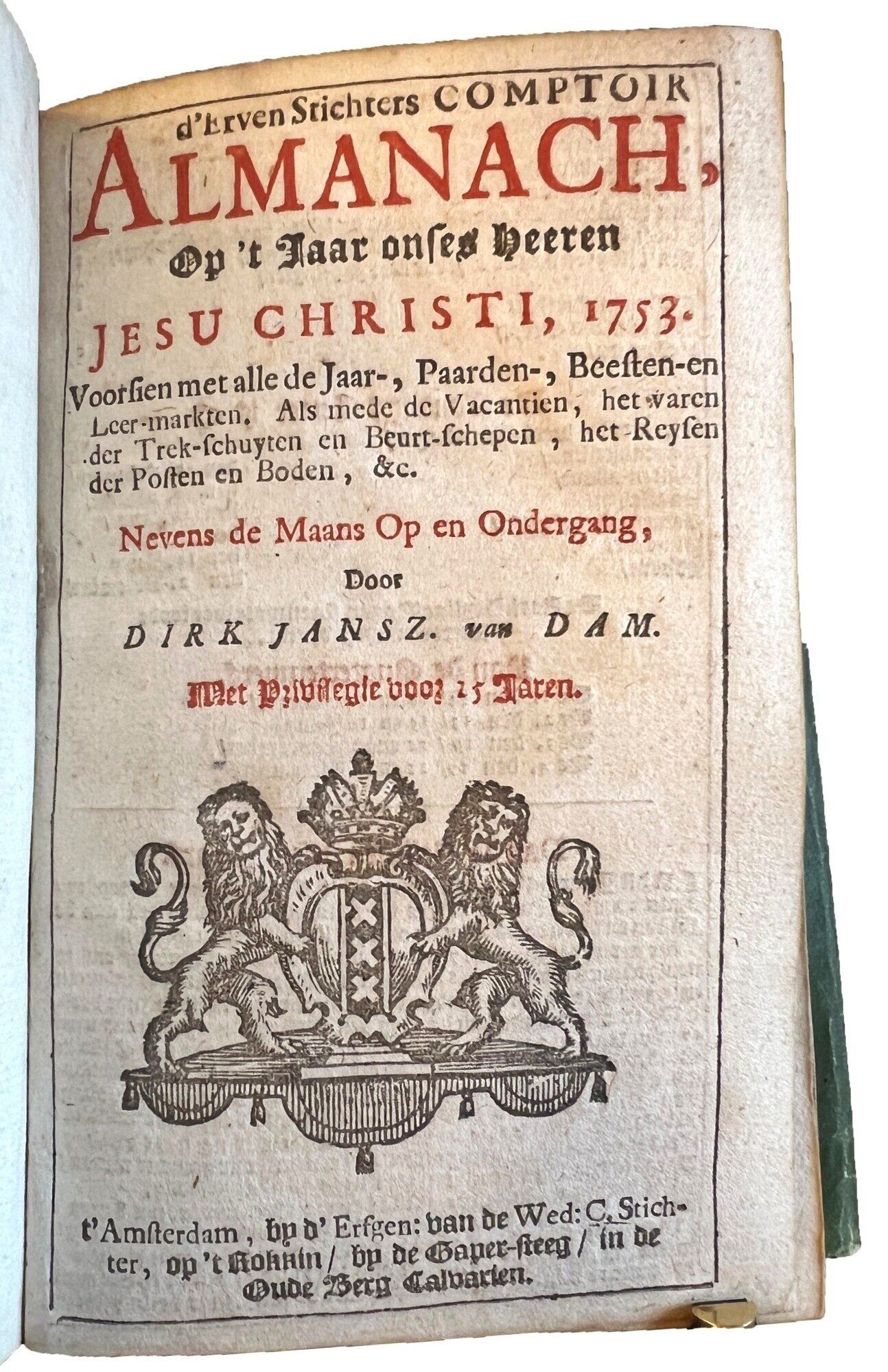
D'erven Stichters comptoir almanach, op't Iaar onses Heeren Jesu Christi, 1753

- Amsterdam: heirs of the widow of C. Stichter, 1752
Amsterdam: heirs of the widow of C. Stichter, 1752. 8vo (158 x 95 mm). [48] pages. Printed in red and black throughout. Woodcut arms of Amsterdam on title. 12 half-page woodcuts in calendar. Interleaved and bound with 2 blank leaves at front and 72 at back. Annotated by a contemporary owner with a couple of stray notes on interleaves and a total of 70 pages of manuscript historical notes on the blank leaves at end (one blank leaf almost detached). Contemporary plain green parchment over thin pasteboards, flat spine, large flap extending from lower cover, the parchment of the upper cover not attached to upper fore-edge, leaving a slot to insert the flap, lower free endleaf backed in pasteboard and with folding leather-lined pieces at top and bottom attaching it to lower cover, thus forming a wallet or envelope. ***
Part almanac, part blank book, this useful volume is bound in a supremely practical wallet binding, of a kind that was common once and is no doubt found in large numbers in historical collections, but which surfaces rarely in the book trade. The slot in the front cover to insert the folding tab from the lower cover protected the volume from Dutch weather, and the lower cover contains a pocket for loose papers or even money.
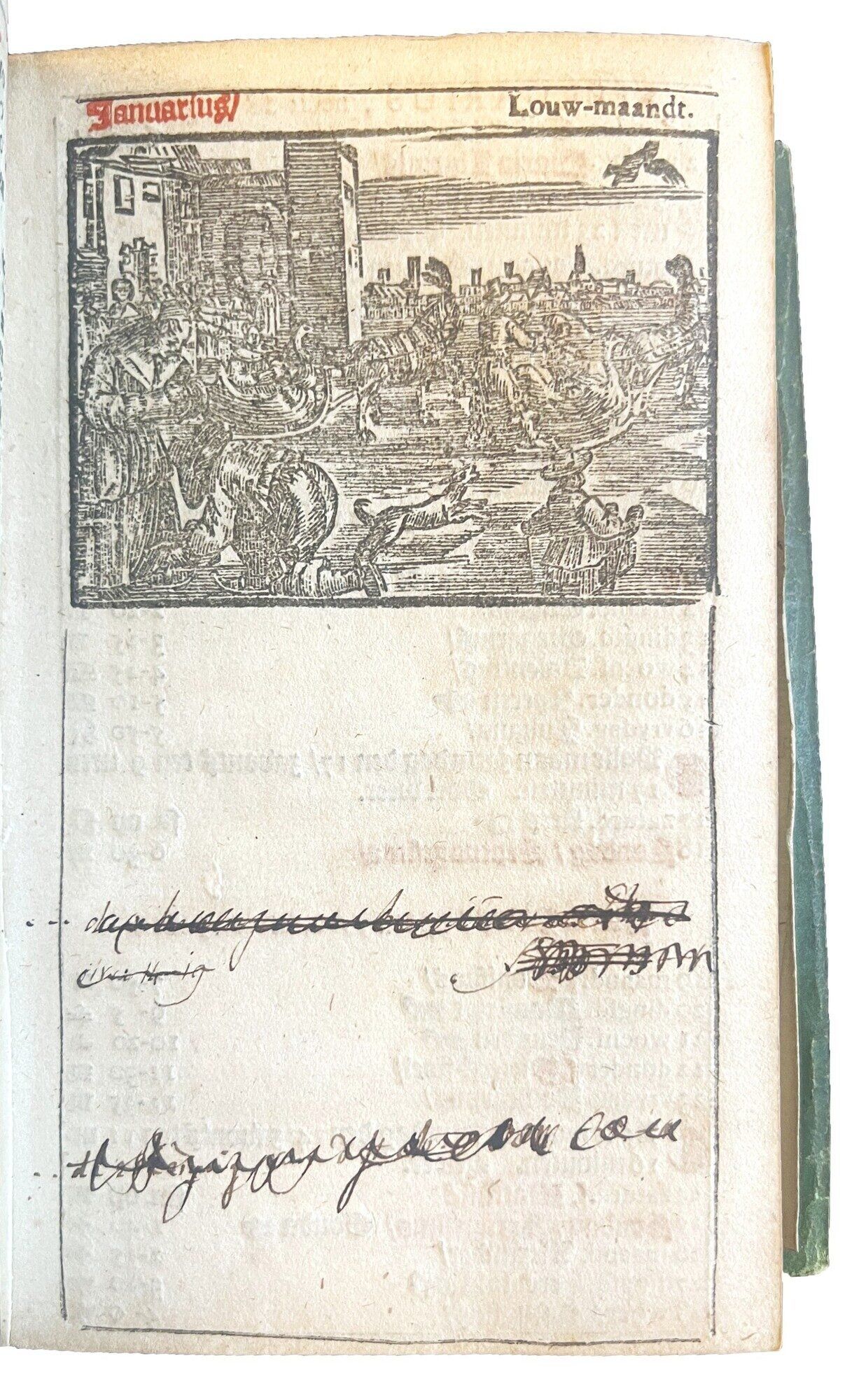
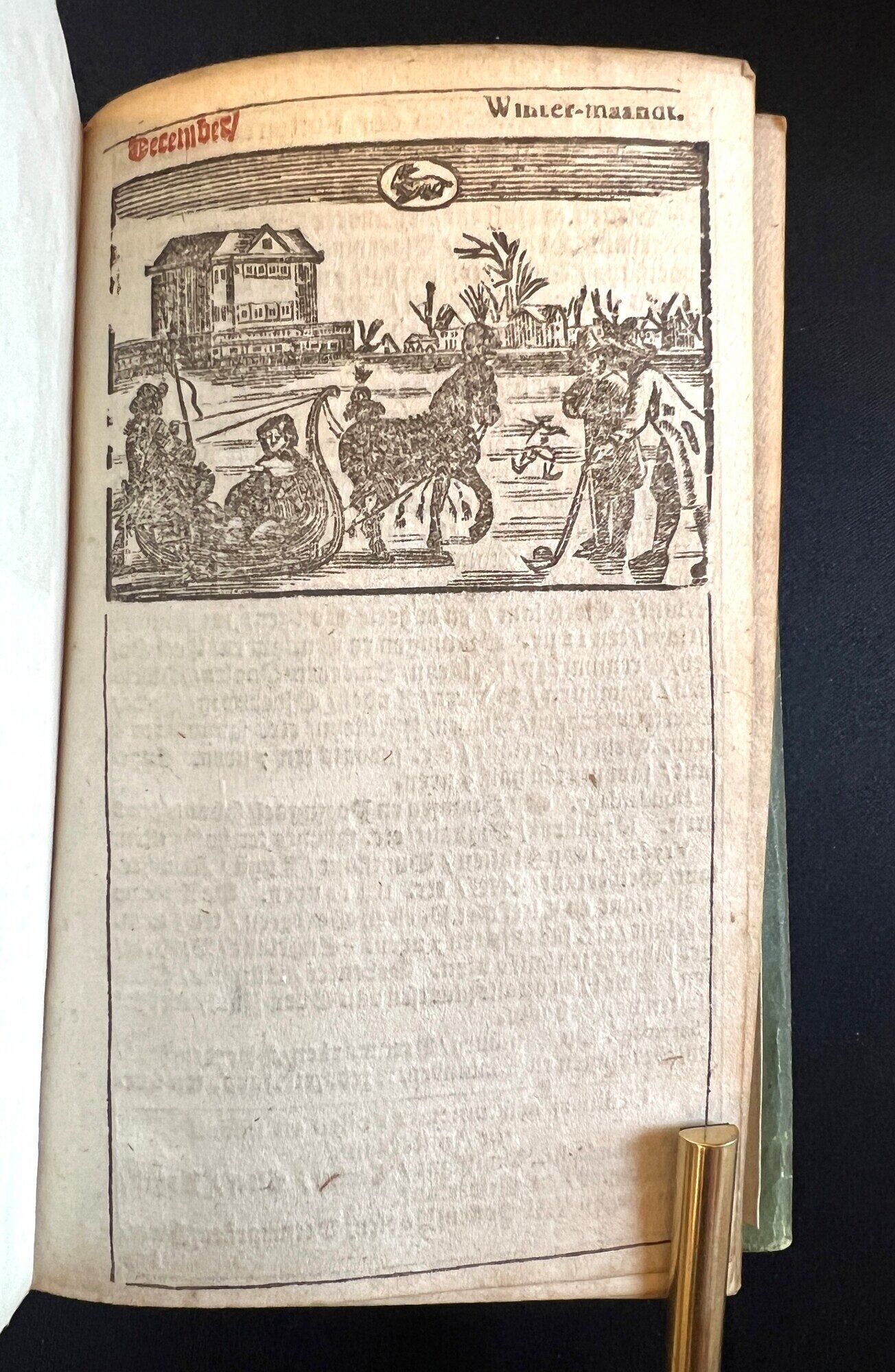
The Amsterdam comptoir almanacs were issued yearly by successive members of the Stichter printing family from 1728 to the mid-19th century. Unlike their French counterparts, these Dutch almanacs were generously proportioned, being at least originally intended for the “counters” of merchants and businessmen, rather than for gentlemen’s or ladies’ pockets. The calendars were always interleaved, and the contents were standard: one page is devoted to each month, containing a half-page woodcut above a blank space for notes on the recto, and the monthly calendar on the verso. These woodcuts, each with a tiny inset astrological sign, show indoor and outdoor scenes: ice-sports in December and January, a family huddled by the fire, with boisterous children in the background, in February, tree-trimming and pruning in March, gardening in April, a pastoral scene with lovers in May, sheep-shearing in June, and so on. The blocks are here quite worn.
Following the calendar are postal and transportation schedules (by coach or ship), 3 pages of astrological predictions, and a short chronicle of the year 1734 (someone forgot to update the sheets?).
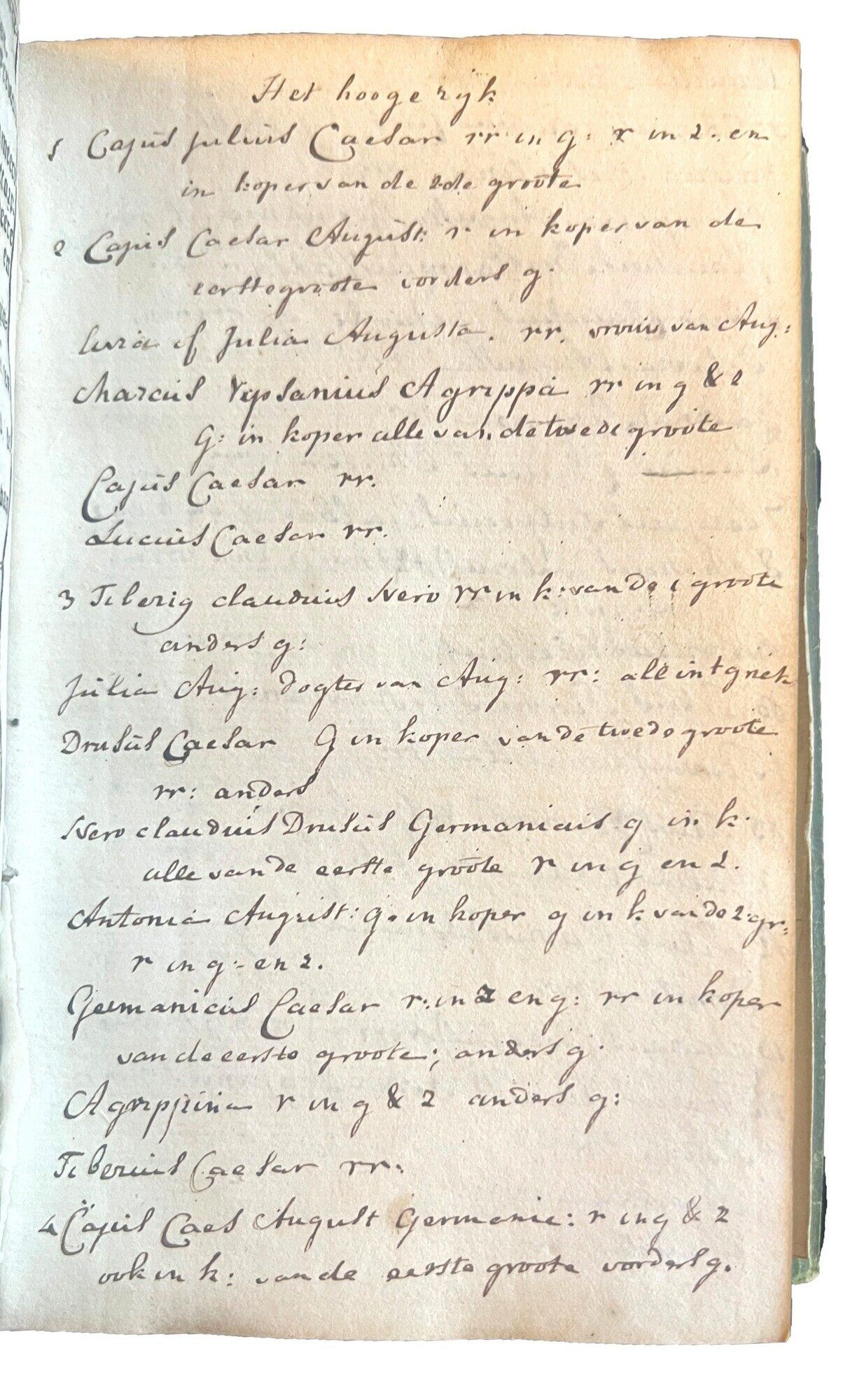
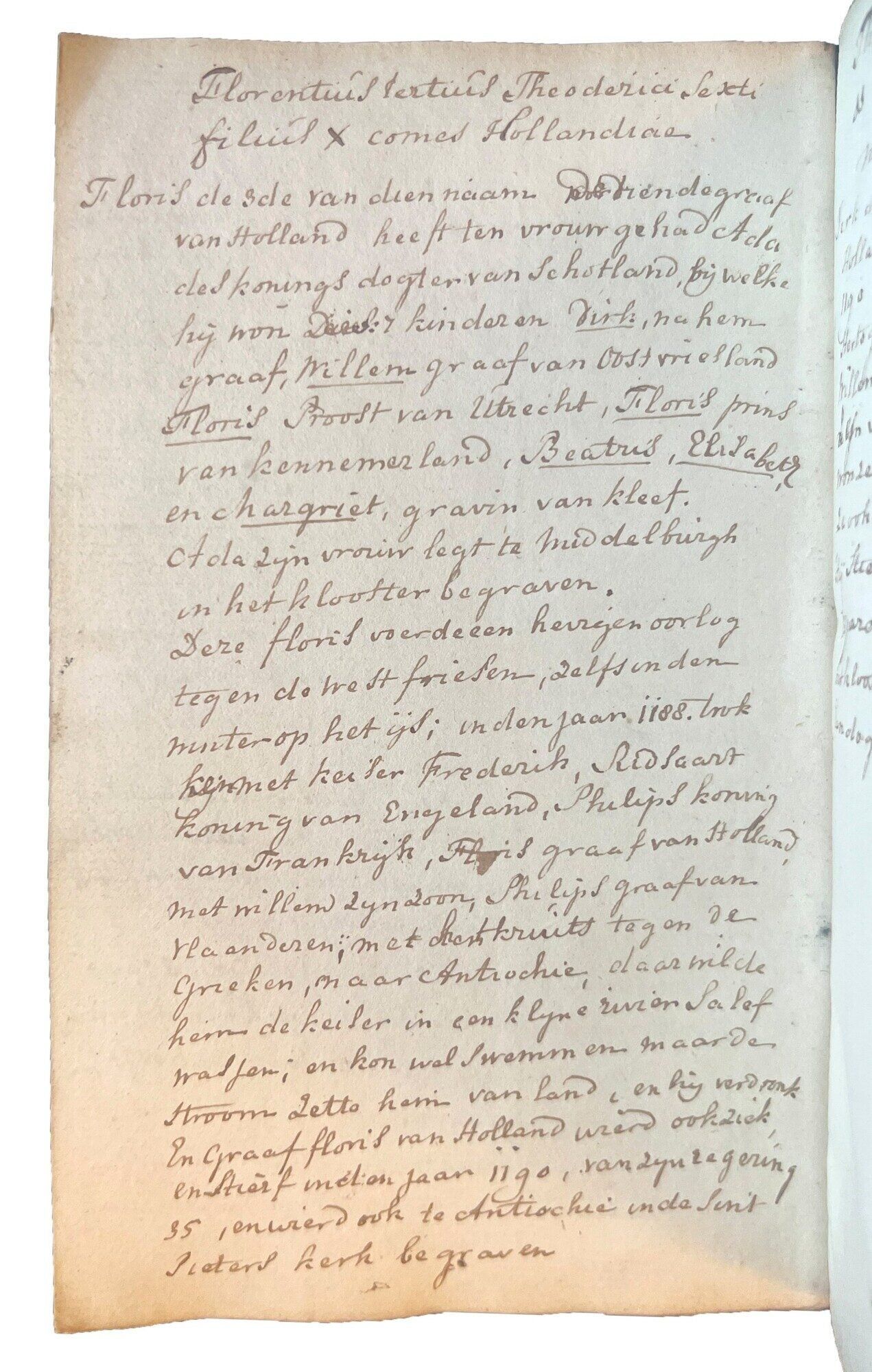
The contemporary reader who used this almanac / notebook (and whose hand seems feminine to me) was a student of history. The first 16 and 1/2 pages, at the beginning of the blank leaves, contain a list of Roman emperors. Toward the end of the blank leaves are 32 pages on the succession of the Dukes of Flanders, titled “Opvolgengen der Graven von Holland, uit het Goudasche Kronyken.”
Short-Title Catalogue Netherlands 328765627.
Part almanac, part blank book, this useful volume is bound in a supremely practical wallet binding, of a kind that was common once and is no doubt found in large numbers in historical collections, but which surfaces rarely in the book trade. The slot in the front cover to insert the folding tab from the lower cover protected the volume from Dutch weather, and the lower cover contains a pocket for loose papers or even money.
The Amsterdam comptoir almanacs were issued yearly by successive members of the Stichter printing family from 1728 to the mid-19th century. Unlike their French counterparts, these Dutch almanacs were generously proportioned, being at least originally intended for the “counters” of merchants and businessmen, rather than for gentlemen’s or ladies’ pockets. The calendars were always interleaved, and the contents were standard: one page is devoted to each month, containing a half-page woodcut above a blank space for notes on the recto, and the monthly calendar on the verso. These woodcuts, each with a tiny inset astrological sign, show indoor and outdoor scenes: ice-sports in December and January, a family huddled by the fire, with boisterous children in the background, in February, tree-trimming and pruning in March, gardening in April, a pastoral scene with lovers in May, sheep-shearing in June, and so on. The blocks are here quite worn.
Following the calendar are postal and transportation schedules (by coach or ship), 3 pages of astrological predictions, and a short chronicle of the year 1734 (someone forgot to update the sheets?).
The contemporary reader who used this almanac / notebook (and whose hand seems feminine to me) was a student of history. The first 16 and 1/2 pages, at the beginning of the blank leaves, contain a list of Roman emperors. Toward the end of the blank leaves are 32 pages on the succession of the Dukes of Flanders, titled “Opvolgengen der Graven von Holland, uit het Goudasche Kronyken.”
Short-Title Catalogue Netherlands 328765627.
Details
Title
D'erven Stichters comptoir almanach, op't Iaar onses Heeren Jesu Christi, 1753
Author
ALMANAC, DUTCH — DAM, Dirk Jansz van (1705-1784)
Condition
Unknown
Publisher
heirs of the widow of C. Stichter: Amsterdam
Date
1752