

Dritte Symphonie (F dur) für Groſses Orchester ... Op. 90. Partitur. [Full score]
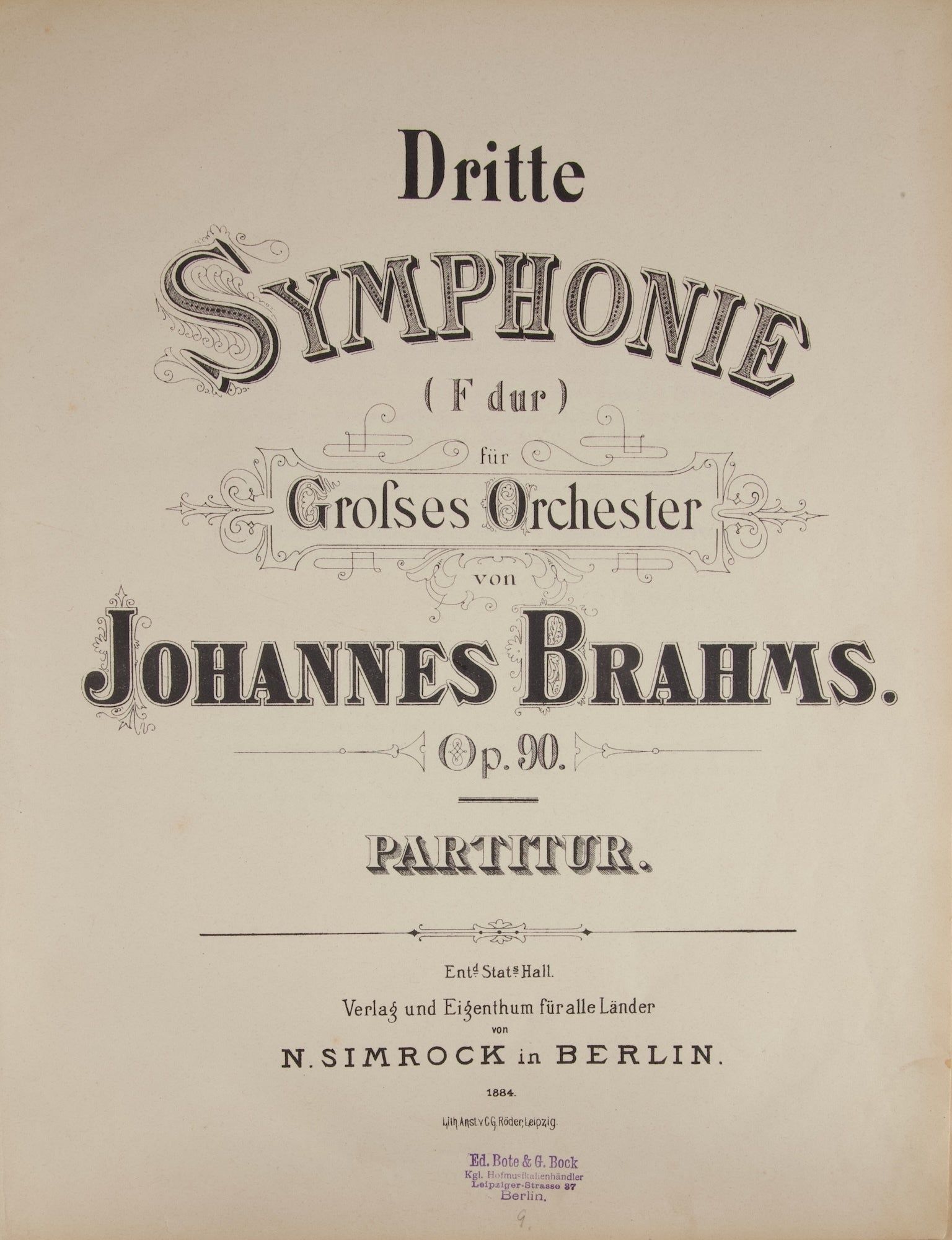
- Berlin: Verlag und Eigenthum für alle Länder von N. Simrock [PN 8454], 1884
Berlin: Verlag und Eigenthum für alle Länder von N. Simrock [PN 8454], 1884. Folio. Black leather-backed textured cloth, titling gilt to spine. 1f. (recto title, verso blank), 1f. (recto publisher's note, verso blank), 5-109, [i] (blank) pp. Title lithographed, with "Lith. Anst. v. C.G. Röder, Leipzig" to foot; music transfer-printed.
With small handstamp of Berlin music publisher and distributor Bote & G. Bock to blank foot of title.
Binding worn, rubbed, and bumped. Occasional minor staining and small tears to blank lower margins; some signatures loose; tear to pp. 33/34 repaired with clear tape; pp. 35/36 detached. First Edition, second issue. Deutsch p. 259. Hofmann p. 191. McCorkle p. 372. Fuld pp. 554-555 and pp. 691-692. Sonneck p. 56. Possibly printed at approximately the same time as the first, engraved, issue (virtually unobtainable), which was printed in only a handful of copies, most probably expressly for the composer and friends.
"With his Third Symphony op. 90 Brahms achieved a new level of coherence in a large-scale orchestral work. It is the shortest of the four symphonies, lasting only half an hour in most performances. The durations of the individual movements are closer to being equal than in any of the others. The compact dimensions and balanced proportions seem intended to point up processes that extend over the entire work. These include the most direct thematic recall in any symphonic work by Brahms: the opening motto and theme return transfigured at the end of the finale. Coherence is also imparted by harmonic devices, such as the frequent juxtaposition of F major and F minor. The tonal scheme is unique in the genre: outer movements centred on F and inner movements on C, thus creating a plateau of harmonic tension in the dominant that implies a large-scale sonata form over the whole work." George S. Bozarth and Walter Frisch in Grove Music Online.
With small handstamp of Berlin music publisher and distributor Bote & G. Bock to blank foot of title.
Binding worn, rubbed, and bumped. Occasional minor staining and small tears to blank lower margins; some signatures loose; tear to pp. 33/34 repaired with clear tape; pp. 35/36 detached. First Edition, second issue. Deutsch p. 259. Hofmann p. 191. McCorkle p. 372. Fuld pp. 554-555 and pp. 691-692. Sonneck p. 56. Possibly printed at approximately the same time as the first, engraved, issue (virtually unobtainable), which was printed in only a handful of copies, most probably expressly for the composer and friends.
"With his Third Symphony op. 90 Brahms achieved a new level of coherence in a large-scale orchestral work. It is the shortest of the four symphonies, lasting only half an hour in most performances. The durations of the individual movements are closer to being equal than in any of the others. The compact dimensions and balanced proportions seem intended to point up processes that extend over the entire work. These include the most direct thematic recall in any symphonic work by Brahms: the opening motto and theme return transfigured at the end of the finale. Coherence is also imparted by harmonic devices, such as the frequent juxtaposition of F major and F minor. The tonal scheme is unique in the genre: outer movements centred on F and inner movements on C, thus creating a plateau of harmonic tension in the dominant that implies a large-scale sonata form over the whole work." George S. Bozarth and Walter Frisch in Grove Music Online.
Details
Title
Dritte Symphonie (F dur) für Groſses Orchester ... Op. 90. Partitur. [Full score]
Author
BRAHMS, Johannes 1833-1897
Condition
Unknown
Publisher
Verlag und Eigenthum für alle Länder von N. Simrock [PN 8454]: Berlin
Date
1884