

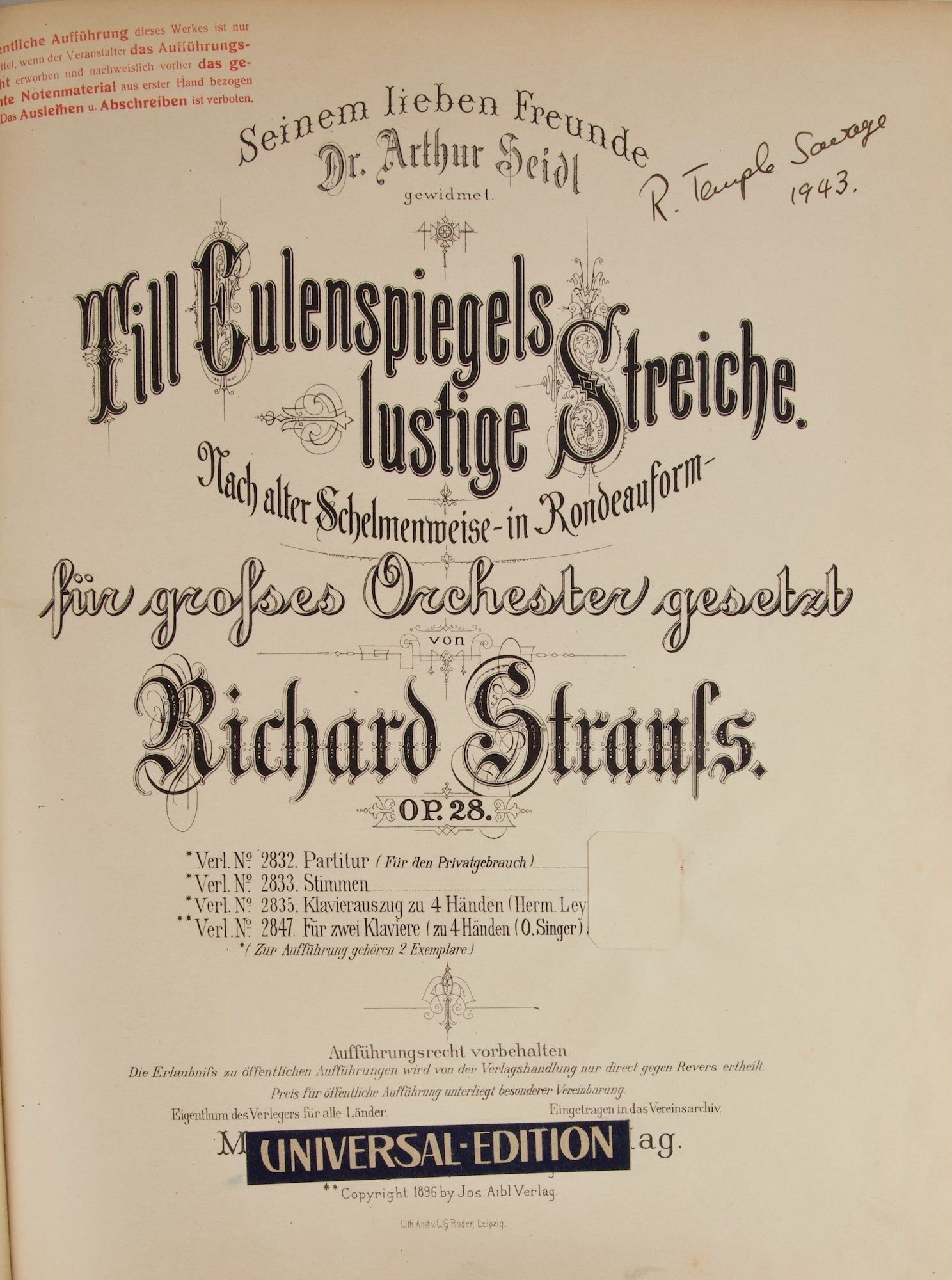
Till Eulenspiegels lustige Streiche. Nach alter Schelmenweise - in Rondeauform für grosses Orchester gesetzt ... Seinem lieben Freunde Dr. Arthur Seidl gewidmet ... Op. 28. Verl. No. 2832. Partitur (Für den Privatgebrauch). [Full score]
- München: Jos. Aibl Verlag [PN 2832], 1896
München: Jos. Aibl Verlag [PN 2832], 1896. Folio. Full dark blue cloth with titling and owner's name "R. Temple Savage" gilt to upper, titling gilt to spine. 1f. (recto title, verso "Orchesterbesetzung"), 3-60 pp. With notice of the 4-hand arrangement by O. Singer added to title and "Lith. Anst. v. C. G. Röder" to foot.
With red handstamped copyright notice to upper inner corner of title and rectangular Univeral-Edition overpaste to lower margin; small octagonal ivory label laid down over printed prices.
Provenance
Richard Temple Savage (1909-1996), bass clarinettist under Sir Thomas Beecham in the London Philharmonic Orchestra, 1934-1946 then Chief Librarian and member of the orchestra at the Royal Opera House, Covent Garden, with his handstamp "The Property of R. Temple Savage" within rectangular border to front free endpaper and signature and date of 1943 to upper outer corner of title.
Binding slightly worn, rubbed, and bumped. Minor internal wear and browning; upper outer corners slightly creased. First Edition, later issue. Sonneck Orchestral Music p. 453. Fuld p. 580. Trenner 171. Asow I, p. 156.
Strauss "emerged soon after the deaths of Wagner and Brahms as the most important living German composer. During an artistic career which spanned nearly eight decades, he composed in virtually all musical genres, but became best known for his tone poems (composed during the closing years of the 19th century) and his operas (from the early decades of the 20th). ...
Shortly after the Guntram première he decided to compose a one-act opera Till Eulenspiegel bei den Schildbürgern, though he never got beyond an incomplete text draft. Why he scrapped the opera for a tone poem is not clear, but judging from his programme notes, the symphonic work is based on a different scenario: 'Once upon a time there was a knavish fool named Till Eulenspiegel. He was a wicked goblin up to new tricks'. Till rides on horseback through the market, mocks religion (disguised as a cleric), flirts with women, engages in academic double talk with his philistine audience, and by the end finds himself on the scaffold, soon to be hanged. Strauss did not call Till a tone poem but rather a 'Rondeau Form for Large Orchestra'. Richard Specht suggested this might well have been the first prank, given that the only connection with the old French forme fixe is in the spelling. Strauss later described the structure as being an 'expansion of rondo form through poetic content', and cited Beethoven's Eighth Symphony as his model. Given the libertine qualities of young Till, as well as the episodic nature of the work, a rondo would seem quite appropriate. But, as in Don Juan, the form is hardly conventional: the sense of rondo is achieved mostly by the return of Till's two themes to articulate his various adventures. Completed in May 1895, the compact Till Eulenspiegel was introduced with great success six months later and remains Strauss's most often performed orchestral piece. That he had learnt much about orchestral detail and nuance during the six years since Tod und Verklärung is evinced by his brilliant use of the ratchet when Till rides through the market, or by the piercing D clarinet when he whistles in the face of death." Bryan Gilliam and Charles Youmans in Grove Music Online.
With red handstamped copyright notice to upper inner corner of title and rectangular Univeral-Edition overpaste to lower margin; small octagonal ivory label laid down over printed prices.
Provenance
Richard Temple Savage (1909-1996), bass clarinettist under Sir Thomas Beecham in the London Philharmonic Orchestra, 1934-1946 then Chief Librarian and member of the orchestra at the Royal Opera House, Covent Garden, with his handstamp "The Property of R. Temple Savage" within rectangular border to front free endpaper and signature and date of 1943 to upper outer corner of title.
Binding slightly worn, rubbed, and bumped. Minor internal wear and browning; upper outer corners slightly creased. First Edition, later issue. Sonneck Orchestral Music p. 453. Fuld p. 580. Trenner 171. Asow I, p. 156.
Strauss "emerged soon after the deaths of Wagner and Brahms as the most important living German composer. During an artistic career which spanned nearly eight decades, he composed in virtually all musical genres, but became best known for his tone poems (composed during the closing years of the 19th century) and his operas (from the early decades of the 20th). ...
Shortly after the Guntram première he decided to compose a one-act opera Till Eulenspiegel bei den Schildbürgern, though he never got beyond an incomplete text draft. Why he scrapped the opera for a tone poem is not clear, but judging from his programme notes, the symphonic work is based on a different scenario: 'Once upon a time there was a knavish fool named Till Eulenspiegel. He was a wicked goblin up to new tricks'. Till rides on horseback through the market, mocks religion (disguised as a cleric), flirts with women, engages in academic double talk with his philistine audience, and by the end finds himself on the scaffold, soon to be hanged. Strauss did not call Till a tone poem but rather a 'Rondeau Form for Large Orchestra'. Richard Specht suggested this might well have been the first prank, given that the only connection with the old French forme fixe is in the spelling. Strauss later described the structure as being an 'expansion of rondo form through poetic content', and cited Beethoven's Eighth Symphony as his model. Given the libertine qualities of young Till, as well as the episodic nature of the work, a rondo would seem quite appropriate. But, as in Don Juan, the form is hardly conventional: the sense of rondo is achieved mostly by the return of Till's two themes to articulate his various adventures. Completed in May 1895, the compact Till Eulenspiegel was introduced with great success six months later and remains Strauss's most often performed orchestral piece. That he had learnt much about orchestral detail and nuance during the six years since Tod und Verklärung is evinced by his brilliant use of the ratchet when Till rides through the market, or by the piercing D clarinet when he whistles in the face of death." Bryan Gilliam and Charles Youmans in Grove Music Online.
Details
Title
Till Eulenspiegels lustige Streiche. Nach alter Schelmenweise - in Rondeauform für grosses Orchester gesetzt ... Seinem lieben Freunde Dr. Arthur Seidl gewidmet ... Op. 28. Verl. No. 2832. Partitur (Für den Privatgebrauch). [Full score]
Author
STRAUSS, Richard 1864-1949
Condition
Unknown
Publisher
Jos. Aibl Verlag [PN 2832]: München
Date
1896