

Solomon. A Serenata, In Score, Taken from The Canticles. Set to Musick By Mr. William Boyce, Composer to His Majesty. [Full score]
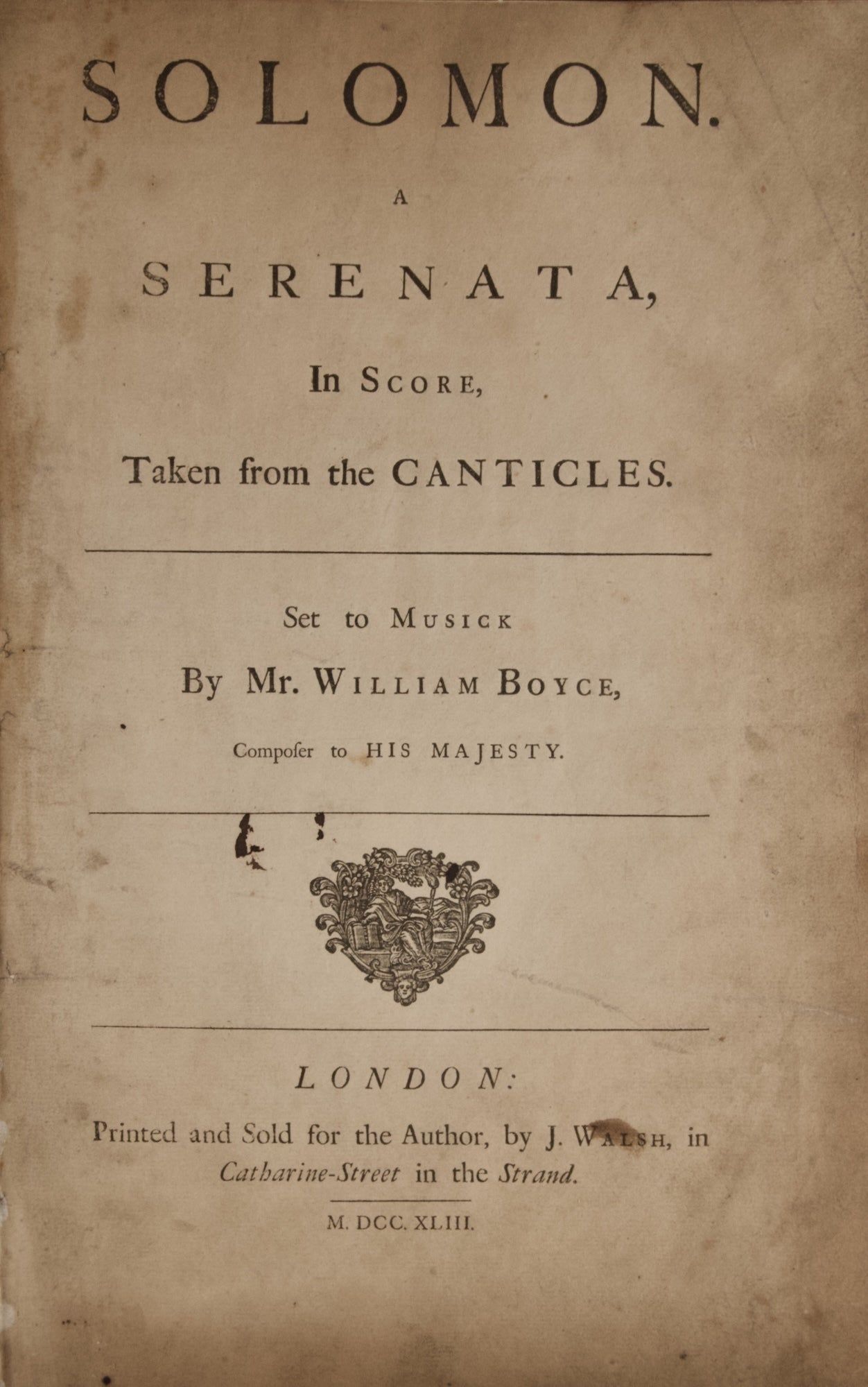
- London: Printed and Sold for the Author, by J. Walsh, in Catharine-Street in the Strand, 1743
London: Printed and Sold for the Author, by J. Walsh, in Catharine-Street in the Strand, 1743. Folio. Disbound. Contemporary half mid-tan leather with marbled boards with titling in contemporary manuscript to upper, spine in compartments gilt with dark red leather title label gilt. 1f. (recto title, verso blank), 100, [101], [i] (blank), [iv] (list of subscribers) pp. Title and subscribers list typeset, music engraved.
Binding worn, rubbed, and bumped; upper detached. Occasional wear; small stains, foxing, browning, soiling, and repairs; outer margin of blank verso of title reinforced with narrow strip of paper. Page 101 lacking and provided in 18th manuscript facsimile. First Edition. Smith and Humphries 248, p. 57. BUC p. 129. RISM B4074.
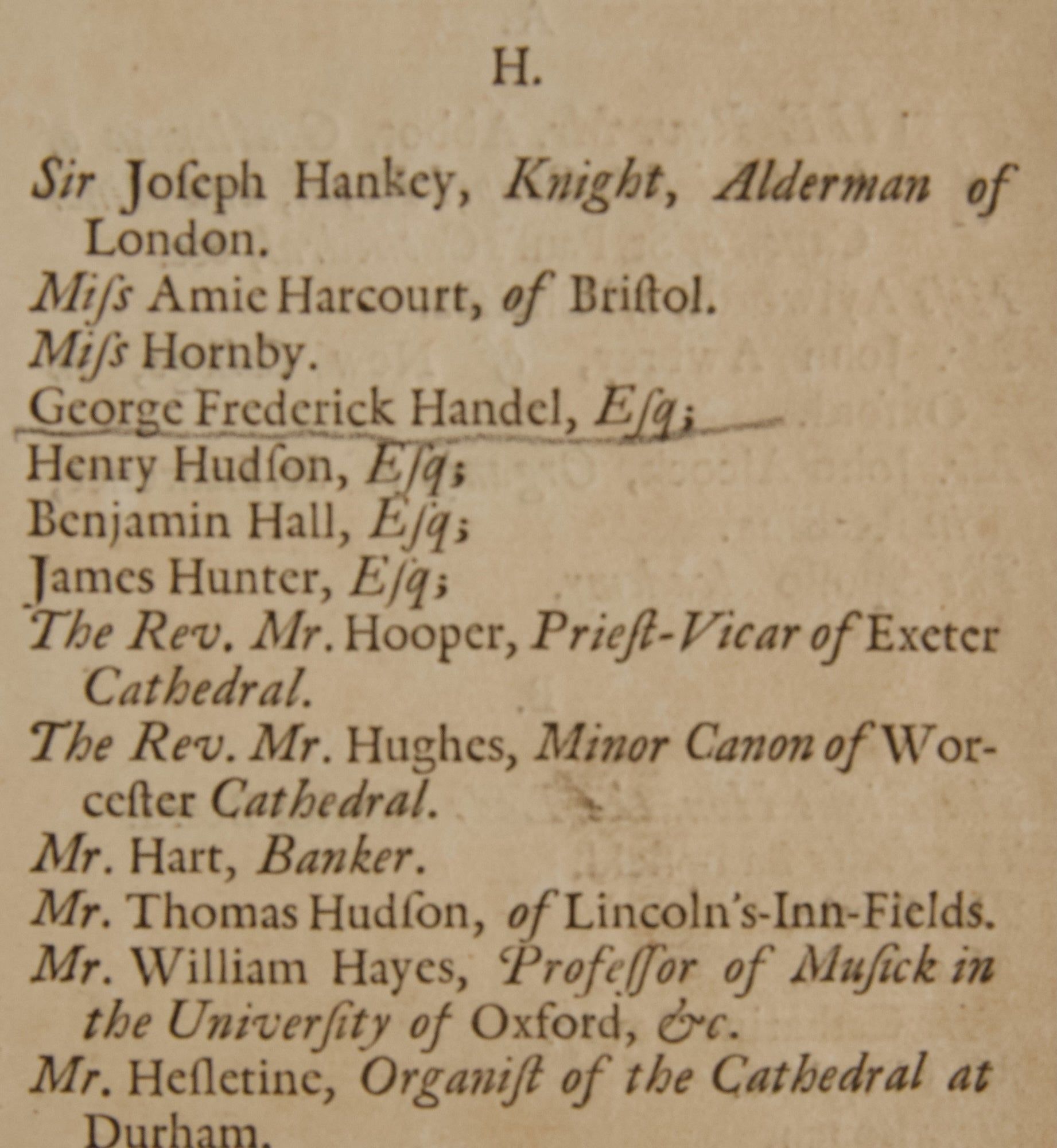
The subscribers list is quite distinguished and includes most of the leading English church musicians of the day, most notably George Frederick Handel, one of only 15 musical publications to which he subscribed. See Simon: Handel A Celebration of his Life and Times 1685-1759, p. 288.
"Eminent equally as a composer for the church and the theatre, [Boyce] has claims to be regarded as the leading English representative of the late Baroque style, and was also significant for his role as a musical antiquarian and editor... It was probably in autumn 1742 that the serenata Solomon was first given, at the Society of Apollo; a performance in Dublin may have followed. The work became popular enough to be published in full score in 1743 and it enjoyed fairly frequent performances until the turn of the century, after which it lost favour because of the mild eroticism of some of the words. These derive from the Song of Solomon; of the two soloists, the tenor has the title role while the soprano represents the unnamed girl he loves. There are some fine vigorous fugal choruses and a remarkable air with bassoon obbligato. The whole work has a formal balance and a consistently high musical quality." The New Grove Vol. 3, p. 138.
"It was through 'Solomon' that Boyce achieved his first notable success as a composer in the early 1740s... Though outwardly a cantata-like work for two vocal soloists, chorus and orchestra with a text based on the biblical 'Song of Solomon', it was one of the few English works to be designated from the outset by the Italian term 'serenata'. The librettist, Edward Moore, was resident in Ireland during its composition, and he may well have envisaged a first performance there; however, it was first heard at the Apollo Academy in autumn 1742... John Walsh's publication of 'Solomon' on behalf of the composer early in 1743 was enthusiastically received. Unusually for a work of its kind, it was issued complete and in full score, thus facilitating the first public performances at Ruckhold House, Essex, in summer 1743 and later that year in London." Ian Bartlett in Grove Music Online.
Binding worn, rubbed, and bumped; upper detached. Occasional wear; small stains, foxing, browning, soiling, and repairs; outer margin of blank verso of title reinforced with narrow strip of paper. Page 101 lacking and provided in 18th manuscript facsimile. First Edition. Smith and Humphries 248, p. 57. BUC p. 129. RISM B4074.
The subscribers list is quite distinguished and includes most of the leading English church musicians of the day, most notably George Frederick Handel, one of only 15 musical publications to which he subscribed. See Simon: Handel A Celebration of his Life and Times 1685-1759, p. 288.
"Eminent equally as a composer for the church and the theatre, [Boyce] has claims to be regarded as the leading English representative of the late Baroque style, and was also significant for his role as a musical antiquarian and editor... It was probably in autumn 1742 that the serenata Solomon was first given, at the Society of Apollo; a performance in Dublin may have followed. The work became popular enough to be published in full score in 1743 and it enjoyed fairly frequent performances until the turn of the century, after which it lost favour because of the mild eroticism of some of the words. These derive from the Song of Solomon; of the two soloists, the tenor has the title role while the soprano represents the unnamed girl he loves. There are some fine vigorous fugal choruses and a remarkable air with bassoon obbligato. The whole work has a formal balance and a consistently high musical quality." The New Grove Vol. 3, p. 138.
"It was through 'Solomon' that Boyce achieved his first notable success as a composer in the early 1740s... Though outwardly a cantata-like work for two vocal soloists, chorus and orchestra with a text based on the biblical 'Song of Solomon', it was one of the few English works to be designated from the outset by the Italian term 'serenata'. The librettist, Edward Moore, was resident in Ireland during its composition, and he may well have envisaged a first performance there; however, it was first heard at the Apollo Academy in autumn 1742... John Walsh's publication of 'Solomon' on behalf of the composer early in 1743 was enthusiastically received. Unusually for a work of its kind, it was issued complete and in full score, thus facilitating the first public performances at Ruckhold House, Essex, in summer 1743 and later that year in London." Ian Bartlett in Grove Music Online.
Details
Title
Solomon. A Serenata, In Score, Taken from The Canticles. Set to Musick By Mr. William Boyce, Composer to His Majesty. [Full score]
Author
BOYCE, William 1711-1779
Condition
Unknown
Publisher
Printed and Sold for the Author, by J. Walsh, in Catharine-Street in the Strand: London
Date
1743