

Collection of rare early 18th century songs published in London ca. 1700-1735
Folio. Contemporary dark brown leather-backed blue/gray boards. Titled "A collection of Songs by several eminent Masters" in contemporary manuscript on recto of first page of music. Engraved throughout.
Provenance
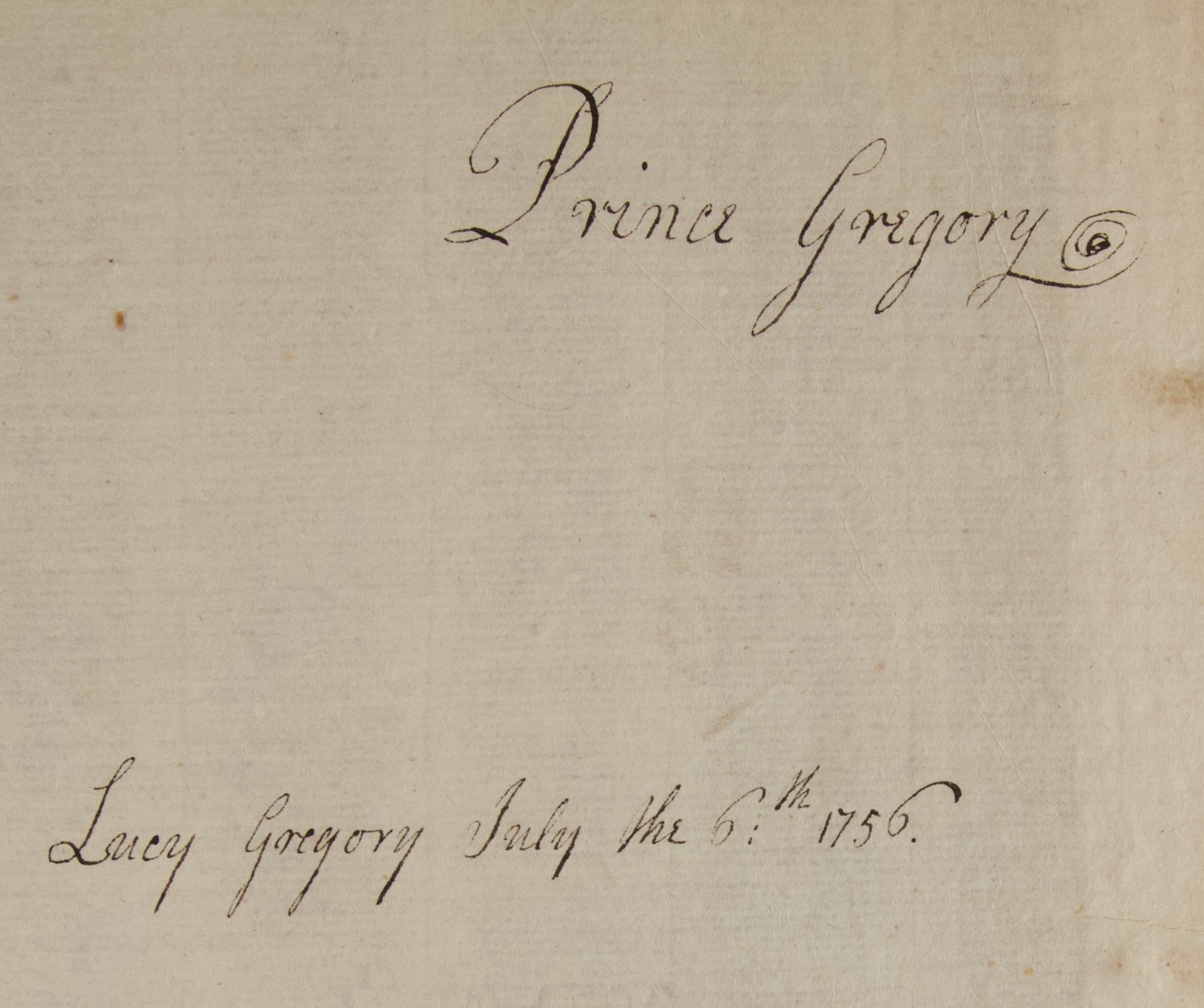
With "Lucy Gregory July the 6th 1756" and "Prince Gregory" in contemporary manuscript to front pastedown. Manuscript titling and annotation "Ex dono Revd. Dr. Dawson For use of Musical Society, Windsor Castle to be returned to Dr. Dawson When ye club ceases viz when it is reduced to three persons" to blank recto of first song along with title, and index to blank verso of final song.
Contains 33 songs including works by Barrett, Blow, Eccles, Galliard, Handel (8), Leveridge, Orlandini, Pepusch, Daniel Purcell, Henry Purcell (2), Weldon, and others. Scored mainly for voice (most for one voice and few for two) and figured basso continuo, with single-line flute arrangements for some songs.
1. Handel. "A Favorite song in the Opera of Theseus" ["See, see your faithfull lover pineing"]. London, ca. 1720. [i] (blank), 2, [i] (blank) pp. BUC p. 1001.
2. Purcell, H. "Sing all ye muses. A song set by Mr. Henr. Purcell The Words by Mr Durfey." London, ca. 1700. From Part I of The Comical History of Don Quixote. 4 pp. BUC p. 861 (another edition). Scored for two voices and figured basso continuo.
3. Handel. "Mi brilla in English and Italian" ["Be Kind and Love" / "Mi brilla nel seno"]. London, ca. 1720. [i] (blank), 2, [i] (blank) pp. [HWV 10, Silla].BUC p. 93.
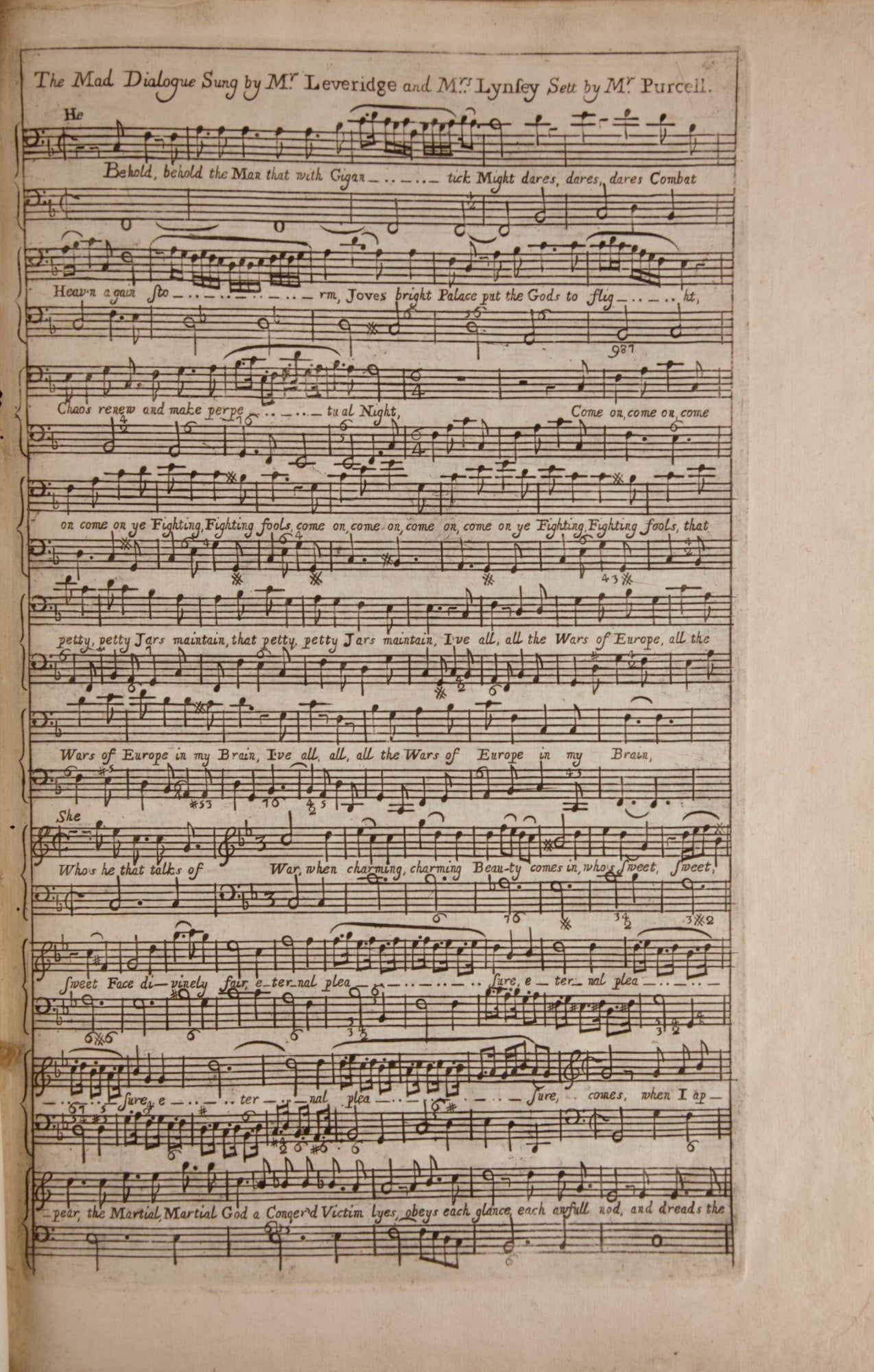
4. Purcell, H. "The Mad Dialogue Sung by Mr. Leveridge and Mrs. Lynsey" ["Behold the man with gigantick might"]. From The Richmond Heiress. London, ca. 1700. 3, [i] (blank) pp. BUC p. 862.
5. Handel. "Vieni torna in English & Italian" ["Turn o turn thee dearest Creature / Vieni torna Idolo mio"]. London, ca. 1715. [i] (blank), 2, [i] (blank) pp. [HWV 9, Teseo]. BUC p. 1041.
6. Handel. "A Favourite Song by an Eminent Master Within the Compass of the Flute" [Recitativo: "Lo here my Love" / Aria: "Love in her eyes sits playing"]. London, ca. 1725. [i] (blank), 2, [i] (blank) pp. BUC p. 624.
7. Handel. "A Song with a Symphony for an Octave Flute & Violins" [Recitativo: "Ye verdant Plains" / Aria: "Hush ye pretty warbling Quire"]. London, ca. 1722. [i], 3 (paginated 4-6), [i] (blank) pp. [HWV 49, Acis and Galatea]. BUC p. 432 (date incorrect); JISC (two copies, at Oxford and the British Library). In score, for piccolo, violin, voice, and unfigured basso continuo.
8. Handel. "A song by an Eminent Master" ["Would you gain the tender Creature"]. London, ca. 1750. [HWV 49, Acis and Galatea]. BUC pp. 432, [?]1091.
9. Eccles. "Air in the Opera Semele. The words by Mr Congreve" ["Come Zephrys"]. London, ca. 1730. [i] (blank), 2, [i] (blank) pp. BUC p. 309.
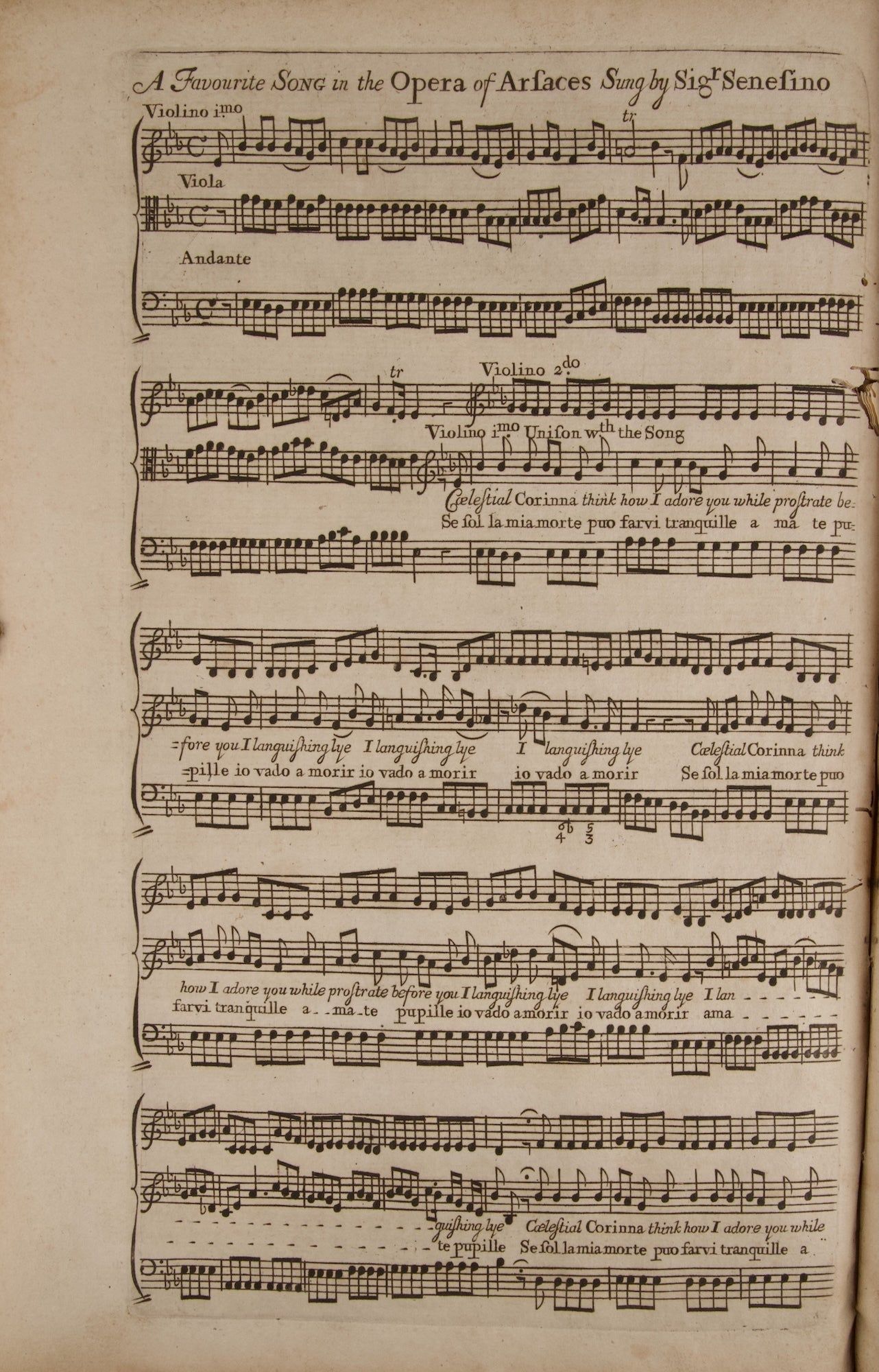
10. Orlandini. "A favourite Song in the Opera of Arsaces Sung by Sigr. Senesino" ["Se sol la mia morte" / "Cœlestial Corinna"]. London, ca. 1721. [i] (blank), 2, [i] (blank) pp. BUC p. 56. "Lucy Gregory" in contemporary manuscript to upper outer corner of final blank page.
11. Anon. "The Ladys Repulse or Favourite Minuet in Hercules" [a pasticcio]. London, ca. 1715. 2 pp. BUC p. 478.
12. Barrett. "A Song sett by Mr. Iohn Barrett Sung by Mrs. Lindsey" ["Mistake not Nymph"]. London, ca. 1705. 1f. (recto music, verso blank) pp. BUC p. 86.
13. Barrett. "Liberia A Song Set to Musick" ["Liberia's all my Thought"]. London, ca. 1715. 1f. (recto music, verso blank) pp. BUC p. 86.
14. Purcell, D. "Lovely Charmer. A song in the Island Princess." London, ca. 1700. 1f. (recto music, verso blank) pp. BUC, p. 856.
15. Leveridge. "A Favorite Song in the new Opera The words by Mr. Leveridge." London, ca. 1720. 1f. (recto music, verso blank) pp. BUC p. 339.
16. Anon. "Tom a Bedlam" ["Forth from my dark and Dismall cell"]. London, ca. 1720. 1f. (recto music, verso blank) pp. BUC p. 345.
17. Leveridge. "A Scotch Song Sung by Mr. Leveridge the words by Mr Durfey" ["Farewell my Bonny"]. London, ca. 1710. 1f. (recto music paginated "10," verso blank) pp. BUC p. 325.
18. Blow. "Go Perjur'd Man. A Song, for two Voices." London, ca. 1710. 1f. (recto music, verso blank) pp. BUC p. 115.
19. Anon. "A song by a Gentleman" ["How charming"]. London, ca. 1730. 1f. (recto music, verso blank) pp. BUC p. 370.
20. Weldon. "Orpheus Song to the Waves Sett by Mr. Iohn Weldon Sung by Mrs. Linsey." ["Stop, O ye Waves"]. London, ca. 1710. 1f. (recto song, verso version for flute) pp. BUC p. 1065.
21. Anon. "A Song by a Great Master" ["Beauteous Idol, charming Creature"]. London, ca. 1720. 1f. (recto music, verso blank) pp. BUC p. 93.
22. Turner. "A Song On Mira's Singing and Beauty" ["Singing charms The Bless'd above"]. London, ca. 1710. 1f. (recto music, verso blank) pp. BUC p. 1024.
23. M. F. "A song in the Italian style by F M" ["Ah, Crudel prenesto"]. London, ca. 1720. 1f. (recto music, verso blank) pp. BUC p. 638. A humorous song satirizing Italian opera with text in nonsense-Italian.
24. Galliard. "Sung by Mr. Pack in The Opera of Circe" ["Fairest if thou can'st be King"]. London, ca. 1720. 1f. (recto music, verso blank) pp. BUC p. 358.
25. Vanbrughe. "Apollo to Daphne by Mr. Vanbrughe" ["My Dearest Daphne"]. London, ca. 1735. Not in BUC, but may be from Vanbrughe's collection Mirth & Harmony; see BUC p. 1034.
26. Anon. "The Address with The Lady's Answer" ["Ah lovely Nymph"]. London, ca. 1725. 1f. (recto music paginated "7," verso blank) pp. BUC p. 11.
27. Handel. "A Song the words by Mr. Kirkland set to a Trumpet Minuet of Mr. Hendell's" ["Phillis the Lovely"]. London, ca. 1725. 1f. (recto music, verso blank) pp. [HWV 349, Watermusic]. BUC p. 781.
28. Young and Leveridge. "The Reproach" ["Send back my long stray'd Eyes"] and "Mr. Leveridge's Tune." London, ca. 1720. 1f. (recto music, verso blank). BUC p. 1098. The instrumental tune appears to be unrelated to the song; here may, however, be some association as the song incorporates imagery related to the eyes, and the tune's name (not given here) is "Black-eyed Susan."
29. Anon. "A Song after the Italian Manner by an Eminent Master" ["Lovely cruel charming fair"]. London, ca. 1715. 1f. (recto music, verso blank) pp. BUC p. 632 (another edition).
30. Handel. "Di godere in English & Italian by Mr. Hendell" ["Di godere" / "Oh my dearest"]. London, ca. 1720. 1f. (recto music, verso blank). [HWV 228]. Not in BUC; possibly related to an edition in Foundling Museum. JISC ("This song appeared in two editions in 1719: the first was in The Yearly Subscriptions, a volume of twenty songs, advertised on 5 December, the second in the Monthly Mask of Vocal Music issued on 24 December").
31. Pepusch. "A Song in the Mask of Martillo" ["Tender Hearts to ev'ry Passion"]. London, ca. 1716. 1f. (recto music, verso blank) pp. BUC p. 722.
32. Carey. "The Midsummer Wish Taken from the Journal" ["Waft me some soft and cooling Breeze"]. London, ca. 1725. 1f. (recto music, verso blank) pp. BUC p. 165.
33. Leveridge. "A Song in the Beau Demolish'd Sung by Mr. Leveridge" ["Whilst I'm carrouzing"]. London, ca. 1730. 1f. (recto music, verso index in contemporary manuscript) pp. BUC p. 615.
Binding worn, rubbed, and bumped; spine partially lacking; lower board nearly detached. Minor dampstaining and worming; occasional small stains. John Barrett (ca. 1674-ca. 1745) was an English composer and organist, pupil of John Blow. "Like many of his contemporaries, such as Jeremiah Clarke, John Eccles and Daniel Purcell, Barrett composed mainly for the theatre, and his many songs, mostly of the double-barrelled art song variety, are both tuneful and attractive." Christopher Powell, revised by H. Diack Johnstone in Grove Music Online
John Blow (1649-1708) was an English composer, organist, and teacher. "By his mid-20s he had become the foremost musician in England, and in later years he was the elder statesman of the Restoration school, whose chief luminary was Henry Purcell." Bruce Wood in Grove Music Online
John Eccles (ca. 1668-1735) was an English composer. "Eccles's greatest talent is revealed in his many songs. Remarkable for their beautifully contoured melodies and impeccable prosody, they quickly capture the mood and subtleties of the poetry and are eminently singable. His large works are notable for their dramatic pacing and their carefully planned tonal architecture. In the latter respect he surpassed even Purcell, and was far in advance of his day. Eccles brought the Restoration tradition to its close. After Purcell's death in 1695 he was undoubtedly the greatest of the Restoration theatre composers." Stoddard Lincoln in Grove Music Online
John Ernest Galliard (ca. 1687-1749), German composer and oboist, "certainly played a significant role in London's musical life in the first half of the 18th century." Roger Fiske, revised by Richard G. King in Grove Music Online
George Frideric Handel (1685-1759), English composer of German birth, was "one of the greatest composers of his age." Anthony Hicks in Grove Music Online
Richard Leveridge (1670-1758), English bass and composer, was "a leading singer on the London stage and a popular composer of songs." Olive Baldwin, revised by Thelma Wilson in Grove Music Online.
Giuseppe Maria Orlandini (1676-1760) was an Italian composer. "The large number and wide spread of performances of his operas confirm the opinions of Burney, La Borde, Martini and Quadrio that Orlandini was highly celebrated as a composer of dramatic music. He was best known for his comic intermezzos, in which genre his importance almost certainly outweighs that of Pergolesi. Indeed, Orlandini's Bacocco e Serpilla (under various titles and with added music by various composers) appears to have been the most frequently performed piece of musical drama in the entire 18th century." John Walter Hill and Francesco Giuntini in Grove Music Online
Johann Christoph Pepusch (1667-1752), a German-born composer and theorist active in England, is best known for his arrangement of music for The Beggar's Opera to John Gay's libretto; he composed works in all genres, including vocal music.
Daniel Purcell (ca. 1664-1717), brother (or cousin) of Henry Purcell, was an English composer and organist. "Although he was a victim of invidious comparison with Henry, Daniel was a talented composer whose style, while perhaps too ornate, is never dull or incompetent." Mark Humphreys, revised by Robert Thompson in Grove Music Online
Henry Purcell (1659-1695), composer and organist, "was one of the most important 17th century composers and one of the greatest of all English composers." Peter Holman and Robert Thompson in Grove Music Online
John Weldon (1676-1736), an English organist and composer "of considerable talent," was a pupil of Henry Purcell. Margaret Laurie, revised by Stephen Bullamore in Grove Music Online.
Provenance
With "Lucy Gregory July the 6th 1756" and "Prince Gregory" in contemporary manuscript to front pastedown. Manuscript titling and annotation "Ex dono Revd. Dr. Dawson For use of Musical Society, Windsor Castle to be returned to Dr. Dawson When ye club ceases viz when it is reduced to three persons" to blank recto of first song along with title, and index to blank verso of final song.
Contains 33 songs including works by Barrett, Blow, Eccles, Galliard, Handel (8), Leveridge, Orlandini, Pepusch, Daniel Purcell, Henry Purcell (2), Weldon, and others. Scored mainly for voice (most for one voice and few for two) and figured basso continuo, with single-line flute arrangements for some songs.
1. Handel. "A Favorite song in the Opera of Theseus" ["See, see your faithfull lover pineing"]. London, ca. 1720. [i] (blank), 2, [i] (blank) pp. BUC p. 1001.
2. Purcell, H. "Sing all ye muses. A song set by Mr. Henr. Purcell The Words by Mr Durfey." London, ca. 1700. From Part I of The Comical History of Don Quixote. 4 pp. BUC p. 861 (another edition). Scored for two voices and figured basso continuo.
3. Handel. "Mi brilla in English and Italian" ["Be Kind and Love" / "Mi brilla nel seno"]. London, ca. 1720. [i] (blank), 2, [i] (blank) pp. [HWV 10, Silla].BUC p. 93.
4. Purcell, H. "The Mad Dialogue Sung by Mr. Leveridge and Mrs. Lynsey" ["Behold the man with gigantick might"]. From The Richmond Heiress. London, ca. 1700. 3, [i] (blank) pp. BUC p. 862.
5. Handel. "Vieni torna in English & Italian" ["Turn o turn thee dearest Creature / Vieni torna Idolo mio"]. London, ca. 1715. [i] (blank), 2, [i] (blank) pp. [HWV 9, Teseo]. BUC p. 1041.
6. Handel. "A Favourite Song by an Eminent Master Within the Compass of the Flute" [Recitativo: "Lo here my Love" / Aria: "Love in her eyes sits playing"]. London, ca. 1725. [i] (blank), 2, [i] (blank) pp. BUC p. 624.
7. Handel. "A Song with a Symphony for an Octave Flute & Violins" [Recitativo: "Ye verdant Plains" / Aria: "Hush ye pretty warbling Quire"]. London, ca. 1722. [i], 3 (paginated 4-6), [i] (blank) pp. [HWV 49, Acis and Galatea]. BUC p. 432 (date incorrect); JISC (two copies, at Oxford and the British Library). In score, for piccolo, violin, voice, and unfigured basso continuo.
8. Handel. "A song by an Eminent Master" ["Would you gain the tender Creature"]. London, ca. 1750. [HWV 49, Acis and Galatea]. BUC pp. 432, [?]1091.
9. Eccles. "Air in the Opera Semele. The words by Mr Congreve" ["Come Zephrys"]. London, ca. 1730. [i] (blank), 2, [i] (blank) pp. BUC p. 309.
10. Orlandini. "A favourite Song in the Opera of Arsaces Sung by Sigr. Senesino" ["Se sol la mia morte" / "Cœlestial Corinna"]. London, ca. 1721. [i] (blank), 2, [i] (blank) pp. BUC p. 56. "Lucy Gregory" in contemporary manuscript to upper outer corner of final blank page.
11. Anon. "The Ladys Repulse or Favourite Minuet in Hercules" [a pasticcio]. London, ca. 1715. 2 pp. BUC p. 478.
12. Barrett. "A Song sett by Mr. Iohn Barrett Sung by Mrs. Lindsey" ["Mistake not Nymph"]. London, ca. 1705. 1f. (recto music, verso blank) pp. BUC p. 86.
13. Barrett. "Liberia A Song Set to Musick" ["Liberia's all my Thought"]. London, ca. 1715. 1f. (recto music, verso blank) pp. BUC p. 86.
14. Purcell, D. "Lovely Charmer. A song in the Island Princess." London, ca. 1700. 1f. (recto music, verso blank) pp. BUC, p. 856.
15. Leveridge. "A Favorite Song in the new Opera The words by Mr. Leveridge." London, ca. 1720. 1f. (recto music, verso blank) pp. BUC p. 339.
16. Anon. "Tom a Bedlam" ["Forth from my dark and Dismall cell"]. London, ca. 1720. 1f. (recto music, verso blank) pp. BUC p. 345.
17. Leveridge. "A Scotch Song Sung by Mr. Leveridge the words by Mr Durfey" ["Farewell my Bonny"]. London, ca. 1710. 1f. (recto music paginated "10," verso blank) pp. BUC p. 325.
18. Blow. "Go Perjur'd Man. A Song, for two Voices." London, ca. 1710. 1f. (recto music, verso blank) pp. BUC p. 115.
19. Anon. "A song by a Gentleman" ["How charming"]. London, ca. 1730. 1f. (recto music, verso blank) pp. BUC p. 370.
20. Weldon. "Orpheus Song to the Waves Sett by Mr. Iohn Weldon Sung by Mrs. Linsey." ["Stop, O ye Waves"]. London, ca. 1710. 1f. (recto song, verso version for flute) pp. BUC p. 1065.
21. Anon. "A Song by a Great Master" ["Beauteous Idol, charming Creature"]. London, ca. 1720. 1f. (recto music, verso blank) pp. BUC p. 93.
22. Turner. "A Song On Mira's Singing and Beauty" ["Singing charms The Bless'd above"]. London, ca. 1710. 1f. (recto music, verso blank) pp. BUC p. 1024.
23. M. F. "A song in the Italian style by F M" ["Ah, Crudel prenesto"]. London, ca. 1720. 1f. (recto music, verso blank) pp. BUC p. 638. A humorous song satirizing Italian opera with text in nonsense-Italian.
24. Galliard. "Sung by Mr. Pack in The Opera of Circe" ["Fairest if thou can'st be King"]. London, ca. 1720. 1f. (recto music, verso blank) pp. BUC p. 358.
25. Vanbrughe. "Apollo to Daphne by Mr. Vanbrughe" ["My Dearest Daphne"]. London, ca. 1735. Not in BUC, but may be from Vanbrughe's collection Mirth & Harmony; see BUC p. 1034.
26. Anon. "The Address with The Lady's Answer" ["Ah lovely Nymph"]. London, ca. 1725. 1f. (recto music paginated "7," verso blank) pp. BUC p. 11.
27. Handel. "A Song the words by Mr. Kirkland set to a Trumpet Minuet of Mr. Hendell's" ["Phillis the Lovely"]. London, ca. 1725. 1f. (recto music, verso blank) pp. [HWV 349, Watermusic]. BUC p. 781.
28. Young and Leveridge. "The Reproach" ["Send back my long stray'd Eyes"] and "Mr. Leveridge's Tune." London, ca. 1720. 1f. (recto music, verso blank). BUC p. 1098. The instrumental tune appears to be unrelated to the song; here may, however, be some association as the song incorporates imagery related to the eyes, and the tune's name (not given here) is "Black-eyed Susan."
29. Anon. "A Song after the Italian Manner by an Eminent Master" ["Lovely cruel charming fair"]. London, ca. 1715. 1f. (recto music, verso blank) pp. BUC p. 632 (another edition).
30. Handel. "Di godere in English & Italian by Mr. Hendell" ["Di godere" / "Oh my dearest"]. London, ca. 1720. 1f. (recto music, verso blank). [HWV 228]. Not in BUC; possibly related to an edition in Foundling Museum. JISC ("This song appeared in two editions in 1719: the first was in The Yearly Subscriptions, a volume of twenty songs, advertised on 5 December, the second in the Monthly Mask of Vocal Music issued on 24 December").
31. Pepusch. "A Song in the Mask of Martillo" ["Tender Hearts to ev'ry Passion"]. London, ca. 1716. 1f. (recto music, verso blank) pp. BUC p. 722.
32. Carey. "The Midsummer Wish Taken from the Journal" ["Waft me some soft and cooling Breeze"]. London, ca. 1725. 1f. (recto music, verso blank) pp. BUC p. 165.
33. Leveridge. "A Song in the Beau Demolish'd Sung by Mr. Leveridge" ["Whilst I'm carrouzing"]. London, ca. 1730. 1f. (recto music, verso index in contemporary manuscript) pp. BUC p. 615.
Binding worn, rubbed, and bumped; spine partially lacking; lower board nearly detached. Minor dampstaining and worming; occasional small stains. John Barrett (ca. 1674-ca. 1745) was an English composer and organist, pupil of John Blow. "Like many of his contemporaries, such as Jeremiah Clarke, John Eccles and Daniel Purcell, Barrett composed mainly for the theatre, and his many songs, mostly of the double-barrelled art song variety, are both tuneful and attractive." Christopher Powell, revised by H. Diack Johnstone in Grove Music Online
John Blow (1649-1708) was an English composer, organist, and teacher. "By his mid-20s he had become the foremost musician in England, and in later years he was the elder statesman of the Restoration school, whose chief luminary was Henry Purcell." Bruce Wood in Grove Music Online
John Eccles (ca. 1668-1735) was an English composer. "Eccles's greatest talent is revealed in his many songs. Remarkable for their beautifully contoured melodies and impeccable prosody, they quickly capture the mood and subtleties of the poetry and are eminently singable. His large works are notable for their dramatic pacing and their carefully planned tonal architecture. In the latter respect he surpassed even Purcell, and was far in advance of his day. Eccles brought the Restoration tradition to its close. After Purcell's death in 1695 he was undoubtedly the greatest of the Restoration theatre composers." Stoddard Lincoln in Grove Music Online
John Ernest Galliard (ca. 1687-1749), German composer and oboist, "certainly played a significant role in London's musical life in the first half of the 18th century." Roger Fiske, revised by Richard G. King in Grove Music Online
George Frideric Handel (1685-1759), English composer of German birth, was "one of the greatest composers of his age." Anthony Hicks in Grove Music Online
Richard Leveridge (1670-1758), English bass and composer, was "a leading singer on the London stage and a popular composer of songs." Olive Baldwin, revised by Thelma Wilson in Grove Music Online.
Giuseppe Maria Orlandini (1676-1760) was an Italian composer. "The large number and wide spread of performances of his operas confirm the opinions of Burney, La Borde, Martini and Quadrio that Orlandini was highly celebrated as a composer of dramatic music. He was best known for his comic intermezzos, in which genre his importance almost certainly outweighs that of Pergolesi. Indeed, Orlandini's Bacocco e Serpilla (under various titles and with added music by various composers) appears to have been the most frequently performed piece of musical drama in the entire 18th century." John Walter Hill and Francesco Giuntini in Grove Music Online
Johann Christoph Pepusch (1667-1752), a German-born composer and theorist active in England, is best known for his arrangement of music for The Beggar's Opera to John Gay's libretto; he composed works in all genres, including vocal music.
Daniel Purcell (ca. 1664-1717), brother (or cousin) of Henry Purcell, was an English composer and organist. "Although he was a victim of invidious comparison with Henry, Daniel was a talented composer whose style, while perhaps too ornate, is never dull or incompetent." Mark Humphreys, revised by Robert Thompson in Grove Music Online
Henry Purcell (1659-1695), composer and organist, "was one of the most important 17th century composers and one of the greatest of all English composers." Peter Holman and Robert Thompson in Grove Music Online
John Weldon (1676-1736), an English organist and composer "of considerable talent," was a pupil of Henry Purcell. Margaret Laurie, revised by Stephen Bullamore in Grove Music Online.
Details
Title
Collection of rare early 18th century songs published in London ca. 1700-1735
Author
[VOCAL MUSIC - 18th Century - English]
Condition
Unknown