

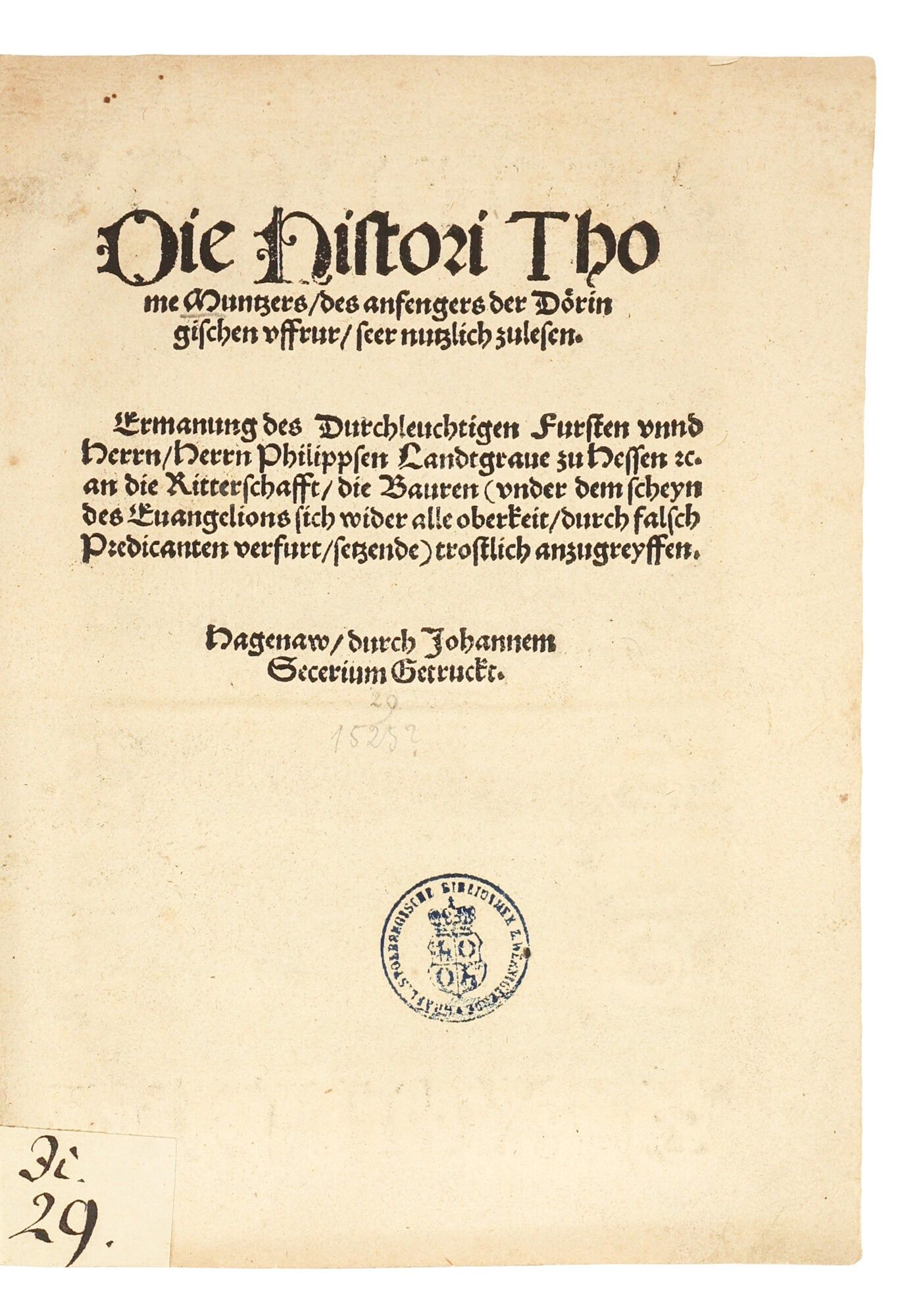
Die Histori Thome Muntzers, des anfengers der Döringischen vffrur, seer nutzlich zulesen. Ermanung des Durchleuchtigen Fursten vnnd Herrn, Herrn Philippsen Landtgraue zu Hessen etc. an die Ritterschafft, die Bauren (vnder dem scheyn des Euangelions sich wider alle oberkeit, durch falsch Predicanten verfurt, setzende) trostlich anzugreyffen

- Hardcover
- Hagenau: Johann Setzer, 1525
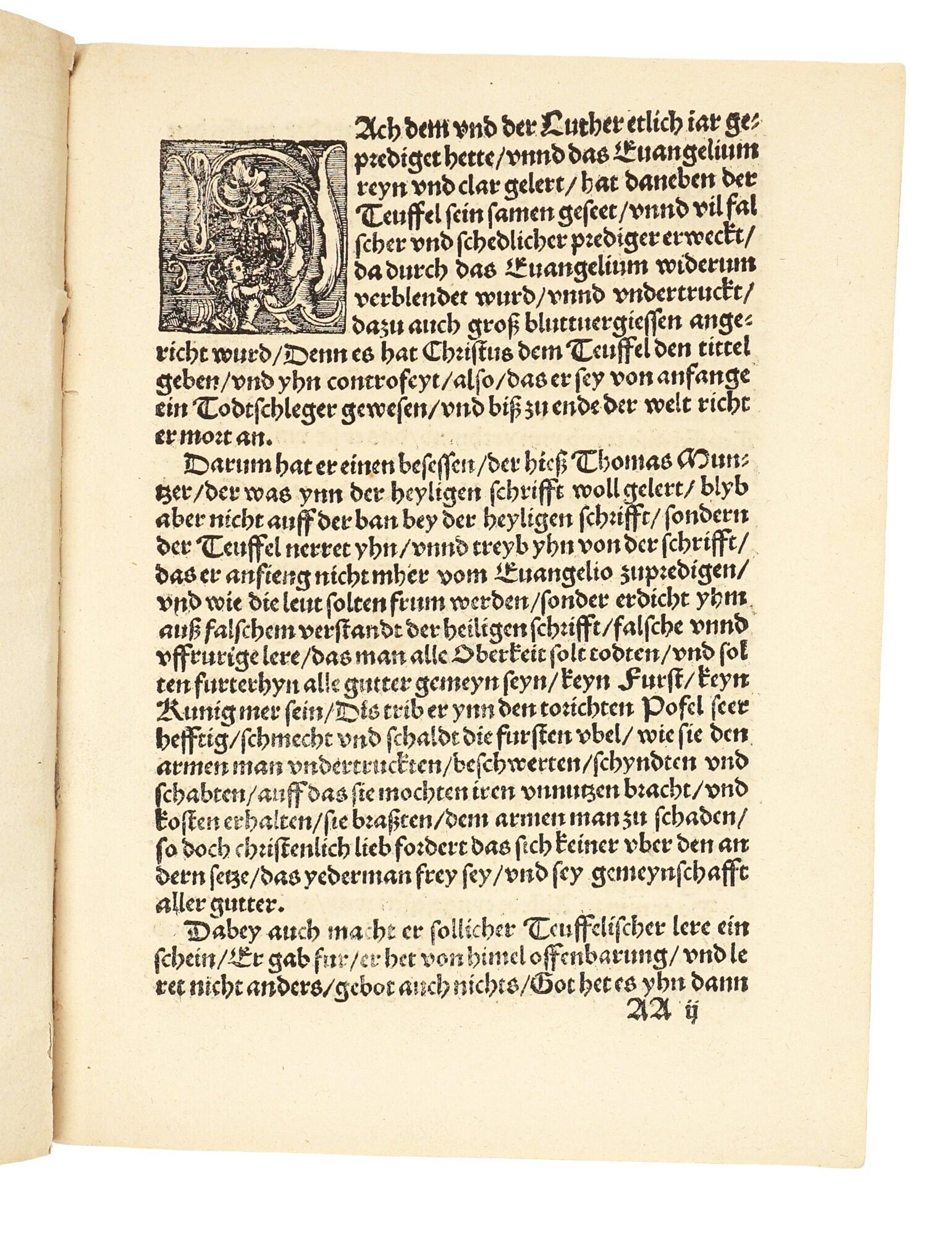
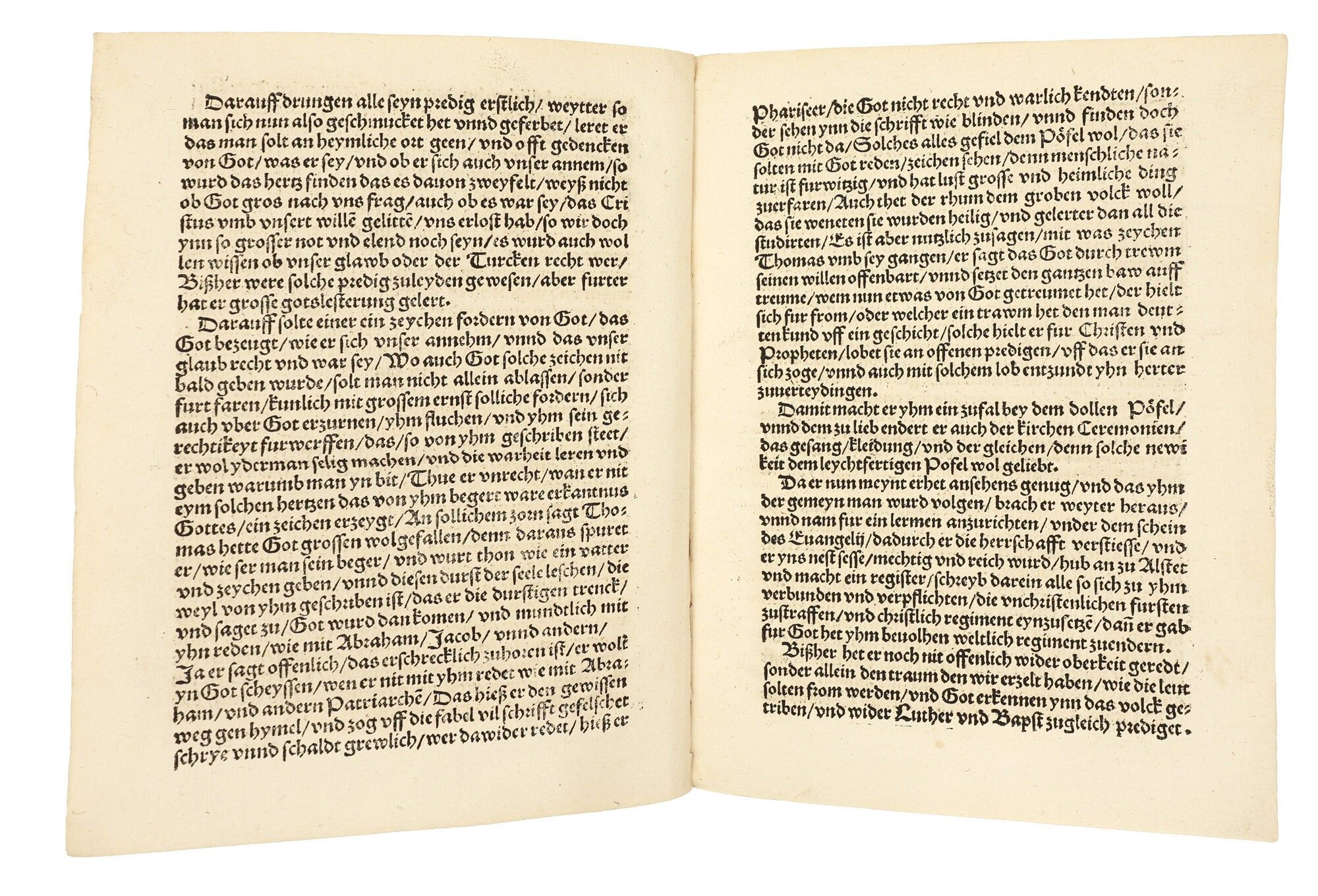
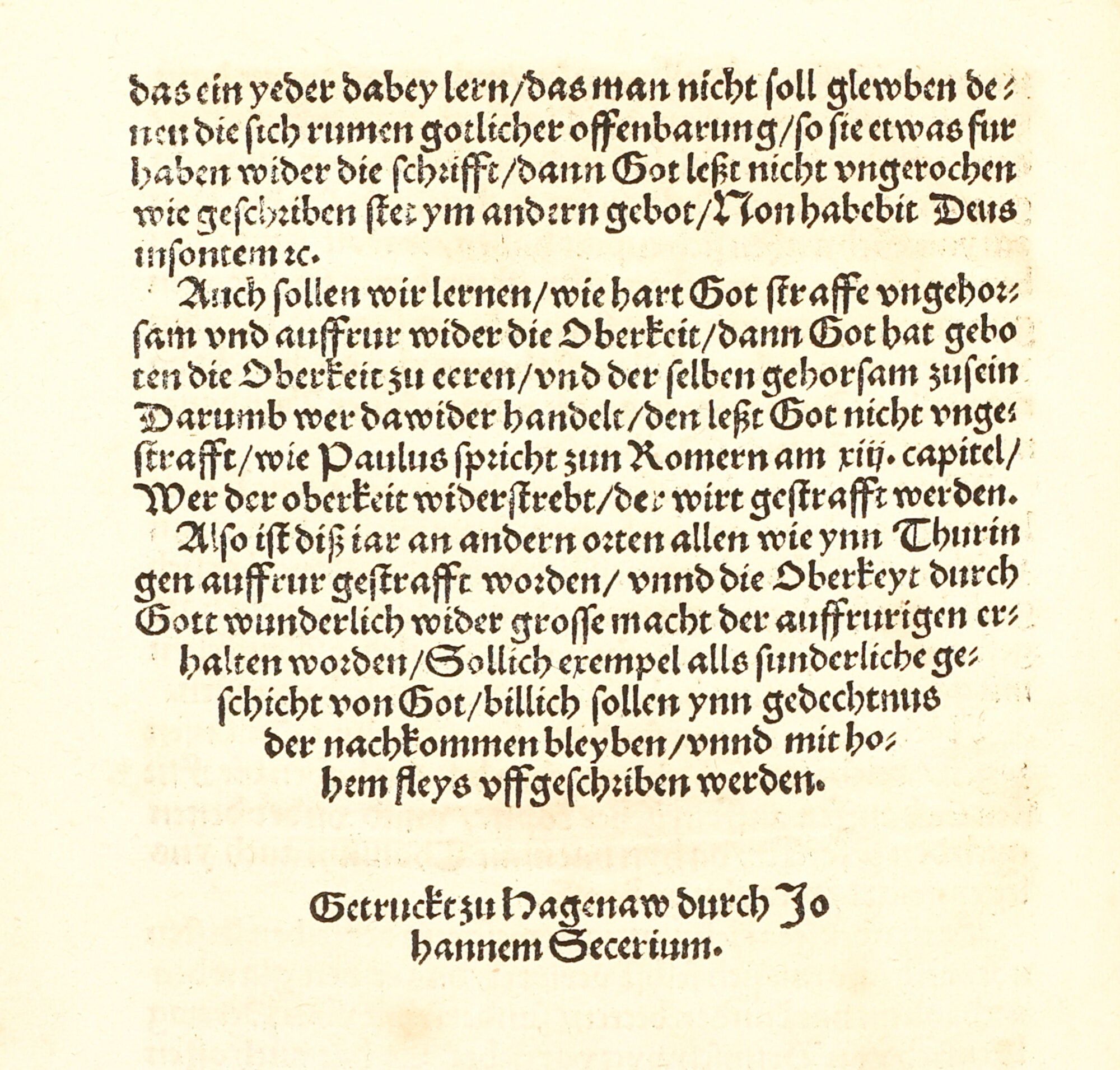
Hagenau: Johann Setzer, 1525. SOLE EDITION. Hardcover. Fine. Bound in late 19th or early 20th c. marbled boards, spine mended. A nice copy with the impressions of bearer type on the first and final leaf. Small light dampstain to corner of two leaves and some light spots on final printed leaf. A rare polemic by Philip Melanchthon against the radical reformer Thomas Müntzer, the "murderous and bloodthirsty prophet" and the most significant figure in the second, crucial phase of the Peasants' War. In the face of crushing taxation and crop failures, the German peasants had declared open rebellion against the oppression of their feudal lords. Müntzer encouraged them with fiery oratory and led them into battle. The peasants' were defeated at the Battle of Frankenhausen. Captured in battle, Müntzer was executed by beheading, his body was impaled, and his head stuck on a stake outside the gates of Mühlhausen, where it remained for years. This book was printed a month after Müntzer's decisive defeat.
Melanchthon's purpose in publishing this book was to show that Müntzer was a tool of the devil and to warn others not to follow his teachings. The book contains a speech purportedly given by Müntzer to rally his troops as they prepared to meet the armies of the Saxon and Hessian princes on 17 May 1525 at Frankenhausen. Contemporary reports indicate Müntzer did in fact give a speech, but the text as given in this book was almost certainly composed by Melanchthon and his allies:
"There is absolutely no evidence to suggest that the words are Müntzer's; he certainly made some kind of speech, and an idea of what he said was reported by men such as Hans Hut, who had been at Müntzer's side. But Melanchthon was on that day in Wittenberg, 150 kms distant, and certainly would not have been able to record the words spoken. At best, the text is reported third-hand and faulty; at worst, it is a complete fabrication."(Drummond)
In Melanchthon's version of the speech, Müntzer claimed a divine prophecy led him to call for the uprising: "I only began all this at God's command, and not for selfish reason or out of boldness, for I have never been a soldier in all my days; but because God spoke to me and told me to march forth".
Melanchthon presents Müntzer's case in language that closely resembles Müntzer's writings, and the speech includes a battle cry against the nobility: "They are nothing but tyrants, who fleece the people, and exhaust our blood and sweat with their splendour, with useless pomp, with their whoring and villainy. . . . But what do our princes do? They do not give justice, they do not keep the roads clear, do not prevent murder and robbery or punish offences and evil, do not defend widows and orphans, do not help the poor to justice - which is the very reason that God created the rulers . . . You should not imagine that God will let this go on for much longer, for, just as he destroyed the Canaanites, so he will destroy our princes.
Melanchthon adds his commentary to the speech. Despite not being present, he argues that many of Müntzer's followers seemed reluctant to join the battle: "And when Thomas had finished speaking, the majority of the army were desperate and wanted to get away from there, for they saw that the water was about to overflow the bucket. But there was no order or discipline which allowed anyone to take good advice on what to do." (translated by Andy Drummond)
Thomas Müntzer
In 1523, Müntzer, formerly the leader of the radical "Zwickau Prophets" began to radicalize the area of Allstedt, where he was then pastor, preaching that the ungodly were to be eliminated and the elect would establish a kingdom of Christ on earth and threatening the political rulers of the area with rebellion. In early 1524, as Müntzer grew bolder in his denunciation of the authorities and called for an elimination of the enemies of God, he divided the citizenry into military units in order to resist any outside interference in his activities. Müntzer openly challenged and attacked Luther, who was openly opposed to Müntzer's ministry of the elect, as one of "our mad, debauching pigs, which are horrified by the windstorm, the raging billows and by all the waters of wisdom." Following the Battle of Frankenhausen, Müntzer was captured and executed by beheading. His body was impaled and his head stuck on a stake outside the gates of Mühlhausen, where it remained for years. Following Müntzer's execution on May 27, Luther would write "I killed Müntzer; his death is on my shoulders. But I did it because he wanted to kill my Christ'". (Brecht Vol II, p. 185)
The Peasants' War
The Peasants' War was one of the bloodiest chapters in the turbulent early history of the German Reformation. The uprising began in upper Swabia in early 1524 and quickly spread to southern and western Germany, as well as to parts of Switzerland and Austria. The peasants were motivated by a number of factors: crushing taxation, lack of a voice in government, no recourse to the courts, crop failure, and helplessness in the face of their feudal masters' demands. But whereas these conditions had resulted in smaller uprisings in the past, the massive rebellion of 1524-5 was also a result of the turbulent upheaval caused by the nascent Reformation. By the time the rebellion was crushed in late 1525, some 100,000 combatants and civilians had been killed. Reprisals were carried out for the next two years, and the peasants' demands, as outlined in their Twelve Articles, came to nothing.
Melanchthon's purpose in publishing this book was to show that Müntzer was a tool of the devil and to warn others not to follow his teachings. The book contains a speech purportedly given by Müntzer to rally his troops as they prepared to meet the armies of the Saxon and Hessian princes on 17 May 1525 at Frankenhausen. Contemporary reports indicate Müntzer did in fact give a speech, but the text as given in this book was almost certainly composed by Melanchthon and his allies:
"There is absolutely no evidence to suggest that the words are Müntzer's; he certainly made some kind of speech, and an idea of what he said was reported by men such as Hans Hut, who had been at Müntzer's side. But Melanchthon was on that day in Wittenberg, 150 kms distant, and certainly would not have been able to record the words spoken. At best, the text is reported third-hand and faulty; at worst, it is a complete fabrication."(Drummond)
In Melanchthon's version of the speech, Müntzer claimed a divine prophecy led him to call for the uprising: "I only began all this at God's command, and not for selfish reason or out of boldness, for I have never been a soldier in all my days; but because God spoke to me and told me to march forth".
Melanchthon presents Müntzer's case in language that closely resembles Müntzer's writings, and the speech includes a battle cry against the nobility: "They are nothing but tyrants, who fleece the people, and exhaust our blood and sweat with their splendour, with useless pomp, with their whoring and villainy. . . . But what do our princes do? They do not give justice, they do not keep the roads clear, do not prevent murder and robbery or punish offences and evil, do not defend widows and orphans, do not help the poor to justice - which is the very reason that God created the rulers . . . You should not imagine that God will let this go on for much longer, for, just as he destroyed the Canaanites, so he will destroy our princes.
Melanchthon adds his commentary to the speech. Despite not being present, he argues that many of Müntzer's followers seemed reluctant to join the battle: "And when Thomas had finished speaking, the majority of the army were desperate and wanted to get away from there, for they saw that the water was about to overflow the bucket. But there was no order or discipline which allowed anyone to take good advice on what to do." (translated by Andy Drummond)
Thomas Müntzer
In 1523, Müntzer, formerly the leader of the radical "Zwickau Prophets" began to radicalize the area of Allstedt, where he was then pastor, preaching that the ungodly were to be eliminated and the elect would establish a kingdom of Christ on earth and threatening the political rulers of the area with rebellion. In early 1524, as Müntzer grew bolder in his denunciation of the authorities and called for an elimination of the enemies of God, he divided the citizenry into military units in order to resist any outside interference in his activities. Müntzer openly challenged and attacked Luther, who was openly opposed to Müntzer's ministry of the elect, as one of "our mad, debauching pigs, which are horrified by the windstorm, the raging billows and by all the waters of wisdom." Following the Battle of Frankenhausen, Müntzer was captured and executed by beheading. His body was impaled and his head stuck on a stake outside the gates of Mühlhausen, where it remained for years. Following Müntzer's execution on May 27, Luther would write "I killed Müntzer; his death is on my shoulders. But I did it because he wanted to kill my Christ'". (Brecht Vol II, p. 185)
The Peasants' War
The Peasants' War was one of the bloodiest chapters in the turbulent early history of the German Reformation. The uprising began in upper Swabia in early 1524 and quickly spread to southern and western Germany, as well as to parts of Switzerland and Austria. The peasants were motivated by a number of factors: crushing taxation, lack of a voice in government, no recourse to the courts, crop failure, and helplessness in the face of their feudal masters' demands. But whereas these conditions had resulted in smaller uprisings in the past, the massive rebellion of 1524-5 was also a result of the turbulent upheaval caused by the nascent Reformation. By the time the rebellion was crushed in late 1525, some 100,000 combatants and civilians had been killed. Reprisals were carried out for the next two years, and the peasants' demands, as outlined in their Twelve Articles, came to nothing.
Details
Title
Die Histori Thome Muntzers, des anfengers der Döringischen vffrur, seer nutzlich zulesen. Ermanung des Durchleuchtigen Fursten vnnd Herrn, Herrn Philippsen Landtgraue zu Hessen etc. an die Ritterschafft, die Bauren (vnder dem scheyn des Euangelions sich wider alle oberkeit, durch falsch Predicanten verfurt, setzende) trostlich anzugreyffen
Author
Melanchthon, Philip (1497-1560). Müntzer, Thomas (1489-1525)
Binding
Hardcover
Condition
Fine
Publisher
Johann Setzer: Hagenau
Date
1525
Edition
SOLE EDITION