

AIR VIETNAM | COLLECTION OF FORMER PILOT'S WRITING AND PERSONAL CORRESPONDENCE
- c1968
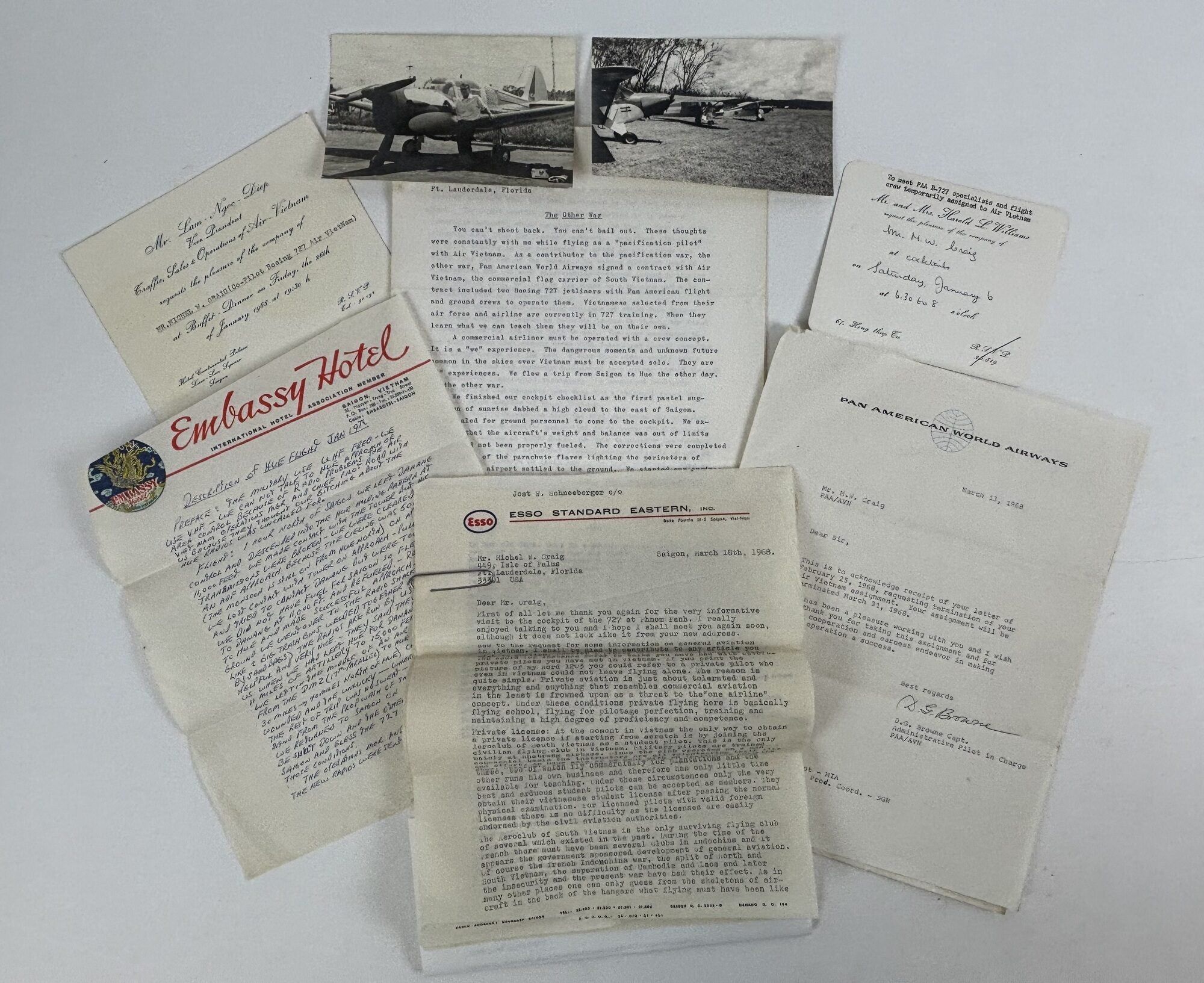
c1968. Group of letters, photographs, and rare firsthand accounts of experiences of Air Vietnam pilot. Michael W. Craig flew with Pan American Airways for 29 years being based in New York; Berlin, Germany; Miami; Hong Kong and Saigon, Vietnam. Under the direction of the State Department, he became a Pan Am pilot volunteer flying for Air Vietnam in 1968. This collection includes the following:
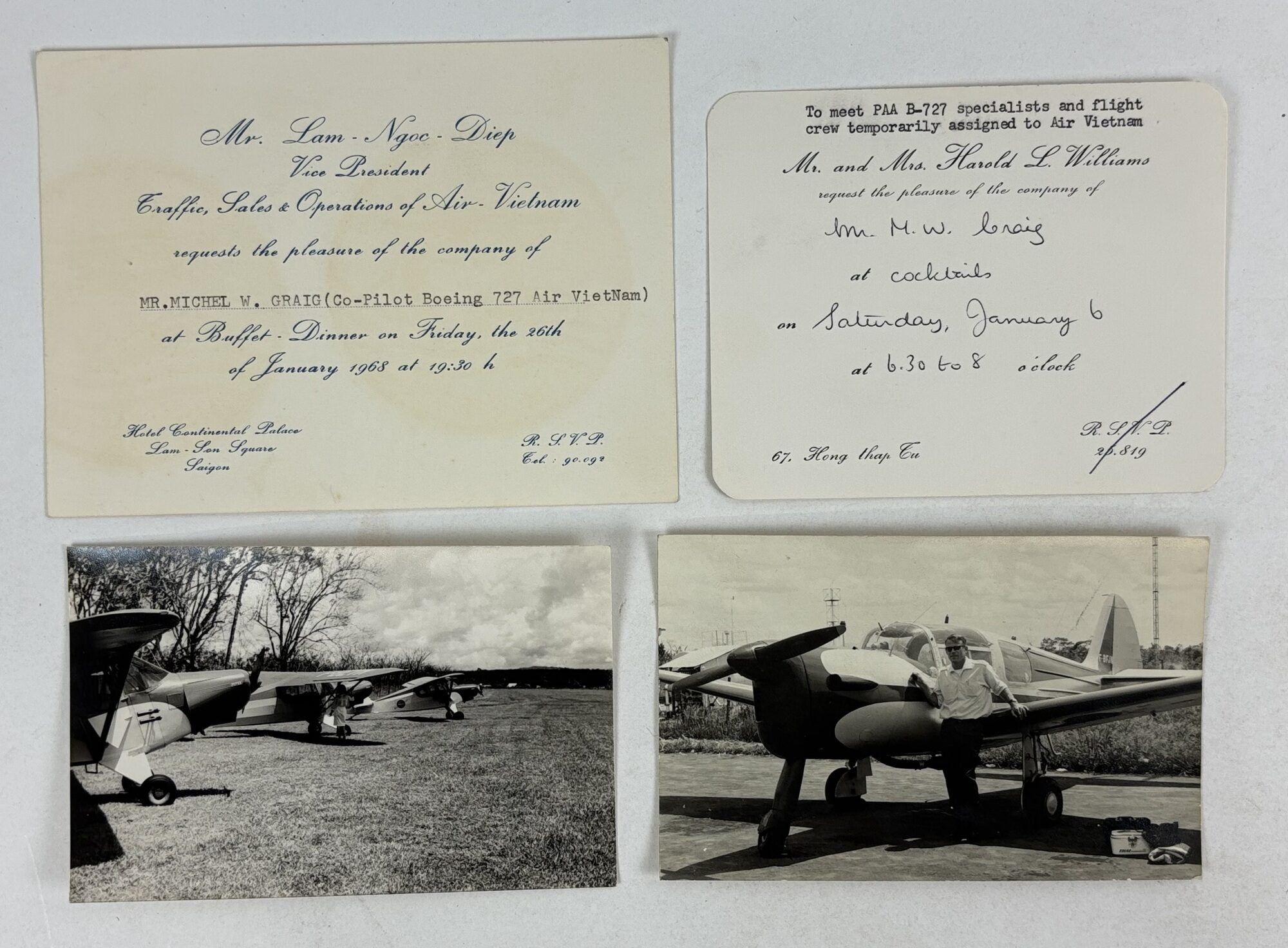
1. Two 3 in. x 6 in. photographs
2. Two Air Vietnam invitations (January 1968)
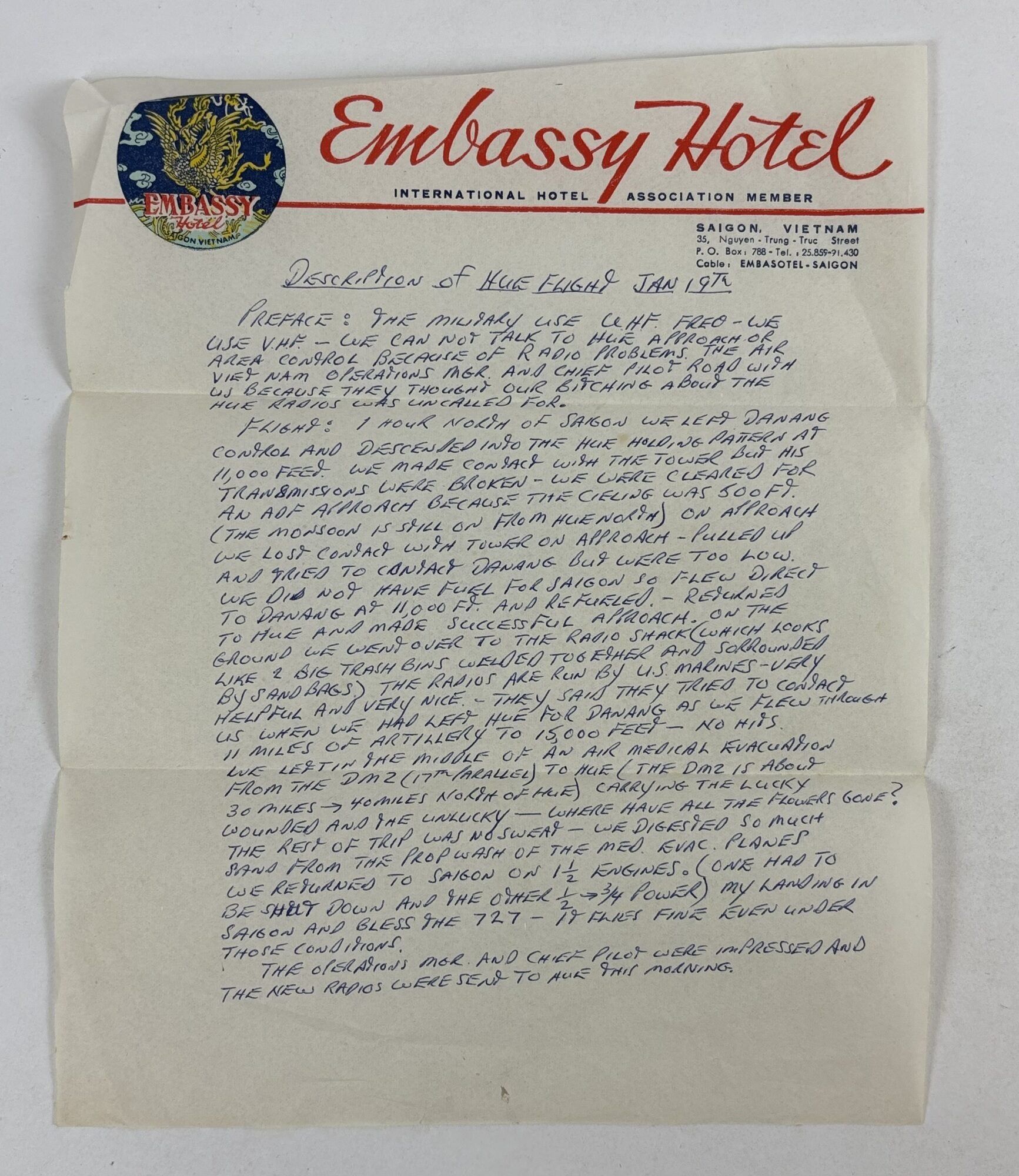
3. One page handwritten note on thin "Embassy Hotel" stationary. Penned in blue ink by Craig, the note is an account of a flight on 1/19/1968 (See "Notes" for transcription)
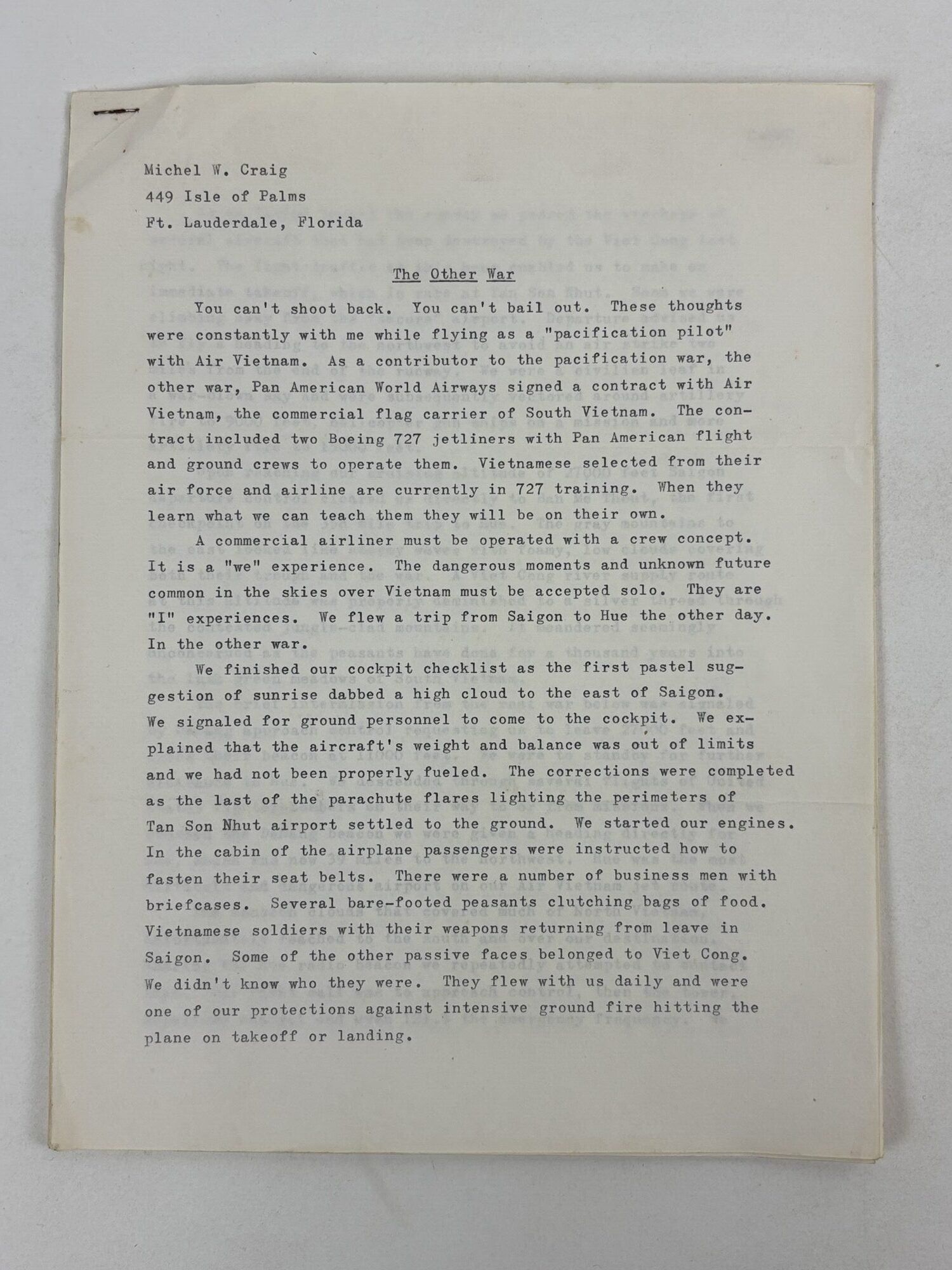
4. Six-page typed memoir titled "The Other War" written by Craig after his period of employment for Air Vietnam (See "Notes" field for transcription of first page).
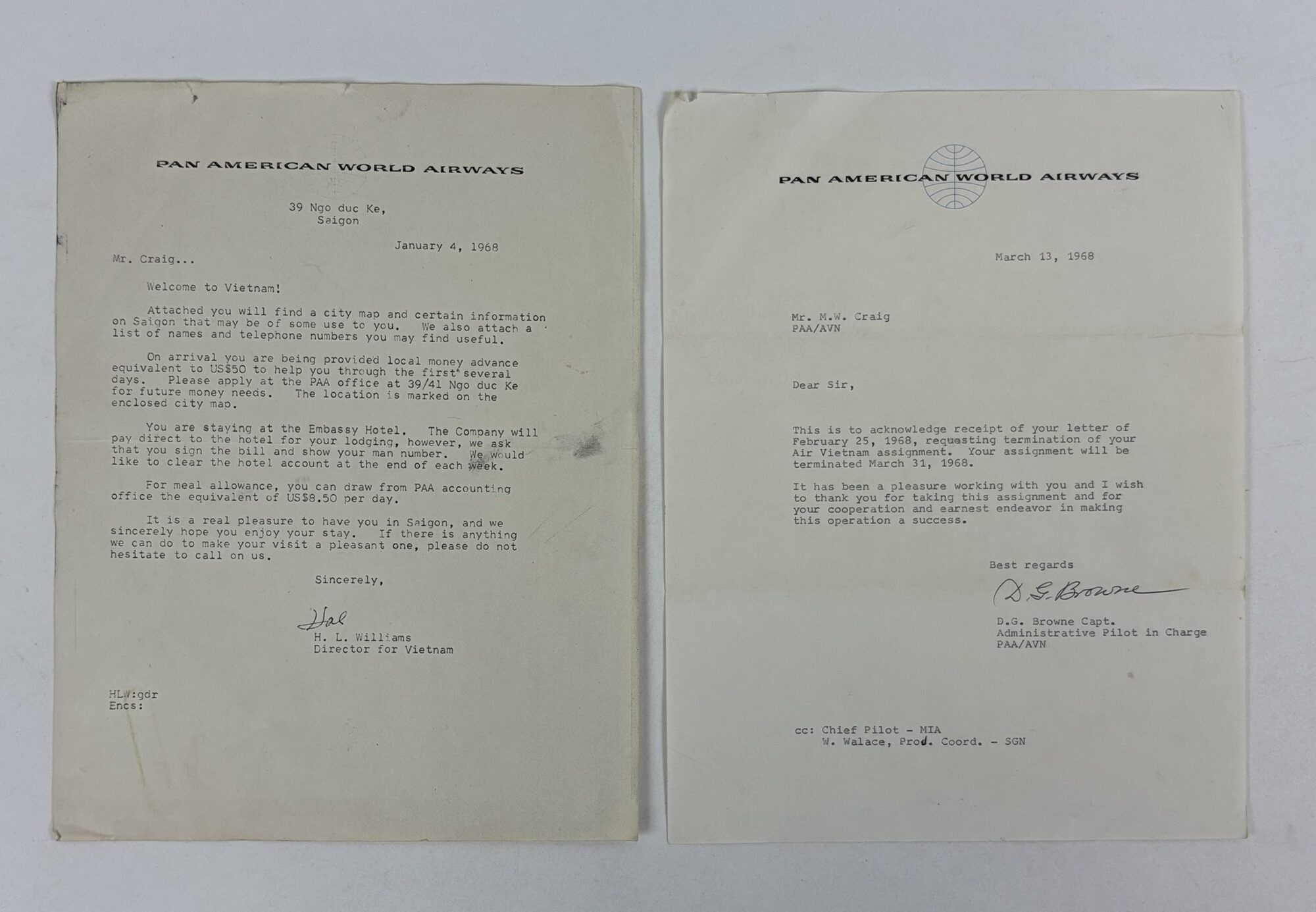
5. Copy of one page TLS from Pan American World Airways welcoming Craig to Vietnam (dated 1/4/1968)
6. One page TLS from Pan American World Airways acknowledging receipt of Craig's request for termination of Air Vietnam assignment (dated 3/13/1968)
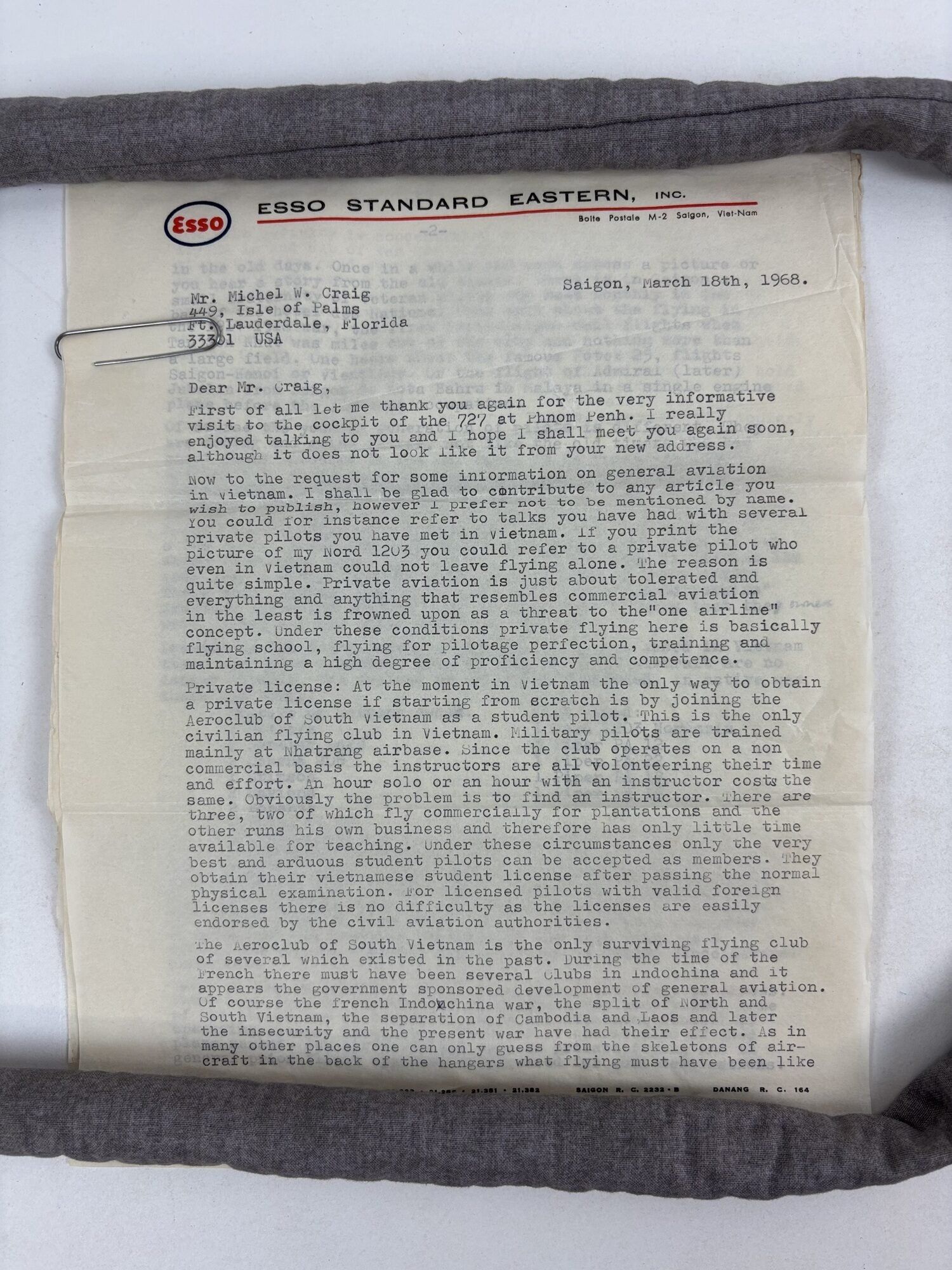
7. Four-page typed letter from ESSO Standard Eastern, Inc. thanking Craig for a recent tour of a 727 cockpit and responding to Craig's recent inquiry regarding "general aviation in Vietnam" and his plans to write an article. Letter signed in black ink and dated 3/18/1968 (See "Notes" field for transcription of first page).
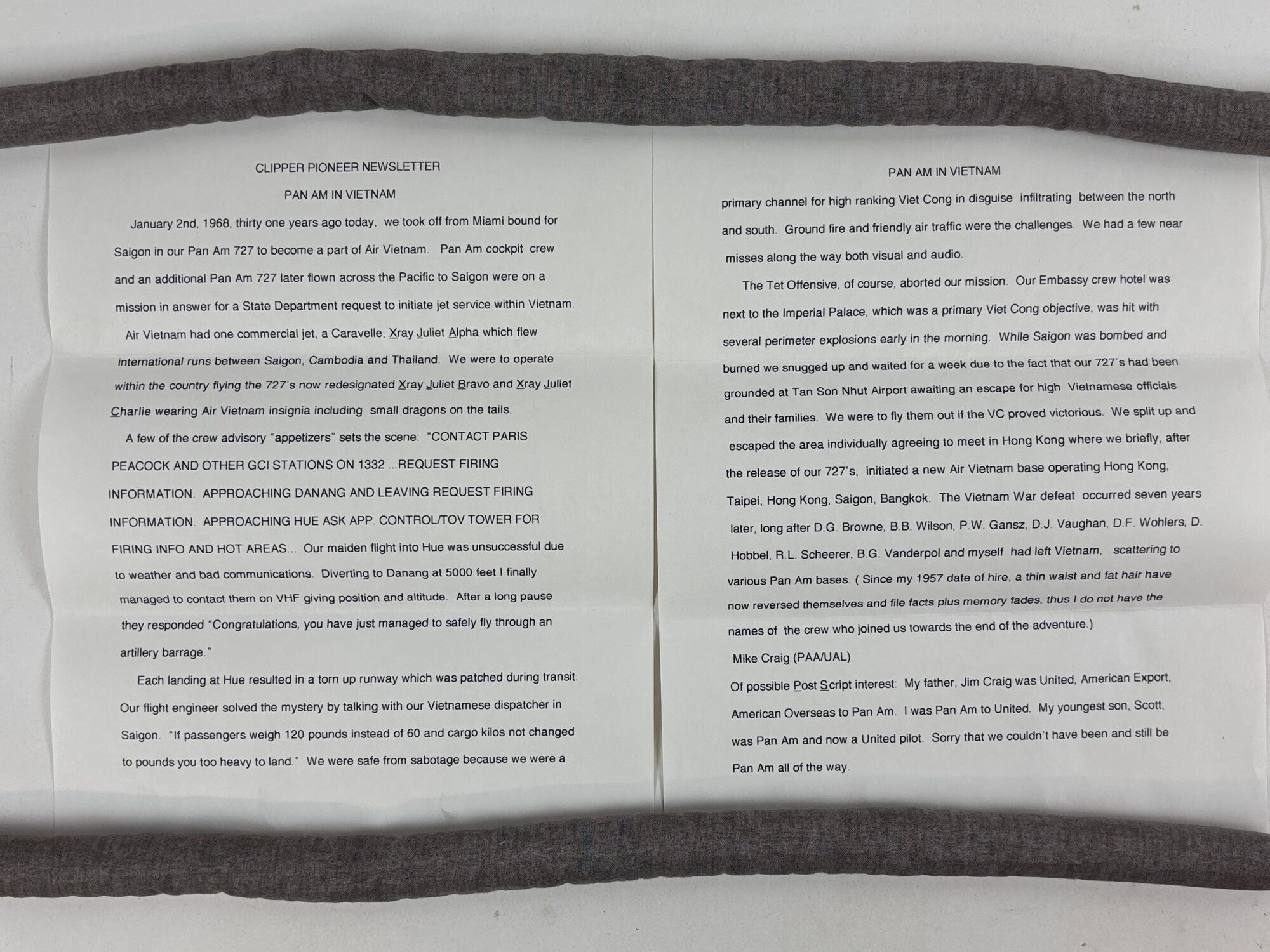
8. Two-page "Clipper Pioneer Newsletter" describing events of 1/2/1968 (a recollection written decades after the events).
Shelved at Rockville Room E. Transcriptions of letters/writings in description:
3. "Description of Hue Flight Jan 19th
Preface: The military use UHF. Free use VHF - we can not talk to Hue approach or area control because of a radio problem. The Air Vietnam operations mgr. and chief pilot rode with us because they thought our bird unsafe - although the Hue radios was uncalled for.
Flight: 1 hour north of Saigon we left Danang control and descended into the Hue holding pattern at 11,000 feet. We made contact with the tower but his transmissions were broken. We were cleared for an NDB approach because the ceiling was 500 ft. (The monsoon is still on from Hue north). On approach we lost contact with tower on approach - pulled up and tried to contact Danang but were too low. We did not have fuel for Saigon so flew direct to Danang at 11,000 ft. and refueled. Returned to Hue and made successful approach. On the ground we went over to the radio shack (which looks like 2 big trash bins welded together and surrounded by sandbags). The radios are run by U.S. Marines - very helpful and very nice. They said they tried to contact us when we had left Hue for Danang as we flew through 15 miles of artillery to 35,000 feet - no hits.
We left in the middle of an air medical evacuation from the DMZ (17th parallel) to one of the DMZ is about 30 miles → 40 miles north of Hue carrying the lucky wounded and the unlucky - where have all the flowers gone?
The rest of trip was uneventful - we digested so much sand from the propwash of the med. evac. planes we returned to Saigon on 1½ engines. (One had to be shut down and the other ½ → ¾ power) My landing in Saigon and bless the 727 - it flies fine even under those conditions.
The operations mgr. and chief pilot were impressed and the new radios were sent to Hue that morning."
4. "The Other War
You can't shoot back. You can't bail out. These thoughts were constantly with me while flying as a "pacification pilot" with Air Vietnam. As a contributor to the pacification war, the other war, Pan American World Airways signed a contract with Air Vietnam, the commercial flag carrier of South Vietnam. The contract included two Boeing 727 jetliners with Pan American flight and ground crews to operate them. Vietnamese selected from their air force and airline are currently in 727 training. When they learn what we can teach them they will be on their own.
A commercial airliner must be operated with a crew concept. It is a "we" experience. The dangerous moments and unknown future common in the skies over Vietnam must be accepted solo. They are "I" experiences. We flew a trip from Saigon to Hue the other day. In the other war.
We finished our cockpit checklist as the first pastel suggestion of sunrise dabbed a high cloud to the east of Saigon. We signaled for ground personnel to come to the cockpit. We explained that the aircraft's weight and balance was out of limits and we had not been properly fueled. The corrections were completed as the last of the parachute flares lighting the perimeters of Tan Son Nhut airport settled to the ground. We started our engines. In the cabin of the airplane passengers were instructed how to fasten their seat belts. There were a number of business men with briefcases. Several bare-footed peasants clutching bags of food. Vietnamese soldiers with their weapons returning from leave in Saigon. Some of the other passive faces belonged to Viet Cong. We didn't know who they were. They flew with us daily and were one of our protections against intensive ground fire hitting the plane on takeoff or landing."
7. "Dear Mr. Craig,
First of all let me thank you again for the very informative visit to the cockpit of the 727 at Phnom Penh. I really enjoyed talking to you and I hope I shall meet you again soon, although it does not look like it from your new address.
Now to the request for some information on general aviation in Vietnam. I shall be glad to contribute to any article you wish to publish, however I prefer not to be mentioned by name. You could for instance refer to talks you have had with several private pilots you have met in Vietnam. If you print the picture of my Nord 1203 you could refer to a private pilot who even in Vietnam could not leave flying alone. The reason is quite simple. Private aviation is just about tolerated and everything and anything that resembles commercial aviation in the least is frowned upon as a threat to the "one airline" concept. Under these conditions private flying here is basically flying school, flying for pilotage perfection, training and maintaining a high degree of proficiency and competence.
Private license: At the moment in Vietnam the only way to obtain a private license if starting from scratch is by joining the Aeroclub of South Vietnam as a student pilot. This is the only civilian flying club in Vietnam. Military pilots are trained mainly at Nhatrang airbase. Since the club operates on a non commercial basis the instructors are all volunteering their time and effort. An hour solo or an hour with an instructor costs the same. Obviously the problem is to find an instructor. There are three, two of which fly commercially for plantations and the other runs his own business and therefore has only little time available for teaching. Under these circumstances only the very best and arduous student pilots can be accepted as members. They obtain their Vietnamese student license after passing the normal physical examination. For licensed pilots with valid foreign licenses there is no difficulty as the licenses are easily endorsed by the civil aviation authorities.
The Aeroclub of South Vietnam is the only surviving flying club of several which existed in the past. During the time of the French there must have been several clubs in Indochina and it appears the government sponsored development of general aviation. Of course the French Indochina war, the split of North and South Vietnam, the separation of Cambodia and Laos and later the insecurity and the present war have had their effect. As in many other places one can only guess from the skeletons of aircraft in the back of the hangars what flying must have been like.". 1409122. Special Collections - Upstairs.
1. Two 3 in. x 6 in. photographs
2. Two Air Vietnam invitations (January 1968)
3. One page handwritten note on thin "Embassy Hotel" stationary. Penned in blue ink by Craig, the note is an account of a flight on 1/19/1968 (See "Notes" for transcription)
4. Six-page typed memoir titled "The Other War" written by Craig after his period of employment for Air Vietnam (See "Notes" field for transcription of first page).
5. Copy of one page TLS from Pan American World Airways welcoming Craig to Vietnam (dated 1/4/1968)
6. One page TLS from Pan American World Airways acknowledging receipt of Craig's request for termination of Air Vietnam assignment (dated 3/13/1968)
7. Four-page typed letter from ESSO Standard Eastern, Inc. thanking Craig for a recent tour of a 727 cockpit and responding to Craig's recent inquiry regarding "general aviation in Vietnam" and his plans to write an article. Letter signed in black ink and dated 3/18/1968 (See "Notes" field for transcription of first page).
8. Two-page "Clipper Pioneer Newsletter" describing events of 1/2/1968 (a recollection written decades after the events).
Shelved at Rockville Room E. Transcriptions of letters/writings in description:
3. "Description of Hue Flight Jan 19th
Preface: The military use UHF. Free use VHF - we can not talk to Hue approach or area control because of a radio problem. The Air Vietnam operations mgr. and chief pilot rode with us because they thought our bird unsafe - although the Hue radios was uncalled for.
Flight: 1 hour north of Saigon we left Danang control and descended into the Hue holding pattern at 11,000 feet. We made contact with the tower but his transmissions were broken. We were cleared for an NDB approach because the ceiling was 500 ft. (The monsoon is still on from Hue north). On approach we lost contact with tower on approach - pulled up and tried to contact Danang but were too low. We did not have fuel for Saigon so flew direct to Danang at 11,000 ft. and refueled. Returned to Hue and made successful approach. On the ground we went over to the radio shack (which looks like 2 big trash bins welded together and surrounded by sandbags). The radios are run by U.S. Marines - very helpful and very nice. They said they tried to contact us when we had left Hue for Danang as we flew through 15 miles of artillery to 35,000 feet - no hits.
We left in the middle of an air medical evacuation from the DMZ (17th parallel) to one of the DMZ is about 30 miles → 40 miles north of Hue carrying the lucky wounded and the unlucky - where have all the flowers gone?
The rest of trip was uneventful - we digested so much sand from the propwash of the med. evac. planes we returned to Saigon on 1½ engines. (One had to be shut down and the other ½ → ¾ power) My landing in Saigon and bless the 727 - it flies fine even under those conditions.
The operations mgr. and chief pilot were impressed and the new radios were sent to Hue that morning."
4. "The Other War
You can't shoot back. You can't bail out. These thoughts were constantly with me while flying as a "pacification pilot" with Air Vietnam. As a contributor to the pacification war, the other war, Pan American World Airways signed a contract with Air Vietnam, the commercial flag carrier of South Vietnam. The contract included two Boeing 727 jetliners with Pan American flight and ground crews to operate them. Vietnamese selected from their air force and airline are currently in 727 training. When they learn what we can teach them they will be on their own.
A commercial airliner must be operated with a crew concept. It is a "we" experience. The dangerous moments and unknown future common in the skies over Vietnam must be accepted solo. They are "I" experiences. We flew a trip from Saigon to Hue the other day. In the other war.
We finished our cockpit checklist as the first pastel suggestion of sunrise dabbed a high cloud to the east of Saigon. We signaled for ground personnel to come to the cockpit. We explained that the aircraft's weight and balance was out of limits and we had not been properly fueled. The corrections were completed as the last of the parachute flares lighting the perimeters of Tan Son Nhut airport settled to the ground. We started our engines. In the cabin of the airplane passengers were instructed how to fasten their seat belts. There were a number of business men with briefcases. Several bare-footed peasants clutching bags of food. Vietnamese soldiers with their weapons returning from leave in Saigon. Some of the other passive faces belonged to Viet Cong. We didn't know who they were. They flew with us daily and were one of our protections against intensive ground fire hitting the plane on takeoff or landing."
7. "Dear Mr. Craig,
First of all let me thank you again for the very informative visit to the cockpit of the 727 at Phnom Penh. I really enjoyed talking to you and I hope I shall meet you again soon, although it does not look like it from your new address.
Now to the request for some information on general aviation in Vietnam. I shall be glad to contribute to any article you wish to publish, however I prefer not to be mentioned by name. You could for instance refer to talks you have had with several private pilots you have met in Vietnam. If you print the picture of my Nord 1203 you could refer to a private pilot who even in Vietnam could not leave flying alone. The reason is quite simple. Private aviation is just about tolerated and everything and anything that resembles commercial aviation in the least is frowned upon as a threat to the "one airline" concept. Under these conditions private flying here is basically flying school, flying for pilotage perfection, training and maintaining a high degree of proficiency and competence.
Private license: At the moment in Vietnam the only way to obtain a private license if starting from scratch is by joining the Aeroclub of South Vietnam as a student pilot. This is the only civilian flying club in Vietnam. Military pilots are trained mainly at Nhatrang airbase. Since the club operates on a non commercial basis the instructors are all volunteering their time and effort. An hour solo or an hour with an instructor costs the same. Obviously the problem is to find an instructor. There are three, two of which fly commercially for plantations and the other runs his own business and therefore has only little time available for teaching. Under these circumstances only the very best and arduous student pilots can be accepted as members. They obtain their Vietnamese student license after passing the normal physical examination. For licensed pilots with valid foreign licenses there is no difficulty as the licenses are easily endorsed by the civil aviation authorities.
The Aeroclub of South Vietnam is the only surviving flying club of several which existed in the past. During the time of the French there must have been several clubs in Indochina and it appears the government sponsored development of general aviation. Of course the French Indochina war, the split of North and South Vietnam, the separation of Cambodia and Laos and later the insecurity and the present war have had their effect. As in many other places one can only guess from the skeletons of aircraft in the back of the hangars what flying must have been like.". 1409122. Special Collections - Upstairs.
Details
Title
AIR VIETNAM | COLLECTION OF FORMER PILOT'S WRITING AND PERSONAL CORRESPONDENCE
Author
Craig, Michael W.
Condition
Unknown
Date
c1968