

USE OF ROME
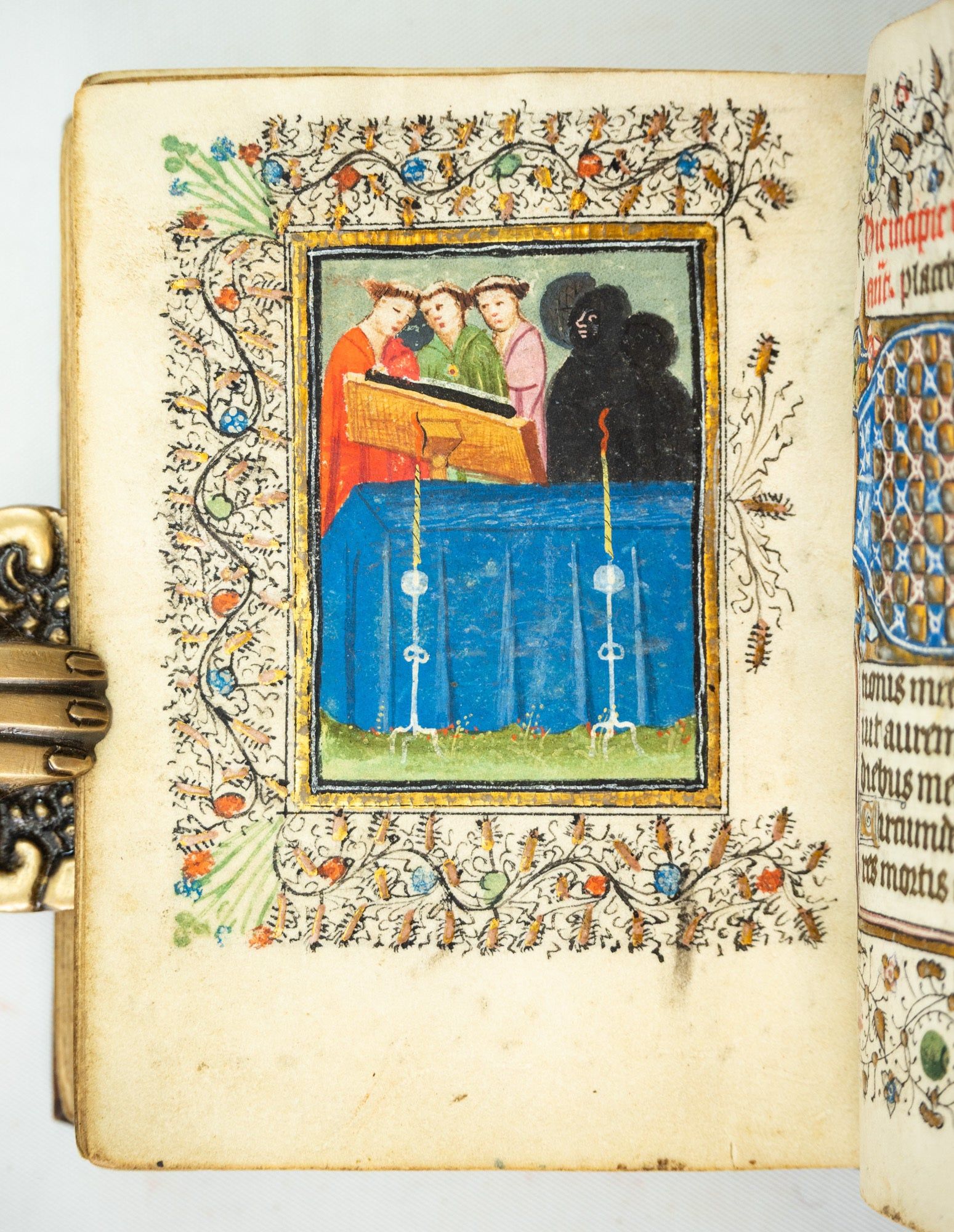
- Flanders , ca. 1450
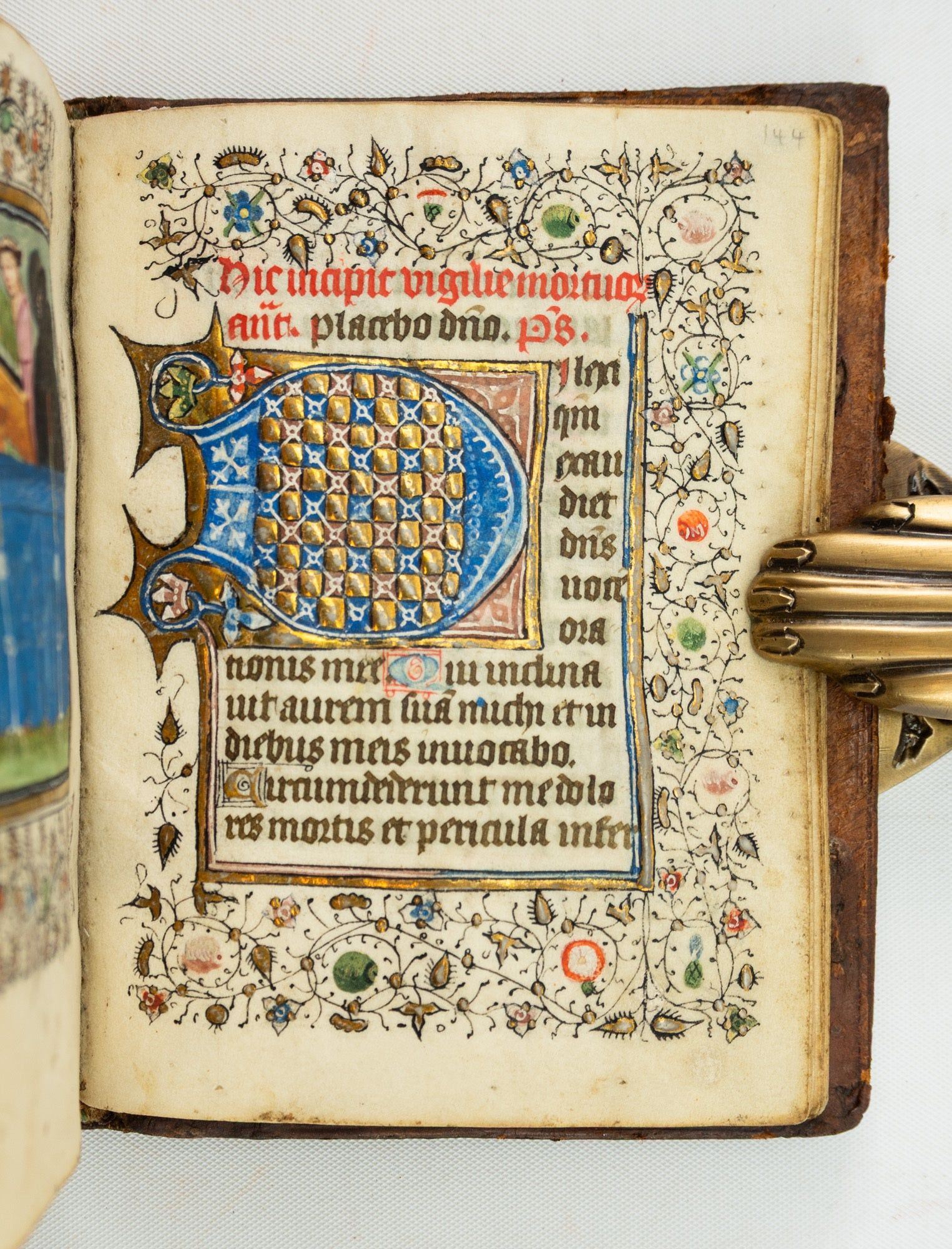
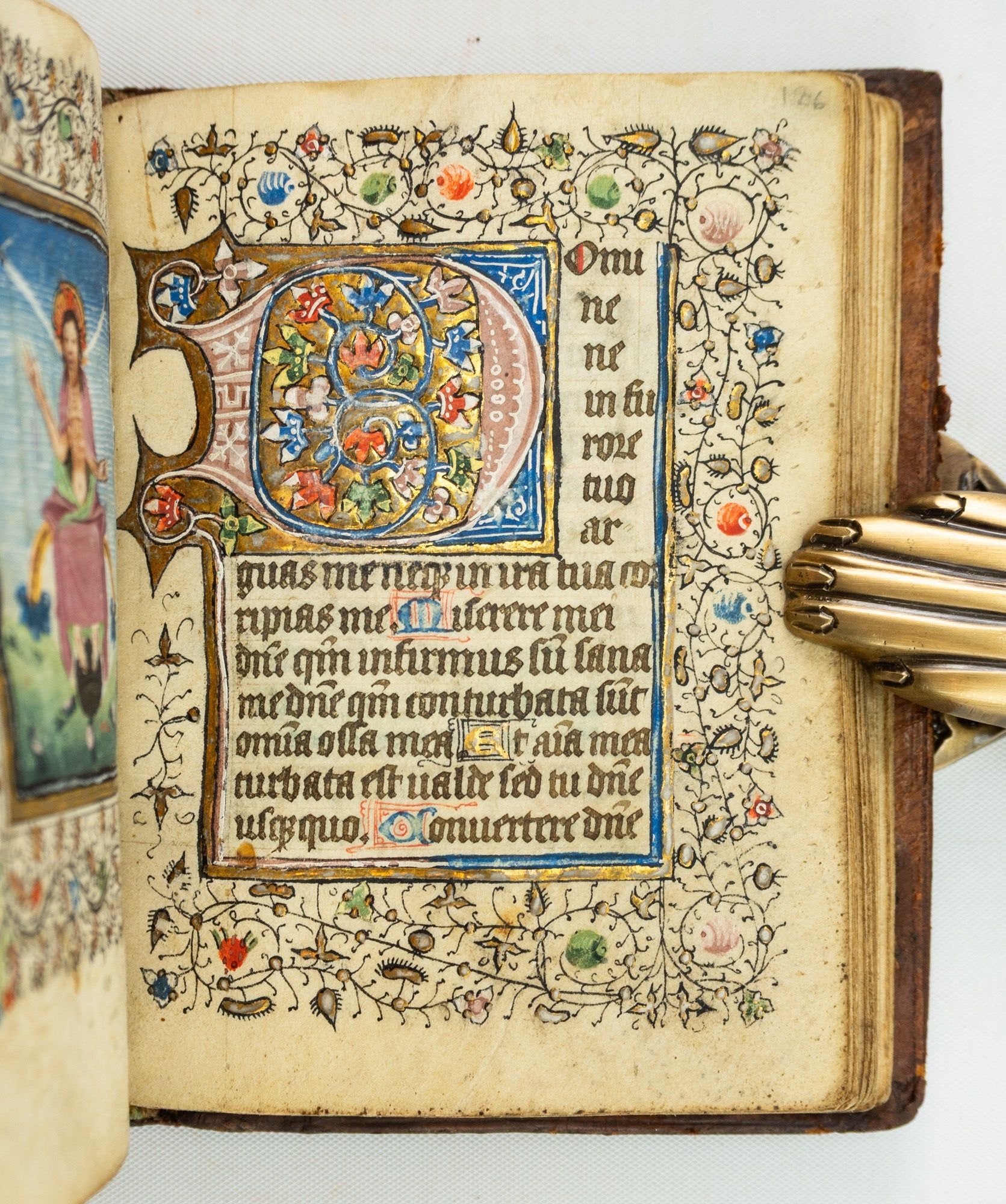
Flanders, ca. 1450. 109 x 81 mm. (4 1/4 x 3 1/8"). Single column, 14 lines in a gothic book hand. 161 leaves. COMPLETE. Contents: Calendar (f. 1r); Mass of the Holy Spirit (f. 14r); Mass of the Holy Cross (f. 23r); Requiem Mass (f. 30r); Prayer on the Seven Last Words of Christ by the Venerable Bede (f. 36v); Passion according to John (f. 40v); blank (f. 53); Hours of the Holy Cross (f. 55r); Mass of the Virgin Mary (f. 60r); Gospel Lessons (f. 66v); Hours of the Virgin (f. 73r); Penitential Psalms (f. 126r); Litany (f. 138r); Office of the Dead (f. 144r).
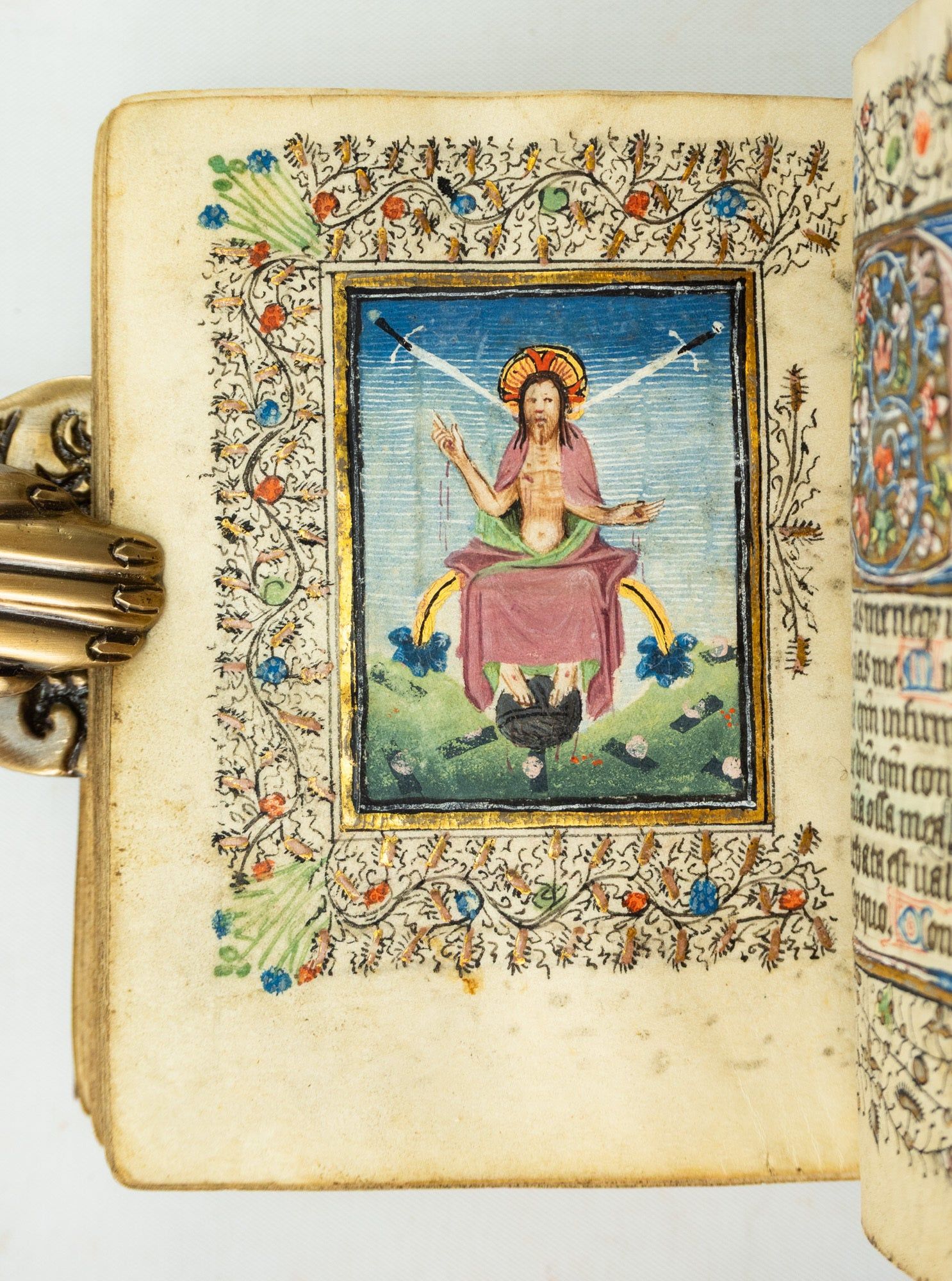
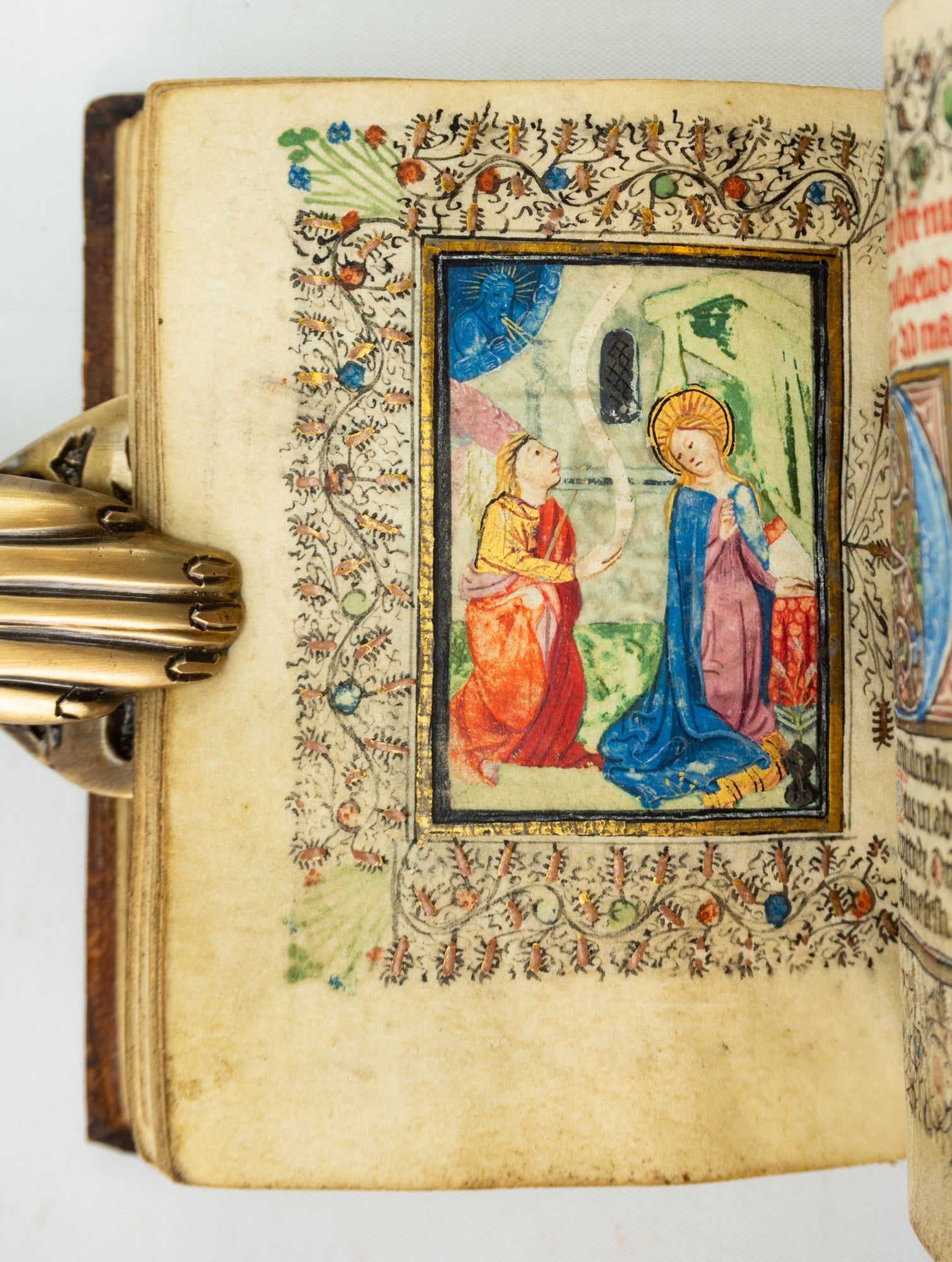
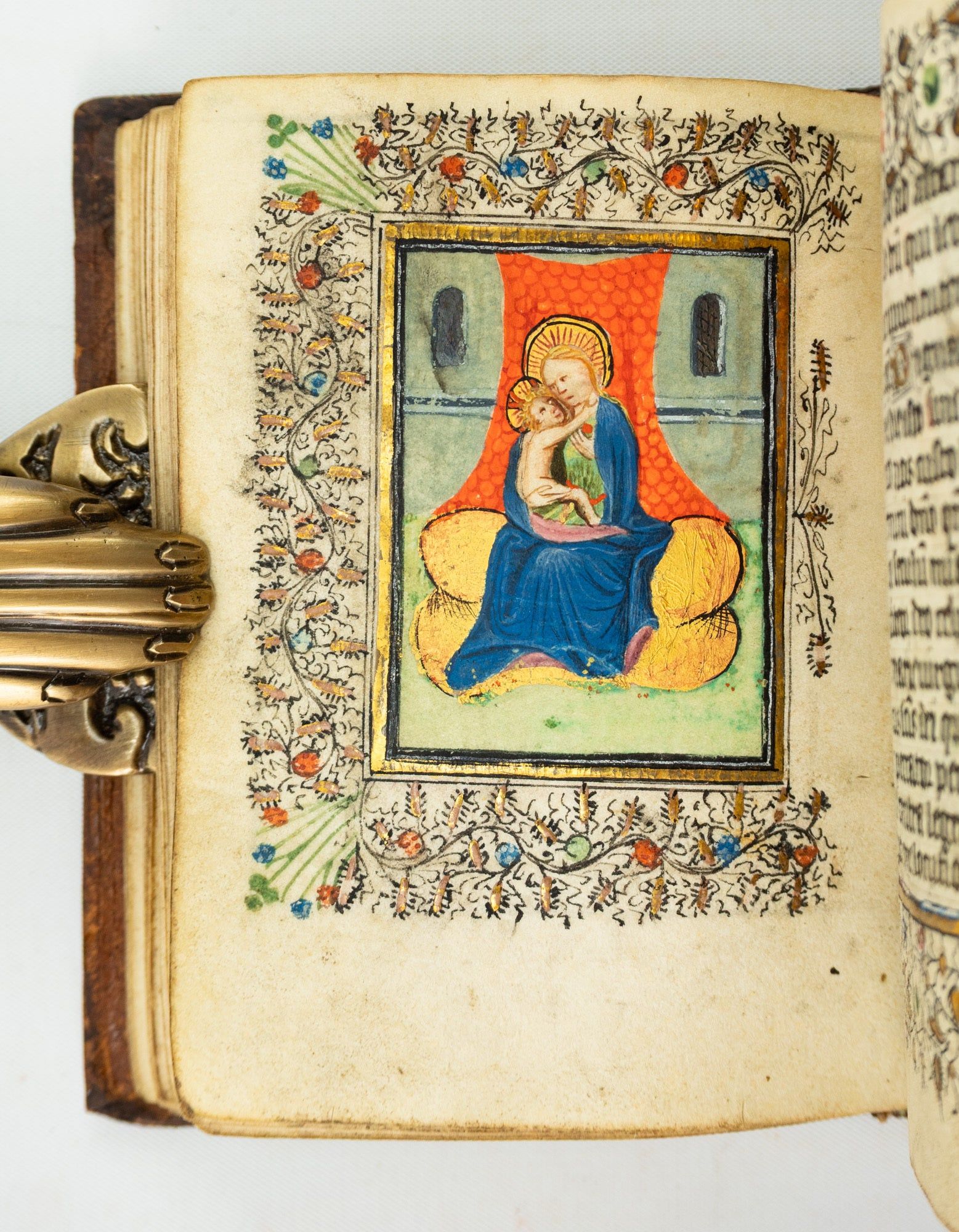
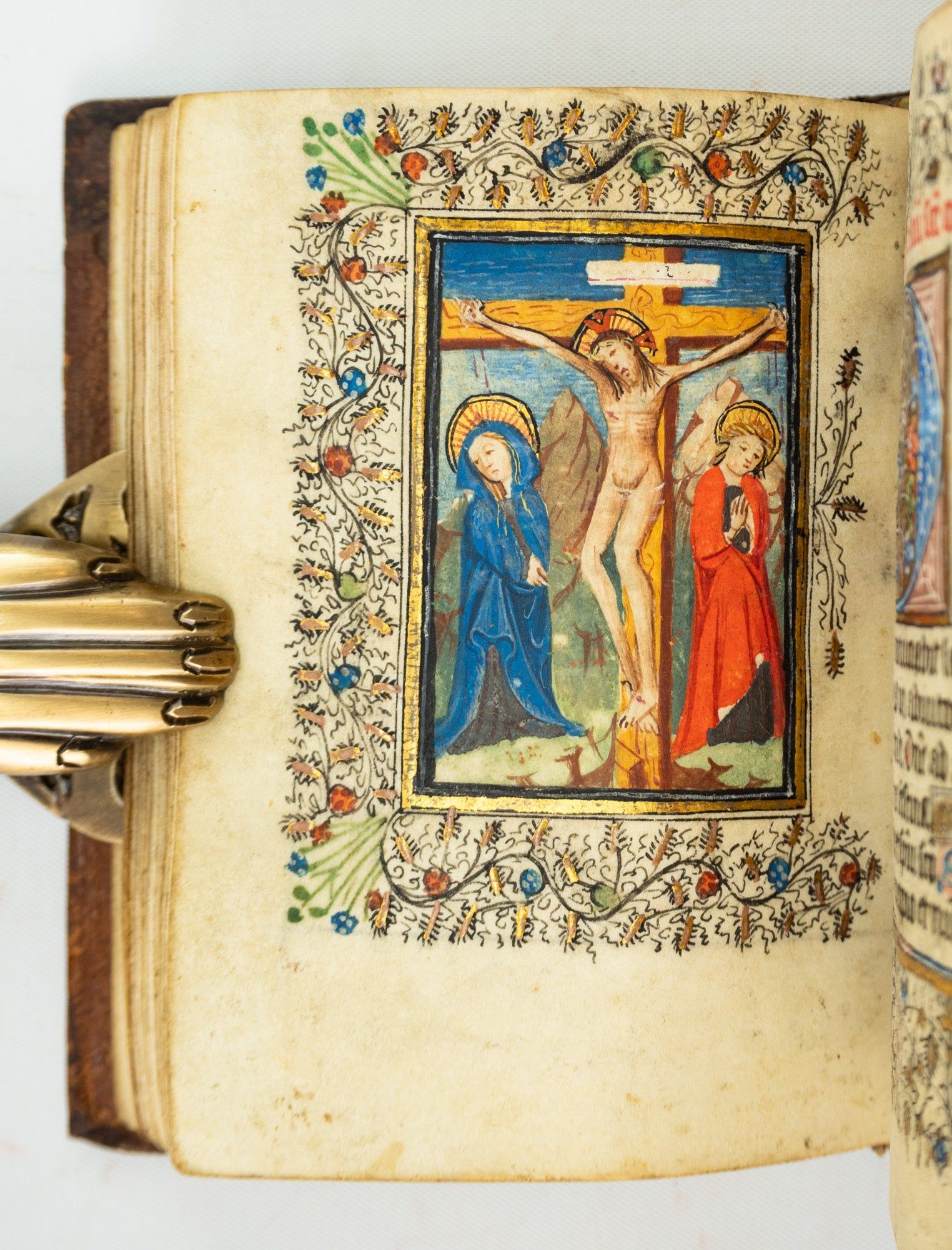
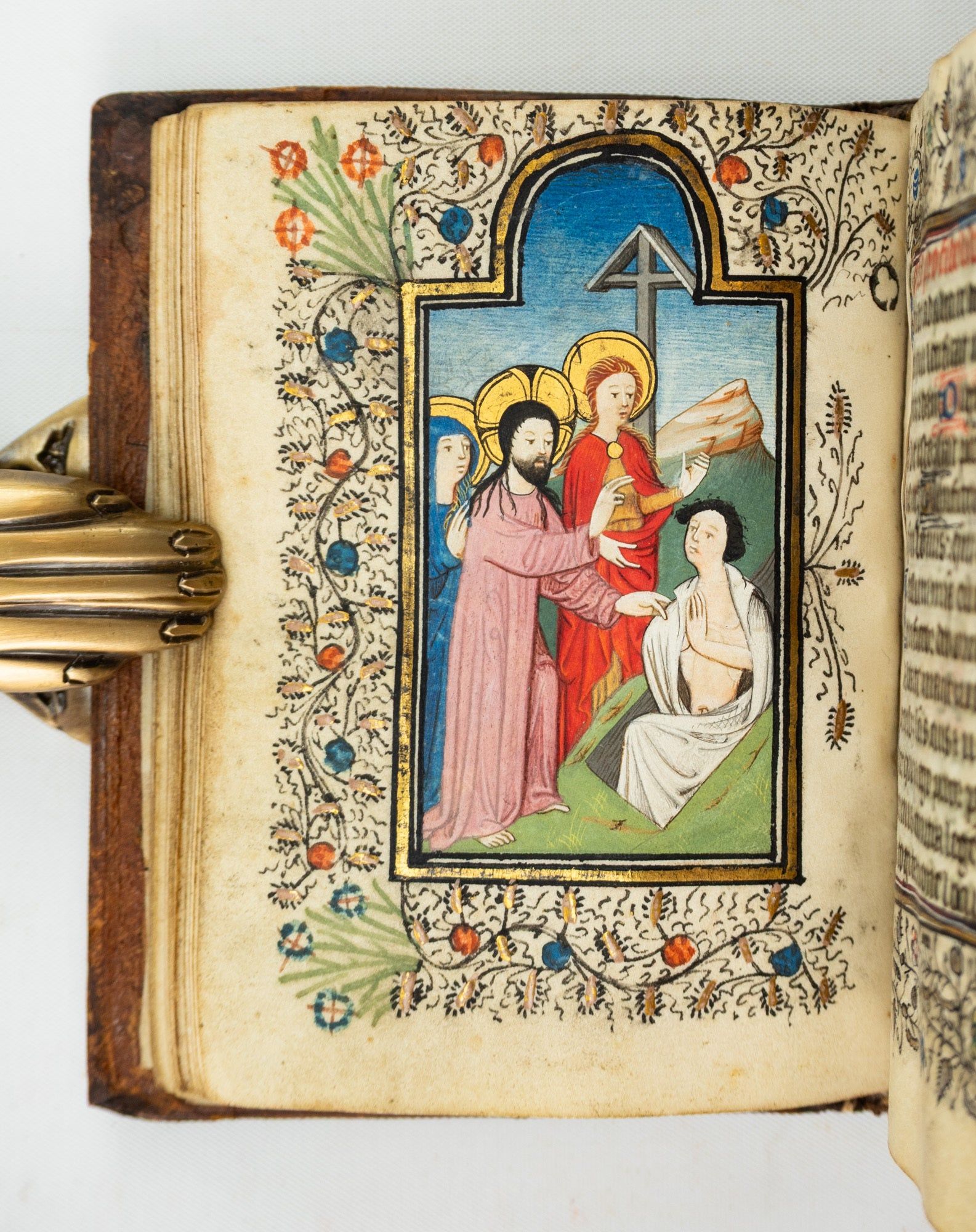
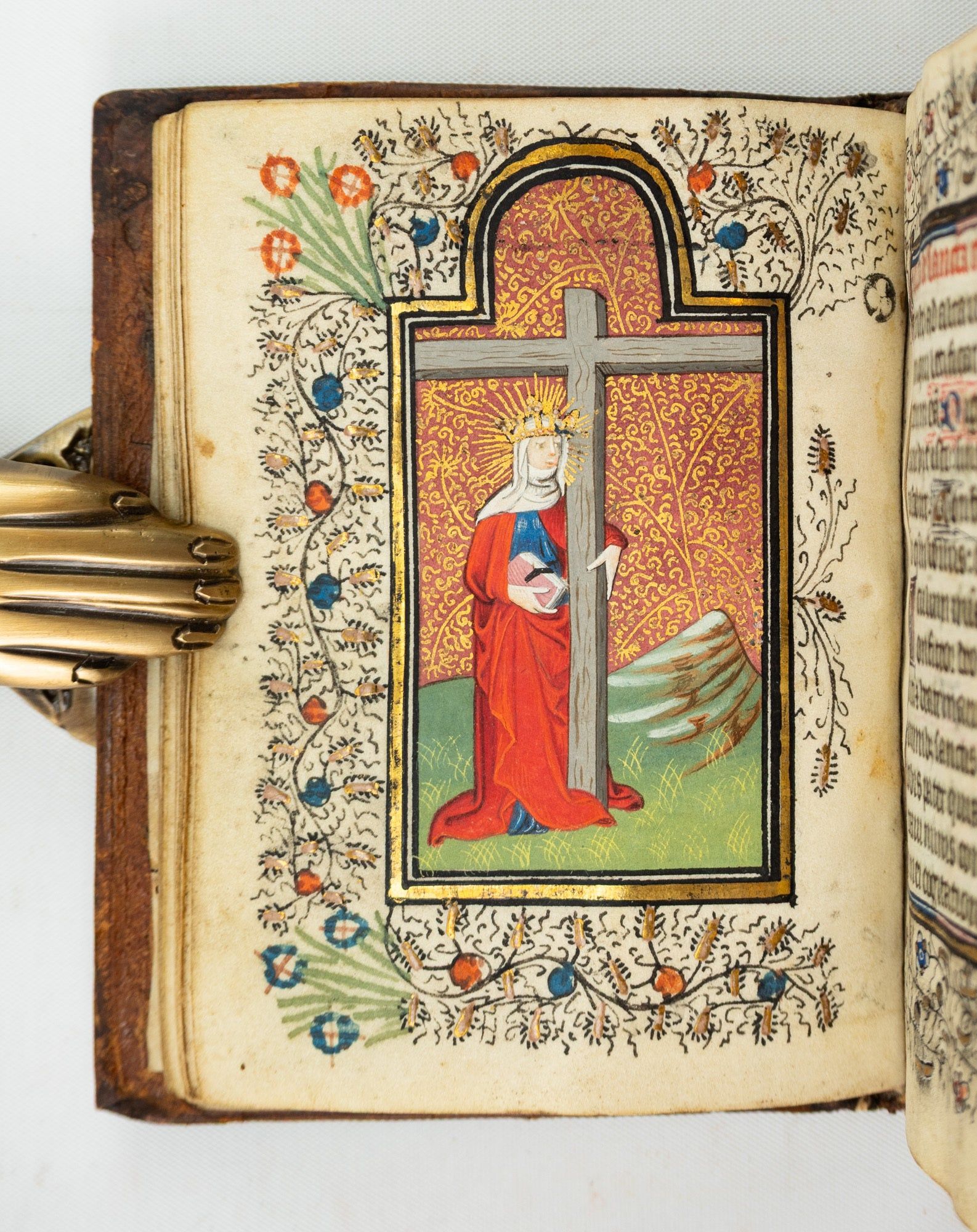
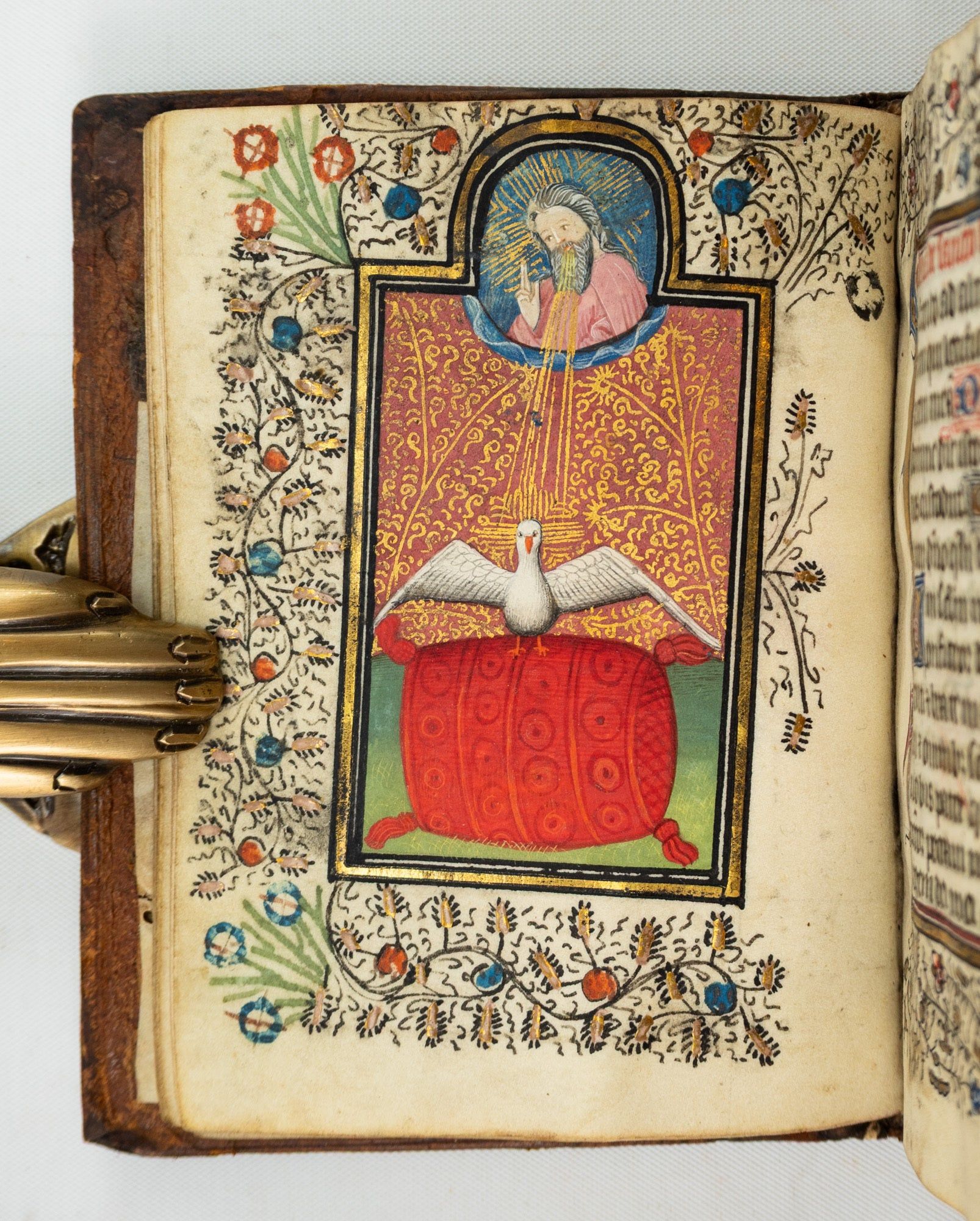
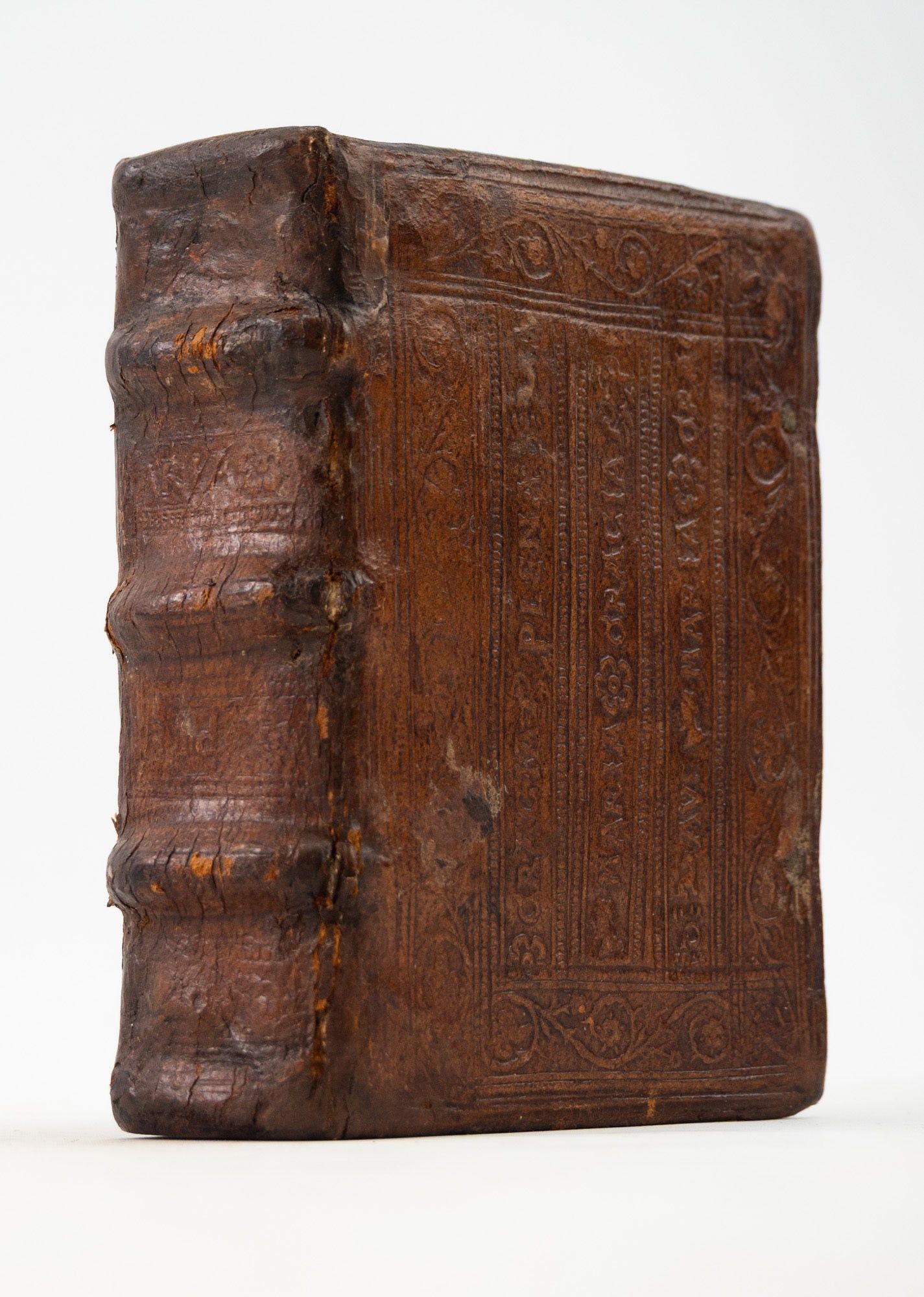
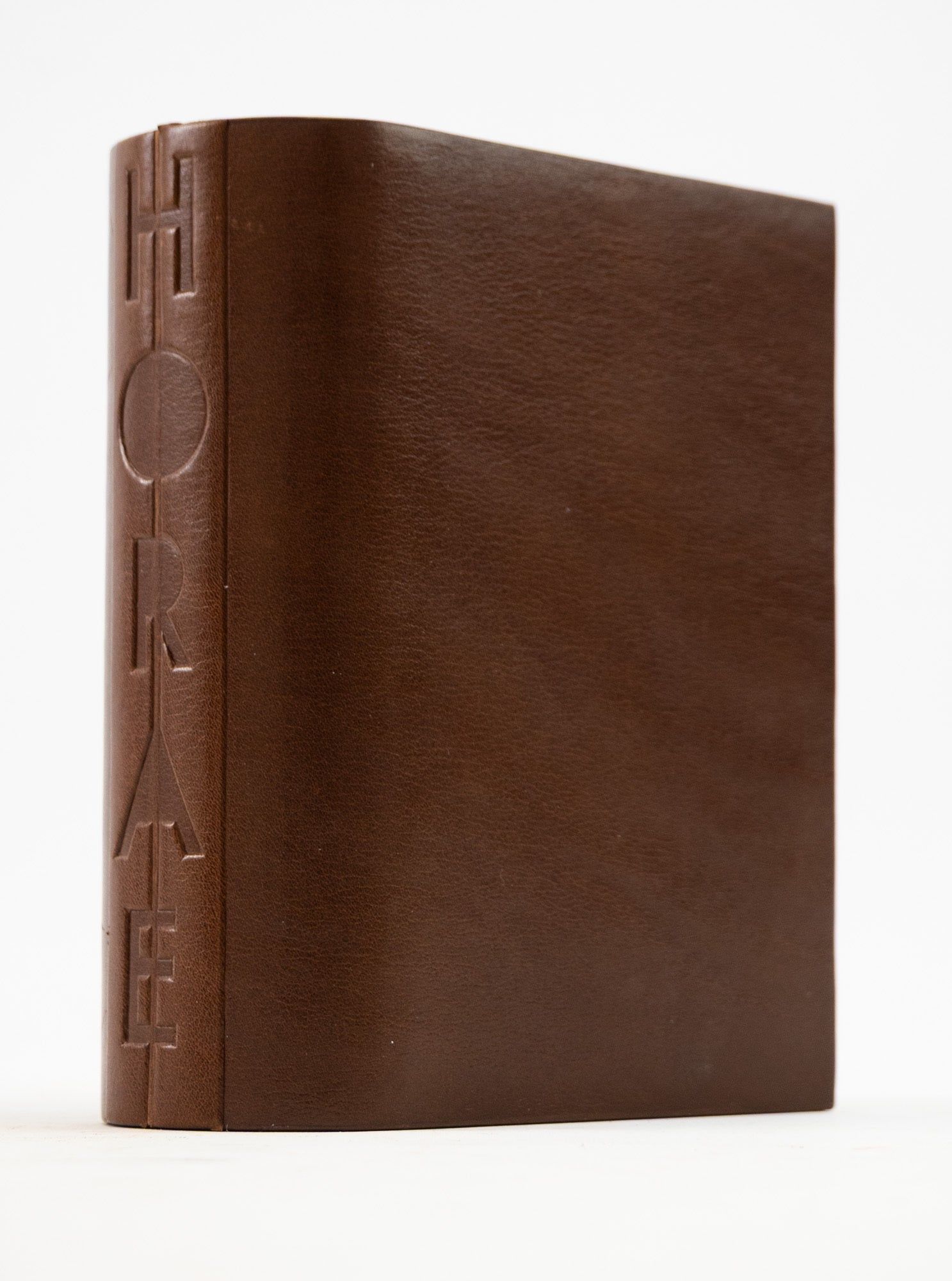
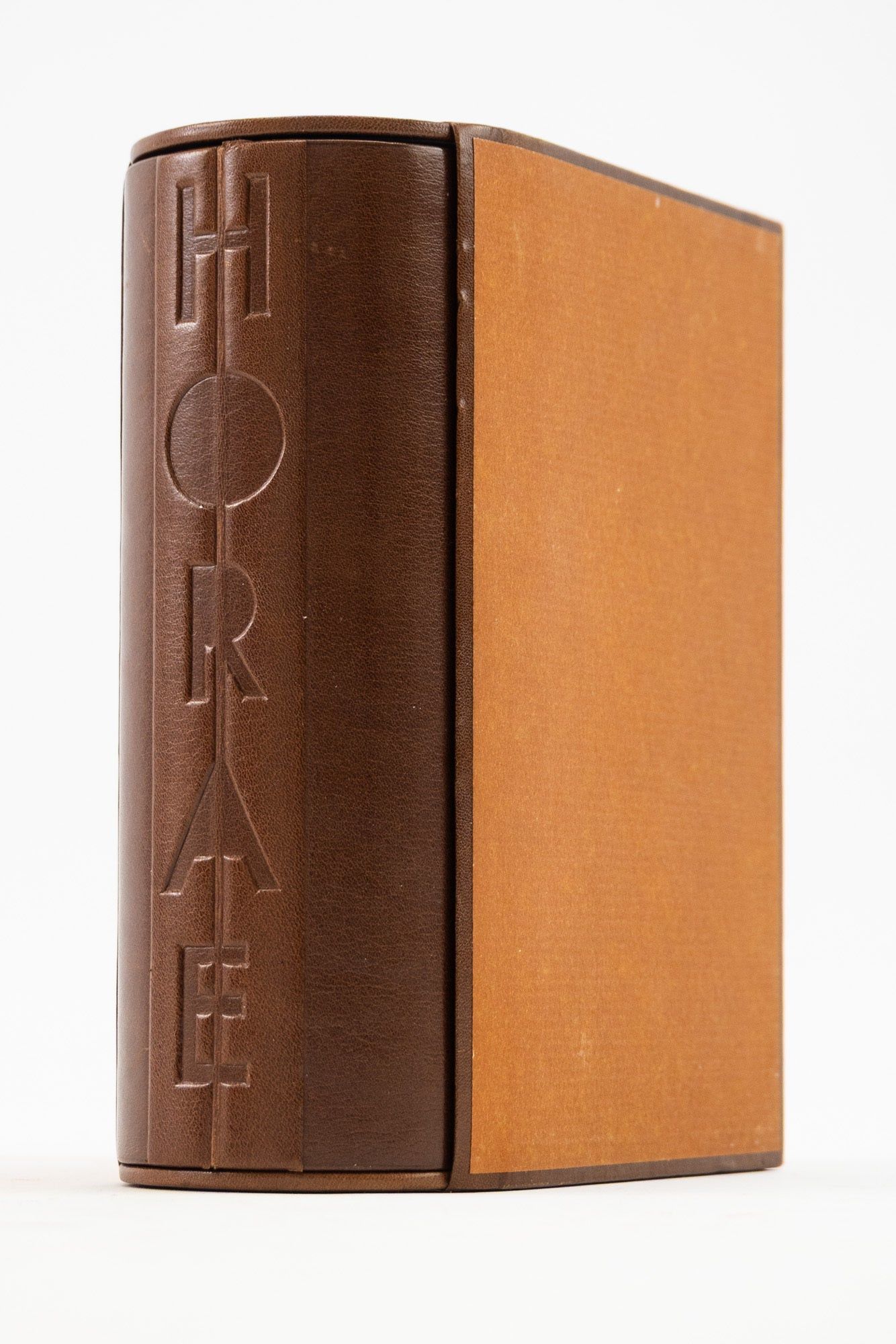
PLEASING NEAR-CONTEMPORARY BLIND-ROLLED CALF (apparently with some old, skilled restoration to joints, spine, and corners), covers with rolled vine border surrounding a panel of three columns bearing a roll with parts of the inscription "AVE MARIA GRACIA PLENA," each word separated by one of four small motifs (a flower, a human profile, the lamb of god, and a sitting animal--perhaps a lion), raised bands, compartments with part of the same inscription roll. Lacking the original ties. Housed in a very attractive custom-made brown calf folding case with blind-stamped lettering on the spine, interior lined in suede, the whole within a calf-lipped, suede-lined matching slipcase. Rubrics in red, numerous one-line initials in blue with red penwork, or gold with dark blue penwork, many two-line initials in burnished gold on pink and blue ground with white embellishments, several larger "I" initials (between four and 11 lines) in burnished gold on pink and blue ground with white embellishments, 12 six- to seven-line initials, some painted pink or blue with white embellishments and filled with flowers and tendrils on a gold ground, or the initial in burnished gold on pink and blue ground with white embellishments, EIGHT LARGE MINIATURES, each inside a thin gold frame and with a three-quarter border of gilt leaves, hairline vines, and floral spays, each facing page with a similar three-quarter border, the subjects of the miniatures being: the Holy Spirit in the form of a dove (f. 13v); St. Helena and the True Cross (f. 22v); Raising of Lazarus (f. 29v); Crucifixion (f. 54v); Virgin and Child Enthroned (f. 59v); Annunciation (f. 72v); Last Judgment (f. 125v); Funeral Mass (f. 143v). Prickings visible in fore margins. See: Defoer, et. al, "The Golden Age of Dutch Manuscript Illumination," pp. 75-86. Just minor wear to the solid, very pleasing early binding. A little chipping (almost always mild) to four of the miniatures with square frames (the fifth, the Annunciation, somewhat rubbed and faded, the three domed miniatures perfectly intact), vellum with minor soiling and thumbing in places (especially in lower corners of leaves in second half), other trivial imperfections, but overall a very well-preserved manuscript with no major issues.
This enchanting little prayer book features eight attractive miniatures, large gleaming burnished gold initials, and a pleasing period binding--all in an excellent state of preservation. The miniature program here can be attributed to the so-called Masters of Otto van Moerdrecht, the name given to a variety of Dutch artists active in the 1430s and '40s, all working in a similar mode (rather than to a specific master or workshop). According to Defoer et al., the work of these miniaturists "exhibit varied compositional formulas and bright, highly contrasting colors . . . . The small, somewhat doll-like figures appear rather wooden, but their expressive gestures give the scenes a varied and vivid character." Two artistic hands are responsible for the present miniatures. The artist behind the first three miniatures, all set within domed gilt frames (the Holy Spirit, St. Helena, and Raising of Lazarus), shows particular skill, with a very smooth application of color, figures with long, eloquent hands, and faces with subtle white highlighting. A second artist was responsible for the remaining five miniatures, set within square golden frames (Crucifixion, Virgin and Child Enthroned, Annunciation, Last Judgment, and Funeral Mass). Though this hand is less polished and the miniatures slightly smaller in size, the scenes are all quite charming and attractively colored with vivid splashes of bright orange, bubblegum pink, sky blue, and pale green. (It is worth noting that the miniatures differ not only because of the artists' degree of success, but also because of their condition: whereas the five are generally well preserved, the other three are in a virtually perfect state.) In addition to the central text of the Hours of the Virgin, this manuscript contains several Masses, each of which is preceded by a miniature. Perhaps the most interesting of these is the Mass of the Holy Cross, which is paired with a miniature of St. Helena, mother of Constantine the Great. According to Christian tradition, Helena found the wooden cross used in the Crucifixion while she was travelling in Jerusalem in the fourth century. Constantine built the Basilica of the Holy Sepulchre in its honor, and installed the relic there to be venerated. Britannica says that the adoration of the True Cross led to wide-spread sale of its fragments, sought after as objects of devotion. It is unusual to find St. Helena depicted in a Book of Hours, and this image is especially appealing, with Helena in a beautiful red robe, crown, and halo, embracing a large wooden cross in the center of the composition. The background is reminiscent of the work of the Gold Scrolls group, with small swirls of liquid gold swimming in a scarlet sky (the same scrolling motif graces the Holy Dove miniature). There is no indication of former ownership in this manuscript, although the Calendar presents a few unusual saints that confirm a Flanders connection. These include St. Amandus (in red), known as the "Apostle of Flanders," on 2 February; St. Guido, known as the "Poor Man of Anderlecht," on 9 September; St. Bavo (in red), patron saint of Ghent (where a Cathedral is named in his honor), on 10 October; and St. Eligius, patron saint of goldsmiths and metalworkers, on 1 December. The binding here is very close to contemporary, and probably dates to the late 15th century. Neither the floral roll nor the "Ave Maria" roll seems to appear in EBDB. Similar rolls include r001954, r000623, and r000670, but ours is the only one with four different (and charming) tools, one of each used between every "Ave" and "Maria." For a manuscript only slightly bigger than the palm of one’s hand, this Book of Hours has a great deal to offer. In addition to its early binding and lovely illumination by an influential group of artists, great care has been put into its preservation, so that it resolutely endures for our pleasure, and for owners in the centuries to come..
PLEASING NEAR-CONTEMPORARY BLIND-ROLLED CALF (apparently with some old, skilled restoration to joints, spine, and corners), covers with rolled vine border surrounding a panel of three columns bearing a roll with parts of the inscription "AVE MARIA GRACIA PLENA," each word separated by one of four small motifs (a flower, a human profile, the lamb of god, and a sitting animal--perhaps a lion), raised bands, compartments with part of the same inscription roll. Lacking the original ties. Housed in a very attractive custom-made brown calf folding case with blind-stamped lettering on the spine, interior lined in suede, the whole within a calf-lipped, suede-lined matching slipcase. Rubrics in red, numerous one-line initials in blue with red penwork, or gold with dark blue penwork, many two-line initials in burnished gold on pink and blue ground with white embellishments, several larger "I" initials (between four and 11 lines) in burnished gold on pink and blue ground with white embellishments, 12 six- to seven-line initials, some painted pink or blue with white embellishments and filled with flowers and tendrils on a gold ground, or the initial in burnished gold on pink and blue ground with white embellishments, EIGHT LARGE MINIATURES, each inside a thin gold frame and with a three-quarter border of gilt leaves, hairline vines, and floral spays, each facing page with a similar three-quarter border, the subjects of the miniatures being: the Holy Spirit in the form of a dove (f. 13v); St. Helena and the True Cross (f. 22v); Raising of Lazarus (f. 29v); Crucifixion (f. 54v); Virgin and Child Enthroned (f. 59v); Annunciation (f. 72v); Last Judgment (f. 125v); Funeral Mass (f. 143v). Prickings visible in fore margins. See: Defoer, et. al, "The Golden Age of Dutch Manuscript Illumination," pp. 75-86. Just minor wear to the solid, very pleasing early binding. A little chipping (almost always mild) to four of the miniatures with square frames (the fifth, the Annunciation, somewhat rubbed and faded, the three domed miniatures perfectly intact), vellum with minor soiling and thumbing in places (especially in lower corners of leaves in second half), other trivial imperfections, but overall a very well-preserved manuscript with no major issues.
This enchanting little prayer book features eight attractive miniatures, large gleaming burnished gold initials, and a pleasing period binding--all in an excellent state of preservation. The miniature program here can be attributed to the so-called Masters of Otto van Moerdrecht, the name given to a variety of Dutch artists active in the 1430s and '40s, all working in a similar mode (rather than to a specific master or workshop). According to Defoer et al., the work of these miniaturists "exhibit varied compositional formulas and bright, highly contrasting colors . . . . The small, somewhat doll-like figures appear rather wooden, but their expressive gestures give the scenes a varied and vivid character." Two artistic hands are responsible for the present miniatures. The artist behind the first three miniatures, all set within domed gilt frames (the Holy Spirit, St. Helena, and Raising of Lazarus), shows particular skill, with a very smooth application of color, figures with long, eloquent hands, and faces with subtle white highlighting. A second artist was responsible for the remaining five miniatures, set within square golden frames (Crucifixion, Virgin and Child Enthroned, Annunciation, Last Judgment, and Funeral Mass). Though this hand is less polished and the miniatures slightly smaller in size, the scenes are all quite charming and attractively colored with vivid splashes of bright orange, bubblegum pink, sky blue, and pale green. (It is worth noting that the miniatures differ not only because of the artists' degree of success, but also because of their condition: whereas the five are generally well preserved, the other three are in a virtually perfect state.) In addition to the central text of the Hours of the Virgin, this manuscript contains several Masses, each of which is preceded by a miniature. Perhaps the most interesting of these is the Mass of the Holy Cross, which is paired with a miniature of St. Helena, mother of Constantine the Great. According to Christian tradition, Helena found the wooden cross used in the Crucifixion while she was travelling in Jerusalem in the fourth century. Constantine built the Basilica of the Holy Sepulchre in its honor, and installed the relic there to be venerated. Britannica says that the adoration of the True Cross led to wide-spread sale of its fragments, sought after as objects of devotion. It is unusual to find St. Helena depicted in a Book of Hours, and this image is especially appealing, with Helena in a beautiful red robe, crown, and halo, embracing a large wooden cross in the center of the composition. The background is reminiscent of the work of the Gold Scrolls group, with small swirls of liquid gold swimming in a scarlet sky (the same scrolling motif graces the Holy Dove miniature). There is no indication of former ownership in this manuscript, although the Calendar presents a few unusual saints that confirm a Flanders connection. These include St. Amandus (in red), known as the "Apostle of Flanders," on 2 February; St. Guido, known as the "Poor Man of Anderlecht," on 9 September; St. Bavo (in red), patron saint of Ghent (where a Cathedral is named in his honor), on 10 October; and St. Eligius, patron saint of goldsmiths and metalworkers, on 1 December. The binding here is very close to contemporary, and probably dates to the late 15th century. Neither the floral roll nor the "Ave Maria" roll seems to appear in EBDB. Similar rolls include r001954, r000623, and r000670, but ours is the only one with four different (and charming) tools, one of each used between every "Ave" and "Maria." For a manuscript only slightly bigger than the palm of one’s hand, this Book of Hours has a great deal to offer. In addition to its early binding and lovely illumination by an influential group of artists, great care has been put into its preservation, so that it resolutely endures for our pleasure, and for owners in the centuries to come..
Details
Title
USE OF ROME
Author
A MEDIEVAL ILLUMINATED VELLUM MANUSCRIPT BOOK OF HOURS IN LATIN, WITH EIGHT MINIATURES IN THE STYLE OF THE MASTERS OF OTTO VAN MOERDRECHT
Condition
Unknown
Publisher
Flanders
Date
ca. 1450