

USE OF ROME
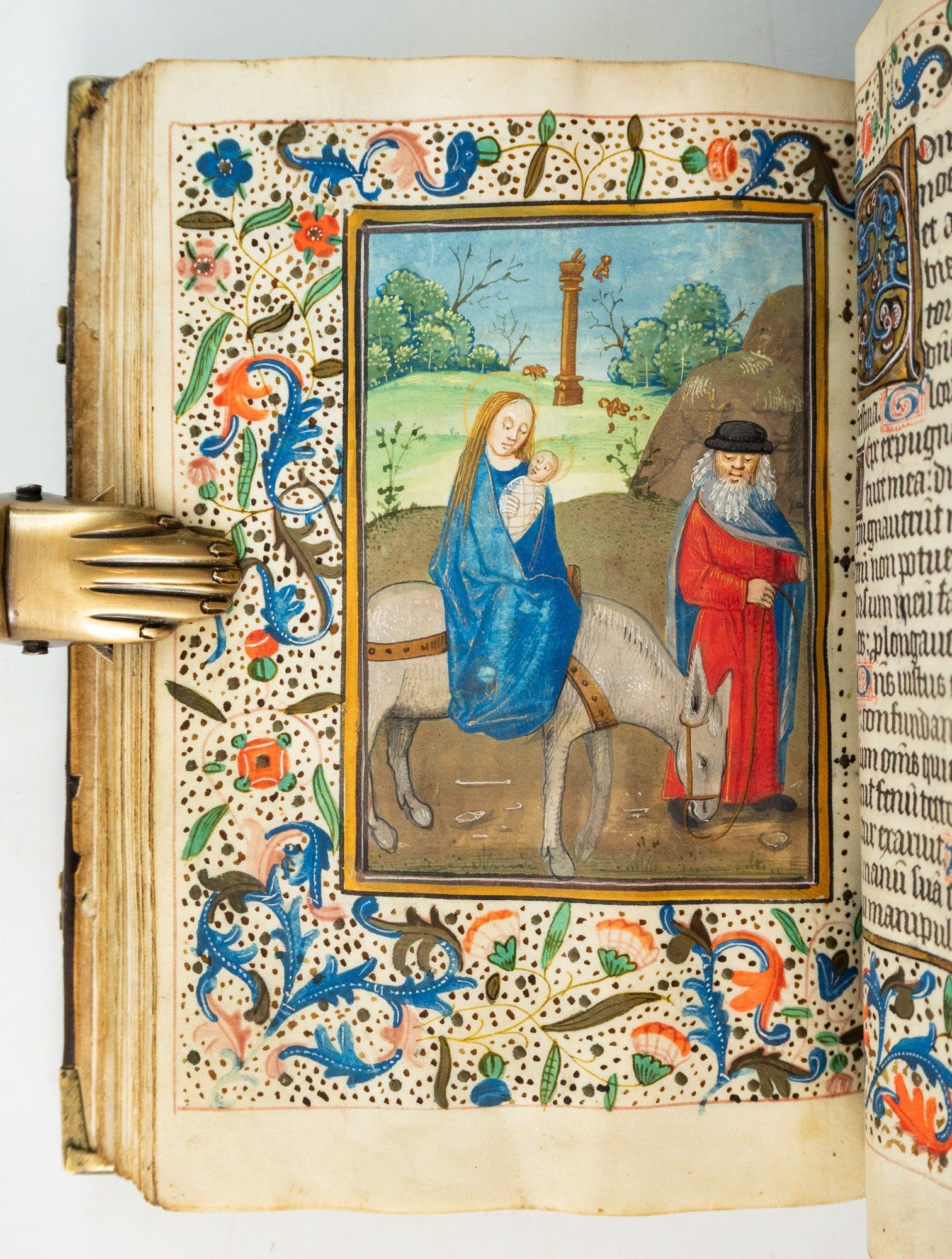
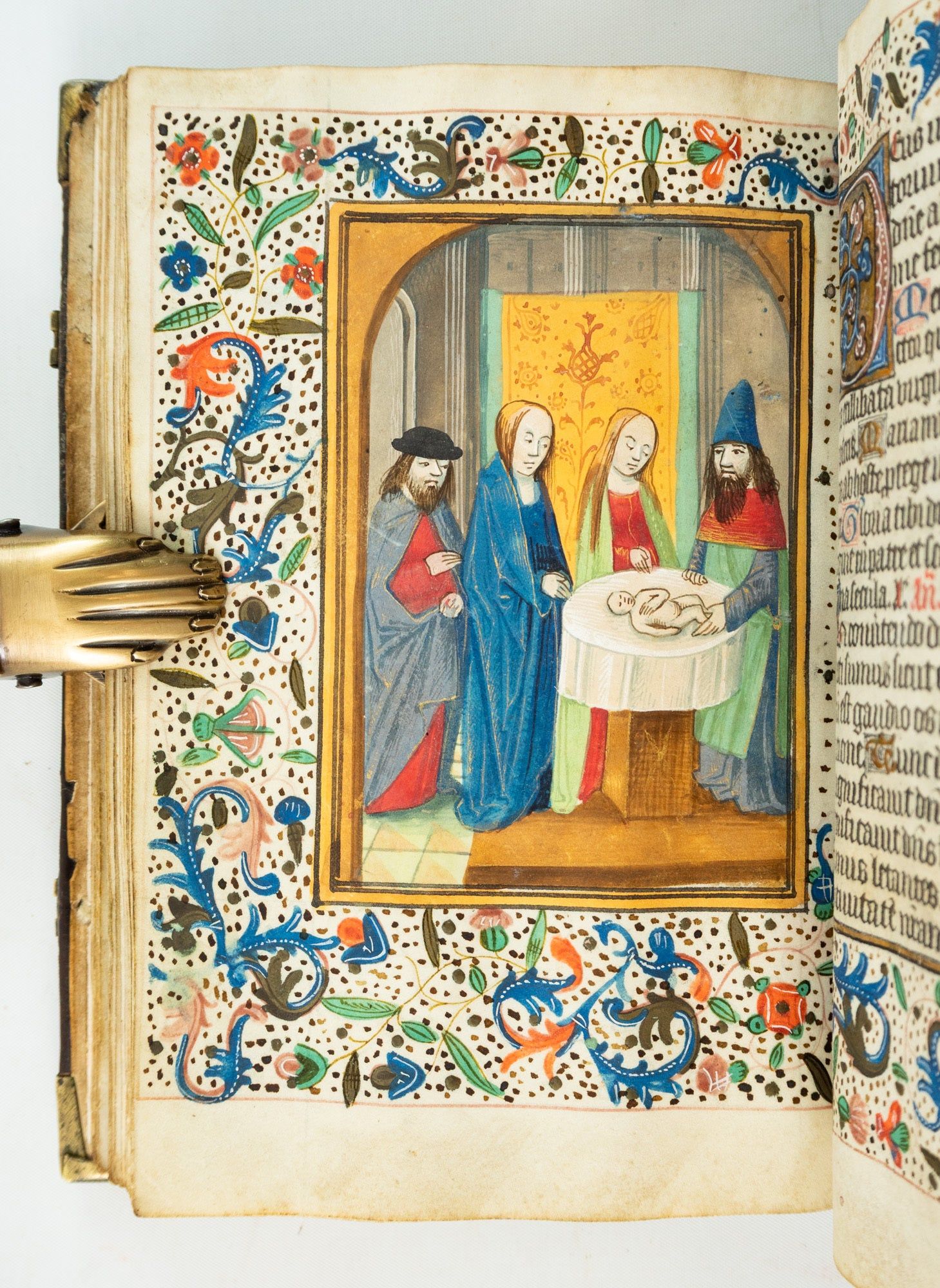
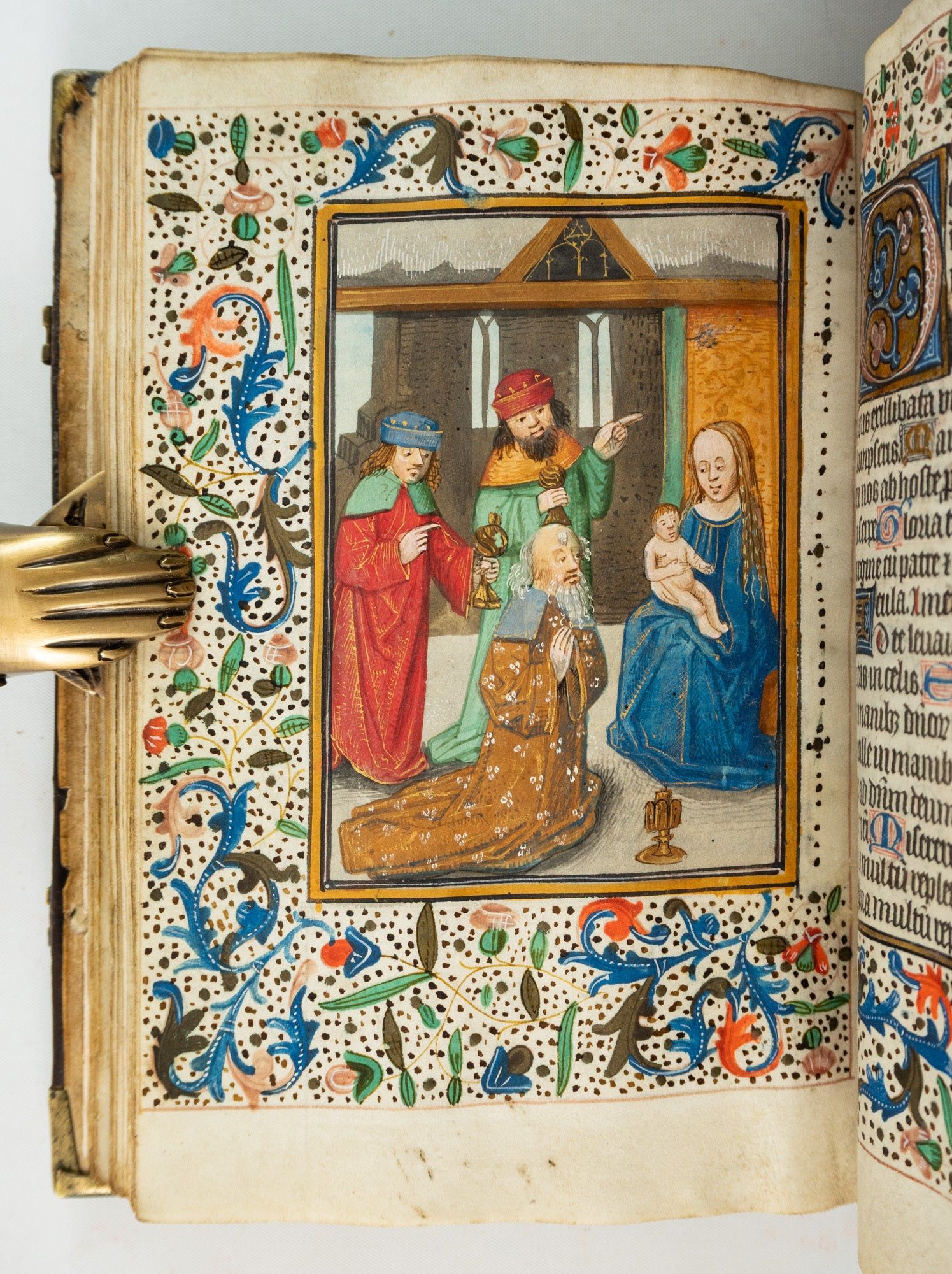
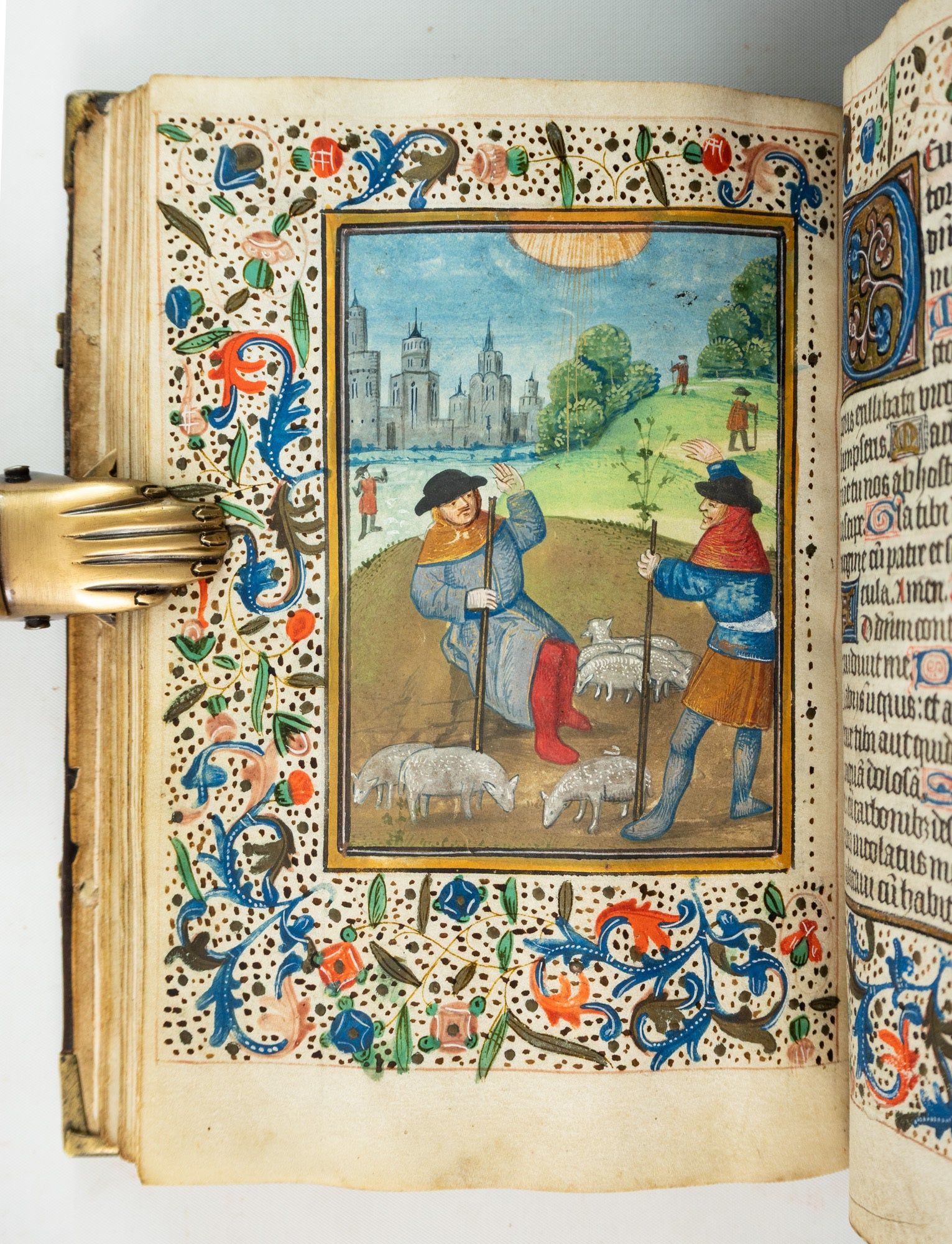
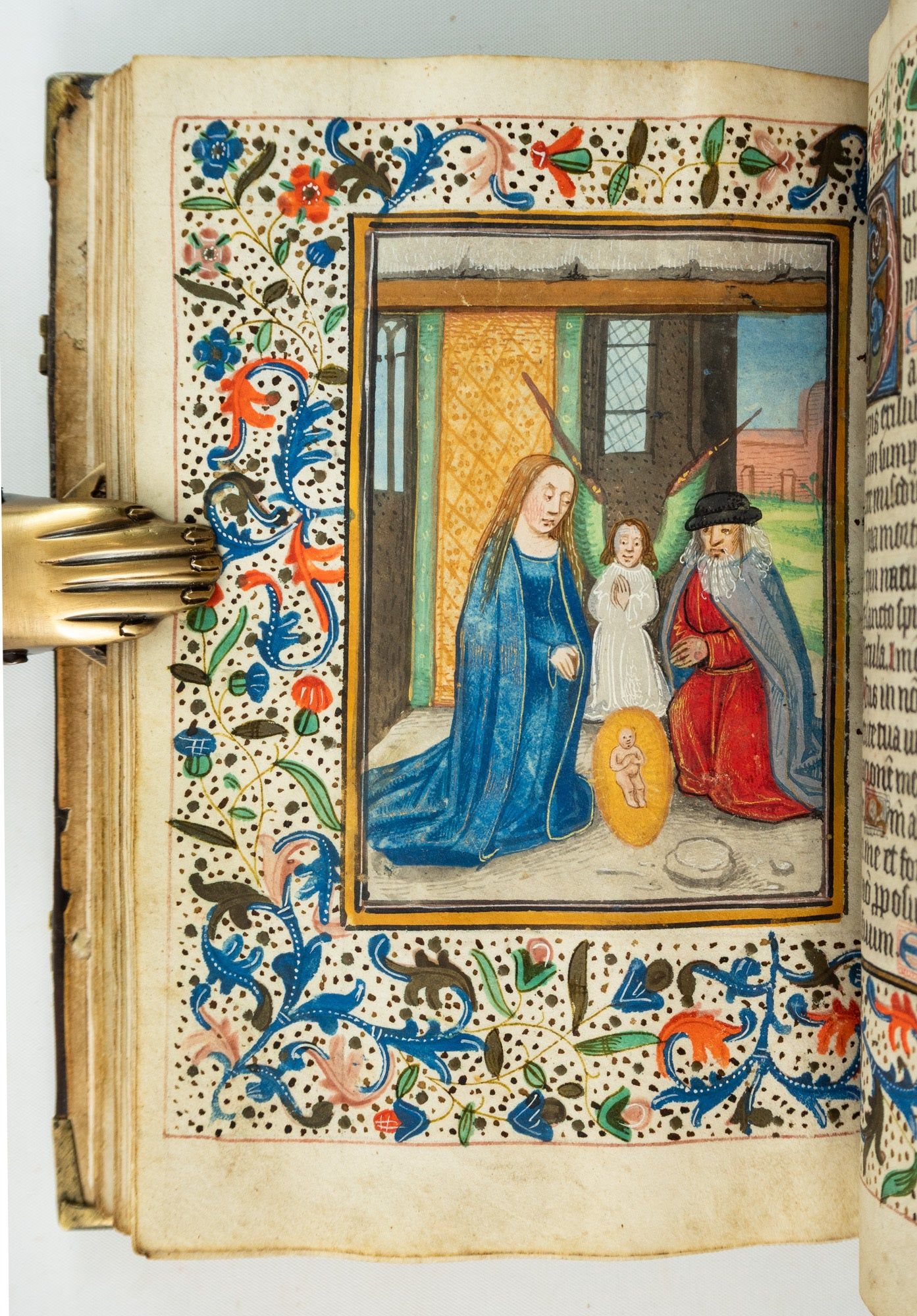
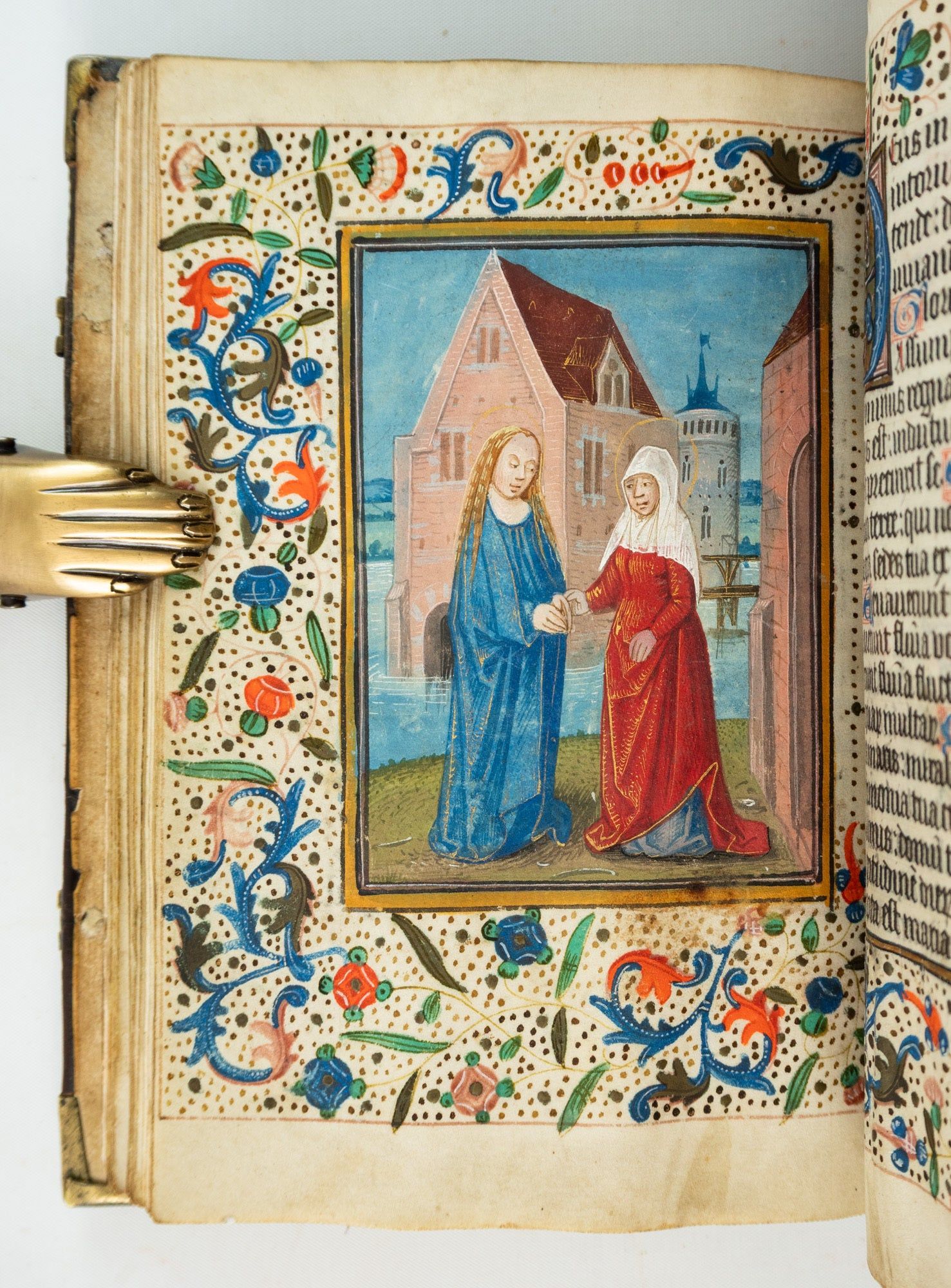
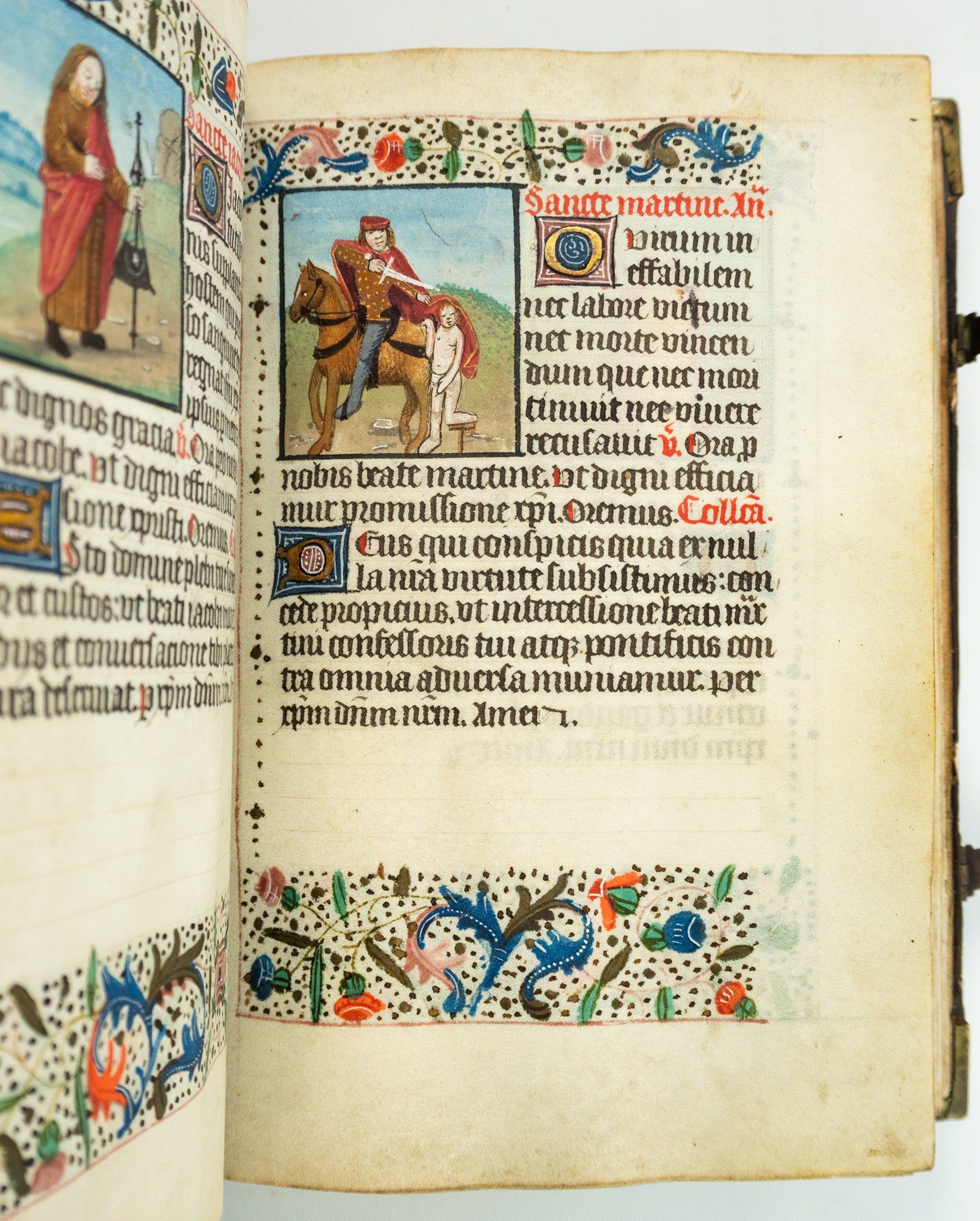
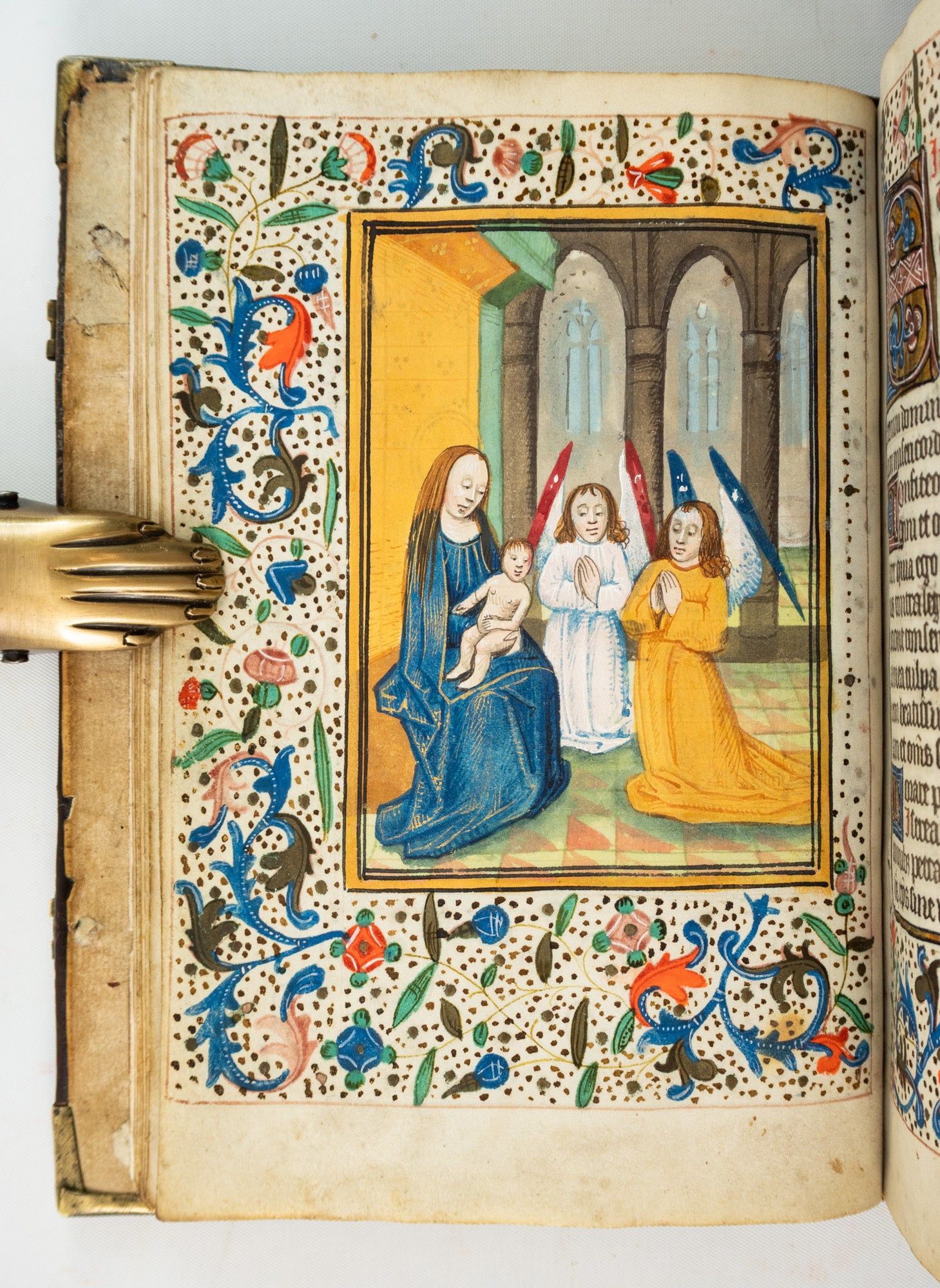
- Low Countries [probably Bruges] , ca. 1470-80
Low Countries [probably Bruges], ca. 1470-80. 186 x 135 mm. (7 3/8 x 5 1/4"). Single column, 20 lines in a gothic book hand. i (blank), 108, i (blank) leaves (bound too tightly for a close collation, but APPARENTLY COMPLETE). Contents: Calendar (f. 1r); Gospel Lessons (f. 7r); Hours of the Holy Cross (f. 11r); Hours of the Holy Spirit (f. 15r); Mass of the Virgin (18r); "Obsecro te" (f. 21r); "O Intemerata" (f. 23r); Suffrages (f. 24r); Hours of the Virgin (f. 33r); Office of the Virgin as said throughout Advent (f. 71r); Penitential Psalms (f. 76r); Litany and petitions (f. 81v); Office of the Dead (f. 87r).
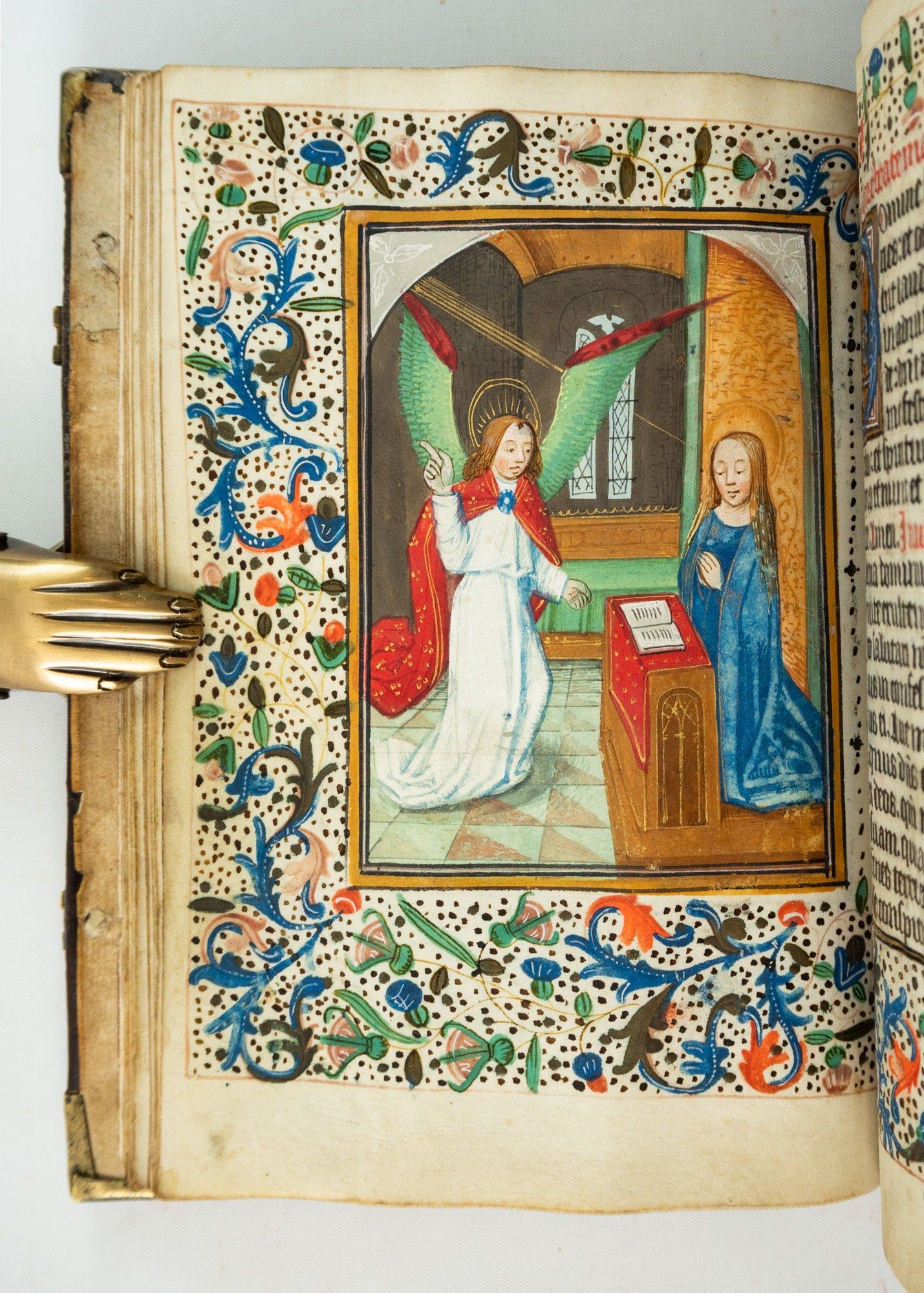
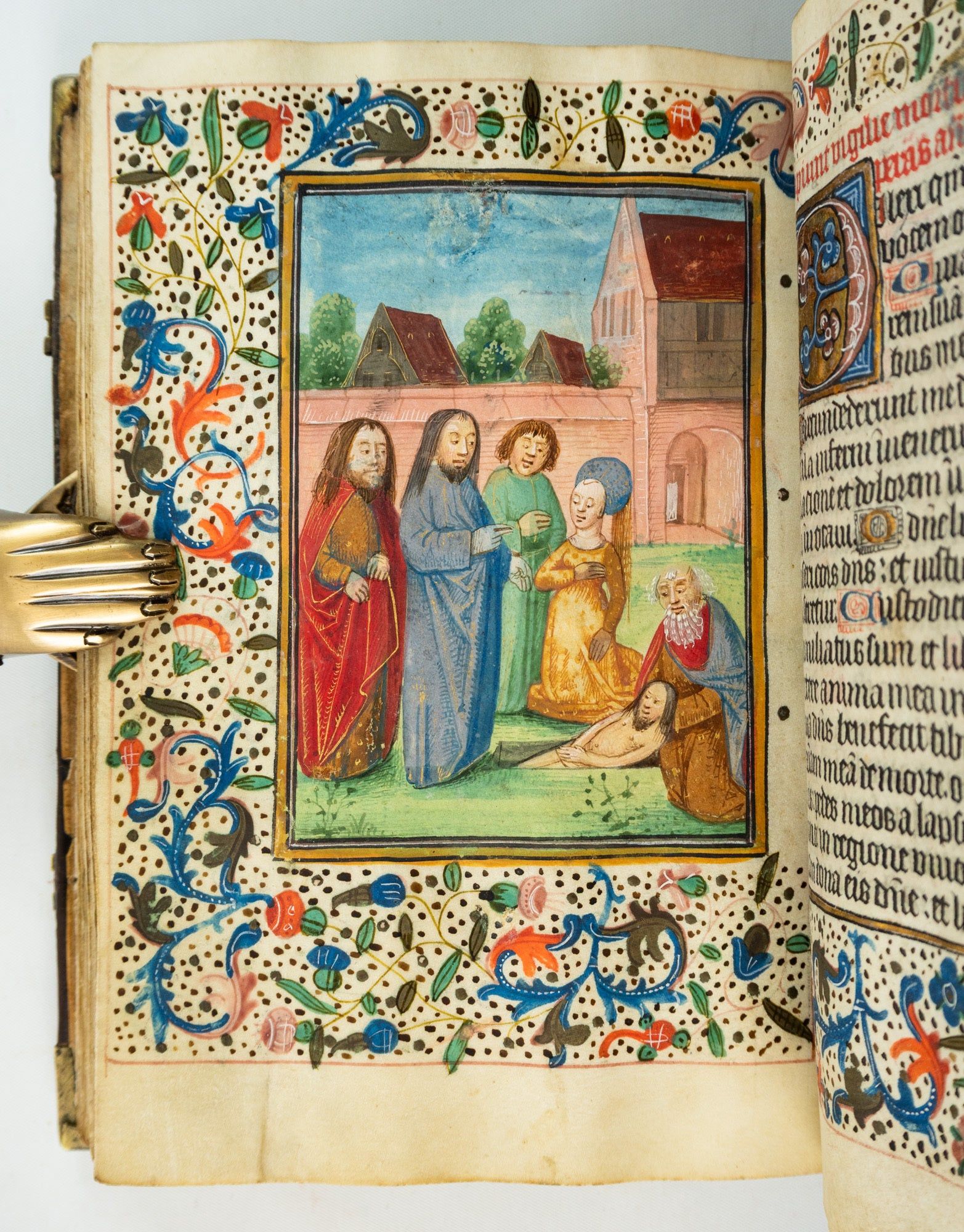
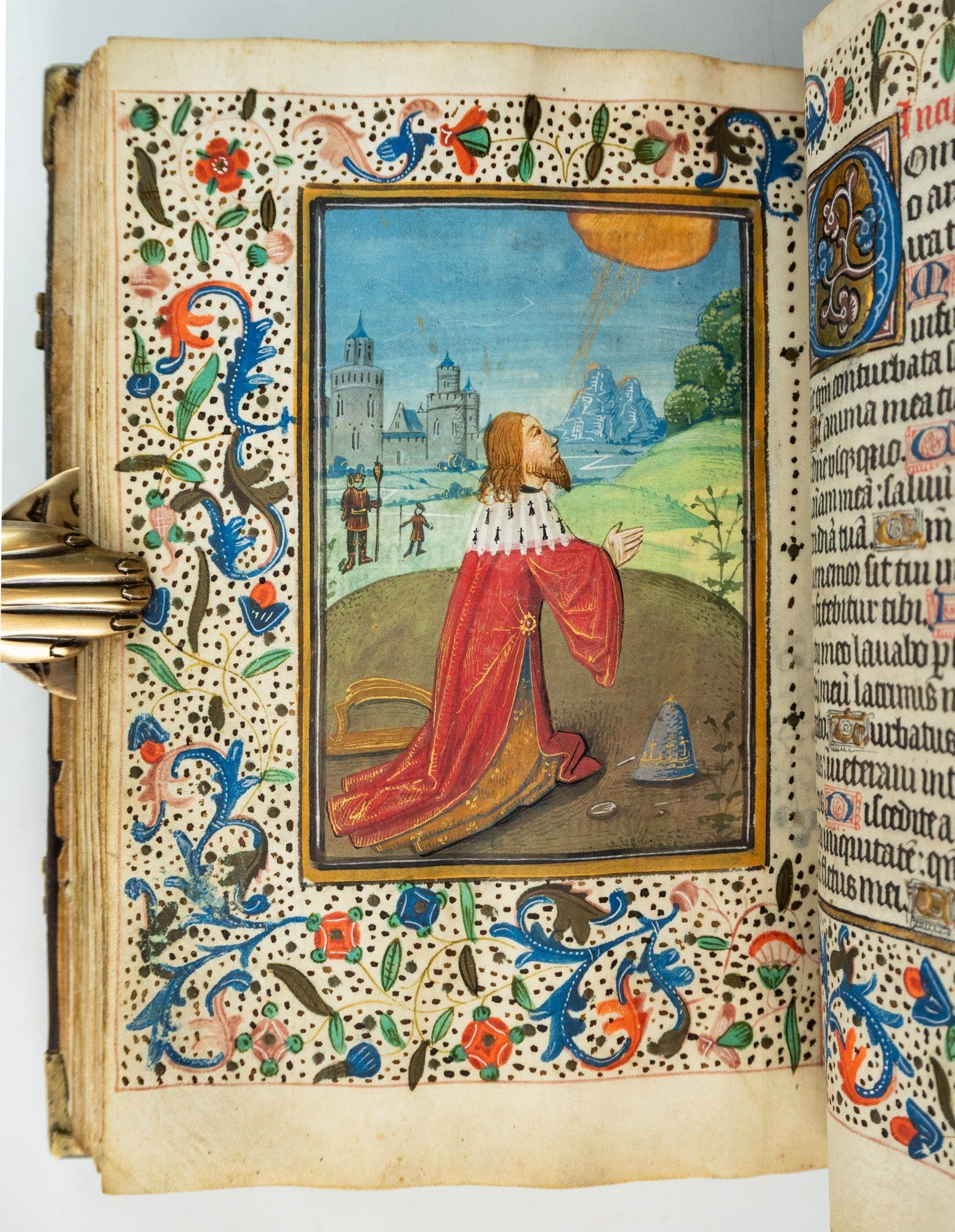
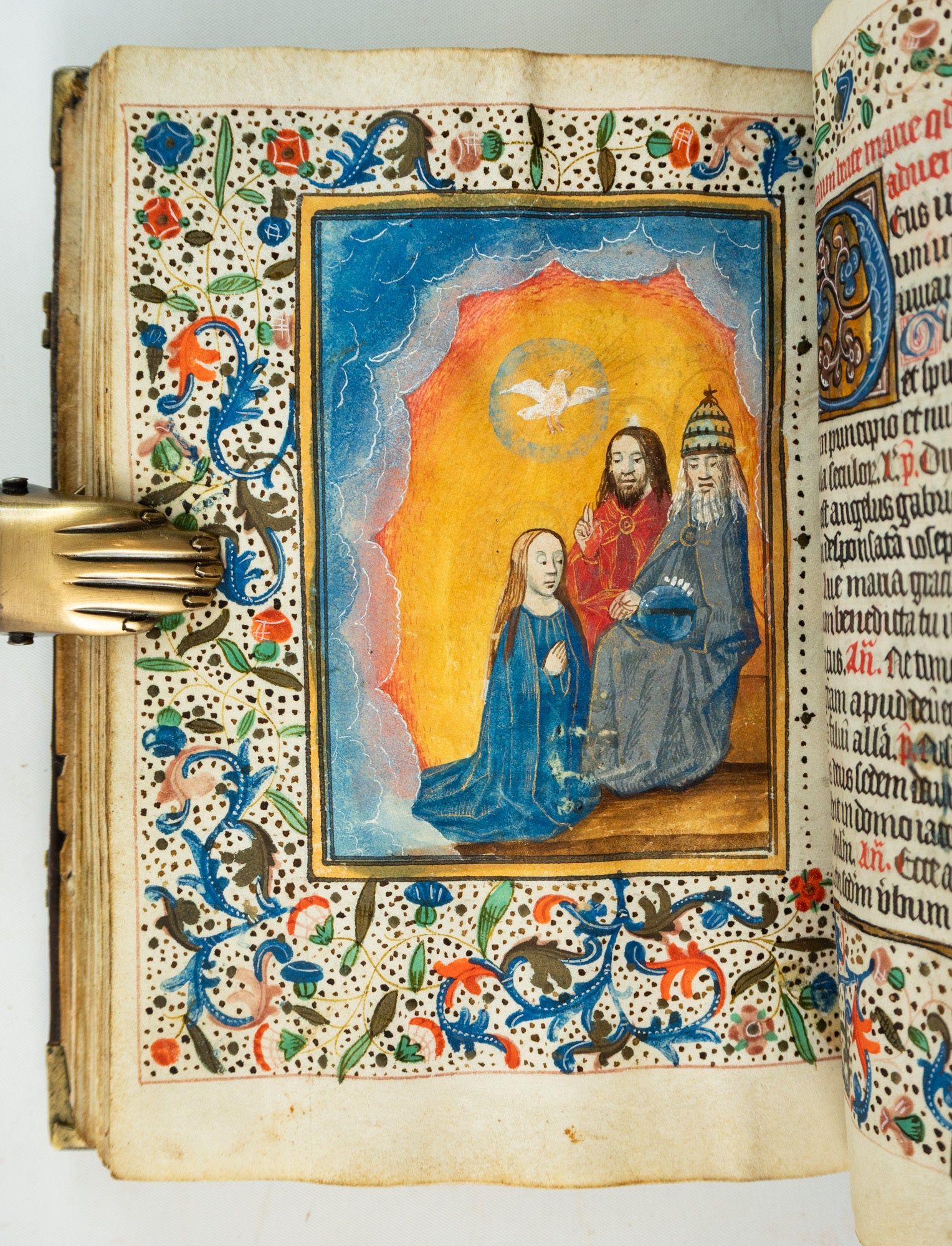
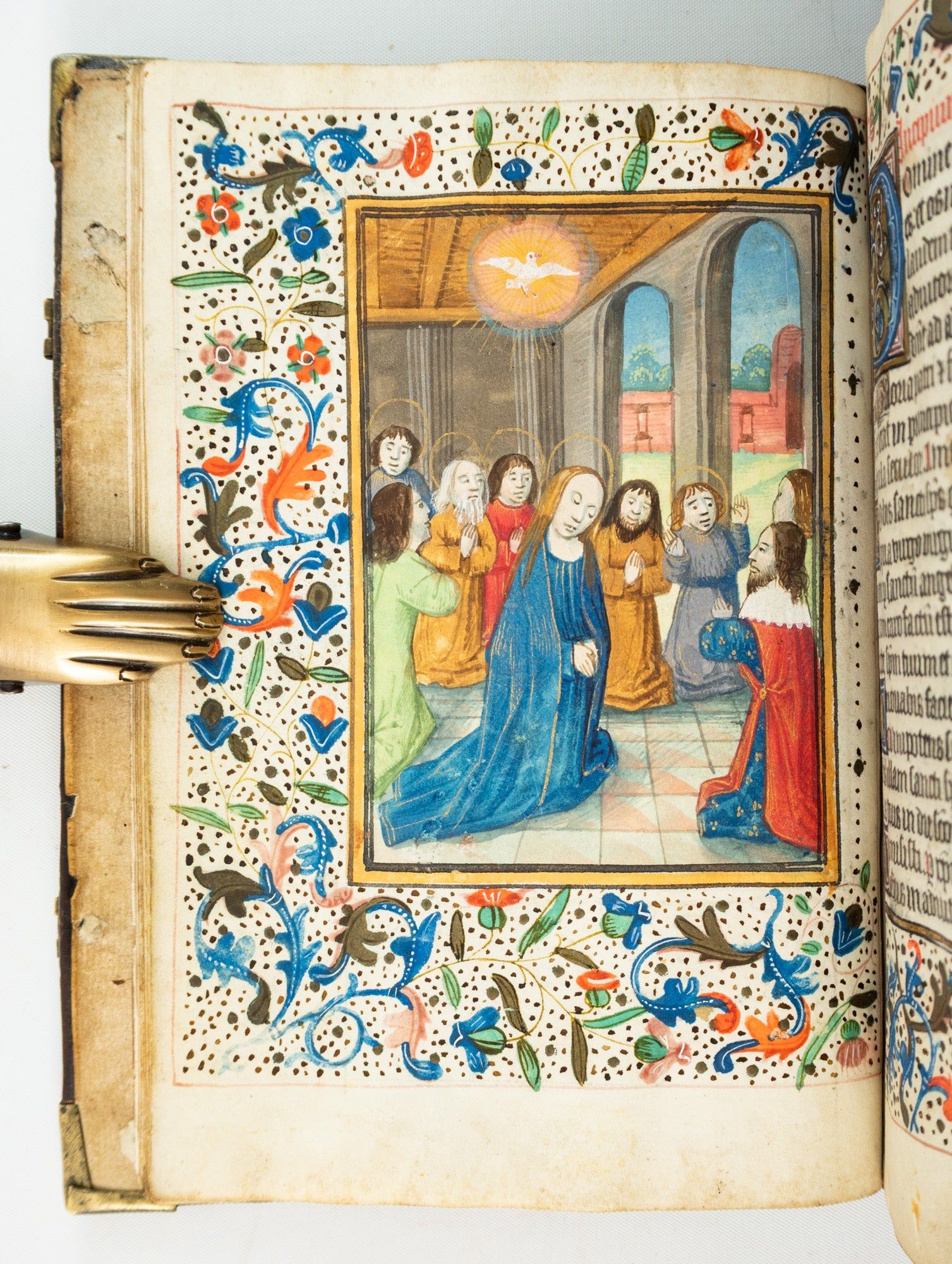
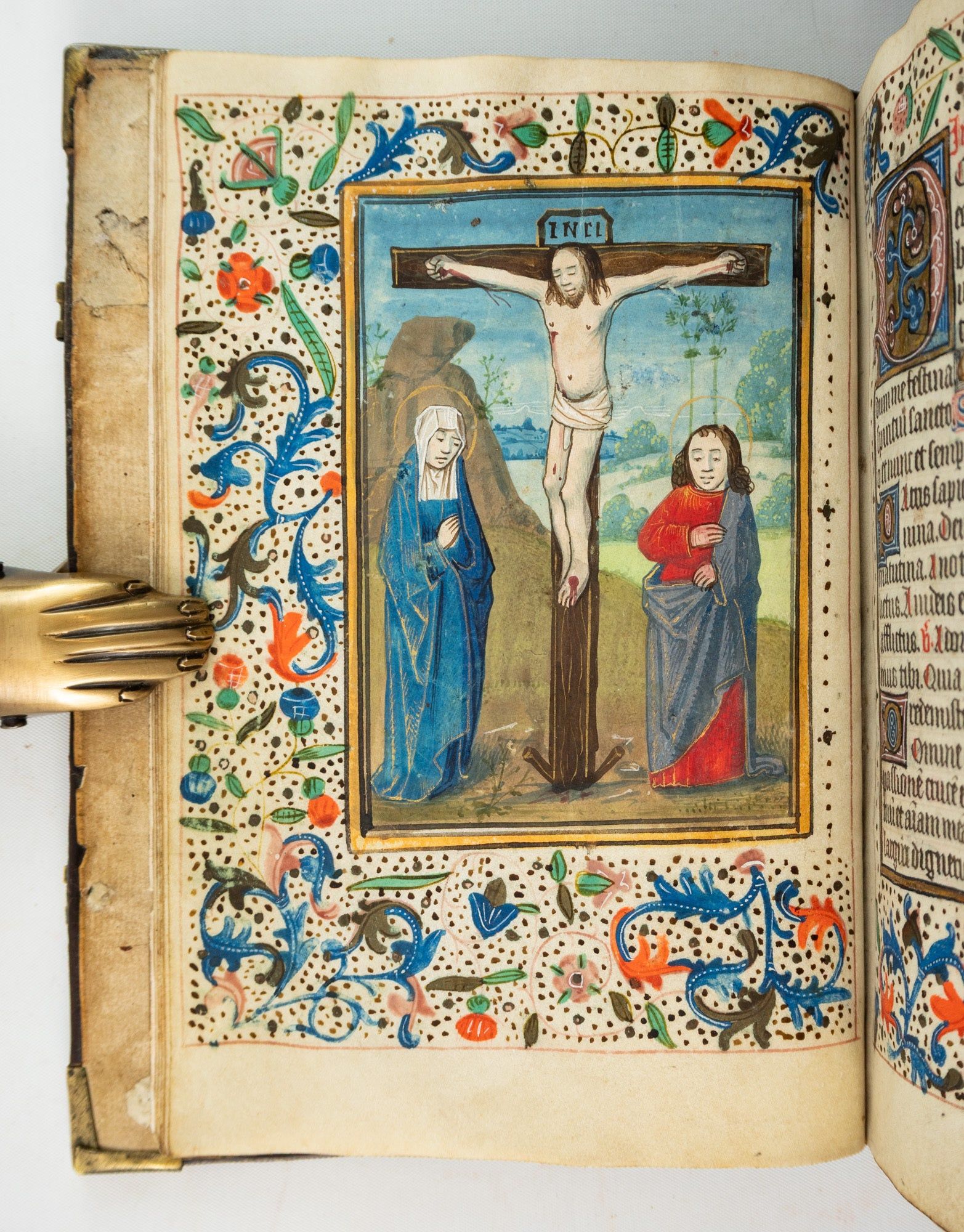
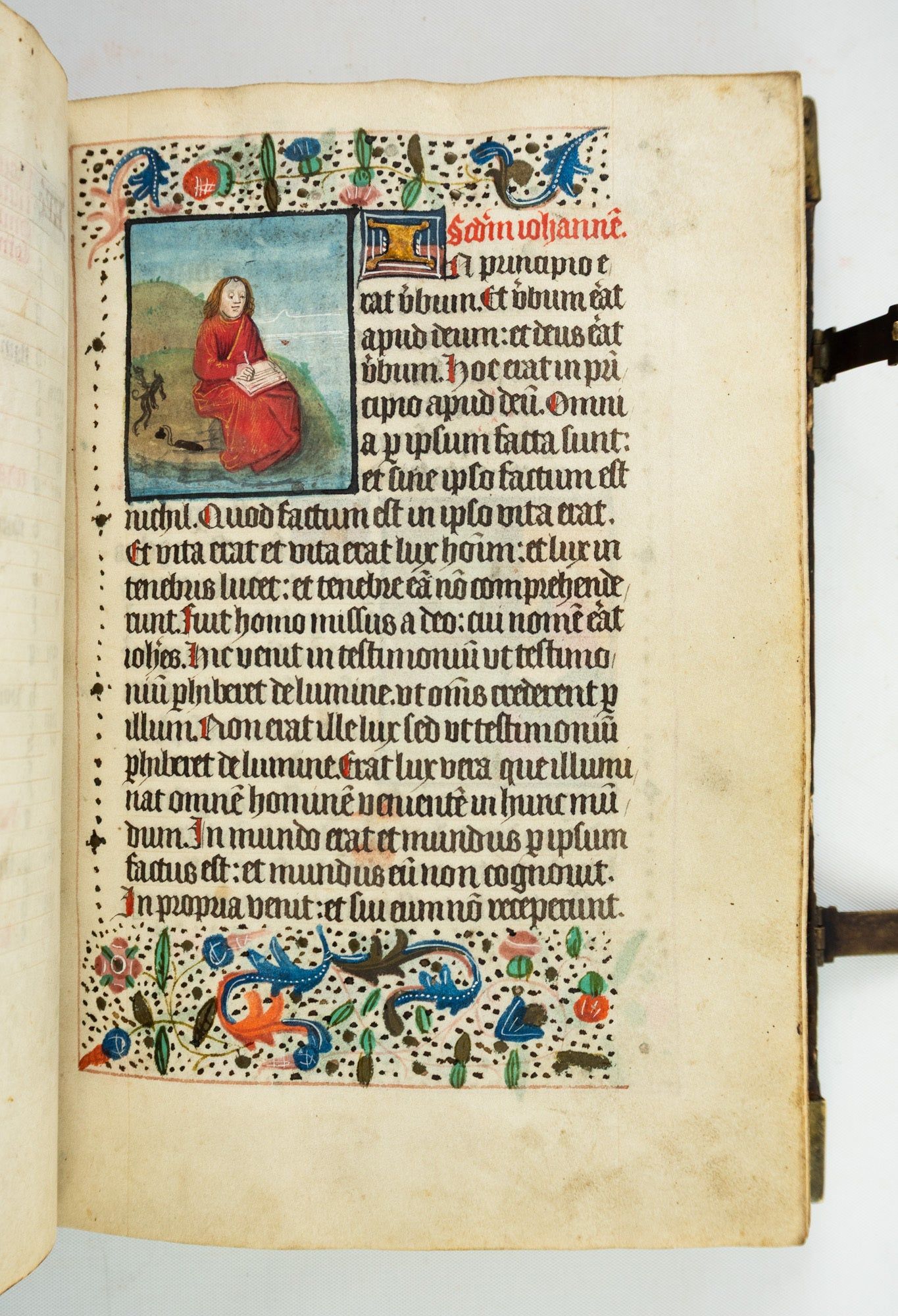
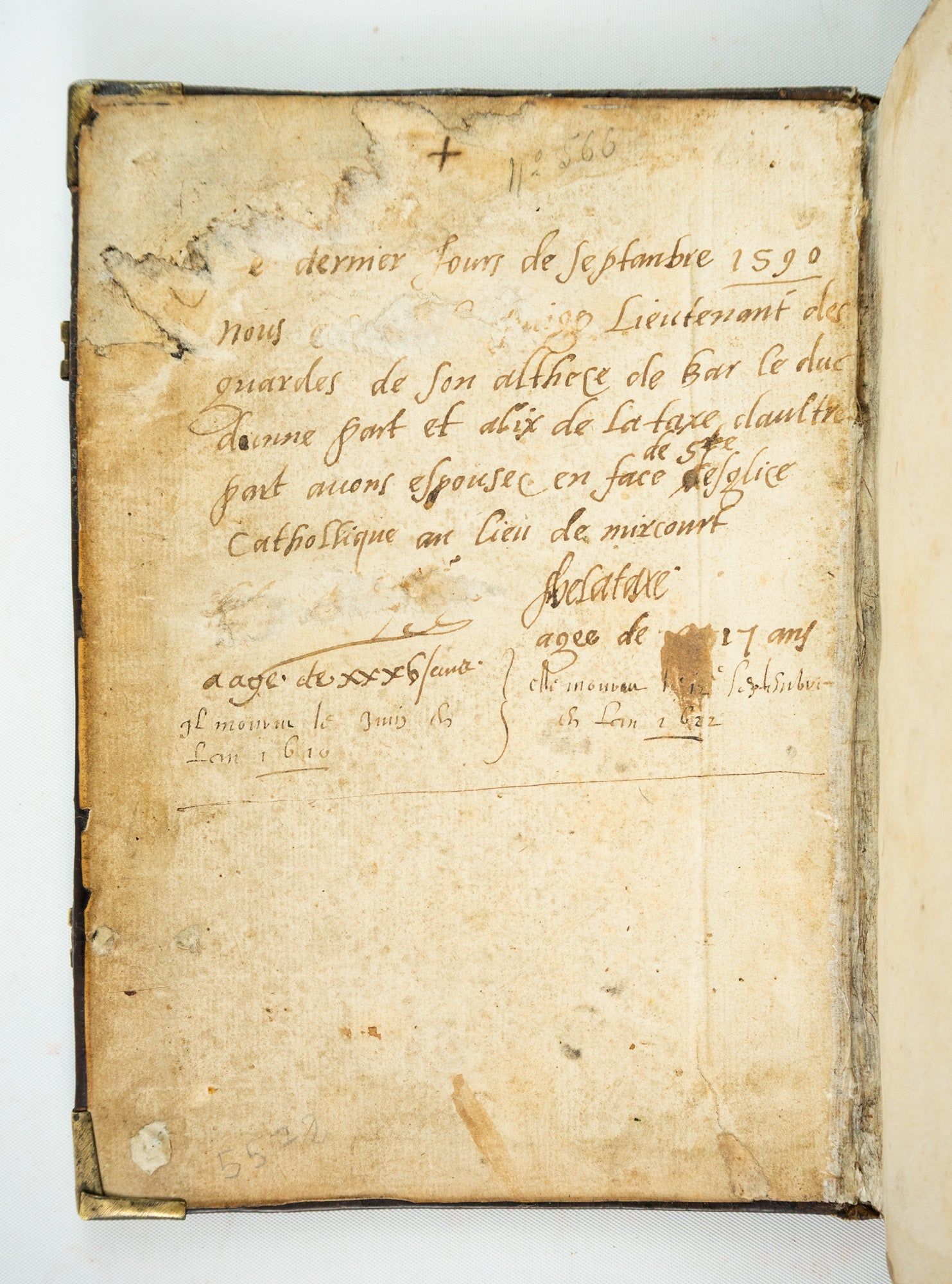
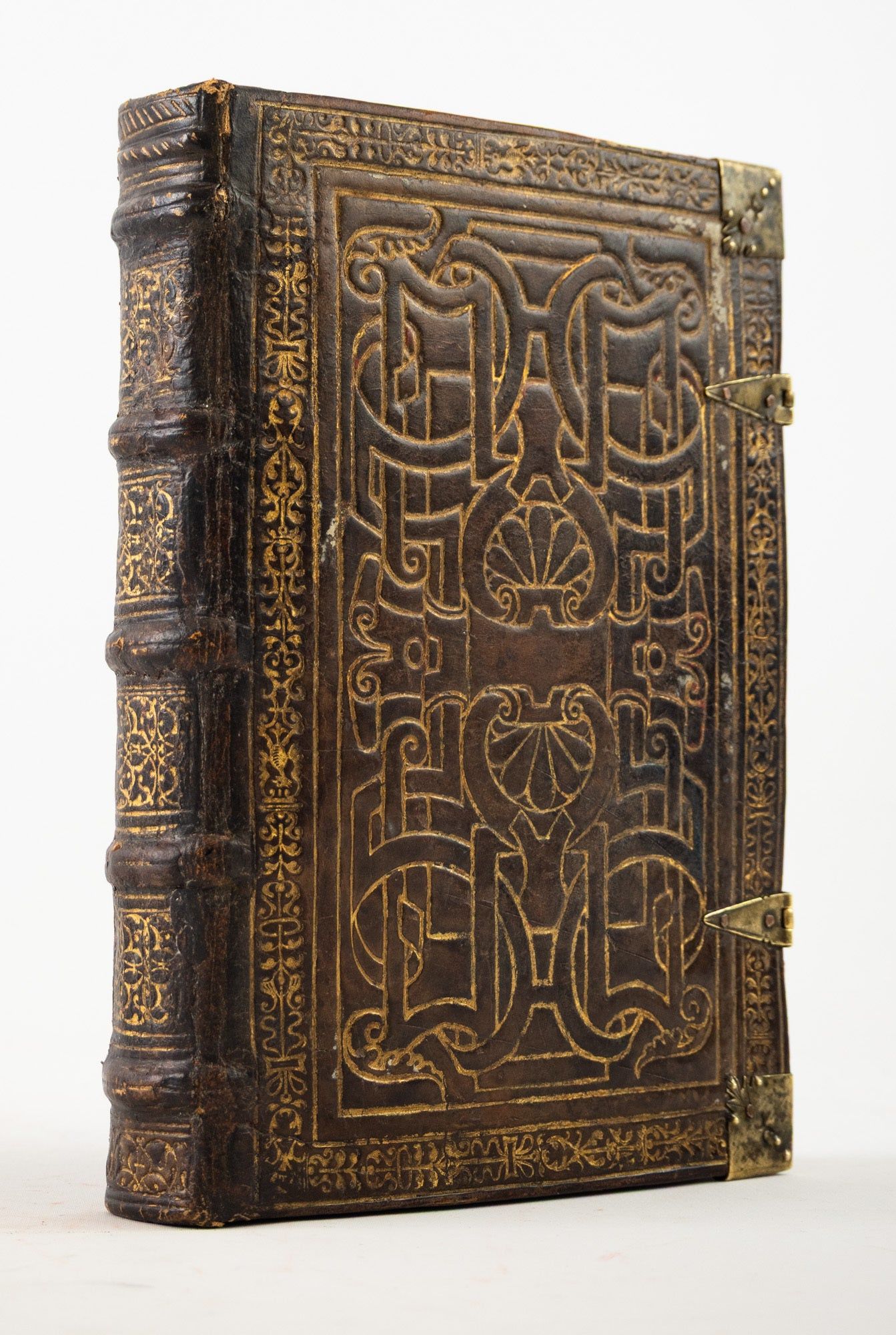
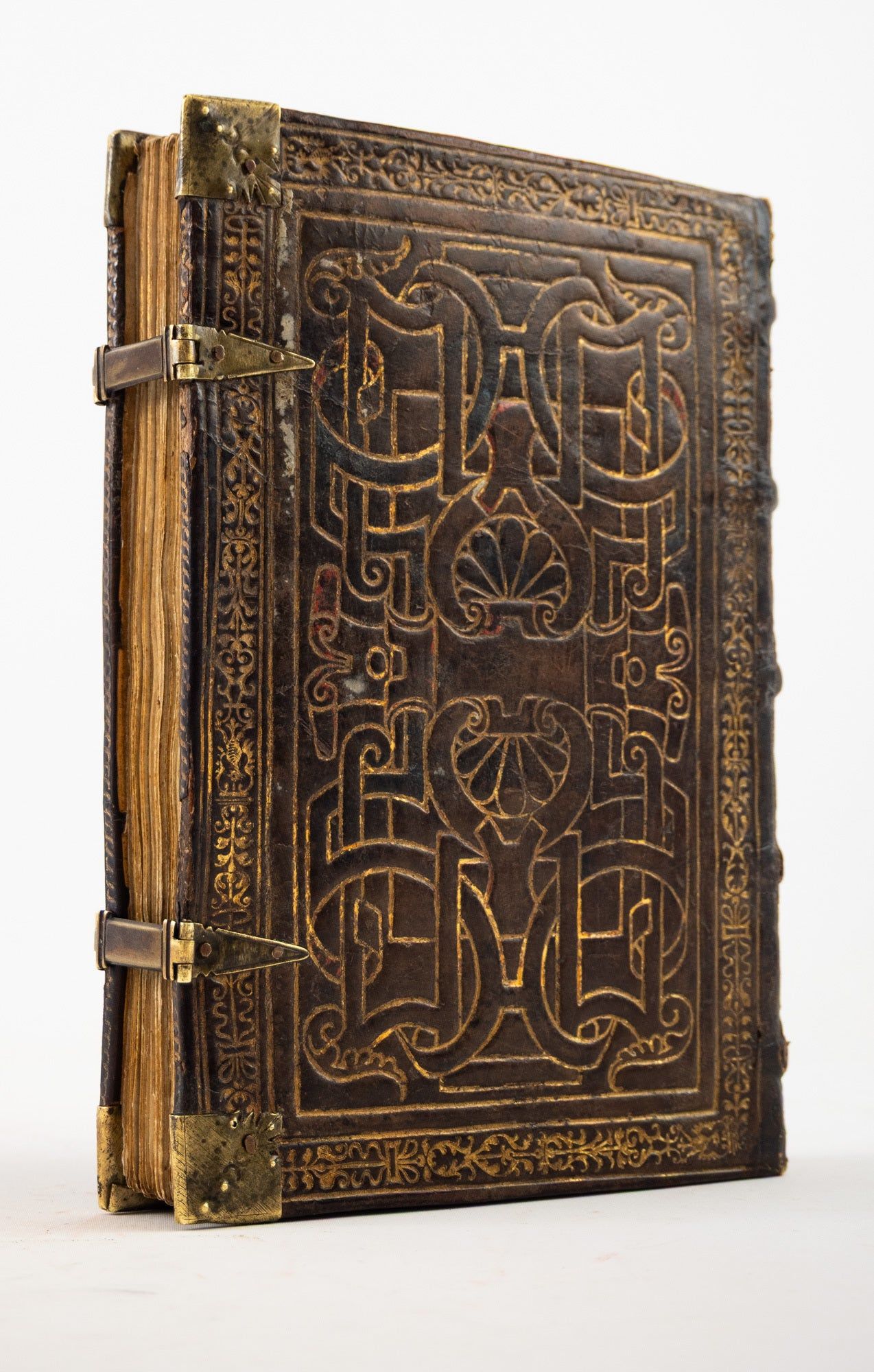
HANDSOME RENAISSANCE ENTRELAC BINDING (upper joint and parts of spine very skillfully repaired), covers with a gilt floral border surrounding a central panel of gilt strapwork design with traces of original polychrome painting, raised bands, spine gilt in compartments, original bosses and catchplates (clasps renewed), all edges gilt. Rubrics in red, numerous one-line initials in blue with red penwork, or gold with dark purple penwork, many two-line initials in burnished gold on pink and blue ground with white highlights, most of these with floral sprays extending into the margins, 22 SMALL MINIATURES (measuring approximately 45 x 37 mm.), each with panel borders of colorful acanthus and flowers at the top and bottom of the page, connected by a strand of gilt bezants, and 14 FULL-PAGE MINIATURES, each surrounded by a full border of acanthus, flowers, and bezants, the facing pages also with full borders and a large six-line initial painted pink or blue, filled with swirling vines and flowers, on gilt and painted ground. Subjects of the large miniatures being: Crucifixion (f. 10v); Pentecost (f. 14v); Virgin and Child (f. 17v); Annunciation (f. 32v); Visitation (f. 42v); Nativity (f. 49v); Annunciation to the Shepherds (f. 52v); Adoration of the Magi (f. 55v); Presentation in the Temple (f. 58v); Massacre of the Innocents (f. 61v); Flight into Egypt (f. 66v); Coronation of the Virgin (f. 70v); David in Prayer (f. 75v); Raising of Lazarus (f. 86v). Front pastedown with a 16th century inscription (see below); rear pastedown with a 17th century ownership inscription in ink, signed François le Paige. Lower joint a bit rubbed, margins with a little soiling and occasional wrinkle, fore-edge border rule just grazed by binder in a few places (the other borders quite ample), miniatures with tiny chips, light fading or rubbing in a couple places, etc., but IN EXCELLENT CONDITION, the attractive period binding very well preserved, with boards showing virtually no signs of wear, the vellum generally clean and bright, and the miniatures fresh and richly colored.
This is an extensively illustrated Book of Hours preserved in an especially attractive early binding, with richly colored miniatures attributed to the Master of Philip of Cleves' "Book of the Hunt." Active in the Low Countries from approximately 1470-90, this artist was patronized by some of the area's wealthiest elite, and is known to have collaborated with another important illuminator called the Bruges Master of 1482. Some trademarks of our painter include faces with subtle blue shading; high, arched eyebrows; thin golden halos; and women with very straight, shoulder-length hair highlighted with strands of gold. Outdoor scenes often contain narrative elements in the distance, such as the figures of a young David and Goliath in the miniature of King David at Prayer, or pagan idols dropping from a column in the Flight into Egypt, recalling a popular apocryphal tale of pagan relics miraculously falling to pieces as the Holy Family passes by. Some miniatures of note (in addition to these two) are the Raising of Lazarus for the Office of the Dead--a popular alternative to funeral images, particularly among Flemish illuminators--and the Massacre of the Innocents for the hour of Vespers, a particularly violent episode in which King Herod commands his soldiers to slaughter the male infants of Bethlehem. Like other miniatures in this work, the action in these scenes is spread out between the fore, middle, and background, creating a multi-layered narrative that invites the eye to explore and meditate. The artist's color palette in this manuscript is quite memorable, and includes a bright mustard yellow, pale green, and cherry blossom pink. The Coronation of the Virgin makes particularly strong use of color, with a sunset-like gradient giving way to billowy blue clouds. The Annunciation miniature also demonstrates the Master's facility with color; here, the Angel Gabriel's red and green wings are fully extended, while the Virgin is radiant against a golden yellow wall covering. In addition to the large compositions, we are treated to 22 smaller miniatures depicting the Evangelists and saints, each of which is charming in its more confined presentation. Although the saints found in the Suffrages are quite typical for a Book of Hours, the Calendar is another story. Despite being rather sparsely filled out, the calendar here includes several feast days, some of them unusual enough to provide additional insight into the manuscript's localization and use. For example, there is St. Landoaldi (19 March), a missionary to Northern France and Belgium, and St. Winnoc (6 November), the son of a Breton king with a former abbey in the far north of France. The calendar is idiosyncratic in other ways as well, with saints' names that are repeated, and others that are either extremely obscure or whose dates seem to be wrong. Whatever the case, additional research into the calendar would undoubtedly prove revealing. We are fortunate to have some early provenance information written into this Book of Hours. The inscription on the front pastedown reads: "This last day of September 1590 we [name erased, but Claude le Paige] lieutenant of the guards of his highness of Bar le Duc on the one hand and Alix de la Taxe on the other hand have married in front of the holy Catholic church at the place of Mir[e]court." Below this inscription are notes indicating the ages of the bride and groom (17 and 36, respectively), as well as the dates of their deaths: he died on 9 May 1610, and she on 14 September 1622. Located in the strategically important Meuse region in northeastern France, the Duchy of Bar-le-Duc unified with Lorraine in 1480 and became extremely wealthy during the 16th century. Although we do not know for whom the manuscript was originally made, it seems quite possible that it was commissioned for a forebear of the named Bar-le-Duc spouses, and was perhaps passed down through later generations of the family. The signature on the pastedown indicates that François le Paige, son of Claude and Alix, inherited the book from his parents. This manuscript was lavishly and tastefully bound early in the 16th century and has survived in excellent condition to the present day. This binding would originally have been painted, but, even without its original colors, it is still quite attractive, perhaps even splendid. In excellent condition inside and out, the manuscript is a fortunate survival and a testament to generations of careful stewardship..
HANDSOME RENAISSANCE ENTRELAC BINDING (upper joint and parts of spine very skillfully repaired), covers with a gilt floral border surrounding a central panel of gilt strapwork design with traces of original polychrome painting, raised bands, spine gilt in compartments, original bosses and catchplates (clasps renewed), all edges gilt. Rubrics in red, numerous one-line initials in blue with red penwork, or gold with dark purple penwork, many two-line initials in burnished gold on pink and blue ground with white highlights, most of these with floral sprays extending into the margins, 22 SMALL MINIATURES (measuring approximately 45 x 37 mm.), each with panel borders of colorful acanthus and flowers at the top and bottom of the page, connected by a strand of gilt bezants, and 14 FULL-PAGE MINIATURES, each surrounded by a full border of acanthus, flowers, and bezants, the facing pages also with full borders and a large six-line initial painted pink or blue, filled with swirling vines and flowers, on gilt and painted ground. Subjects of the large miniatures being: Crucifixion (f. 10v); Pentecost (f. 14v); Virgin and Child (f. 17v); Annunciation (f. 32v); Visitation (f. 42v); Nativity (f. 49v); Annunciation to the Shepherds (f. 52v); Adoration of the Magi (f. 55v); Presentation in the Temple (f. 58v); Massacre of the Innocents (f. 61v); Flight into Egypt (f. 66v); Coronation of the Virgin (f. 70v); David in Prayer (f. 75v); Raising of Lazarus (f. 86v). Front pastedown with a 16th century inscription (see below); rear pastedown with a 17th century ownership inscription in ink, signed François le Paige. Lower joint a bit rubbed, margins with a little soiling and occasional wrinkle, fore-edge border rule just grazed by binder in a few places (the other borders quite ample), miniatures with tiny chips, light fading or rubbing in a couple places, etc., but IN EXCELLENT CONDITION, the attractive period binding very well preserved, with boards showing virtually no signs of wear, the vellum generally clean and bright, and the miniatures fresh and richly colored.
This is an extensively illustrated Book of Hours preserved in an especially attractive early binding, with richly colored miniatures attributed to the Master of Philip of Cleves' "Book of the Hunt." Active in the Low Countries from approximately 1470-90, this artist was patronized by some of the area's wealthiest elite, and is known to have collaborated with another important illuminator called the Bruges Master of 1482. Some trademarks of our painter include faces with subtle blue shading; high, arched eyebrows; thin golden halos; and women with very straight, shoulder-length hair highlighted with strands of gold. Outdoor scenes often contain narrative elements in the distance, such as the figures of a young David and Goliath in the miniature of King David at Prayer, or pagan idols dropping from a column in the Flight into Egypt, recalling a popular apocryphal tale of pagan relics miraculously falling to pieces as the Holy Family passes by. Some miniatures of note (in addition to these two) are the Raising of Lazarus for the Office of the Dead--a popular alternative to funeral images, particularly among Flemish illuminators--and the Massacre of the Innocents for the hour of Vespers, a particularly violent episode in which King Herod commands his soldiers to slaughter the male infants of Bethlehem. Like other miniatures in this work, the action in these scenes is spread out between the fore, middle, and background, creating a multi-layered narrative that invites the eye to explore and meditate. The artist's color palette in this manuscript is quite memorable, and includes a bright mustard yellow, pale green, and cherry blossom pink. The Coronation of the Virgin makes particularly strong use of color, with a sunset-like gradient giving way to billowy blue clouds. The Annunciation miniature also demonstrates the Master's facility with color; here, the Angel Gabriel's red and green wings are fully extended, while the Virgin is radiant against a golden yellow wall covering. In addition to the large compositions, we are treated to 22 smaller miniatures depicting the Evangelists and saints, each of which is charming in its more confined presentation. Although the saints found in the Suffrages are quite typical for a Book of Hours, the Calendar is another story. Despite being rather sparsely filled out, the calendar here includes several feast days, some of them unusual enough to provide additional insight into the manuscript's localization and use. For example, there is St. Landoaldi (19 March), a missionary to Northern France and Belgium, and St. Winnoc (6 November), the son of a Breton king with a former abbey in the far north of France. The calendar is idiosyncratic in other ways as well, with saints' names that are repeated, and others that are either extremely obscure or whose dates seem to be wrong. Whatever the case, additional research into the calendar would undoubtedly prove revealing. We are fortunate to have some early provenance information written into this Book of Hours. The inscription on the front pastedown reads: "This last day of September 1590 we [name erased, but Claude le Paige] lieutenant of the guards of his highness of Bar le Duc on the one hand and Alix de la Taxe on the other hand have married in front of the holy Catholic church at the place of Mir[e]court." Below this inscription are notes indicating the ages of the bride and groom (17 and 36, respectively), as well as the dates of their deaths: he died on 9 May 1610, and she on 14 September 1622. Located in the strategically important Meuse region in northeastern France, the Duchy of Bar-le-Duc unified with Lorraine in 1480 and became extremely wealthy during the 16th century. Although we do not know for whom the manuscript was originally made, it seems quite possible that it was commissioned for a forebear of the named Bar-le-Duc spouses, and was perhaps passed down through later generations of the family. The signature on the pastedown indicates that François le Paige, son of Claude and Alix, inherited the book from his parents. This manuscript was lavishly and tastefully bound early in the 16th century and has survived in excellent condition to the present day. This binding would originally have been painted, but, even without its original colors, it is still quite attractive, perhaps even splendid. In excellent condition inside and out, the manuscript is a fortunate survival and a testament to generations of careful stewardship..
Details
Title
USE OF ROME
Author
A MEDIEVAL ILLUMINATED VELLUM MANUSCRIPT BOOK OF HOURS IN LATIN, WITH 36 LARGE AND SMALL MINIATURES BY THE MAITRE DU LIVRE DE LA CHASSE DE PHILIPPE DE CLEVES
Condition
Unknown
Publisher
Low Countries [probably Bruges]
Date
ca. 1470-80