

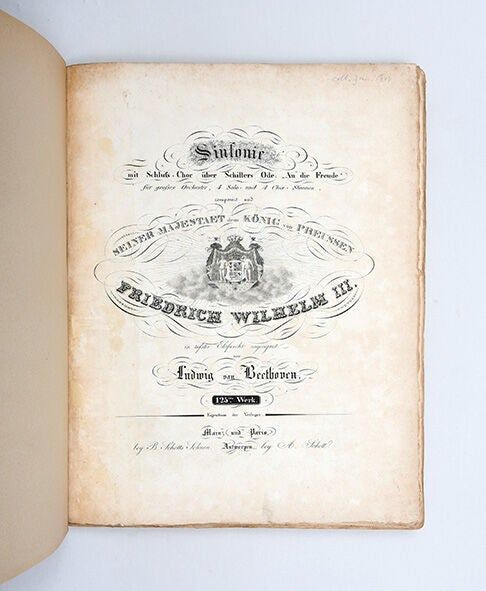
[Full score of Beethoven's Ninth Symphony] Sinfonie mit Schluss-Chor über Schillers Ode: "An die Freude" für grosses Orchester, 4 Solo- und 4 Chor- Stimmen, componirt und Seiner Majestaet de, König von Preussen Friedrich Wilhelm III. 125tes Werk
![[Full score of Beethoven's Ninth Symphony] Sinfoni](https://d3525k1ryd2155.cloudfront.net/h/742/281/1736281742.0.x.jpg)
- Mainz & Paris: B. Schotts Söhnen & Antwerp, A. Schott, 1826
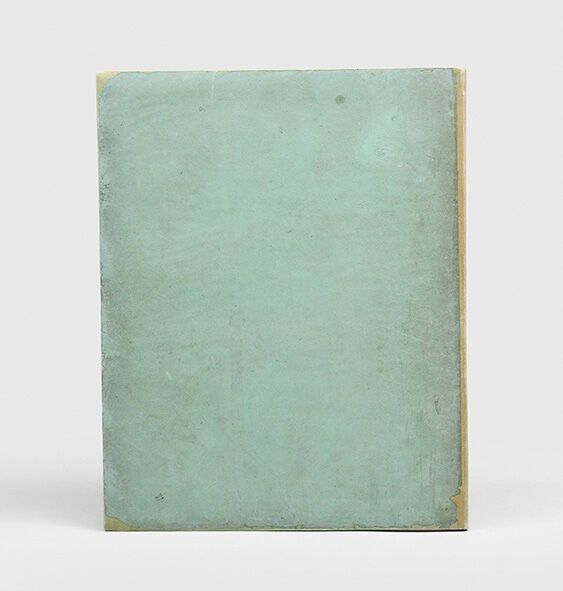
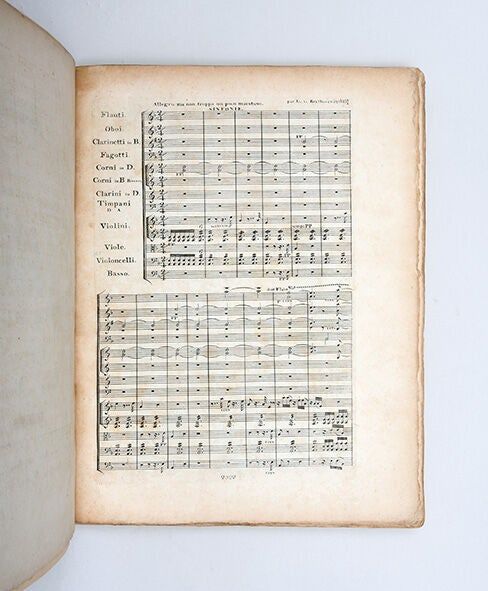
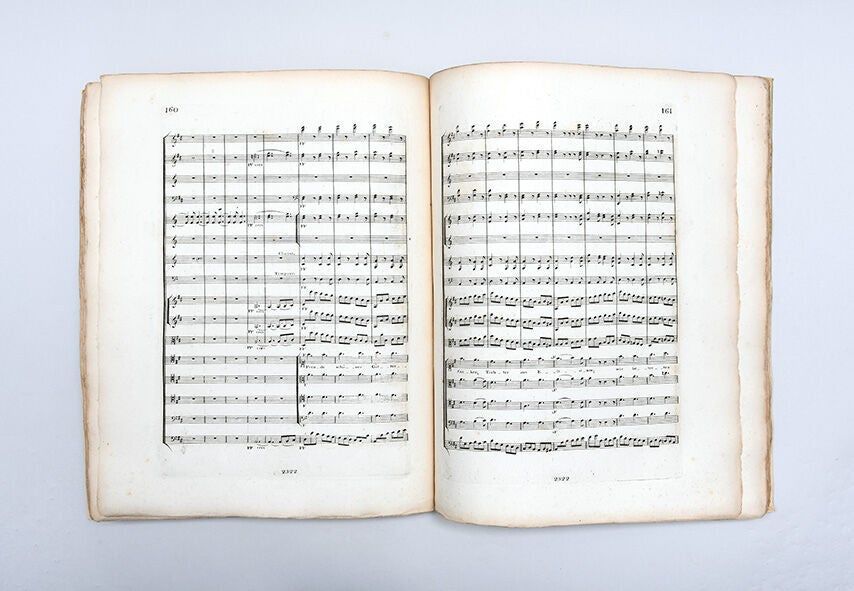
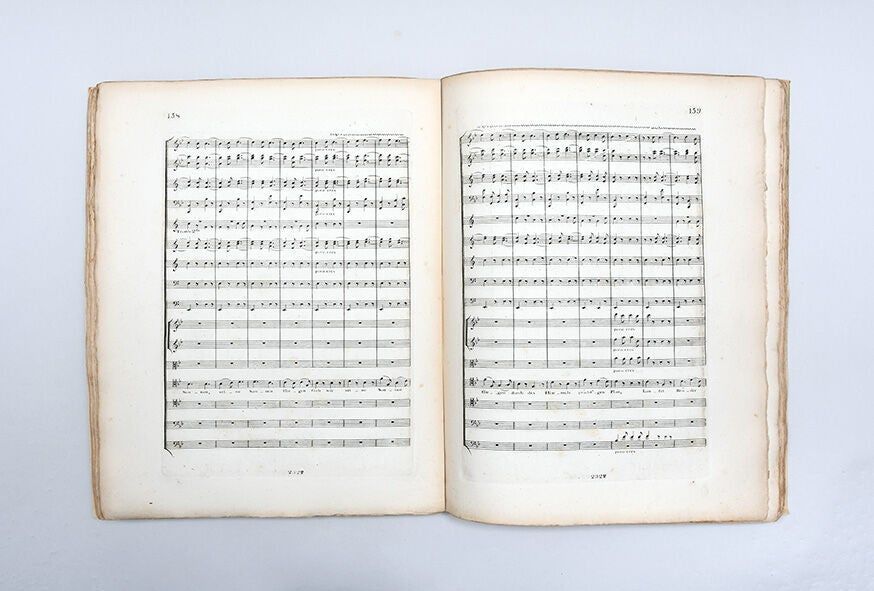
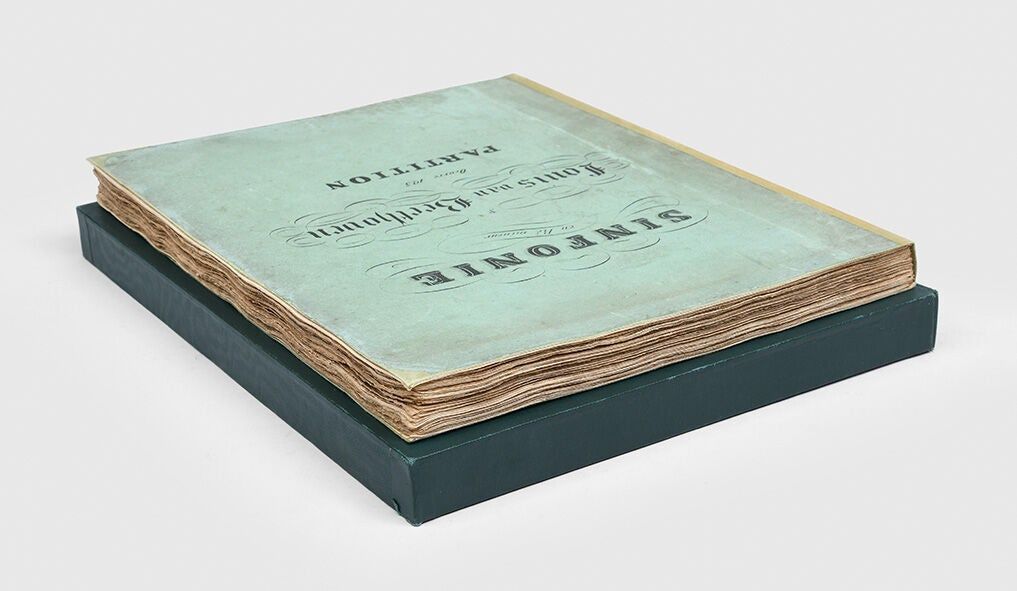
Mainz & Paris: B. Schotts Söhnen & Antwerp, A. Schott, 1826. First edition. Very Good. First edition of the full orchestral score for the Ninth Symphony, first trade issue, published 28 August 1826, without the list of names found in prepublication copies for subscribers and without the metronome markings added to copies from December onwards. Folio. Lithographic title page incorporating arms of Prussia, 226 engraved plates. Without the two-page list of subscribers; plates numbered 2322, often corrected from 2321; plate number present on p. 172 and absent on p. 191; "Partition" printed on front wrapper. Original light blue wrappers printed in black, rebacked and relined, edges untrimmed. Housed in a custom green cloth solander box. Pencilled inscription "Coll. Jan. 1974" at head of title page. Wrappers a little rubbed and marked, extremities restored, first and last page of contents toned, sporadic foxing. A Very Good copy.
Beethoven's final complete symphony redefined the genre, breaking new ground by incorporating vocal soloists and a chorus in its final movement. It was a model for Berlioz, Bruckner, Mahler, Brahms, and Wagner. He composed the symphony between spring 1823 and February 1824. Towards the end of the process, he decided to incorporate Friedrich Schiller's "An die Freude" into the final movement - a poem that he had attempted to put into music since the early 1790s. The symphony premiered at the Theater am Kärntnertor Vienna on May 7, 1824, marking a triumphant public return for Beethoven, who had not appeared on stage in over a decade. At either the end of the scherzo or the symphony - accounts vary - Beethoven, then almost completely deaf and unaware of the audience's reaction, had to be gently turned around by the contralto Caroline Unger so he could see the enthusiastic applause. He died in March the following year.
Fuld, p. 563; Hirsch 395; Hoboken 502; Kinsky 813-832. Very Good.
Beethoven's final complete symphony redefined the genre, breaking new ground by incorporating vocal soloists and a chorus in its final movement. It was a model for Berlioz, Bruckner, Mahler, Brahms, and Wagner. He composed the symphony between spring 1823 and February 1824. Towards the end of the process, he decided to incorporate Friedrich Schiller's "An die Freude" into the final movement - a poem that he had attempted to put into music since the early 1790s. The symphony premiered at the Theater am Kärntnertor Vienna on May 7, 1824, marking a triumphant public return for Beethoven, who had not appeared on stage in over a decade. At either the end of the scherzo or the symphony - accounts vary - Beethoven, then almost completely deaf and unaware of the audience's reaction, had to be gently turned around by the contralto Caroline Unger so he could see the enthusiastic applause. He died in March the following year.
Fuld, p. 563; Hirsch 395; Hoboken 502; Kinsky 813-832. Very Good.
Details
Title
[Full score of Beethoven's Ninth Symphony] Sinfonie mit Schluss-Chor über Schillers Ode: "An die Freude" für grosses Orchester, 4 Solo- und 4 Chor- Stimmen, componirt und Seiner Majestaet de, König von Preussen Friedrich Wilhelm III. 125tes Werk
Author
Beethoven, Ludwig van
Condition
Very Good
Publisher
B. Schotts Söhnen & Antwerp, A. Schott: Mainz & Paris
Date
1826
Edition
First edition