

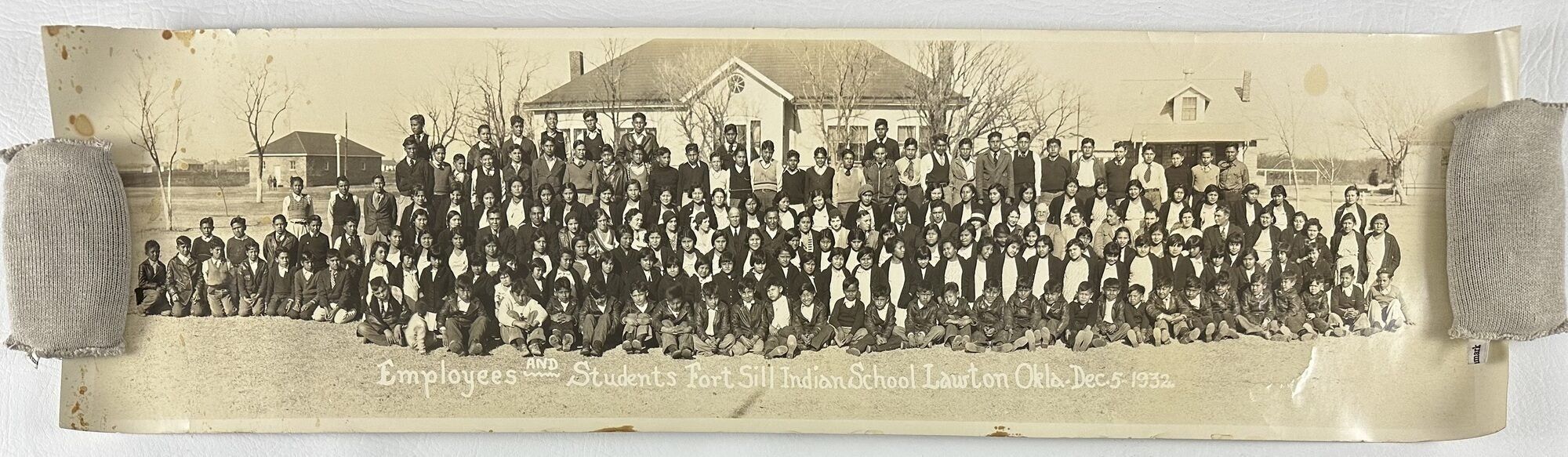
Employees and Students Fort Sill Indian School Lawton Okla. Dec. 5 1932 [caption title]
- [Lawton, Ok.] , 1932
[Lawton, Ok.], 1932. Panoramic photograph, 8 x 28.75 inches. Some staining along border, with a few spots in the image area, a few small chips and creases. Good plus. A striking panoramic photograph featuring several dozen Native American students, along with some faculty, at the Fort Sill Indian School in December 1932. The Fort Sill Indian School was founded in 1871 with twenty-four students and two employees. Within ten years, the school had many more students and seventy-five employees to manage the facility. The present photograph emanates from the era of the Great Depression, and features both male and female students from early grades to teenage years. A handful of white teachers are interspersed within the student population. The subjects of the photograph are arranged seven rows deep, and are posed in front of one of the school buildings in a rather sparse rural setting.
"Because the school was located near Lawton, before World War II Fort Sill's student body was made up largely of Indians from western Oklahoma -- Comanche, Apache, Caddo, Kiowa, Delaware, and Wichita. This changed dramatically in the postwar era, however, as Navajo from New Mexico and Arizona began to be admitted. Within a few years they comprised 80 percent of the student population. The influx of out-of-state Native students gradually declined, and by 1970 more than two hundred of the school's three hundred pupils hailed from Oklahoma. Until the 1950s the curriculum for males consisted of vocational and agricultural training, and females received instruction in homemaking. Thereafter, Fort Sill emphasized more of an academic curriculum, although vocational trades remained important. Students who attended Fort Sill came away from the boarding school with impressions that ranged from downright hatred of the school to enduring fondness for it. For some, the strict discipline and harsh punishment meted out at the institution made it feel more like a prison than a place of learning. Being away from family and tribal communities made the experience even more alienating. Others, however, enjoyed their time there, making lifelong friends, participating in extracurricular activities, and remaining Indian despite attempts by the government's educational machinery to grind it out of them" - The Encyclopedia of Oklahoma History and Culture.
OCLC is silent on other examples of this photograph.
"Because the school was located near Lawton, before World War II Fort Sill's student body was made up largely of Indians from western Oklahoma -- Comanche, Apache, Caddo, Kiowa, Delaware, and Wichita. This changed dramatically in the postwar era, however, as Navajo from New Mexico and Arizona began to be admitted. Within a few years they comprised 80 percent of the student population. The influx of out-of-state Native students gradually declined, and by 1970 more than two hundred of the school's three hundred pupils hailed from Oklahoma. Until the 1950s the curriculum for males consisted of vocational and agricultural training, and females received instruction in homemaking. Thereafter, Fort Sill emphasized more of an academic curriculum, although vocational trades remained important. Students who attended Fort Sill came away from the boarding school with impressions that ranged from downright hatred of the school to enduring fondness for it. For some, the strict discipline and harsh punishment meted out at the institution made it feel more like a prison than a place of learning. Being away from family and tribal communities made the experience even more alienating. Others, however, enjoyed their time there, making lifelong friends, participating in extracurricular activities, and remaining Indian despite attempts by the government's educational machinery to grind it out of them" - The Encyclopedia of Oklahoma History and Culture.
OCLC is silent on other examples of this photograph.
Details
Title
Employees and Students Fort Sill Indian School Lawton Okla. Dec. 5 1932 [caption title]
Author
[Native Americans]: [Education]: [Oklahoma]
Condition
Unknown
Publisher
[Lawton, Ok.]
Date
1932