

1900 – Envelope from one of the best-selling patent medicines of all time that transitioned into a food condiment after the Food and Drug Administration stepped in
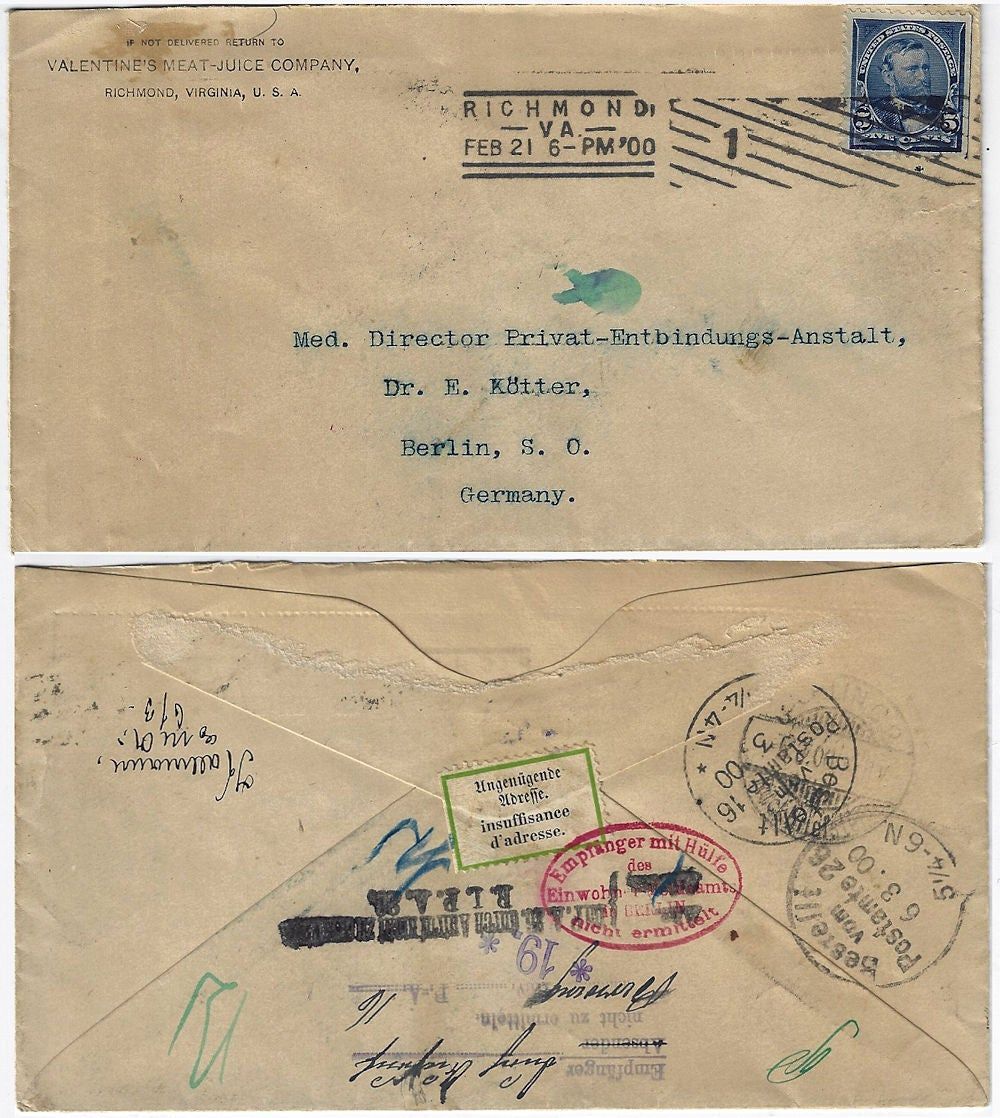
- Envelope or Cover
- Richmond, Virginia , 1900
In downtown Richmond, Mann S. Valentine, a prosperous merchant lived with his family in a large neoclassical home. In 1870, his wife, Anne Maria fell ill from a “severe and protracted derangement of the organs of digestion,” that prevented her from eating solid food. Doctors had given up on curing Anne Maria, so Valentine took it upon himself to concoct his own highly concentrated protein and iron tonic which he distilled from a mix of eggs and beef broth. It worked wonders.
Valentine, ever a merchant, began to create more, which sold well in his store. Seeing the possibility of ever-increasing sales, he began to canvass local, then regional, then nationally known physicians for their endorsements. Some replied with glowing reviews reporting they used it effectively, not just as a nutritional supplement, but as a treatment for everything from nausea to dysentery and cholera. Valentine began to publish these reviews in advertisements and business boomed. He took his meat juice to the International Paris Exposition in 1878 and introduced it to a global market. Recognizing the importance of physician recommendations, Valentine began to contact European doctors for their endorsements. This envelope was, no doubt, used for that purpose.
In 1906, the newly created Food and Drug Administration began its crackdown on patent medicines. Seeing the writing on the wall, Valentine stopped promoting his meat juice as a curative and began to market it as a cooking supplement for flavoring various dishes. As such, it was even more popular than medicine and became a staple on grocery store shelves throughout the country for years until demand finally wore off, and the factory, located at Brook Road and Chamberlayne Avenue shut its doors.
. Valentine amassed a fortune during the last quarter of the 19th century and became an inveterate collector of art and artifacts. In his will, he provided a large endowment to establish a museum to house his collection, and it, much expanded, continues in operation as the famed Valentine Museum in Richmond.(For more information, see “The history of Valentine’s Meat Juice” at the RIC Today website and Castellano’s “In the 1800s, Valentine’s Meant a Bottle of Meat Juice” at the Atlas Obscura website.)
Old meat juice bottles are frequently sold on or encountered in antique malls. Company envelopes used to request endorsements from domestic physician endorsements occasionally appear on or in philatelic auctions. Evidence of Valentines attempts to secure international professional recommendations are seldom encountered; this is the first we have seen.
.Details
Title
1900 – Envelope from one of the best-selling patent medicines of all time that transitioned into a food condiment after the Food and Drug Administration stepped in
Author
Mann S. Valentine
Binding
Envelope or Cover
Condition
Very Good
Publisher
Richmond, Virginia
Date
1900