

1856 – Letter from an American in Mexico to prominent lawyer in Washington seeking assistance in resolving a claim in the turmoil that followed the overthrow of the dictator, Santa Anna, and suggesting the only way to resume order was for the “Anglo-Saxon race” to take control
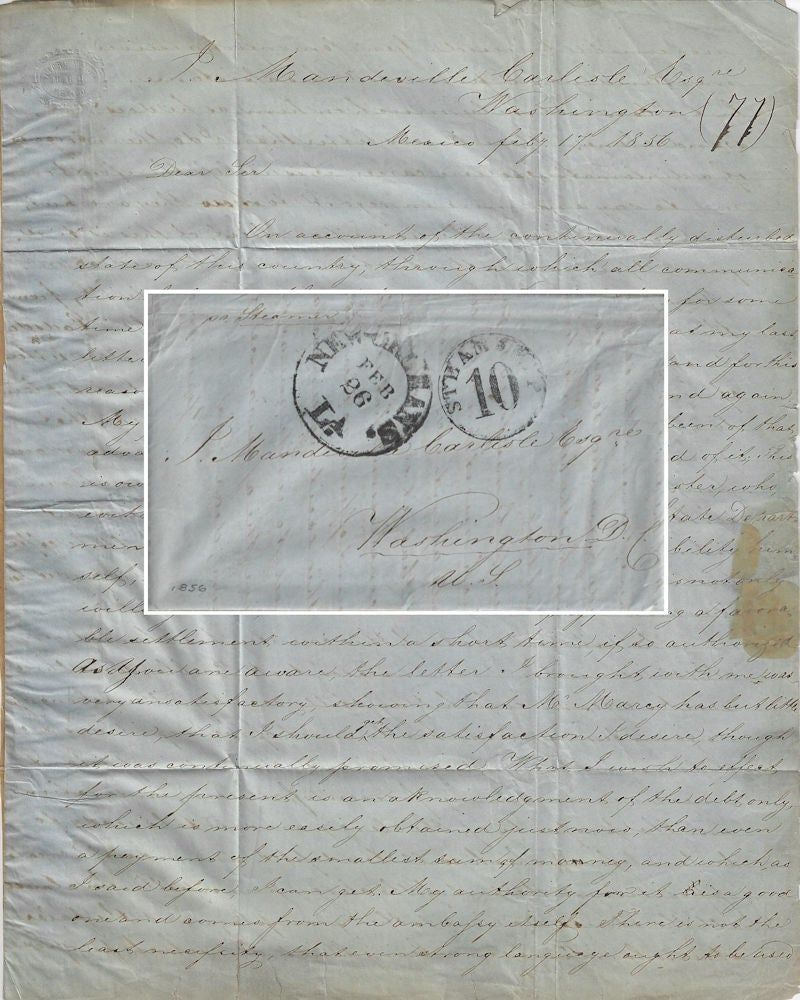
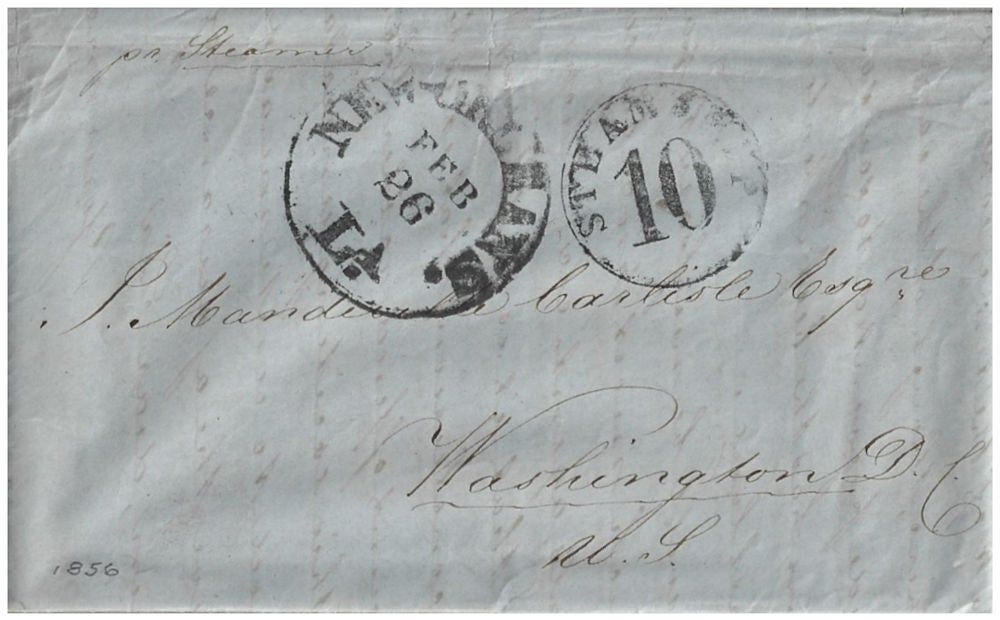
- Envelope or Cover
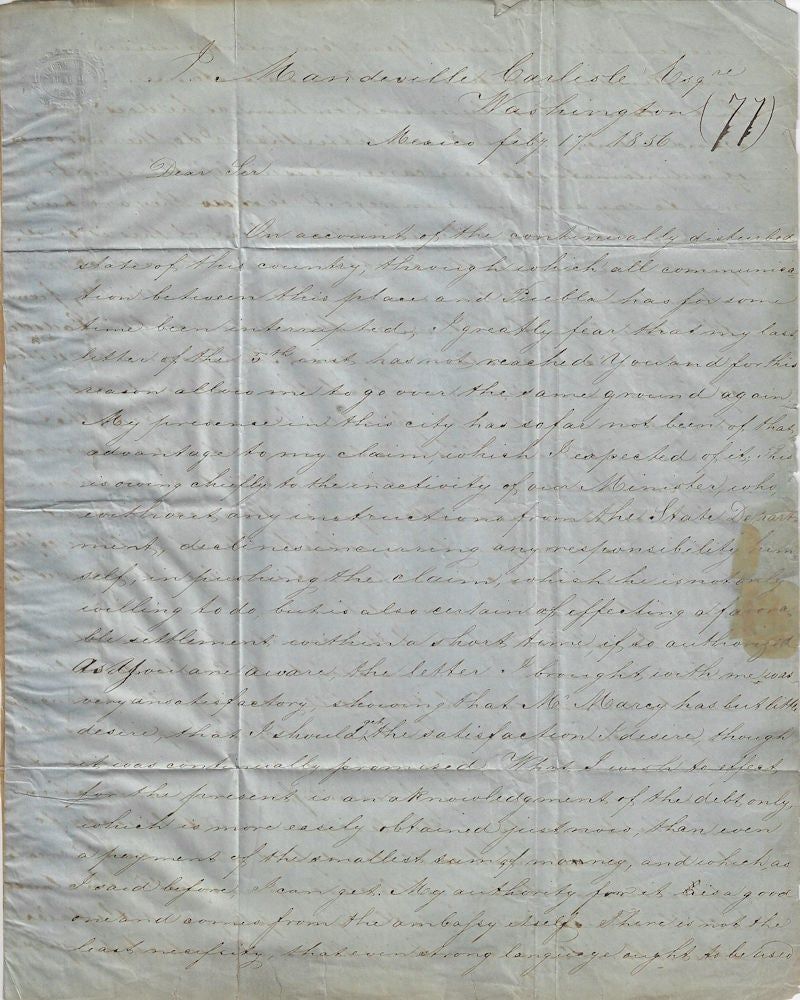
The letter requests Carlisle, who was well-versed in international law, to aid in resolving a legal claim, perhaps in relation to a land dispute following the Gadsden Purchase, which was common at the time, as well as suggesting that maybe it would be best if an “anglo-saxon” filibuster took control of the country.
It reads in part:
“On account of the continually disturbed state of this country, along which all communications between this place and Puebla has for some time been interrupted I greatly fear that my last letter . . . has not reached you. . .. My presence in this city [regarding] a claim [has gone unanswered] due chiefly to the inactivity of our Minister, who, without any instructions of the State Department, declines incurring any responsibility himself in pushing the claim. . .. What I wish to effect . . . is an acknowledgement of the debt [but] it is useless for me to say anymore. . ..
“The political state of this country has changed very little, since the ‘pronunciados’ took Puebla, some three weeks ago, and which they still occupy. Here Congress is going to meet very shortly, most of the Deputados are liberals and even red republicans. Several important measures concerning freedom of religion, immigration and the property of the clergy are said to be ready to be laid before it which will be adopted. . .. In almost all the streets leading to the ‘gran plaza; and the palace strong barricades are being built . . . it is rumored that strong opposition is feared on the part of the clergy. The present government it seems, has the best intentions, nevertheless I fear it will not last long. . ..”In my opinion this otherwise rich and beautiful country is going to ruins, and will only be able to show what it is capable of producing after the anglo-saxon race takes the management of affairs here, and others, though of the same opinion, are from national pride prevented to say so. . .."
. General Antonio López de Santa Anna ruled as the dictator of Mexico from 1853 until 1855. His authoritarian rule and especially his sale of the Mesilla Valley (the Gadsden Purchase) to the United States led to widespread revolt, resulting in his final exile, after which competing conservative and liberal factions fought for control of the government. La Reforma, the liberals, had recently seized control of Puebla at the time of this letter. ,/p>A filibuster was a private individual who engaged in an unauthorized foreign military expedition to foster, incite, or support a rebellion or insurrection in an unstable nation, most often a former Spanish Colony in the Americas, with the goal of establishing a regime that would serve the interests of U.S. citizens. The most notable filibuster was William Walker who unsuccessfully attempted to take over western Mexico and Nicaragua in the 1850s.
(For more information see, Irion and Ball’s “The New York and the Josephine: Two Steamships of the Charles Morgan Line” at the Department of the Interior’s Bureau of Safety and Environmental Enforcement’s website, “Steamer Texas in Quarantine” in the 3 Sep 1856 edition of the New York Times, an annotation to the Collected Works of Abraham Lincoln. Volume 4 in the University of Michigan Library’s Digital Collections, “The Long Shadow: Mexico’s Reforma” in Voekel’s For God and Liberty: Catholicism and Revolution in the Atlantic World, 1790-1861, Bancroft’s History of Mexico, and genealogical records at Ancestry.com.).
Details
Title
1856 – Letter from an American in Mexico to prominent lawyer in Washington seeking assistance in resolving a claim in the turmoil that followed the overthrow of the dictator, Santa Anna, and suggesting the only way to resume order was for the “Anglo-Saxon race” to take control
Binding
Envelope or Cover
Condition
Very Good