

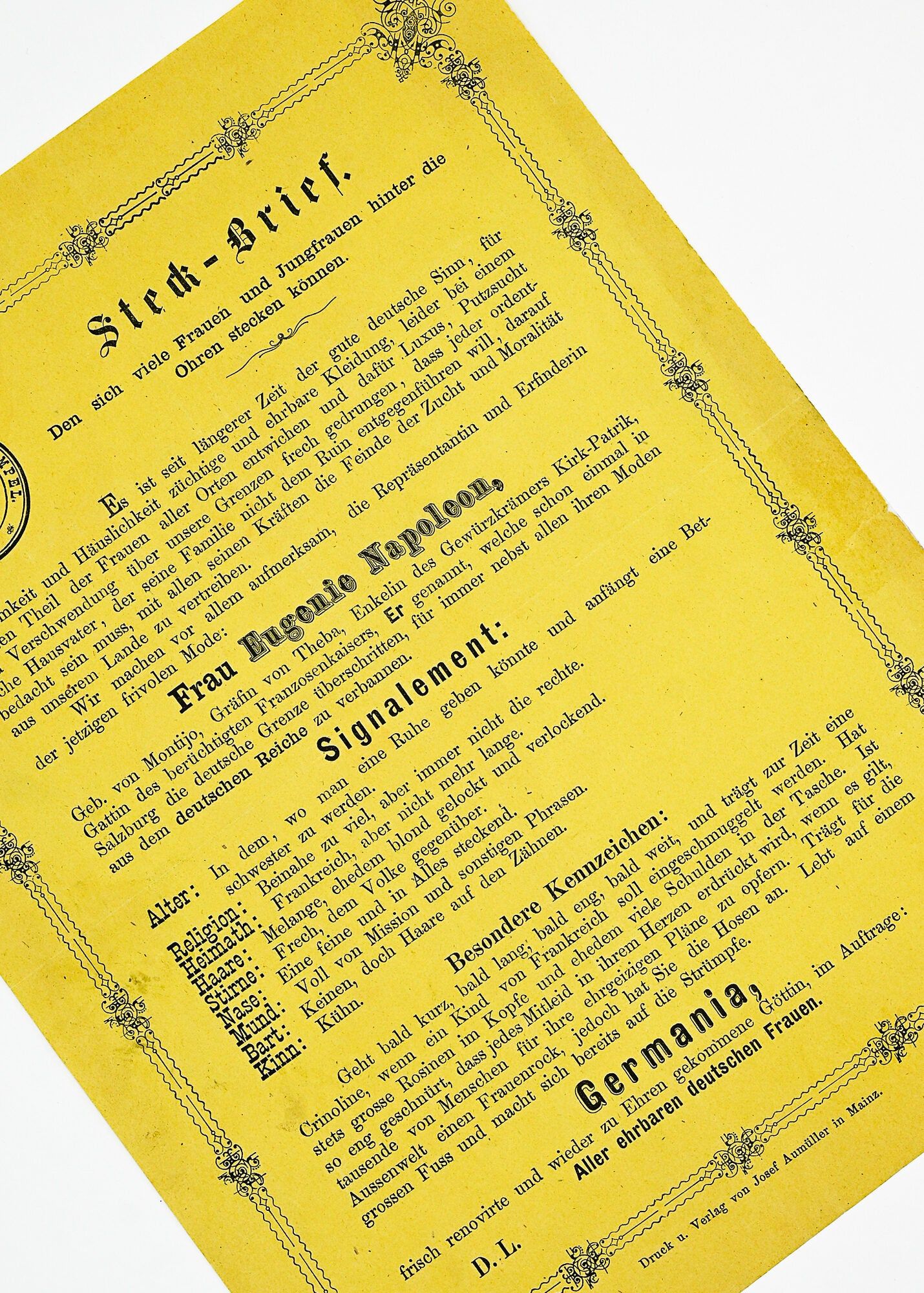
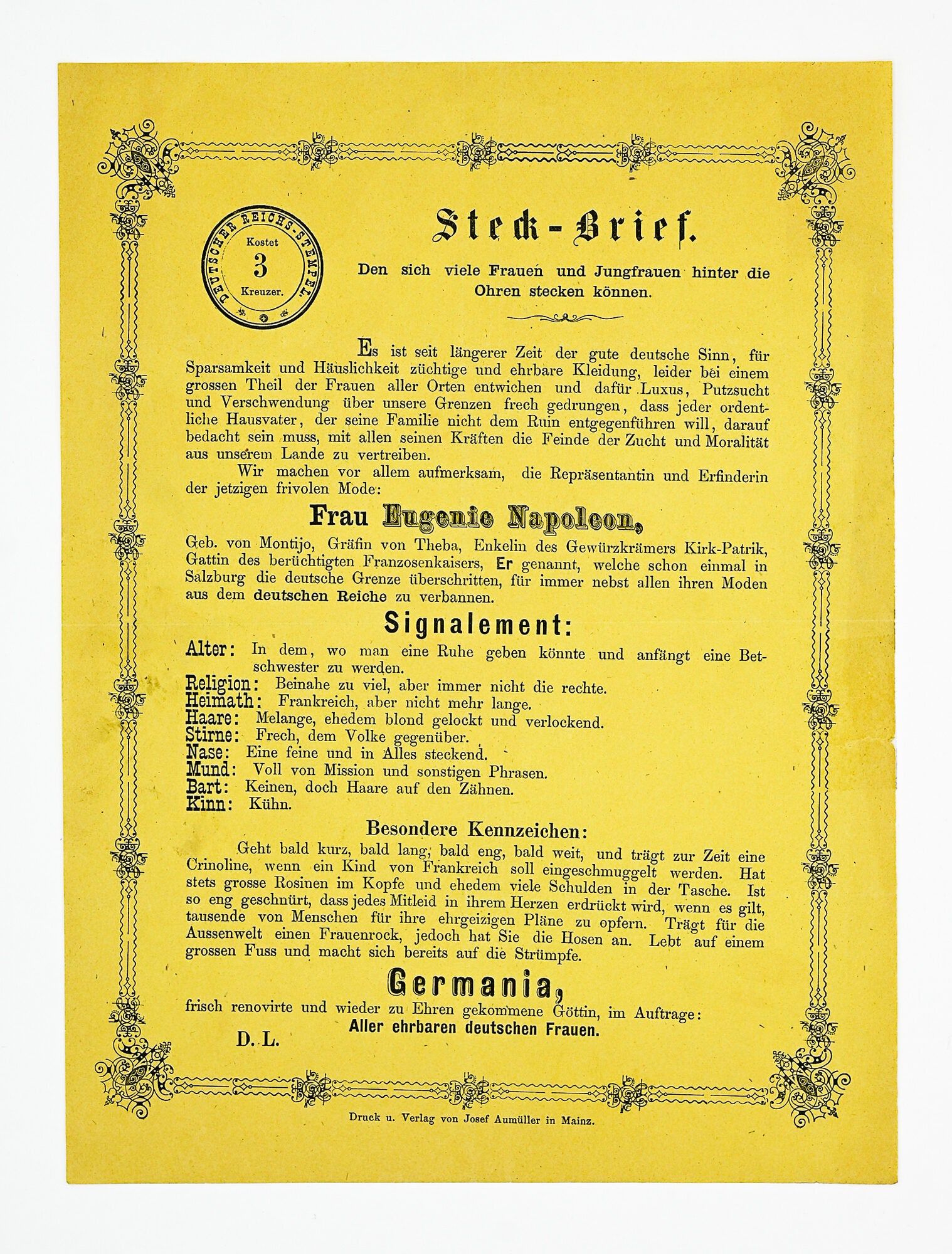
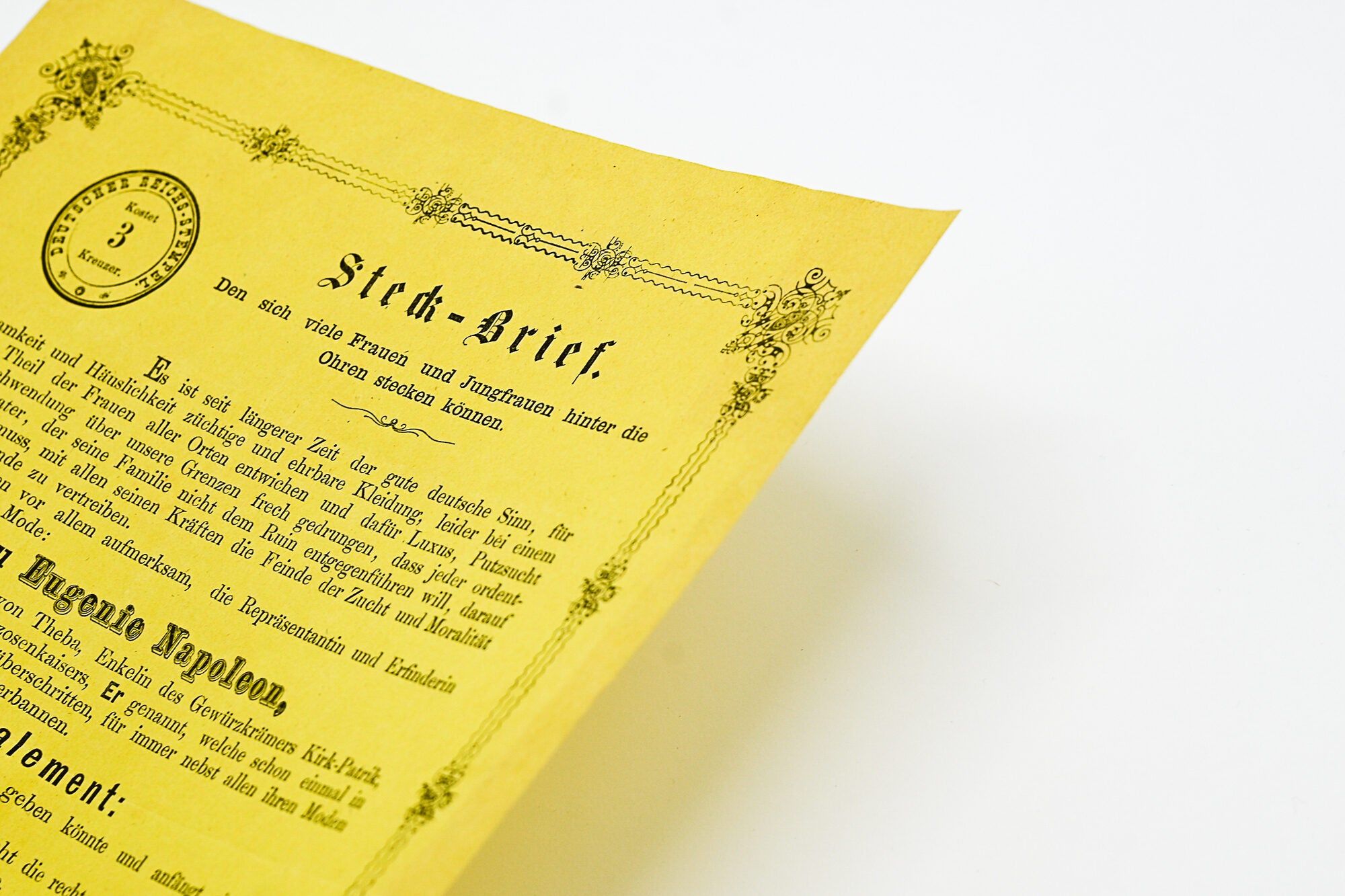
STECK-BRIEF. Den sich viele Frauen und Jungfrauen hinter die Ohren stecken koennen
- Mainz: Josef Aumüller, 1871
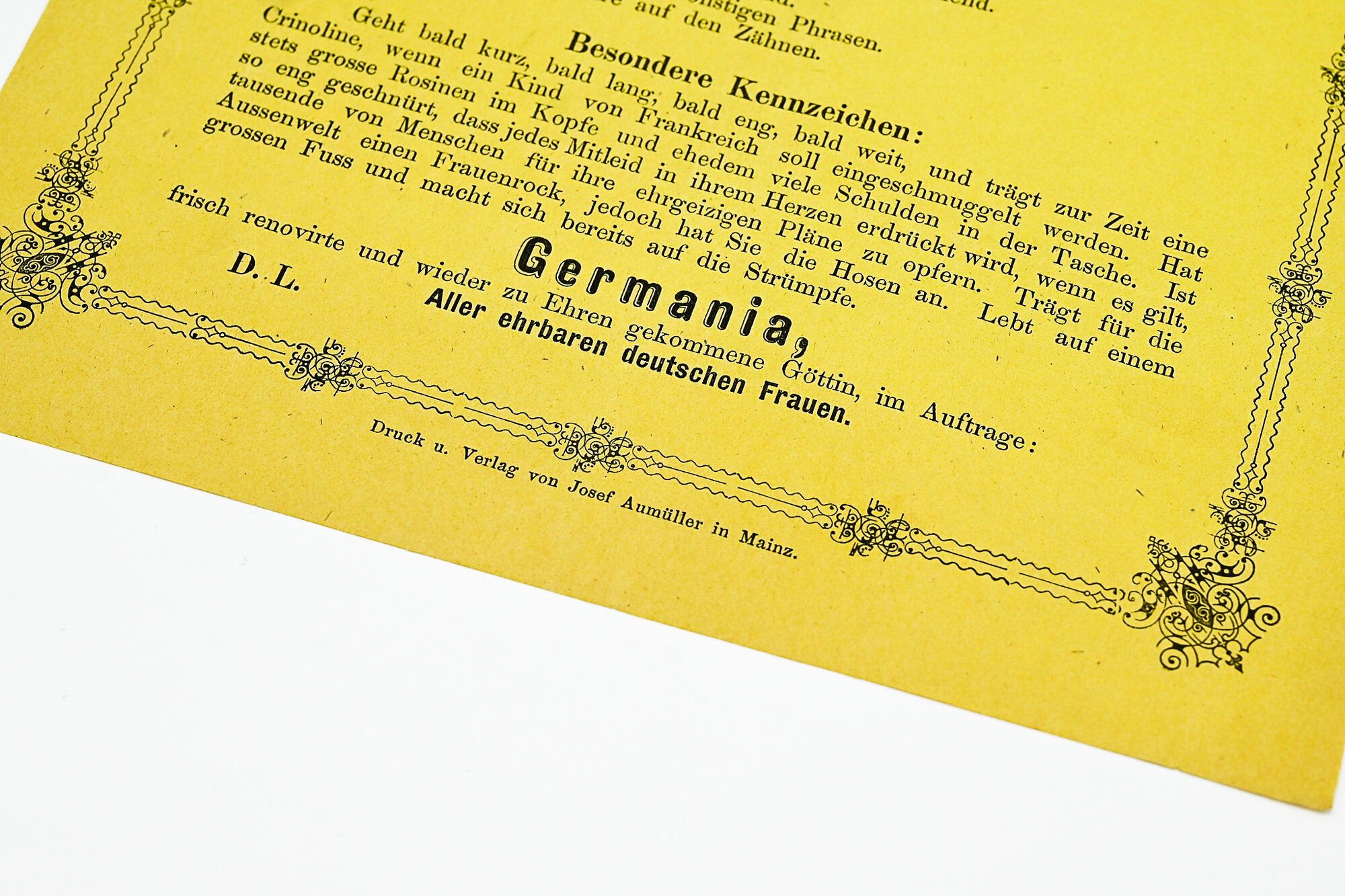
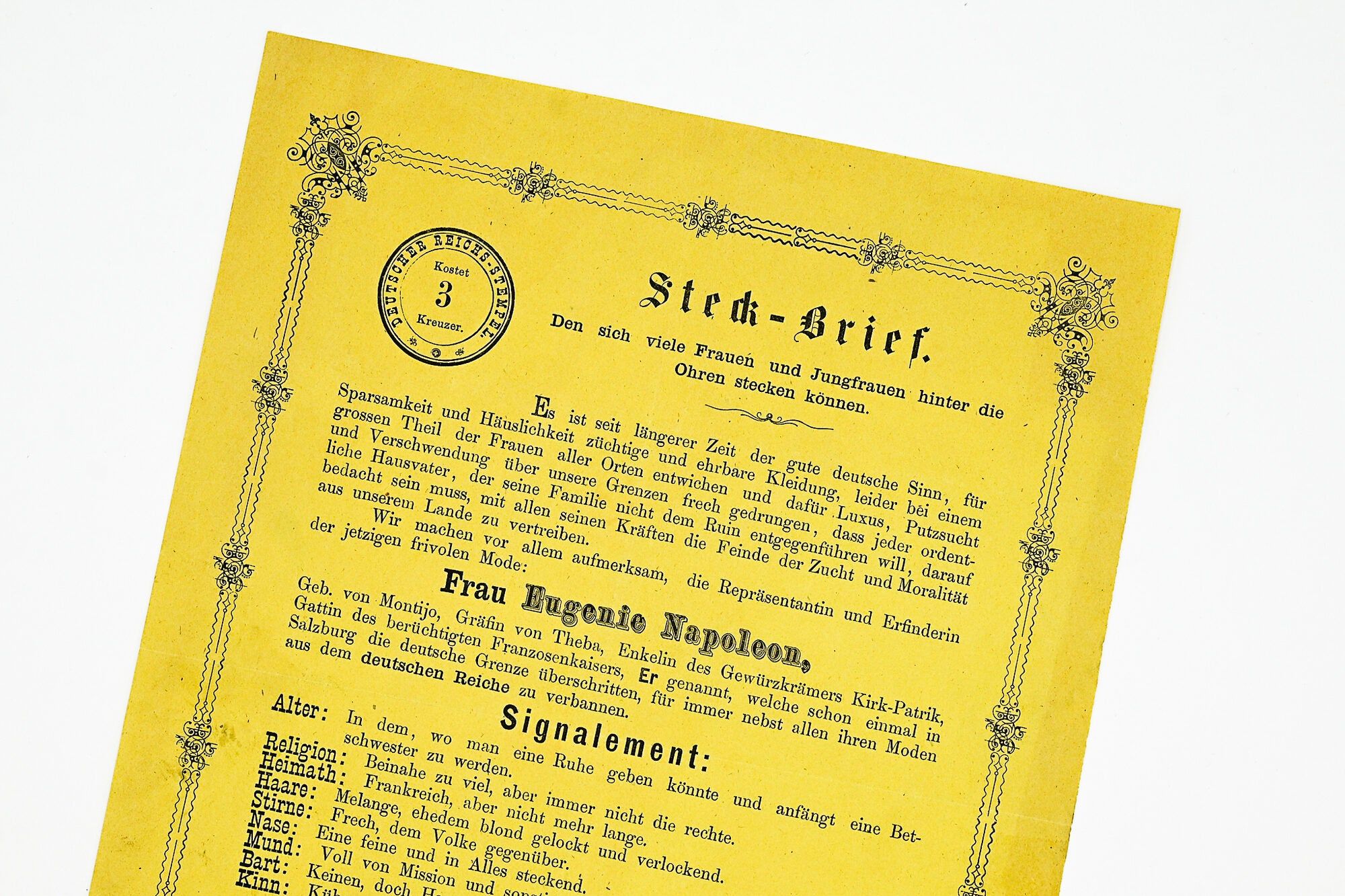
Mainz: Josef Aumüller, 1871. Very good plus.. Rare original satirical "Wanted" poster listing the fashion crimes of Empress, influencer, and Franco-Prussian War enthusiast Eugénie de Montijo. Patron of couturier Charles Worth and luggage-maker Louis Vuitton, Eugénie was the force behind the birth of haute couture and the modern luxury goods industry, with a popular influence felt across Europe and over oceans and an anti-Prussian suite of political convictions that made her highly unpopular in Mainz, among other places, when the Second Empire fell to the North German Confederation.
Since the 1850s, critics had made knowing reference to the Empress's introduction of the crinoline as alleged disguise for her pregnancy, coyly glossed by the SPECTATOR in 1860 as "a most womanly reason" and noted with rude but refreshing bluntness on this poster. ("[T]rägt zur Zeit eine Crinoline, wenn ein Kind von Frankreich soll eingeshmuggelt werden" ["She is currently wearing crinoline, in case a child needs to be smuggled out of France."]) The author or authors offer additional insult to Eugénie's age (too old), her religion (too much of it, not the right kind), her hair (not as blonde as it used to be), and her nose (always in everything). The true target of this invective "on behalf of all honorable German women" was less her sartorial extravagance than what it symbolized: laces so tight they crushed all pity for the thousands "sacrificed for her ambitious plans"; deceptively enormous skirts beneath which she "wore the pants" in her marriage to Napoléon III and by which she could be scapegoated for his many failures. Eugenie was said to have called the doomed Franco-Prussian conflict "My War," and despite her later strenuous denials, the blame stuck. Happily for her reputation, so many more Continental wars have come and gone since 1871 that her legacy now rests on the lasting influence of her once-derided "political outfits" (Green), revitalizing and building the worldwide dominance of the French textile and clothing industries.
A rare and early critique of fashion from a political point-of-view; OCLC locates just one holding, in Germany. 11.25'' x 8.25''. Single leaf, printed in black on yellow. Light wear, minor creasing and toning.
Since the 1850s, critics had made knowing reference to the Empress's introduction of the crinoline as alleged disguise for her pregnancy, coyly glossed by the SPECTATOR in 1860 as "a most womanly reason" and noted with rude but refreshing bluntness on this poster. ("[T]rägt zur Zeit eine Crinoline, wenn ein Kind von Frankreich soll eingeshmuggelt werden" ["She is currently wearing crinoline, in case a child needs to be smuggled out of France."]) The author or authors offer additional insult to Eugénie's age (too old), her religion (too much of it, not the right kind), her hair (not as blonde as it used to be), and her nose (always in everything). The true target of this invective "on behalf of all honorable German women" was less her sartorial extravagance than what it symbolized: laces so tight they crushed all pity for the thousands "sacrificed for her ambitious plans"; deceptively enormous skirts beneath which she "wore the pants" in her marriage to Napoléon III and by which she could be scapegoated for his many failures. Eugenie was said to have called the doomed Franco-Prussian conflict "My War," and despite her later strenuous denials, the blame stuck. Happily for her reputation, so many more Continental wars have come and gone since 1871 that her legacy now rests on the lasting influence of her once-derided "political outfits" (Green), revitalizing and building the worldwide dominance of the French textile and clothing industries.
A rare and early critique of fashion from a political point-of-view; OCLC locates just one holding, in Germany. 11.25'' x 8.25''. Single leaf, printed in black on yellow. Light wear, minor creasing and toning.
Details
Title
STECK-BRIEF. Den sich viele Frauen und Jungfrauen hinter die Ohren stecken koennen
Condition
Very Good
Publisher
Josef Aumüller: Mainz
Date
1871