

Fine illustrated Ginzan emaki (illustrated silver mining handscroll), entitled in manuscript at beginning “Tanshū Ikuno Ginzan ezu” 但州生野銀山繪圖 (“[current] Hyōgo Prefecture, Ikuno Silver Mine, Illustrated”)
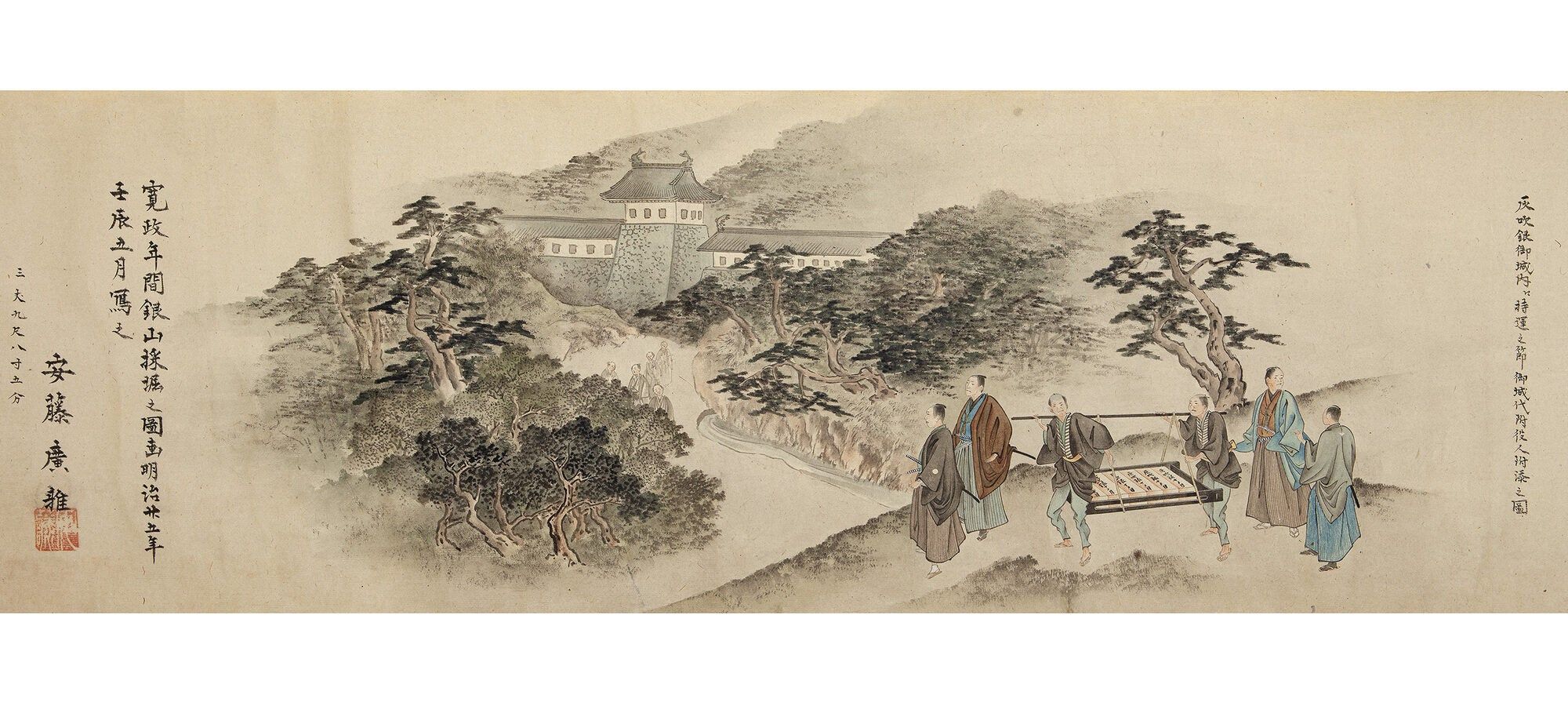
18 fine paintings of the extraction of the ore, smelting, and the administrative & commercial activities associated with the mine. Scroll on paper (311 x 12,170 mm.), inner front endpaper with decorative square-cut gold applications, outer side with silk brocade covering, wooden core roller, backed with mica-embossed paper. [Japan]: “copied 1892.”
An uncommonly well-illustrated scroll depicting the mining and refining activities of the Ikuno silver mine, depicting the technology of mining used in the late 18th century.
Silver was mined at the Ikuno Ginzan (Ikuno Silver Mine) from the 9th century until the late 20th century and was an important source of income for the central government. The main tunnel of the mine is 2.6 km long and extends 1 km. deep. Along with silver, lead, copper, zinc, and gold were extracted. There were several entrances to the mine, and more than 20,000 residents of Ikuno were in some way involved in the local mining industry. One of the most productive periods for the mine was the 18th century, when, in some months, the production of silver reached about 562 kilograms.
Our scroll was created by the artist Andō Kōga 安藤広雅 (see below) and provides an accurate representation of the complicated workings, both below and above ground, taking place at the Ikuno mine during the late 18th century. The 18 paintings are beautifully rendered in fine colors. Each image is preceded by a manuscript explanation.
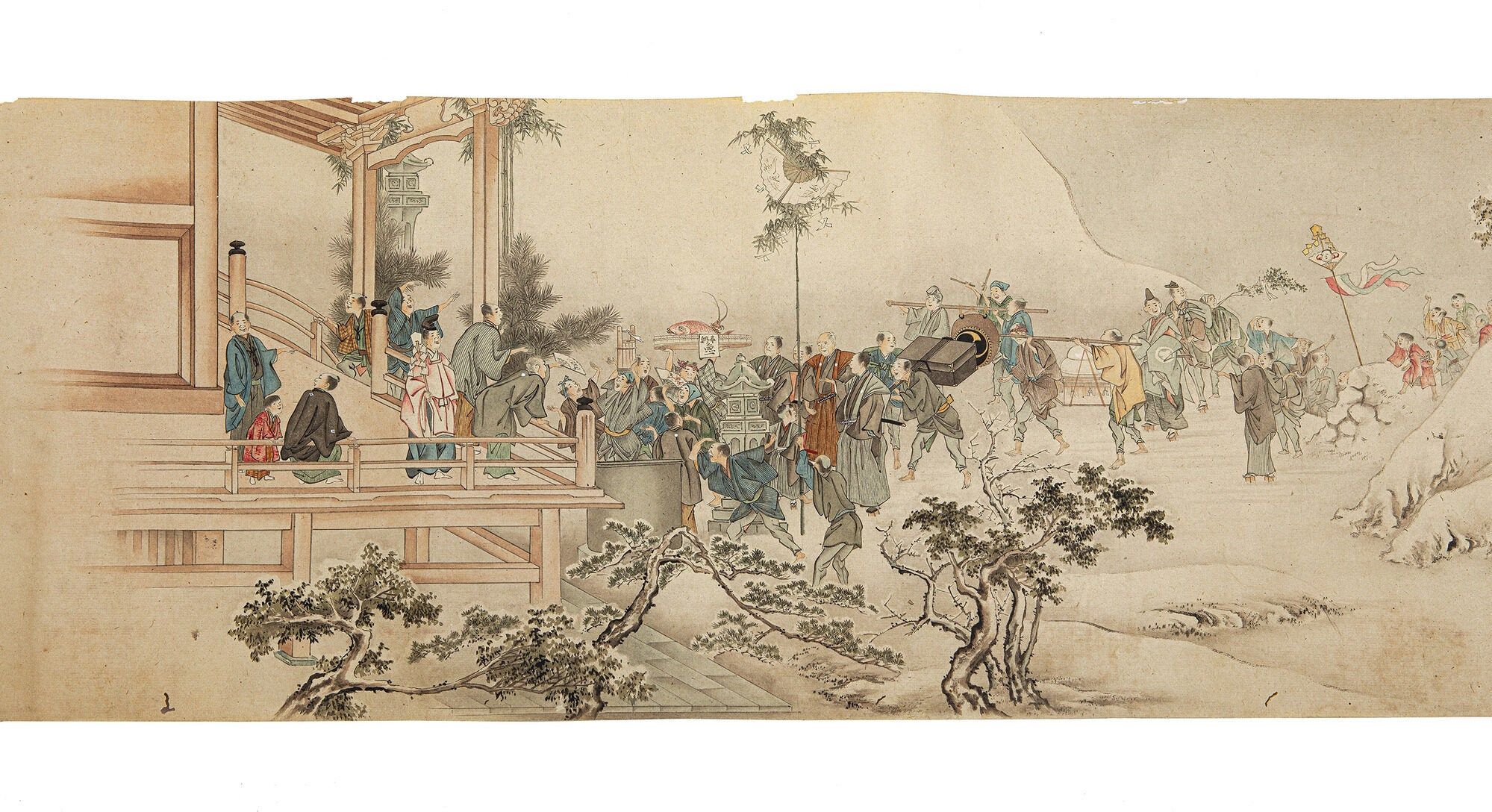
The first image depicts the annual New Year’s celebrations on the 2nd of January with a procession of local miners, government dignitaries, drummers, and children approaching a shrine, carrying a symbolic celebratory feast of porgy, sake, and mochi; banners (one with banknotes tied to it); and other offerings, in a ceremony that would ensure good business luck for the year. Priests are waiting for the procession to arrive.
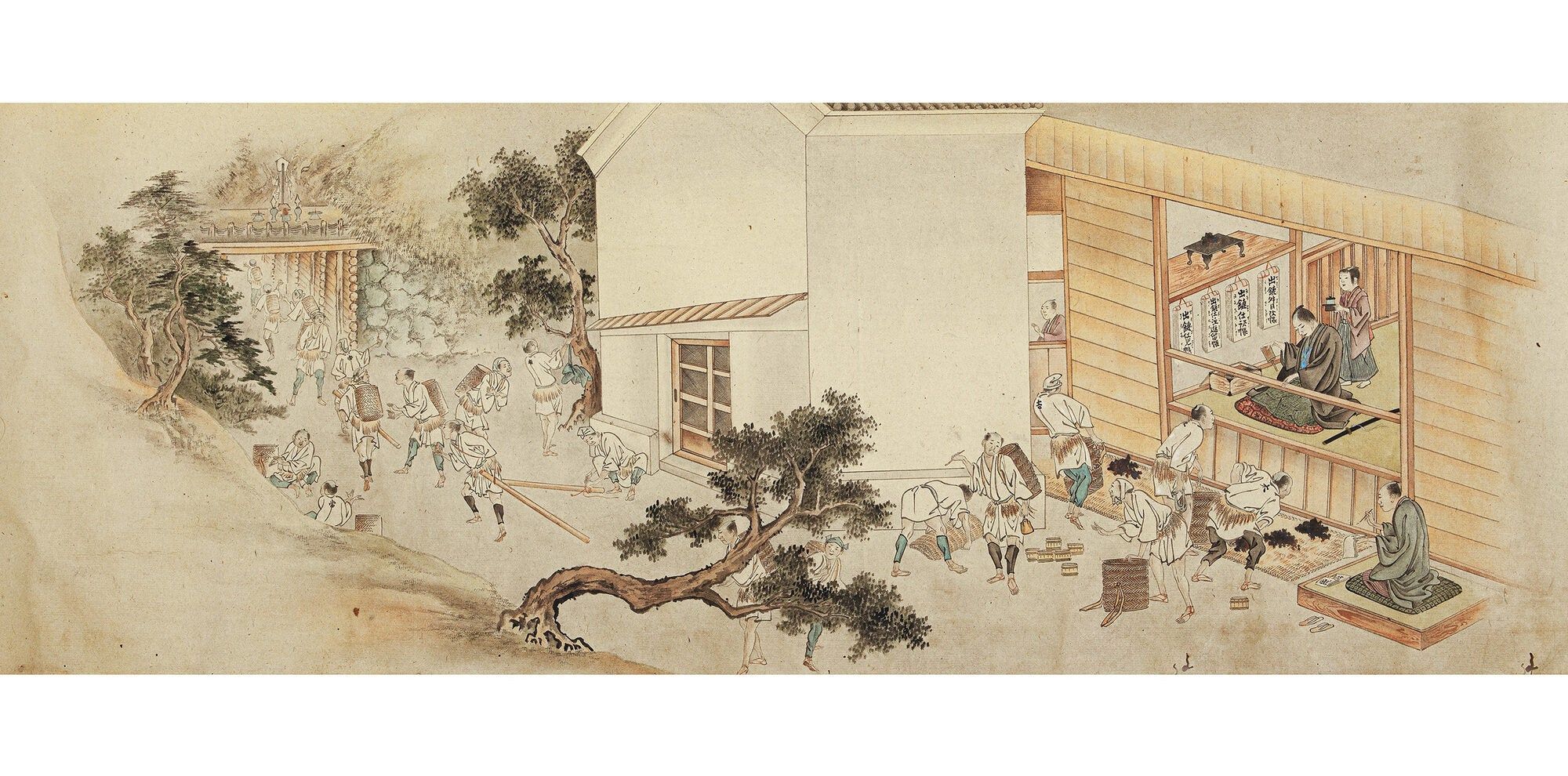
The second image depicts the entrance to the mine, in front of which is the governmental hut (Yokohikiba) where the ore, carried in straw sacks (kamasu), was deposited. Some of the men are carrying waste rubble from the mine. Carpenters (yamadome daiku) are at work constructing wooden supports. Other men (tetsudai horiko) are carrying the supports into the mine. Two representatives of the government are observing the miners carrying out the ore. Tally sheets for keeping track of production are hanging in the office.
Our third painting is a bucolic rendering of the mine entrance, with men entering the mine carrying empty baskets. Several are talking to a government official. The foreman of the miners is reporting details of the production.
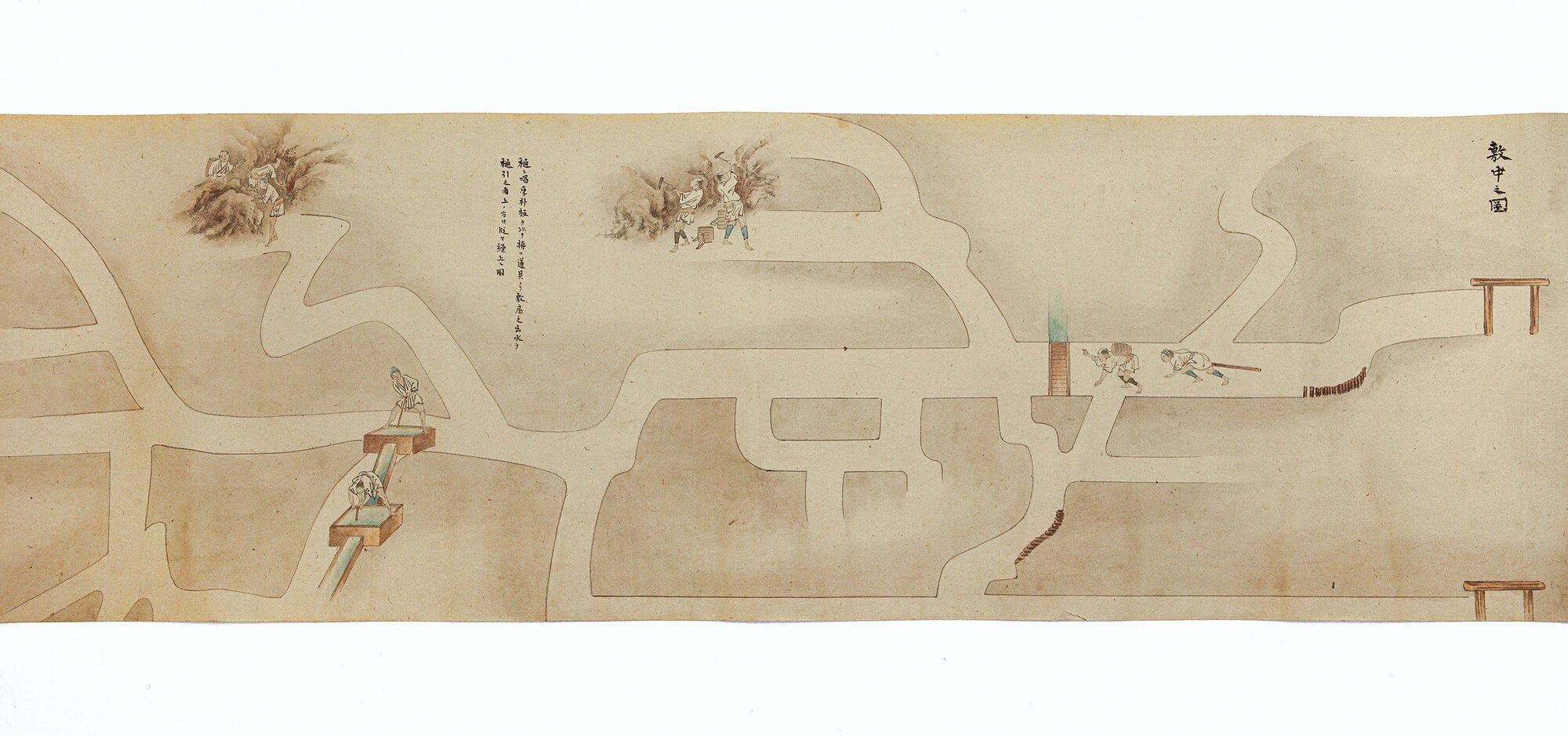
The following image shows a cross-section of the mine with miners using picks to dislodge the ore. Below, men are forcing water out of the mine in long drainage channels by a submerged Archimedes screw (suijōrin), introduced into Japanese mining in the early 17th century. The mine shafts are extremely claustrophobic, the workers hunched over, making their way through the shafts.
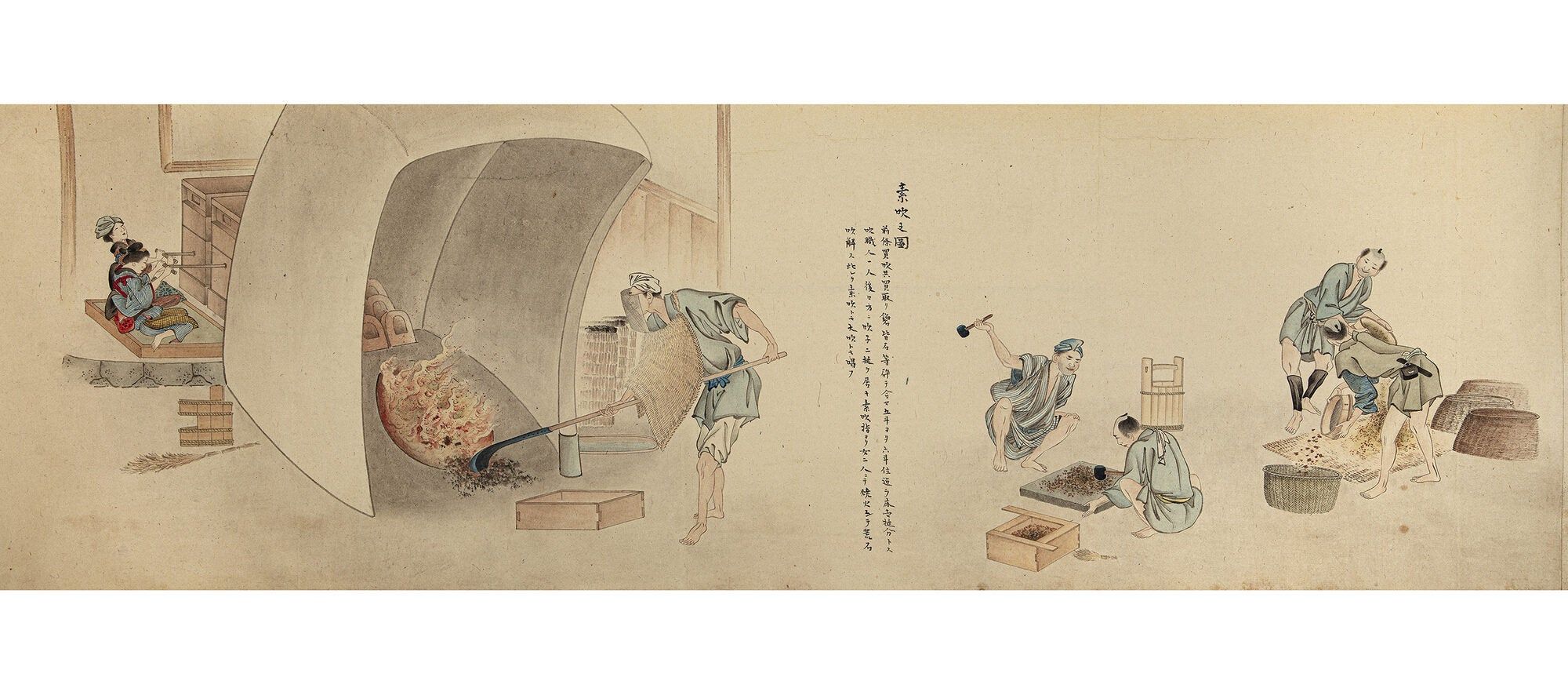
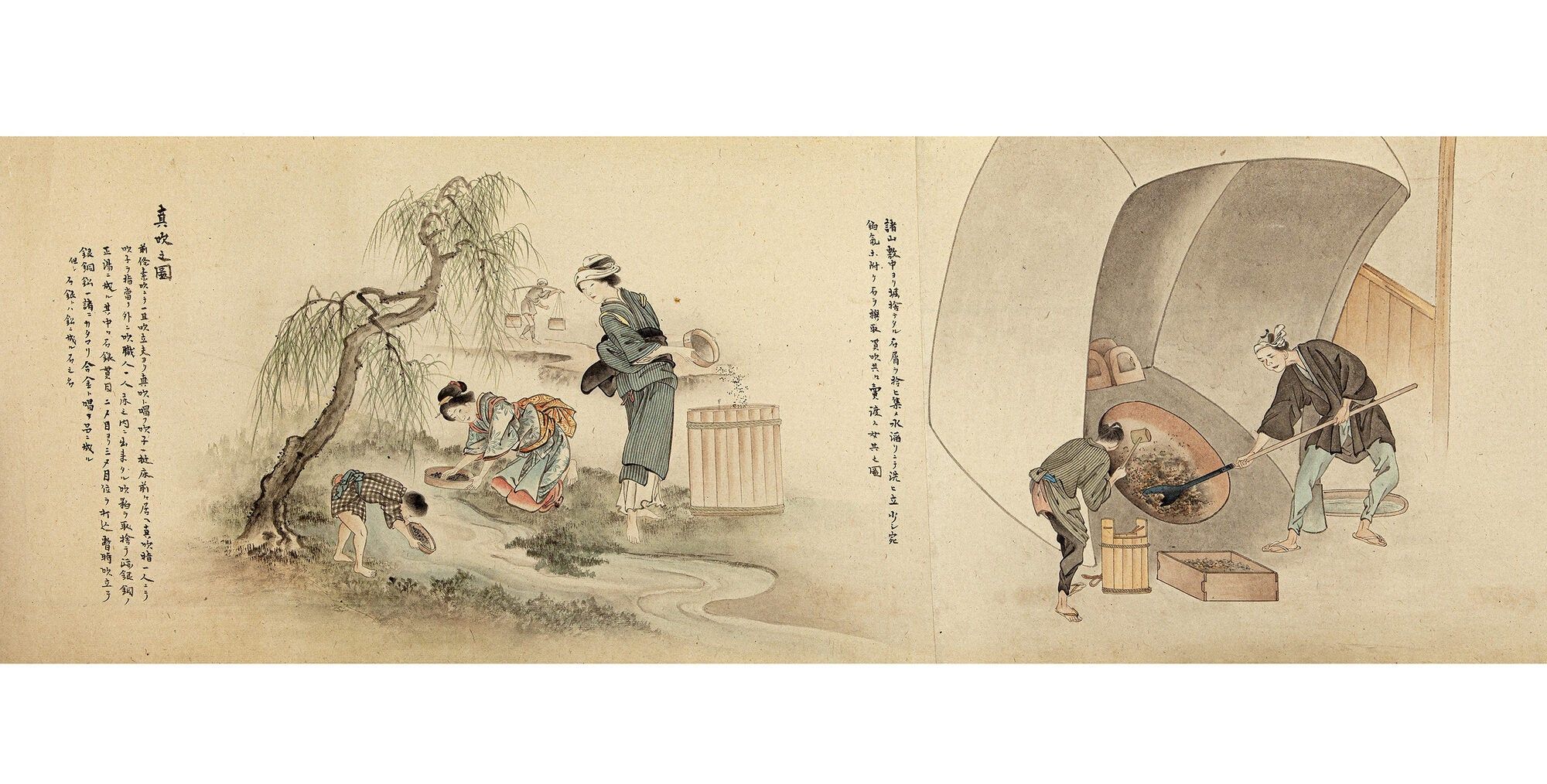
Next is a series of above-ground images of winning precious metals from the ore (konashi). In the first painting, we see men (dobehori) pulverizing and sifting ore, separating it into various constituents, principally gold and silver. The following image shows a man roasting the ore, preparing it for the later smelting. During the roasting, the ore is heated, converting sulfides and other minerals into oxides, which are then later reduced with charcoal in the smelting. The man is shielded from the heat by a straw mat hanging from his shoulders and a woven face protector. Two women, on the opposite side of the furnace, are pumping the bellows. In the next painting, we see two removing the refined ore from the furnace after it cools.
The next image shows two women and a child sifting through the mine’s waste water, which flows into a nearby stream, looking for gold and silver. From the caption, we learn they will sell their findings to the smelters.
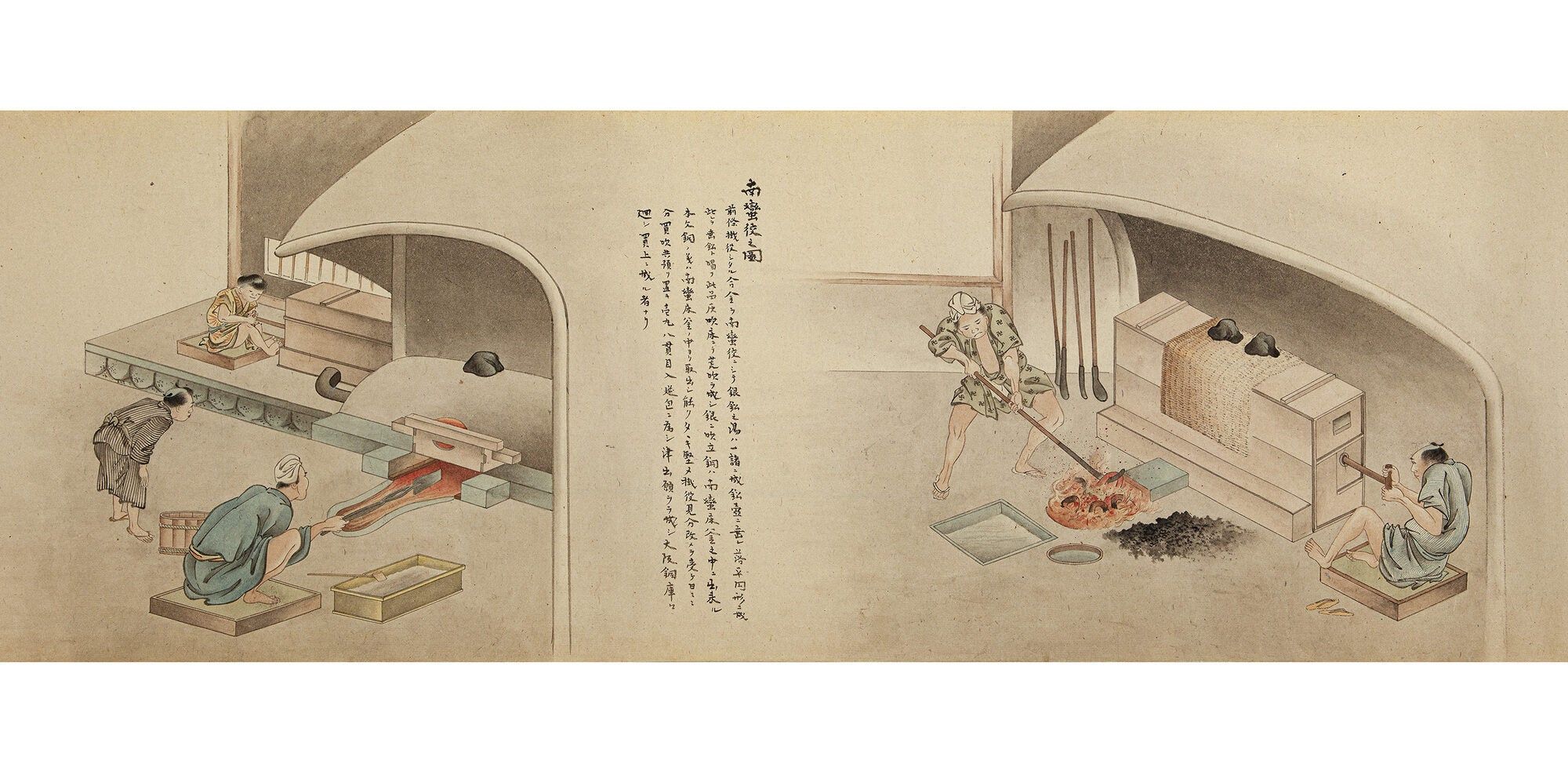
The next step in concentrating the ore is illustrated with a man furiously pumping the bellows of a furnace and the smelter (fukidaiku) removing the refined ore. Then we have a detailed painting of the actual smelting. A boy is pumping the bellows of a large furnace. The next image depicts another small furnace for further refining of the ore, in which the silver is removed and placed into a disc-like mold. This is followed by a depiction of melting the silver and molding it into small oval-shaped discs.
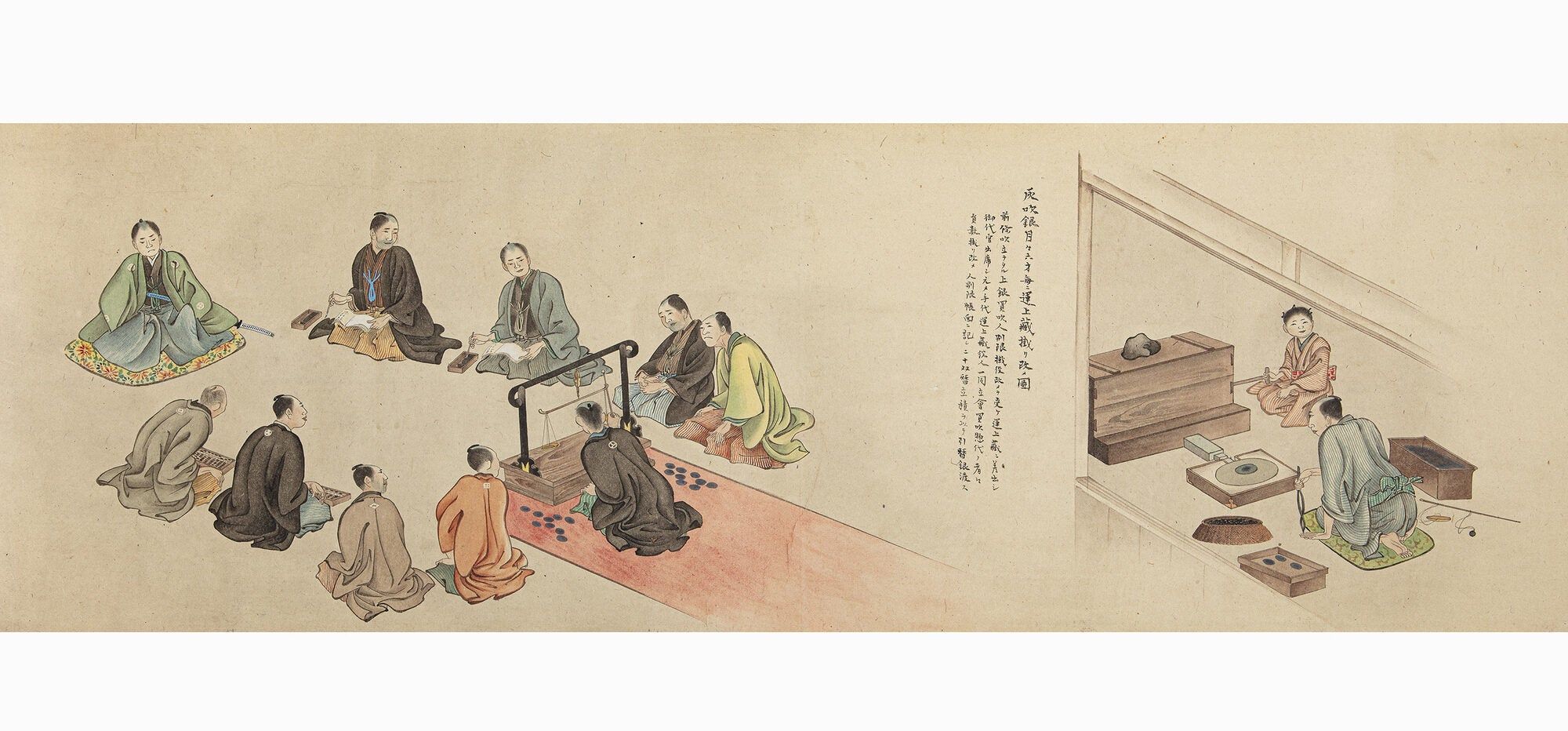
The next image depicts a group of ten government officials, including the head of the mining operations, observing the weighing of the refined silver discs. Several officials are making notes, and others are making calculations using an abacus.
In the following image, workers are packing the partially refined byproducts — copper, lead, and gold ores — observed by government officials.
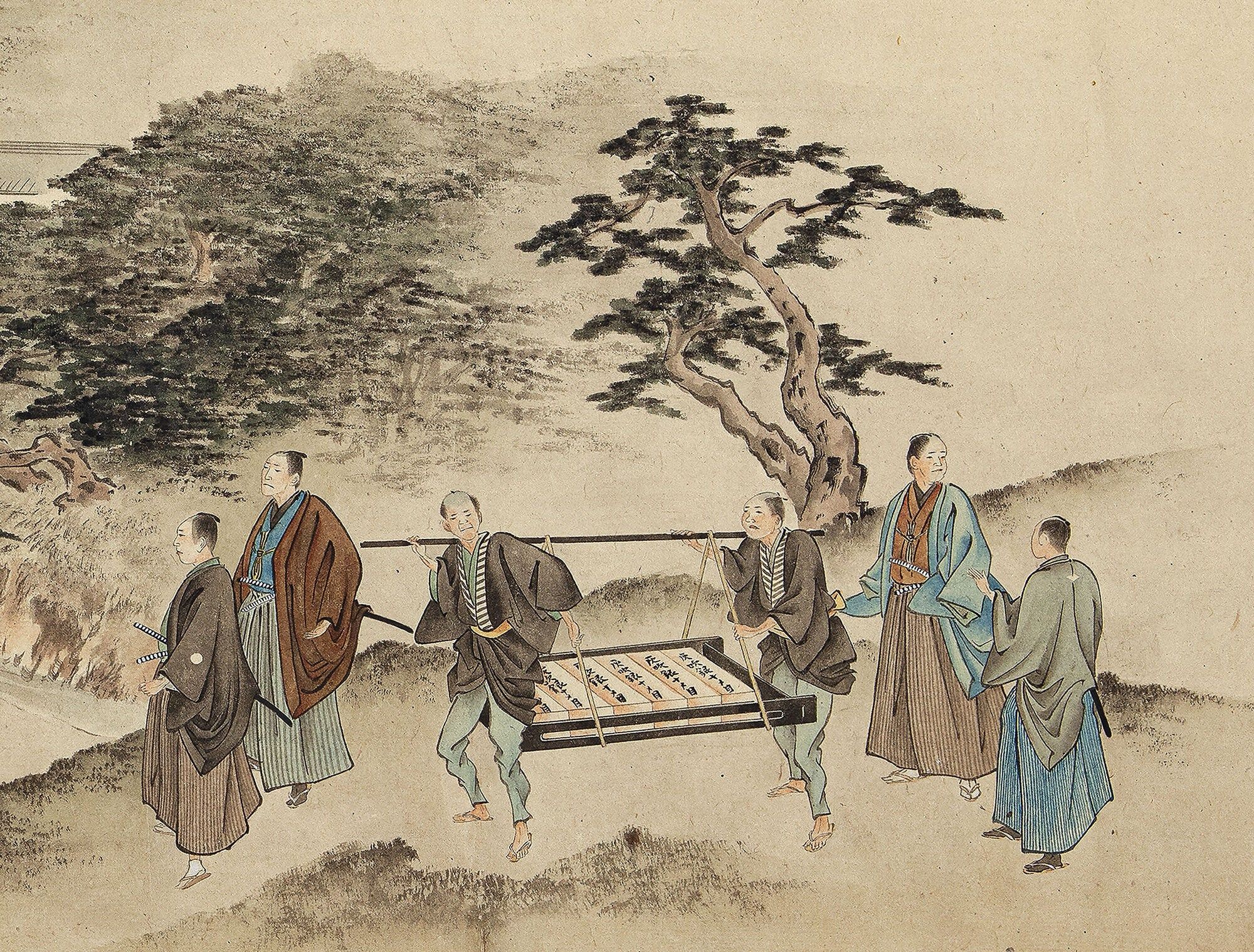
The next image depicts the refined silver being carried to Osaka by horse, surrounded by guards carrying banners. A high government official is carried in a palanquin.
The following image shows government representatives of the mine selling partially refined ores to precious metals dealers in an outdoor setting. One of the officials is seated at a desk, taking notes with an abacus handy. The method of bidding is secretive: a buyer places his hand up the covered arm of an official, counting out his bid with his fingers.
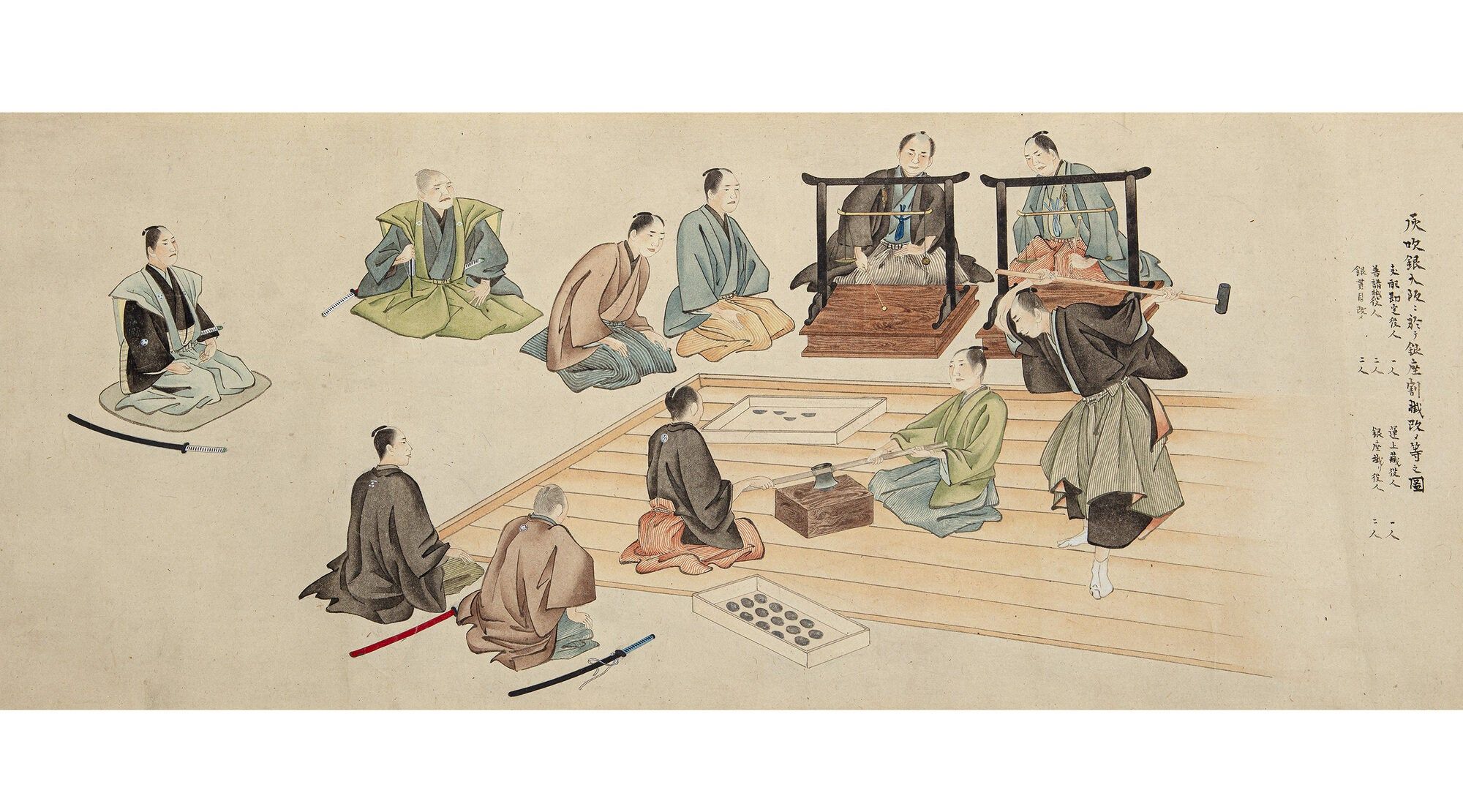
The next image depicts the auction of silver at Osaka. Government officials are observing. The final image depicts men carrying the auctioned silver, escorted by government officials, into what is surely Osaka Castle.
At the end, we find this inscription (in trans.): “Scenes from the Silver Mine, the process of deriving the silver, in the era of Kansei [1789-1800]. Copied in 1892 by artist Andō Kōga.”
In fine and fresh condition, preserved in a wooden box.
❧ For a wonderful account of mining in Sado Island (which can be applied to our Ikuno scroll), see Hamish Todd’s “The British Library’s Sado Mining Scrolls” in The British Library Journal, Vol. 24, No. 1 (Spring 1998), pp. 130-43.
An uncommonly well-illustrated scroll depicting the mining and refining activities of the Ikuno silver mine, depicting the technology of mining used in the late 18th century.
Silver was mined at the Ikuno Ginzan (Ikuno Silver Mine) from the 9th century until the late 20th century and was an important source of income for the central government. The main tunnel of the mine is 2.6 km long and extends 1 km. deep. Along with silver, lead, copper, zinc, and gold were extracted. There were several entrances to the mine, and more than 20,000 residents of Ikuno were in some way involved in the local mining industry. One of the most productive periods for the mine was the 18th century, when, in some months, the production of silver reached about 562 kilograms.
Our scroll was created by the artist Andō Kōga 安藤広雅 (see below) and provides an accurate representation of the complicated workings, both below and above ground, taking place at the Ikuno mine during the late 18th century. The 18 paintings are beautifully rendered in fine colors. Each image is preceded by a manuscript explanation.
The first image depicts the annual New Year’s celebrations on the 2nd of January with a procession of local miners, government dignitaries, drummers, and children approaching a shrine, carrying a symbolic celebratory feast of porgy, sake, and mochi; banners (one with banknotes tied to it); and other offerings, in a ceremony that would ensure good business luck for the year. Priests are waiting for the procession to arrive.
The second image depicts the entrance to the mine, in front of which is the governmental hut (Yokohikiba) where the ore, carried in straw sacks (kamasu), was deposited. Some of the men are carrying waste rubble from the mine. Carpenters (yamadome daiku) are at work constructing wooden supports. Other men (tetsudai horiko) are carrying the supports into the mine. Two representatives of the government are observing the miners carrying out the ore. Tally sheets for keeping track of production are hanging in the office.
Our third painting is a bucolic rendering of the mine entrance, with men entering the mine carrying empty baskets. Several are talking to a government official. The foreman of the miners is reporting details of the production.
The following image shows a cross-section of the mine with miners using picks to dislodge the ore. Below, men are forcing water out of the mine in long drainage channels by a submerged Archimedes screw (suijōrin), introduced into Japanese mining in the early 17th century. The mine shafts are extremely claustrophobic, the workers hunched over, making their way through the shafts.
Next is a series of above-ground images of winning precious metals from the ore (konashi). In the first painting, we see men (dobehori) pulverizing and sifting ore, separating it into various constituents, principally gold and silver. The following image shows a man roasting the ore, preparing it for the later smelting. During the roasting, the ore is heated, converting sulfides and other minerals into oxides, which are then later reduced with charcoal in the smelting. The man is shielded from the heat by a straw mat hanging from his shoulders and a woven face protector. Two women, on the opposite side of the furnace, are pumping the bellows. In the next painting, we see two removing the refined ore from the furnace after it cools.
The next image shows two women and a child sifting through the mine’s waste water, which flows into a nearby stream, looking for gold and silver. From the caption, we learn they will sell their findings to the smelters.
The next step in concentrating the ore is illustrated with a man furiously pumping the bellows of a furnace and the smelter (fukidaiku) removing the refined ore. Then we have a detailed painting of the actual smelting. A boy is pumping the bellows of a large furnace. The next image depicts another small furnace for further refining of the ore, in which the silver is removed and placed into a disc-like mold. This is followed by a depiction of melting the silver and molding it into small oval-shaped discs.
The next image depicts a group of ten government officials, including the head of the mining operations, observing the weighing of the refined silver discs. Several officials are making notes, and others are making calculations using an abacus.
In the following image, workers are packing the partially refined byproducts — copper, lead, and gold ores — observed by government officials.
The next image depicts the refined silver being carried to Osaka by horse, surrounded by guards carrying banners. A high government official is carried in a palanquin.
The following image shows government representatives of the mine selling partially refined ores to precious metals dealers in an outdoor setting. One of the officials is seated at a desk, taking notes with an abacus handy. The method of bidding is secretive: a buyer places his hand up the covered arm of an official, counting out his bid with his fingers.
The next image depicts the auction of silver at Osaka. Government officials are observing. The final image depicts men carrying the auctioned silver, escorted by government officials, into what is surely Osaka Castle.
At the end, we find this inscription (in trans.): “Scenes from the Silver Mine, the process of deriving the silver, in the era of Kansei [1789-1800]. Copied in 1892 by artist Andō Kōga.”
In fine and fresh condition, preserved in a wooden box.
❧ For a wonderful account of mining in Sado Island (which can be applied to our Ikuno scroll), see Hamish Todd’s “The British Library’s Sado Mining Scrolls” in The British Library Journal, Vol. 24, No. 1 (Spring 1998), pp. 130-43.
Details
Title
Fine illustrated Ginzan emaki (illustrated silver mining handscroll), entitled in manuscript at beginning “Tanshū Ikuno Ginzan ezu” 但州生野銀山繪圖 (“[current] Hyōgo Prefecture, Ikuno Silver Mine, Illustrated”)
Author
IKUNO SILVER MINE SCROLL
Condition
Unknown