

Finely decorated woodblock-printed kasuga-ban scroll (春日版装飾経) of Vol. VI of the Lotus Sutra [S. Saddharmapundarikasutra; J. Myohorengekyo 妙法蓮華経]
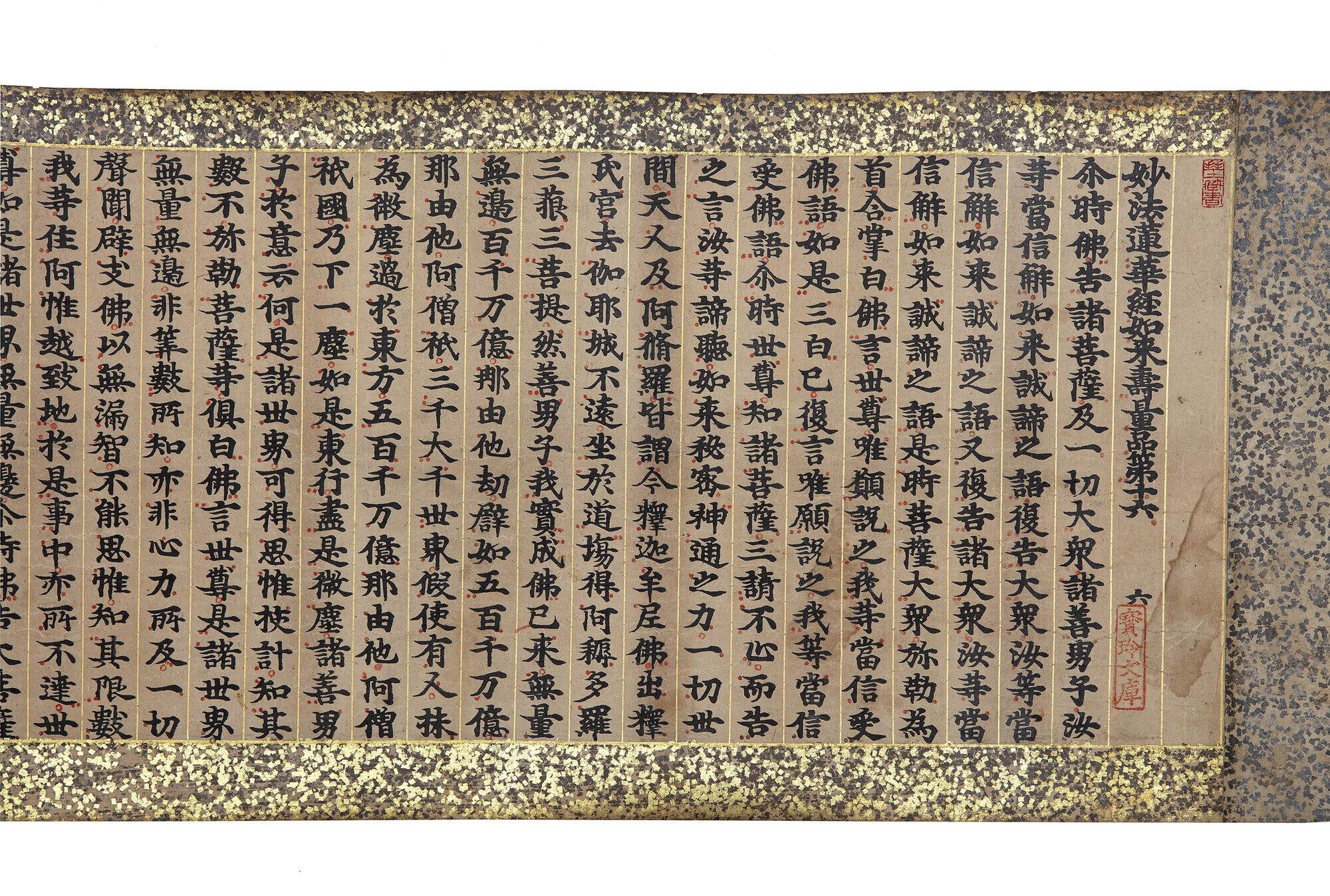
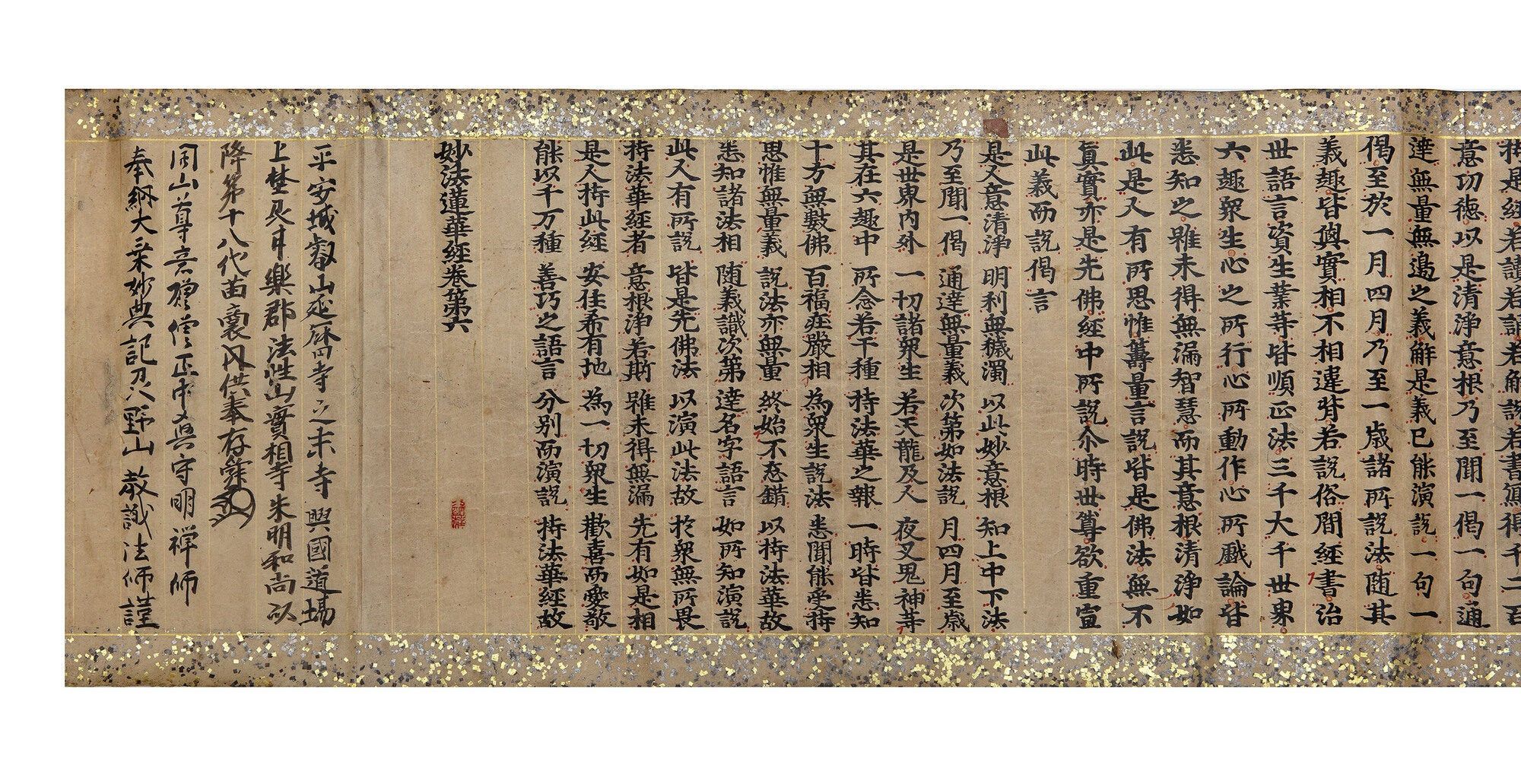
17 characters per column; 25 columns per sheet, 21.5 joined sheets. Scroll (275 x 10,740 mm.), outer front endpaper with nature motifs (quite faded), inner endpaper with dense patterns of applied squares of silver. Columns of text vertically ruled in gold (kinkai) throughout, borders on top & bottom decorated with densely applied cut squares of gold & silver, wooden core roller. Japan: mid- to late Kamakura era (ca. 1250-1333).
A luxuriously produced kasuga-ban edition of Vol. VI of the Lotus Sutra, originally translated into Chinese by Kumarajiva and completed in 406 CE. The Lotus Sutra is the most influential of all sutra and “was highly influential in East Asia, inspiring both a range of devotional practices as well as the creation of new Buddhist schools that had no Indian analogues.”–Buswell & Lopez, eds., The Princeton Dictionary of Buddhism, p. 730. For several Japanese schools of Buddhism, the Lotus Sutra remains their central text and is considered the only valid Buddhist sutra for the degenerate age.
This handsome scroll has been printed on high-quality paper (gampi, or mulberry fibers) and printed in bold, thick strokes using black sumi ink, typical of Kamakura and Muromachi kasuga-ban printings (kasuga-ban is a general term for publications of the Nara monasteries; see below).
Kumarajiva (344-413), Buddhist monk, scholar, missionary, and translator, who came from the Silk Road kingdom of Kucha, was famous for his encyclopedic knowledge of Indian and Vendantic learning. He was the greatest translator of Buddhist scripture from Sanskrit into Chinese, and it was largely owing to his efforts and influence that Buddhist religious and philosophical ideas were disseminated in China. Following many years of study in Kucha and Kashmir, he arrived in Chang’an (now Xi’an) in 401 with a great reputation. He became known as “teacher of the nation.” There, he headed a famous school of translators, and together they translated many important texts into Chinese, including the Vimalakirti, the Diamond, the Lotus, and the Amitabha sutras.
PROVENANCE: At the end of the scroll is an annotation by Zonshun 存舜, a priest at the Jissō ji 實相寺, a temple in what is today’s Gunma Prefecture, stating that this scroll was dedicated to the temple. Our scroll has a distinguished 20th-century provenance: from the library of Frank Hawley, with his seal. Hawley was one of the most discerning collectors of Japanese books and manuscripts. His stamp appears at the beginning of the text. See R.H. van Gulik’s “In Memoriam. Frank Hawley (1906-1961)” in Monumenta Nipponica, Vol. 16, No. 3/4 (Oct. 1960-Jan. 1961), pp. 434-47. This scroll passed on to the great bookseller Sorimachi Shigeo, the “H.P. Kraus of Japan,” who in turn sold it to Donald and Mary Hyde (her sale: Christie’s NY, 7 October 1988, lot 56, $33,000). With the seals of Sorimachi and Hyde.
Very fine and fresh condition, preserved in a modern wooden box with brush inscription of the title by Sorimachi’s bibliographer, Mr. Mori.
❧ K.B. Gardner, “Centres of Printing in Medieval Japan: late Heian to early Edo period” in British Library Occasional Papers 11. Japanese Studies (ed. by Yu-Ying Brown), London: 1990, p. 159–“The term Kasuga-ban became used more loosely, in a wider sense, to denote publications of the Nara monasteries in general, not only of the Kofukuji. The printing of Kasuga-ban in this broader sense flourished throughout the Kamakura period and up to the end of Muromachi (ca. 1570).”.
A luxuriously produced kasuga-ban edition of Vol. VI of the Lotus Sutra, originally translated into Chinese by Kumarajiva and completed in 406 CE. The Lotus Sutra is the most influential of all sutra and “was highly influential in East Asia, inspiring both a range of devotional practices as well as the creation of new Buddhist schools that had no Indian analogues.”–Buswell & Lopez, eds., The Princeton Dictionary of Buddhism, p. 730. For several Japanese schools of Buddhism, the Lotus Sutra remains their central text and is considered the only valid Buddhist sutra for the degenerate age.
This handsome scroll has been printed on high-quality paper (gampi, or mulberry fibers) and printed in bold, thick strokes using black sumi ink, typical of Kamakura and Muromachi kasuga-ban printings (kasuga-ban is a general term for publications of the Nara monasteries; see below).
Kumarajiva (344-413), Buddhist monk, scholar, missionary, and translator, who came from the Silk Road kingdom of Kucha, was famous for his encyclopedic knowledge of Indian and Vendantic learning. He was the greatest translator of Buddhist scripture from Sanskrit into Chinese, and it was largely owing to his efforts and influence that Buddhist religious and philosophical ideas were disseminated in China. Following many years of study in Kucha and Kashmir, he arrived in Chang’an (now Xi’an) in 401 with a great reputation. He became known as “teacher of the nation.” There, he headed a famous school of translators, and together they translated many important texts into Chinese, including the Vimalakirti, the Diamond, the Lotus, and the Amitabha sutras.
PROVENANCE: At the end of the scroll is an annotation by Zonshun 存舜, a priest at the Jissō ji 實相寺, a temple in what is today’s Gunma Prefecture, stating that this scroll was dedicated to the temple. Our scroll has a distinguished 20th-century provenance: from the library of Frank Hawley, with his seal. Hawley was one of the most discerning collectors of Japanese books and manuscripts. His stamp appears at the beginning of the text. See R.H. van Gulik’s “In Memoriam. Frank Hawley (1906-1961)” in Monumenta Nipponica, Vol. 16, No. 3/4 (Oct. 1960-Jan. 1961), pp. 434-47. This scroll passed on to the great bookseller Sorimachi Shigeo, the “H.P. Kraus of Japan,” who in turn sold it to Donald and Mary Hyde (her sale: Christie’s NY, 7 October 1988, lot 56, $33,000). With the seals of Sorimachi and Hyde.
Very fine and fresh condition, preserved in a modern wooden box with brush inscription of the title by Sorimachi’s bibliographer, Mr. Mori.
❧ K.B. Gardner, “Centres of Printing in Medieval Japan: late Heian to early Edo period” in British Library Occasional Papers 11. Japanese Studies (ed. by Yu-Ying Brown), London: 1990, p. 159–“The term Kasuga-ban became used more loosely, in a wider sense, to denote publications of the Nara monasteries in general, not only of the Kofukuji. The printing of Kasuga-ban in this broader sense flourished throughout the Kamakura period and up to the end of Muromachi (ca. 1570).”.
Details
Title
Finely decorated woodblock-printed kasuga-ban scroll (春日版装飾経) of Vol. VI of the Lotus Sutra [S. Saddharmapundarikasutra; J. Myohorengekyo 妙法蓮華経]
Author
LOTUS SUTRA
Condition
Unknown