

Banjo: A Story without a Plot
- New York: Harper & Brothers Publishers, 1929
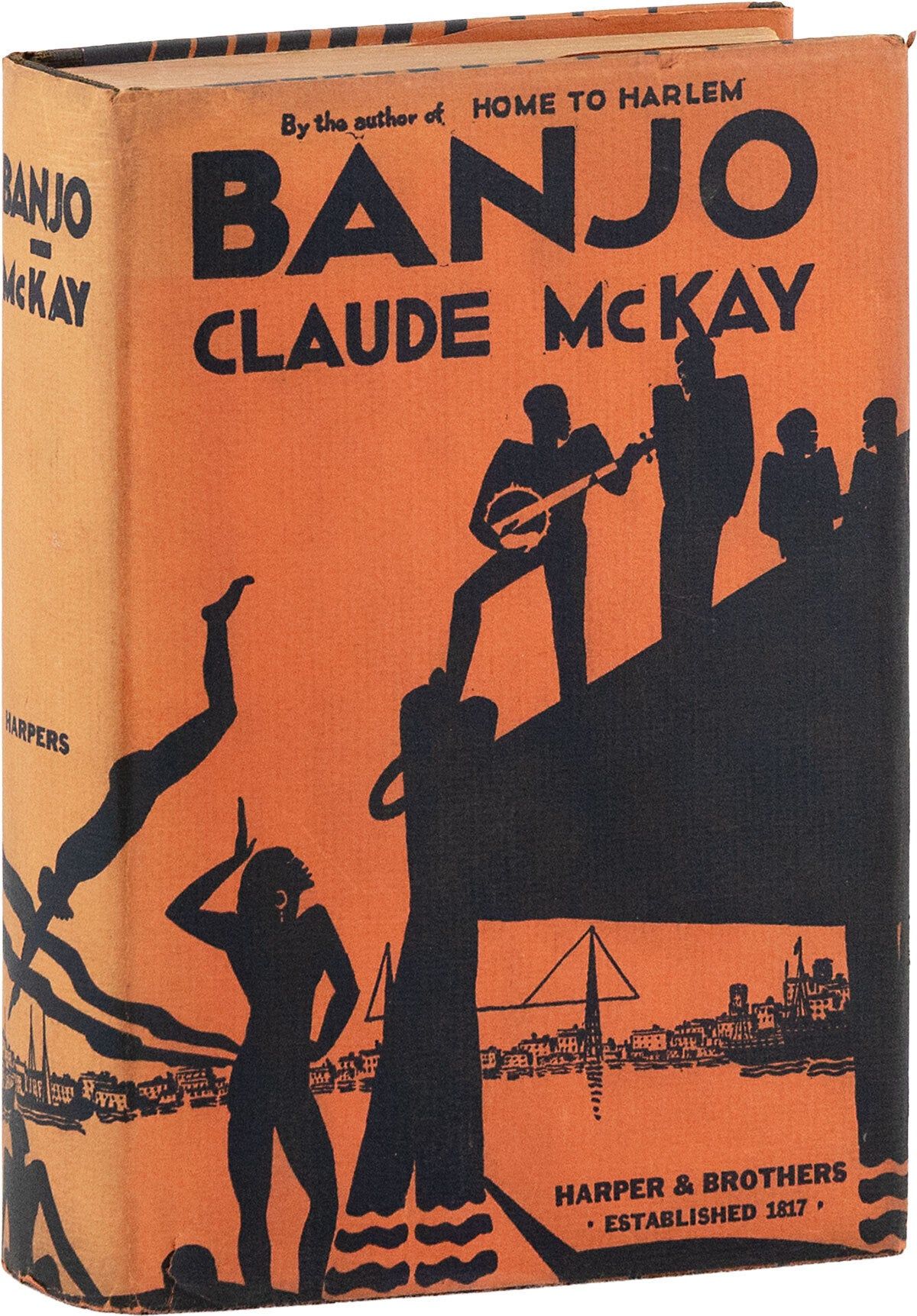
New York: Harper & Brothers Publishers, 1929. First Edition. First Printing. Octavo (19.5cm); navy blue and red paper-covered boards and black cloth backstrip, with titles stamped in gilt on spine; decorative endpapers; orange topstain; dustjacket; [viii],[2],3-326,[2]pp. Spine ends gently nudged, topstain slightly dulled, else a fresh, very Near Fine copy. In the original dustjacket designed by Aaron Douglas; unclipped (priced $2.50), gently spine-sunned and lightly edgeworn, with a few tiny tears, a tiny split at rear flap fold, and some mild dust-soil; still a bright, Near Fine copy.
McKay's second novel, an accurate social perspective of Black life in southern France, drawn directly from McKay's experience living in Marseilles. "Lincoln Agrippa, known to his drifter cohorts on the 1920s Marseilles, waterfront as "Banjo," passes his days panhandeling and dreaming of starting his own little band. At night, Banjo Malty, Ginger, Dengel, Bugsy, Taloufa, Goosey, and even Jake of Home to Harlem prowl the rough waterfront bistros, drinking, looking for women, playing music, fighting, loving, and talking - about their homes in Senegal, the West Indies, or the American South; about Garvey's Back-to-Africa Movement; about being Black. When Ray, a writer, joins the group, it triggers his rediscovery of his African roots and his feeling that, at last, he belongs to a race, "weighted, tested, and poised in the universal scheme" (from the HarperCollins reissue). PERRY 377; GLOSTER p.165-166. 88435.
McKay's second novel, an accurate social perspective of Black life in southern France, drawn directly from McKay's experience living in Marseilles. "Lincoln Agrippa, known to his drifter cohorts on the 1920s Marseilles, waterfront as "Banjo," passes his days panhandeling and dreaming of starting his own little band. At night, Banjo Malty, Ginger, Dengel, Bugsy, Taloufa, Goosey, and even Jake of Home to Harlem prowl the rough waterfront bistros, drinking, looking for women, playing music, fighting, loving, and talking - about their homes in Senegal, the West Indies, or the American South; about Garvey's Back-to-Africa Movement; about being Black. When Ray, a writer, joins the group, it triggers his rediscovery of his African roots and his feeling that, at last, he belongs to a race, "weighted, tested, and poised in the universal scheme" (from the HarperCollins reissue). PERRY 377; GLOSTER p.165-166. 88435.
Details
Title
Banjo: A Story without a Plot
Author
[AFRICAN AMERICAN HISTORY & LITERATURE] MCKAY, Claude (novel); DOUGLAS, Aaron (design)
Condition
Unknown
Publisher
Harper & Brothers Publishers: New York
Date
1929
Edition
First Edition