

Shinpen meihō ruitō isho taizen 新編名方類證醫書大全 [C. Yi shu da quan 醫書大全; Comprehensive Compendium of Medical Writings]
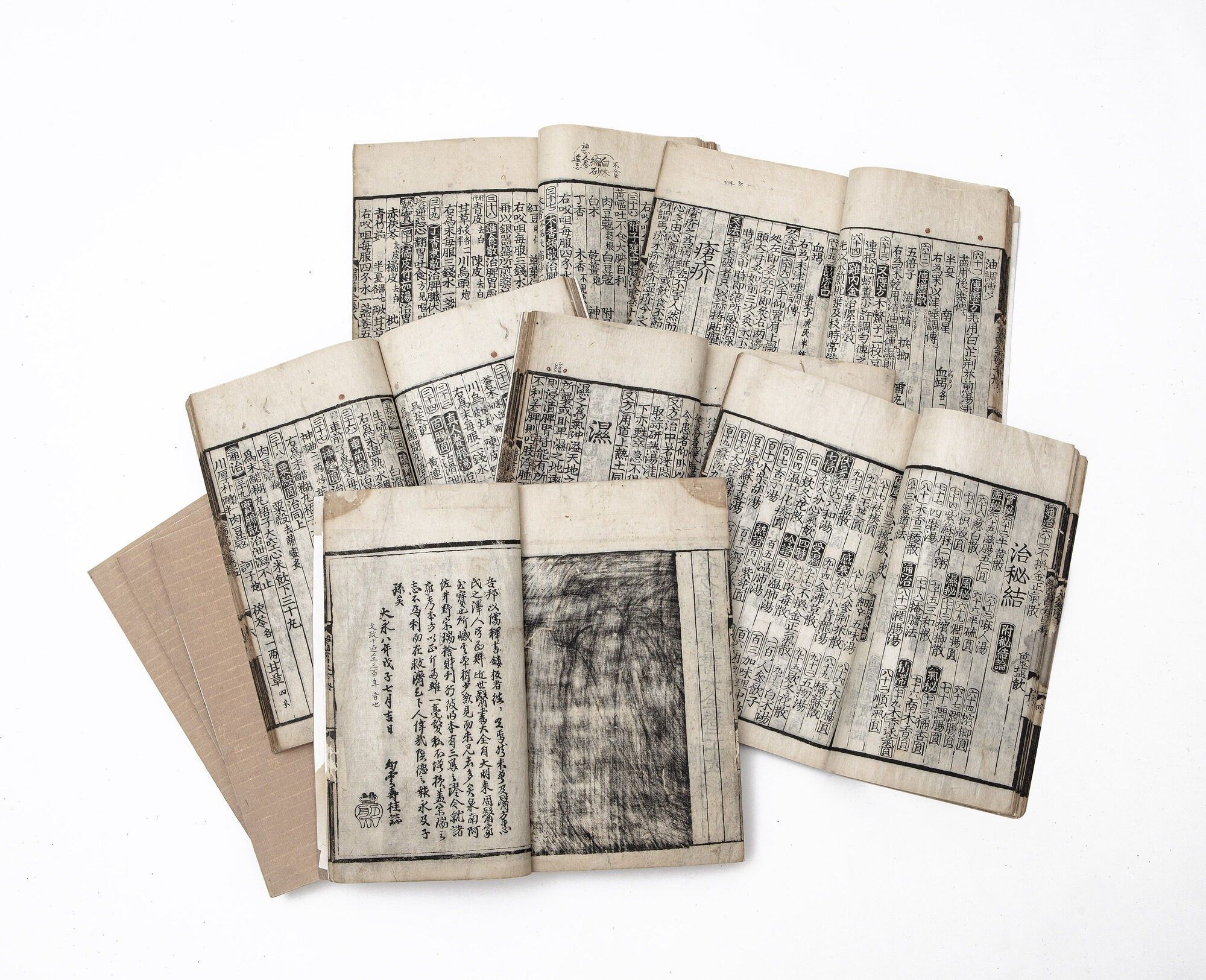
23; 49; 54; 62; 62 (of 64, lacking two leaves); 36; 46; 53; 59 folding leaves. Nine vols. 8vo (271 x 175 mm.), modern wrappers, new stitching. [Sakai?]: [Privately Printed] for Asaino Sōzui 阿佐井野宗瑞, dated 1528 in Postscript.
First edition, privately published, of the first medical book to be printed in Japan. This is the best-known work of the sakaiban 堺版 editions, whose appearance in the port city of Sakai (just south of Osaka) marked the beginning of private/commercial publishing in late medieval Japan. The printing of secular texts was new for Japan, especially for commercial purposes. It was a sign of the beginning of modernity in the island nation, ushering in a new climate of independent thinking.
This is a rare book, with WorldCat locating only the very incomplete UCSF copy.
Kosoto Hiroshi, one of the leading historians of Japanese medicine, describes the significance of this work as follows: “The Isho taizen is the earliest printed medical book in our country [Japan]. The collection of medical recipes based on this work, the Ihō taiseiron 医方大成論, was the most widely circulated medical book in the early to mid-Edo period (1603-1868). The significance of the Isho taizen for the history of medicine in Japan can therefore be considered extraordinarily profound” (「名方類証医書大全」解題, appended to 和刻漢籍医書集成, Vol. 7, エンタプライズ 1989, p. 2).
The 15th and 16th centuries witnessed a rapid inflow of newly developed Chinese medical knowledge into Japan, where it came to be highly regarded among medical practitioners. Japanese physicians such as Tashiro Sanki 田代三喜 (1465-1544) and Saka Jō’un 坂浄運 (n.d.), for example, travelled to Ming China in the 1480s-90s and brought back the medical learnings of Li Dongyuan 李東垣, Zhu Danxi 朱丹溪, and others that had developed there during the Mongol Yuan period, and these teachings later became the foundations of major medical lineages in Japan. But beyond the travel of individual physicians to China, a more extensive exchange of medical knowledge unfolded through the official Sino-Japanese trade, which took place a total of 19 times between 1401 and 1549. The city of Sakai, as being a major port for the trade, saw a substantial influx of Chinese merchandise that included printed books on various topics. A diary entry by the abbot of the Kaieji temple 海会寺 in Sakai dated to 1484 mentions a number of Ming medical texts brought into Japan on merchant ships, including the Isho taizen, which was already garnering popular attention (久保尾俊郎, “阿佐井野宗瑞と「医書大全」の出版,” pp. 162-63).
Within the context of Ming medicine, the Isho taizen (or, as it was known in China, Yishu daquan) was a compendium of medical prescriptions and recipes that aimed to make specialized knowledge of literati-physicians (Ch. ruyi 儒醫) much more accessible to the common folk. The genre of printed collections of prescriptions (Ch. fangshu 方書) goes back to the earliest instances of woodblock publishing in China, when the Song court commissioned works like the Taiping shenghui fang 太平聖惠方 (992 CE) as demonstrations of imperial benevolence. The genre quickly became controversial among physicians, who found that too many patients now placed greater trust in published prescription books than in their own doctors (Angela Ki-che Leung, “Medical Learning from the Song to the Ming,” in The Song-Yuan-Ming Transition in Chinese History, pp. 375-78). Nevertheless, such works continued to be compiled and published.
One important publication in the tradition was the Leibian jingyan yifang dacheng 類編經驗醫方大成 of Sun Yunxian 孫允賢, Preface dated 1321, which drew from no fewer than 19 prescription books already in circulation. The collection was expanded a few decades later by Xiong Yanming 熊彥明, who listed at least six more prescription collections in his bibliography. His book was understood to be a synthesis of “Northern” and “Southern” medical approaches under Yuan rule, after two medical traditions had developed separately during the century and a half of Jin-Song division (范家偉, “從《類編南北經驗醫方大成》論元代南北醫學融合,” 文史哲 2024.4, pp. 70-78).
Xiong Yanming’s work formed the basis of the Yishu daquan, which was published in 1446 by his descendent Xiong Zongli 熊宗立 (1409-81, alias Jun 均), best remembered not as a physician but as the first of the influential Xiong family of publishers based in Jianyang in Fujian. The medical heritage of the Xiong family and the personal inclinations (and to some degree, expertise) of Xiong Zongli left its imprint on the family’s publishing enterprise: not only was the Xiong printing house initially named Weisheng tang 衛生堂 — i.e., Hall for the Protection of Life — and only later changed to Zhongde tang 種德堂, no fewer than 32 of the 40-some Xiong Zongli published in his lifetime were medical works, including reprints of well-known titles (to which he added extensive edits and commentaries) and a few of his own compilations (Lucille Chia, Printing for Profit, Chap. 5). According to Xiong Zongli’s Preface to the Yishu daquan, dated Zhengtong 11 (1446), the work was originally a collection of recipes he had gathered over the years for personal use, due to his weak constitution since childhood. A different Preface, by Wu Gao 吳高, dated 1458 offers a brief biography of Xiong Zongli and more extensive praise for the work itself, stating that it was clearly and accessibly organized into 24 categories of sickness, comprehensive rather than overly specialized, and made its prescriptions (some of which were secret transmissions within the Xiong family) accessible to people who lived in distant lands or remote regions where physicians might be scarce.
The Yishu daquan did, indeed, travel to lands more distant than Xiong Zongli could have anticipated. During or shortly after his lifetime, the Sino-Japanese trade route brought copies of the work to the city of Sakai, which after the Ōnin War (1467-77) that led to Kyoto’s downfall as a national political and publishing center, was quickly gaining importance and influence as a city of commerce. Asaino Sōzui 阿佐井野宗瑞 (1473-1532), born to a family long known in the region for its power and wealth, took an interest in Chinese medicine. Reportedly fascinated by stories of famous doctors in the archaic past, Sōzui studied under Gesshū Jukei 月舟寿桂 (1470-1533), a renowned Zen monk in Kyoto who was well-versed in medical learning (久保尾俊郎, “阿佐井野宗瑞と「医書大全」の出版”). While some scholars have held that Sōzui practiced medicine himself and was particularly well-known as a gynecologist, his major contribution to Japanese medical history was undoubtedly the publication of the Isho taizen in Daiei 8 (1528), based on a 1467 Chinese edition of the Yishu daquan. For this publication, Gesshū composed the following Preface (in trans.):
“In our country many woodblocks have been carved for the printing of Confucian and Buddhist books, but there have never been any for medical recipes. The benefits and healing brought to the people have therefore been sparse. Recently the Isho taizen has arrived from the Great Ming, and it is the utmost treasure for those who practice medicine. Unfortunately, copies of this book are few, and many who look for it have been unable to find a copy. Asaino Sōzui of Sennan has now commissioned the woodblocks for its printing using his own funds, and three errors in the Ming edition have been mended by cross-referencing other texts. Otherwise, the text has not been altered in the slightest. His intention was not for profit but rather for benefitting all who dwell under the heaven. How wonderful! May the recompense for his virtuous deeds be perpetually bestowed upon future generations.”
It is worthwhile to note that the publication of the Isho taizen marked an important event not only in the history of Japanese medicine but also in the history of publishing. The Asaino family would go on to publish editions of the Analects (1533) and Santaishi 三体詩 (n.d.), an anthology of Chinese poetry. These editions are collectively referred to as Asaino-ban. Appearing at a time when publishing in Japan was still dominated by Buddhist monastic printing of canonical texts, “the editions of Sakai reflected a new climate in which secular tastes were exalted. These works were published by independent aesthetes, and they symbolized the pioneering movements that emerged during the transition from medieval to modern times” (“Sakai-ban,” Dictionnaire historique du Japon).
With the growing popularity of printing Chinese texts in the 14th-16th centuries, Chinese woodcarvers came to Japan. The books they carved, like ours, follow their native country’s tradition of somewhat dense and crowded pages, caused by packing the Chinese characters tightly together with more regard for economy of space than for aesthetic effect.
Red square seals on the first folio of each volume read 金合文庫 and 小林蔵書. These are the personal seals of Kobayashi Hideo 小林秀雄 (1902-83), a famous author, literary critic, book collector, and antiques dealer in Japan. A green rectangular seal on the first folio of each volume reads 四阿 (?), of unidentified ownership.
Kosoto Hiroshi’s 1989 survey finds a total of 27 records of complete or near-complete copies of the Isho taizen, including some known to have been lost. A number of extant copies, ours included, lack Xiong Zongli’s separately printed genealogy of medicine, titled Igaku genryū, which Asaino Sōzui printed. As mentioned above, two leaves of text are missing from the fifth volume. We find only one entry in WorldCat for this edition, a highly incomplete copy held at UCSF (1253312180).
Fine set, preserved in a chitsu.
❧ “Sakai-ban,” in Iwao Seiichi et al. (eds.), Dictionnaire historique du Japon, vol. 17 (1991), 89. Kornicki, The Book in Japan (1998), p. 123. 小曽戸洋, “「名方類証医書大全」解題,” in 和刻漢籍医書集成 Vol. 7 (エンタプライズ 1989), pp. 2-16; 久保尾俊郎, « 阿佐井野宗瑞と「医書大全」の出版,” 早稲田大学図書館紀要 42 (1995): pp. 157-76. Mestler, A Galaxy of Old Japanese Medical Books, Part I, p. 302.
First edition, privately published, of the first medical book to be printed in Japan. This is the best-known work of the sakaiban 堺版 editions, whose appearance in the port city of Sakai (just south of Osaka) marked the beginning of private/commercial publishing in late medieval Japan. The printing of secular texts was new for Japan, especially for commercial purposes. It was a sign of the beginning of modernity in the island nation, ushering in a new climate of independent thinking.
This is a rare book, with WorldCat locating only the very incomplete UCSF copy.
Kosoto Hiroshi, one of the leading historians of Japanese medicine, describes the significance of this work as follows: “The Isho taizen is the earliest printed medical book in our country [Japan]. The collection of medical recipes based on this work, the Ihō taiseiron 医方大成論, was the most widely circulated medical book in the early to mid-Edo period (1603-1868). The significance of the Isho taizen for the history of medicine in Japan can therefore be considered extraordinarily profound” (「名方類証医書大全」解題, appended to 和刻漢籍医書集成, Vol. 7, エンタプライズ 1989, p. 2).
The 15th and 16th centuries witnessed a rapid inflow of newly developed Chinese medical knowledge into Japan, where it came to be highly regarded among medical practitioners. Japanese physicians such as Tashiro Sanki 田代三喜 (1465-1544) and Saka Jō’un 坂浄運 (n.d.), for example, travelled to Ming China in the 1480s-90s and brought back the medical learnings of Li Dongyuan 李東垣, Zhu Danxi 朱丹溪, and others that had developed there during the Mongol Yuan period, and these teachings later became the foundations of major medical lineages in Japan. But beyond the travel of individual physicians to China, a more extensive exchange of medical knowledge unfolded through the official Sino-Japanese trade, which took place a total of 19 times between 1401 and 1549. The city of Sakai, as being a major port for the trade, saw a substantial influx of Chinese merchandise that included printed books on various topics. A diary entry by the abbot of the Kaieji temple 海会寺 in Sakai dated to 1484 mentions a number of Ming medical texts brought into Japan on merchant ships, including the Isho taizen, which was already garnering popular attention (久保尾俊郎, “阿佐井野宗瑞と「医書大全」の出版,” pp. 162-63).
Within the context of Ming medicine, the Isho taizen (or, as it was known in China, Yishu daquan) was a compendium of medical prescriptions and recipes that aimed to make specialized knowledge of literati-physicians (Ch. ruyi 儒醫) much more accessible to the common folk. The genre of printed collections of prescriptions (Ch. fangshu 方書) goes back to the earliest instances of woodblock publishing in China, when the Song court commissioned works like the Taiping shenghui fang 太平聖惠方 (992 CE) as demonstrations of imperial benevolence. The genre quickly became controversial among physicians, who found that too many patients now placed greater trust in published prescription books than in their own doctors (Angela Ki-che Leung, “Medical Learning from the Song to the Ming,” in The Song-Yuan-Ming Transition in Chinese History, pp. 375-78). Nevertheless, such works continued to be compiled and published.
One important publication in the tradition was the Leibian jingyan yifang dacheng 類編經驗醫方大成 of Sun Yunxian 孫允賢, Preface dated 1321, which drew from no fewer than 19 prescription books already in circulation. The collection was expanded a few decades later by Xiong Yanming 熊彥明, who listed at least six more prescription collections in his bibliography. His book was understood to be a synthesis of “Northern” and “Southern” medical approaches under Yuan rule, after two medical traditions had developed separately during the century and a half of Jin-Song division (范家偉, “從《類編南北經驗醫方大成》論元代南北醫學融合,” 文史哲 2024.4, pp. 70-78).
Xiong Yanming’s work formed the basis of the Yishu daquan, which was published in 1446 by his descendent Xiong Zongli 熊宗立 (1409-81, alias Jun 均), best remembered not as a physician but as the first of the influential Xiong family of publishers based in Jianyang in Fujian. The medical heritage of the Xiong family and the personal inclinations (and to some degree, expertise) of Xiong Zongli left its imprint on the family’s publishing enterprise: not only was the Xiong printing house initially named Weisheng tang 衛生堂 — i.e., Hall for the Protection of Life — and only later changed to Zhongde tang 種德堂, no fewer than 32 of the 40-some Xiong Zongli published in his lifetime were medical works, including reprints of well-known titles (to which he added extensive edits and commentaries) and a few of his own compilations (Lucille Chia, Printing for Profit, Chap. 5). According to Xiong Zongli’s Preface to the Yishu daquan, dated Zhengtong 11 (1446), the work was originally a collection of recipes he had gathered over the years for personal use, due to his weak constitution since childhood. A different Preface, by Wu Gao 吳高, dated 1458 offers a brief biography of Xiong Zongli and more extensive praise for the work itself, stating that it was clearly and accessibly organized into 24 categories of sickness, comprehensive rather than overly specialized, and made its prescriptions (some of which were secret transmissions within the Xiong family) accessible to people who lived in distant lands or remote regions where physicians might be scarce.
The Yishu daquan did, indeed, travel to lands more distant than Xiong Zongli could have anticipated. During or shortly after his lifetime, the Sino-Japanese trade route brought copies of the work to the city of Sakai, which after the Ōnin War (1467-77) that led to Kyoto’s downfall as a national political and publishing center, was quickly gaining importance and influence as a city of commerce. Asaino Sōzui 阿佐井野宗瑞 (1473-1532), born to a family long known in the region for its power and wealth, took an interest in Chinese medicine. Reportedly fascinated by stories of famous doctors in the archaic past, Sōzui studied under Gesshū Jukei 月舟寿桂 (1470-1533), a renowned Zen monk in Kyoto who was well-versed in medical learning (久保尾俊郎, “阿佐井野宗瑞と「医書大全」の出版”). While some scholars have held that Sōzui practiced medicine himself and was particularly well-known as a gynecologist, his major contribution to Japanese medical history was undoubtedly the publication of the Isho taizen in Daiei 8 (1528), based on a 1467 Chinese edition of the Yishu daquan. For this publication, Gesshū composed the following Preface (in trans.):
“In our country many woodblocks have been carved for the printing of Confucian and Buddhist books, but there have never been any for medical recipes. The benefits and healing brought to the people have therefore been sparse. Recently the Isho taizen has arrived from the Great Ming, and it is the utmost treasure for those who practice medicine. Unfortunately, copies of this book are few, and many who look for it have been unable to find a copy. Asaino Sōzui of Sennan has now commissioned the woodblocks for its printing using his own funds, and three errors in the Ming edition have been mended by cross-referencing other texts. Otherwise, the text has not been altered in the slightest. His intention was not for profit but rather for benefitting all who dwell under the heaven. How wonderful! May the recompense for his virtuous deeds be perpetually bestowed upon future generations.”
It is worthwhile to note that the publication of the Isho taizen marked an important event not only in the history of Japanese medicine but also in the history of publishing. The Asaino family would go on to publish editions of the Analects (1533) and Santaishi 三体詩 (n.d.), an anthology of Chinese poetry. These editions are collectively referred to as Asaino-ban. Appearing at a time when publishing in Japan was still dominated by Buddhist monastic printing of canonical texts, “the editions of Sakai reflected a new climate in which secular tastes were exalted. These works were published by independent aesthetes, and they symbolized the pioneering movements that emerged during the transition from medieval to modern times” (“Sakai-ban,” Dictionnaire historique du Japon).
With the growing popularity of printing Chinese texts in the 14th-16th centuries, Chinese woodcarvers came to Japan. The books they carved, like ours, follow their native country’s tradition of somewhat dense and crowded pages, caused by packing the Chinese characters tightly together with more regard for economy of space than for aesthetic effect.
Red square seals on the first folio of each volume read 金合文庫 and 小林蔵書. These are the personal seals of Kobayashi Hideo 小林秀雄 (1902-83), a famous author, literary critic, book collector, and antiques dealer in Japan. A green rectangular seal on the first folio of each volume reads 四阿 (?), of unidentified ownership.
Kosoto Hiroshi’s 1989 survey finds a total of 27 records of complete or near-complete copies of the Isho taizen, including some known to have been lost. A number of extant copies, ours included, lack Xiong Zongli’s separately printed genealogy of medicine, titled Igaku genryū, which Asaino Sōzui printed. As mentioned above, two leaves of text are missing from the fifth volume. We find only one entry in WorldCat for this edition, a highly incomplete copy held at UCSF (1253312180).
Fine set, preserved in a chitsu.
❧ “Sakai-ban,” in Iwao Seiichi et al. (eds.), Dictionnaire historique du Japon, vol. 17 (1991), 89. Kornicki, The Book in Japan (1998), p. 123. 小曽戸洋, “「名方類証医書大全」解題,” in 和刻漢籍医書集成 Vol. 7 (エンタプライズ 1989), pp. 2-16; 久保尾俊郎, « 阿佐井野宗瑞と「医書大全」の出版,” 早稲田大学図書館紀要 42 (1995): pp. 157-76. Mestler, A Galaxy of Old Japanese Medical Books, Part I, p. 302.
Details
Title
Shinpen meihō ruitō isho taizen 新編名方類證醫書大全 [C. Yi shu da quan 醫書大全; Comprehensive Compendium of Medical Writings]
Author
XIONG, Zongli 熊宗立
Condition
Unknown