

POINT DE LENDEMAIN. [bound with] FRANCE, ANATOLE. NOTICE HISTORIQUE SUR VIVANT DENON
![POINT DE LENDEMAIN. [bound with] FRANCE, ANATOLE.](https://d3525k1ryd2155.cloudfront.net/h/415/139/1738139415.0.x.jpg)
- Paris: P. Rouquette, 1889,1890
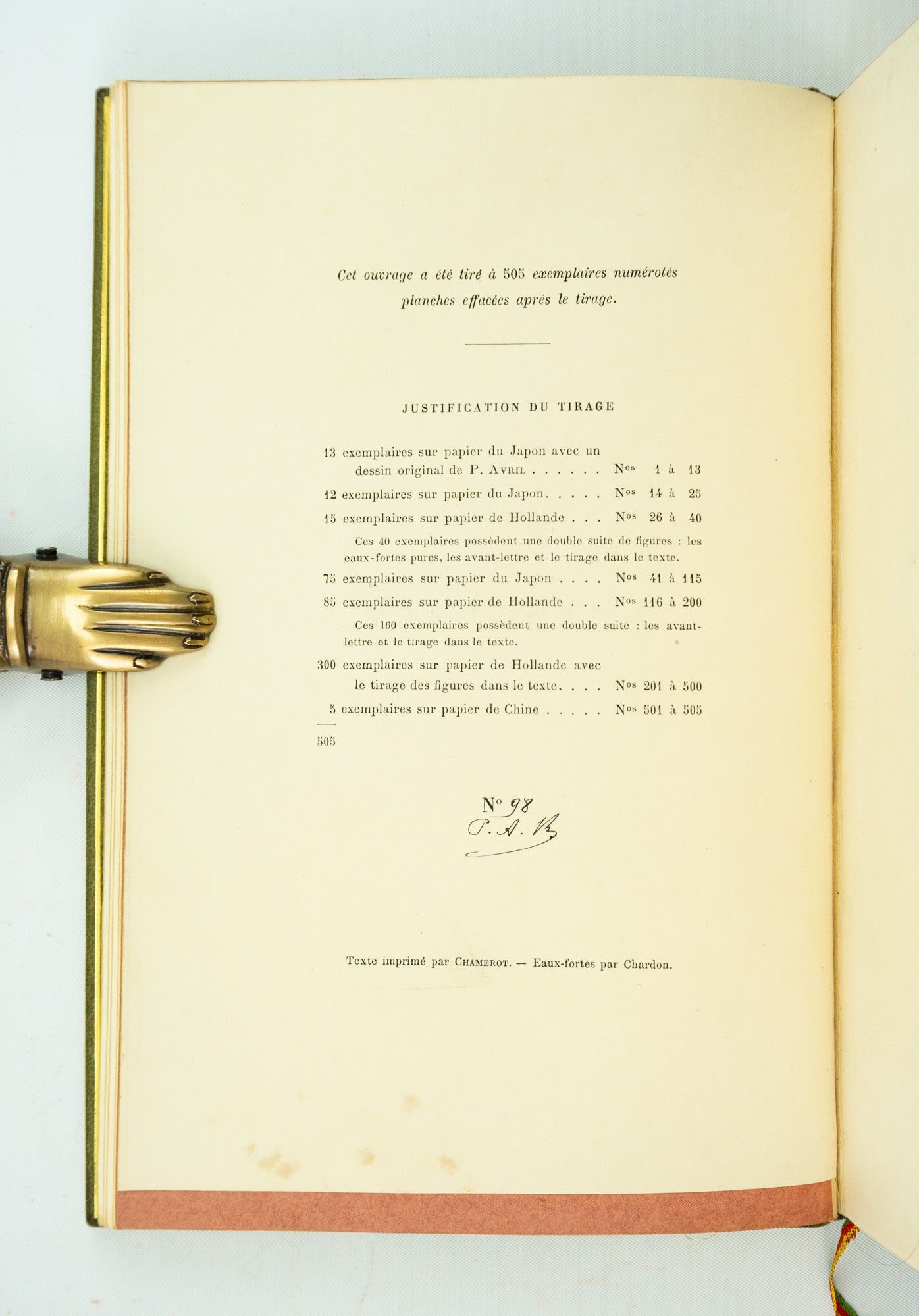
Paris: P. Rouquette, 1889,1890. First work: ONE OF 75 COPIES on Japon, and No. 98 of a total edition of 505. Second work: FIRST EDITION. 240 x 155 mm. (9 1/2 x 6"). 1 p.l. (half title), 38 pp., [1] leaf; XII pp. Two volumes bound in one. .
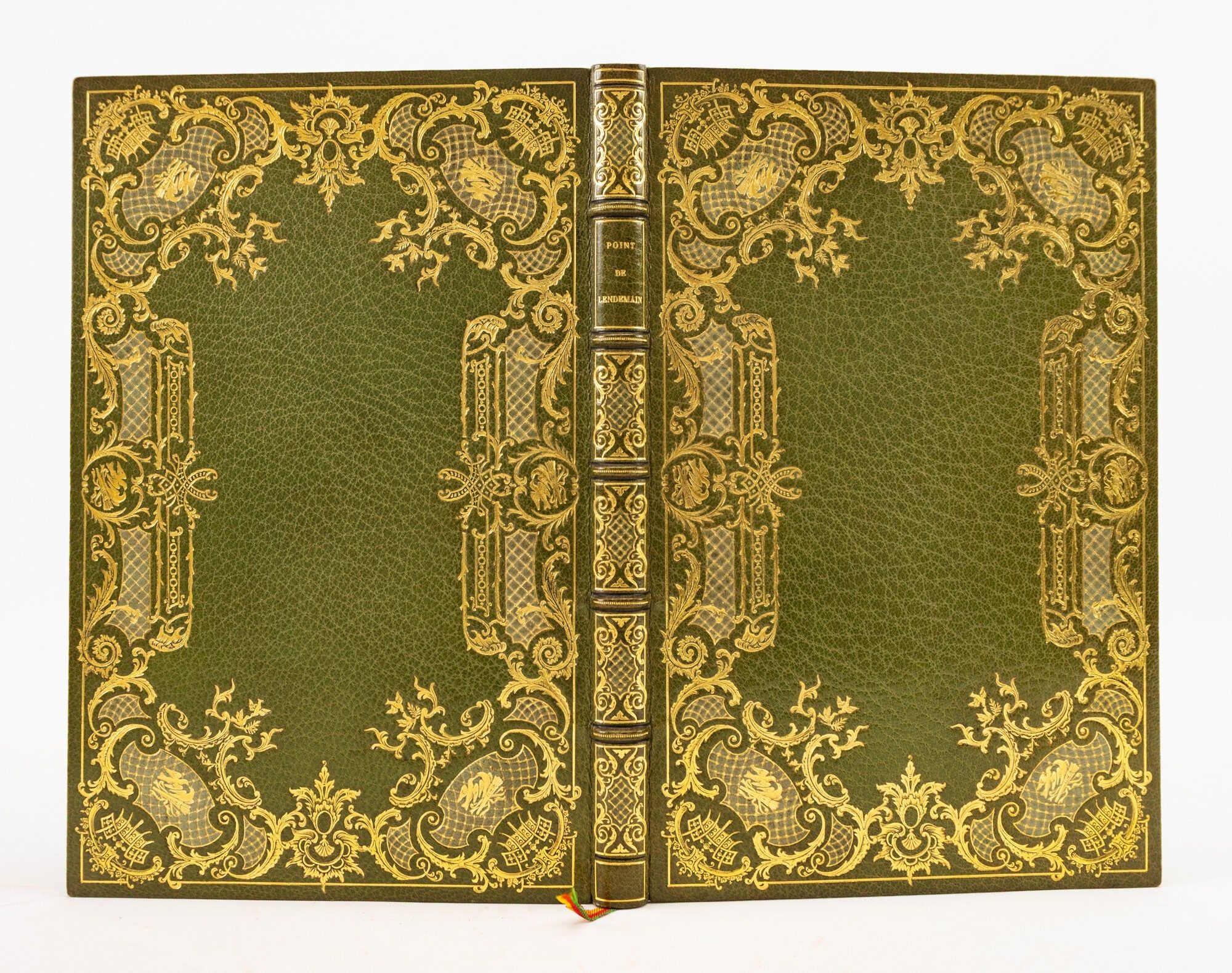
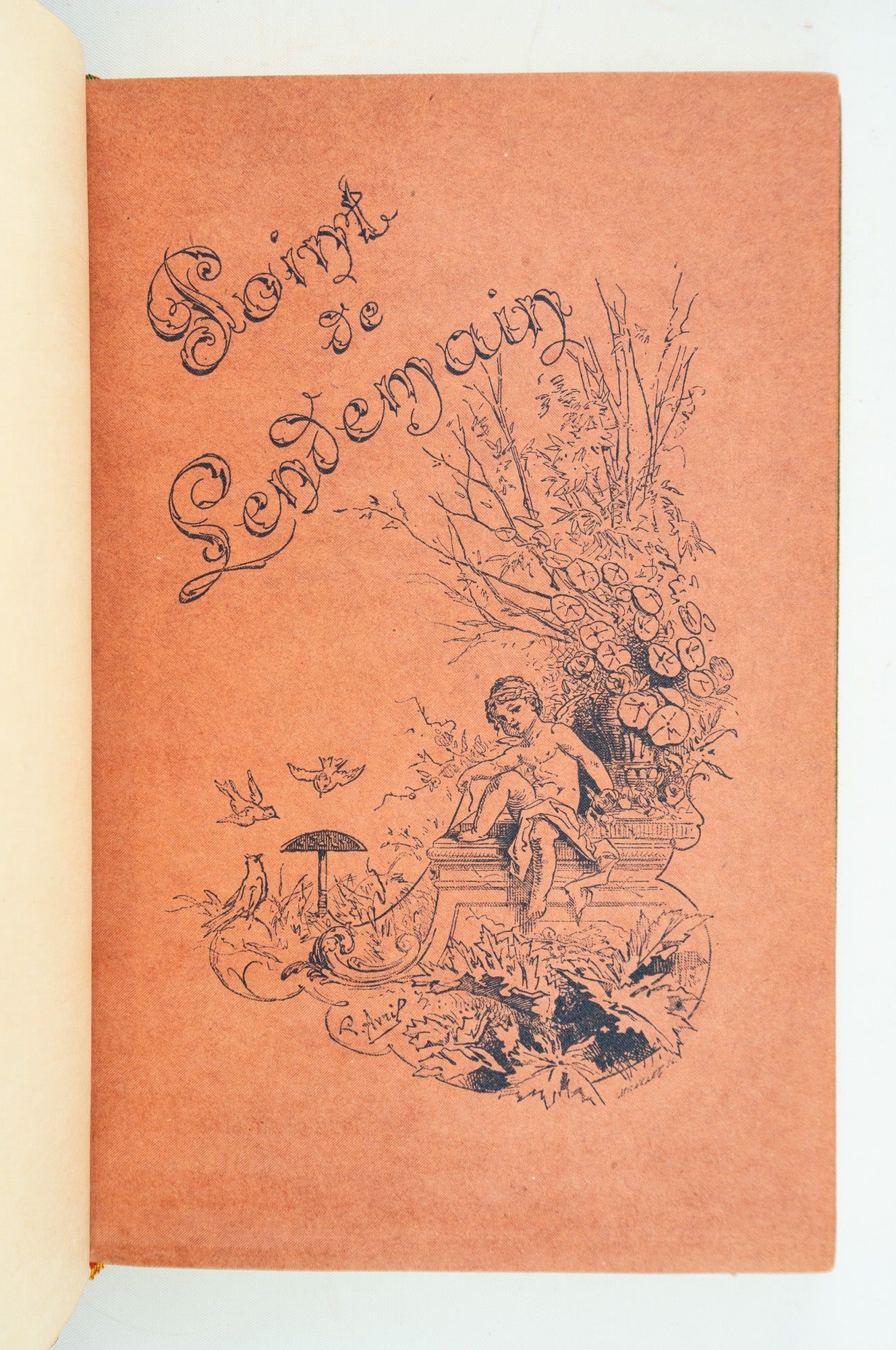
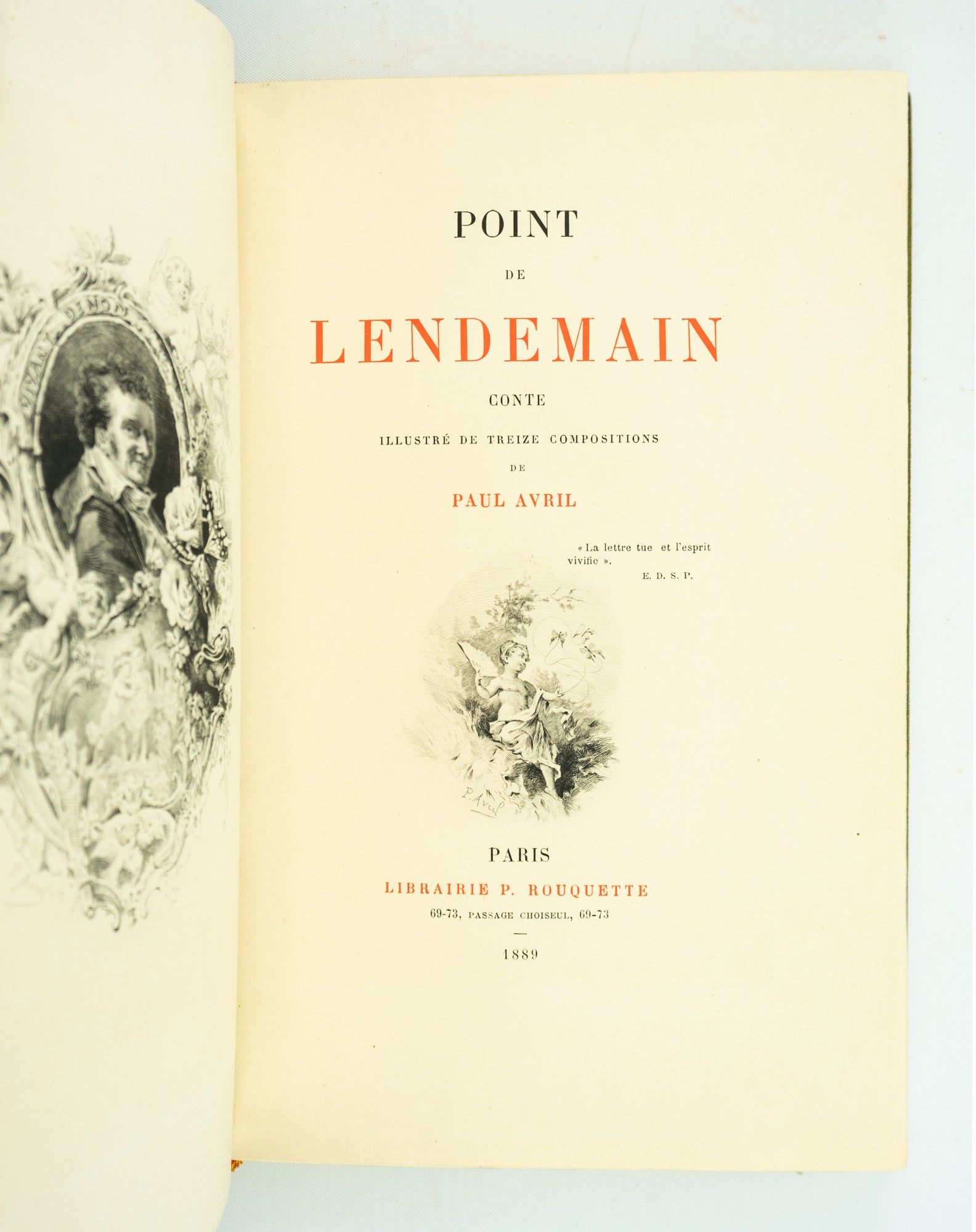
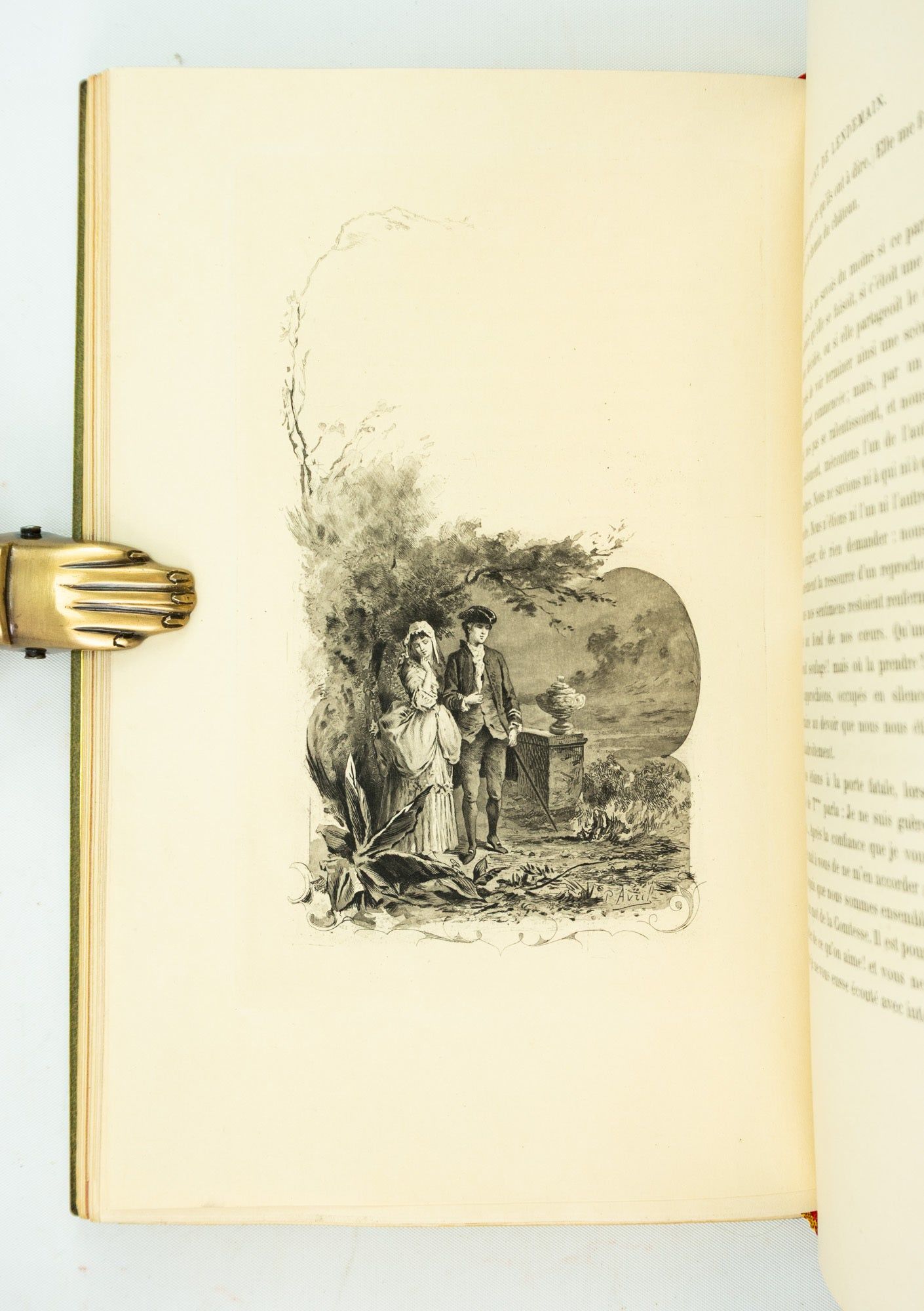
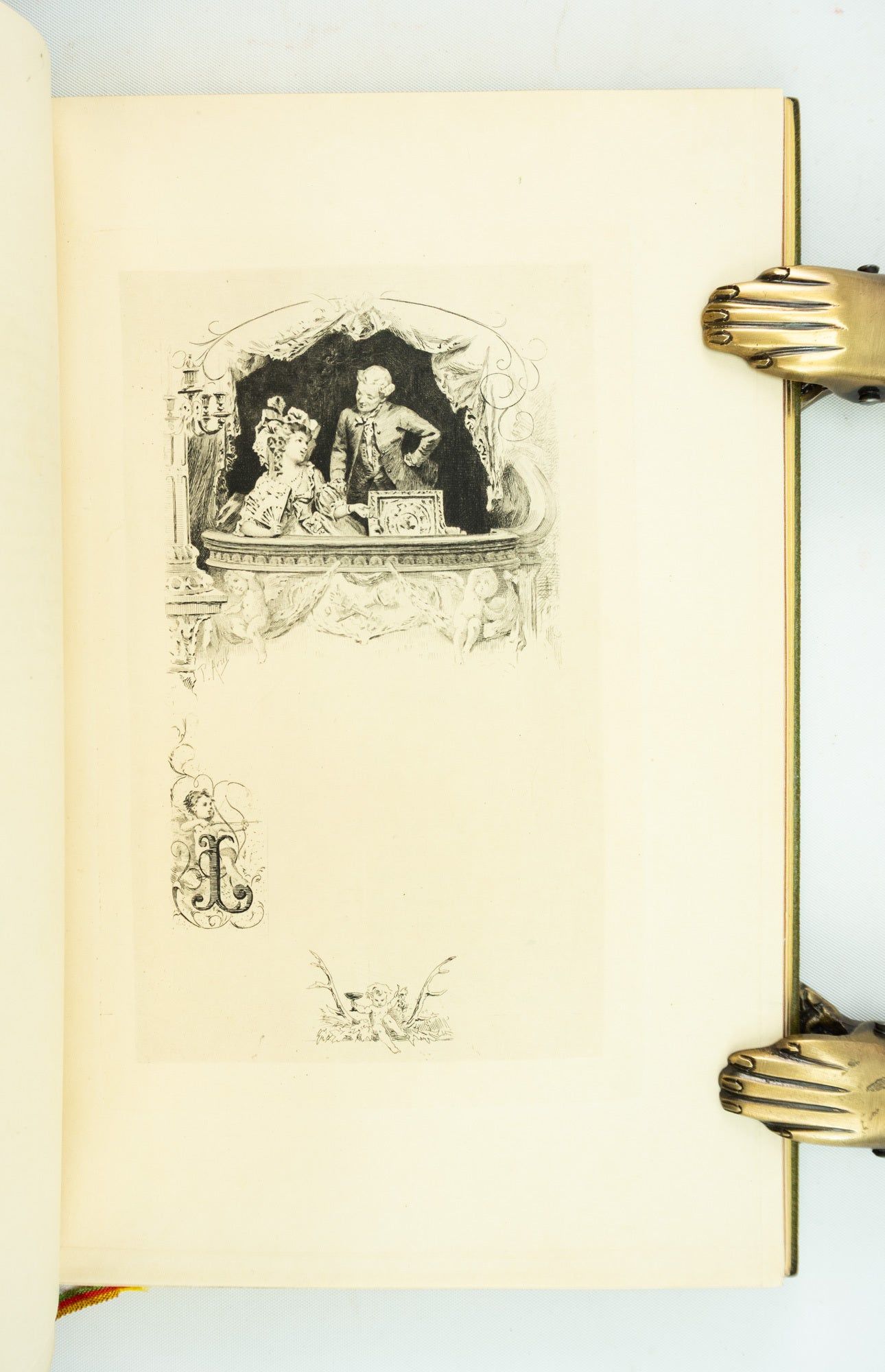
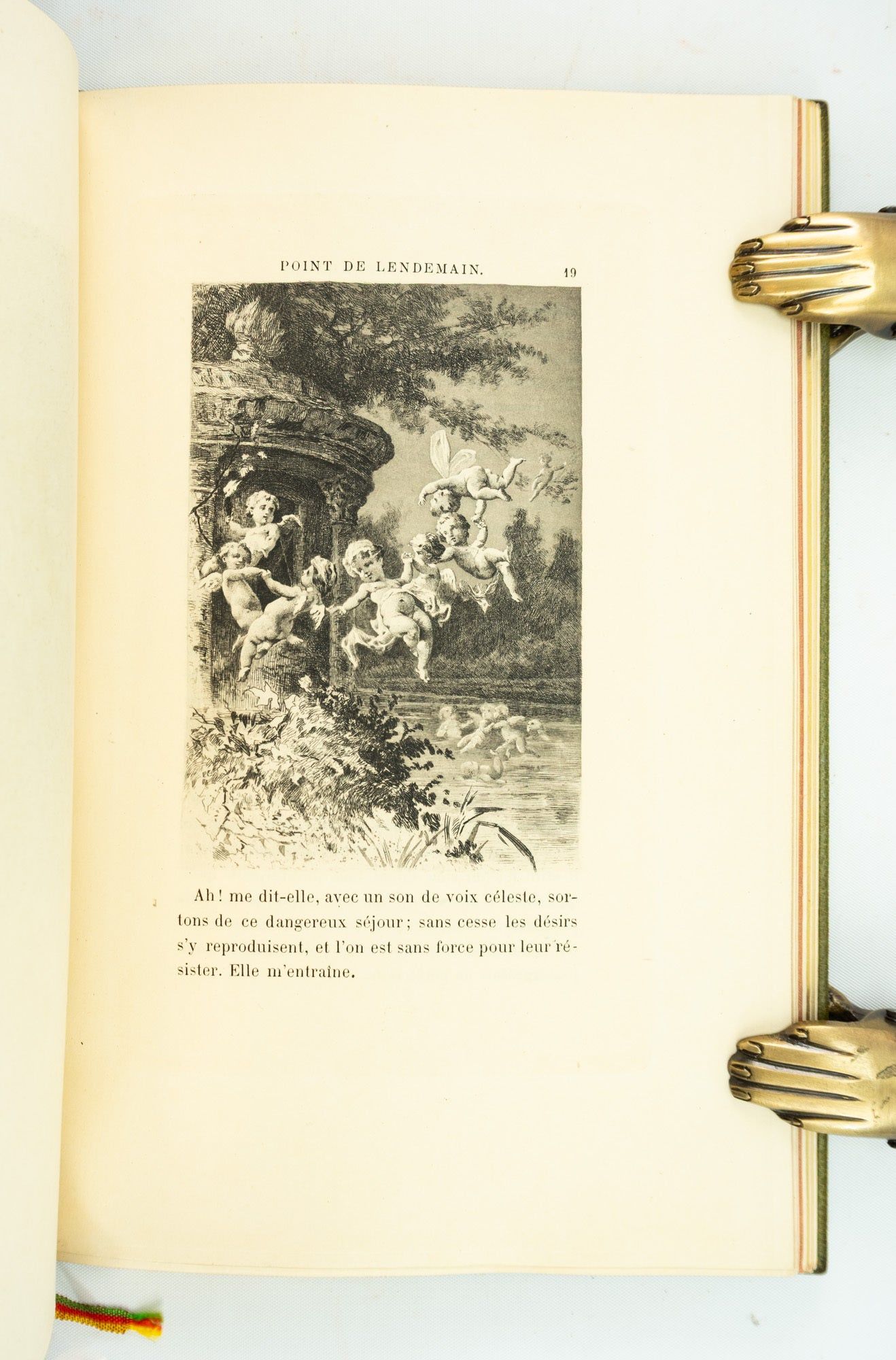
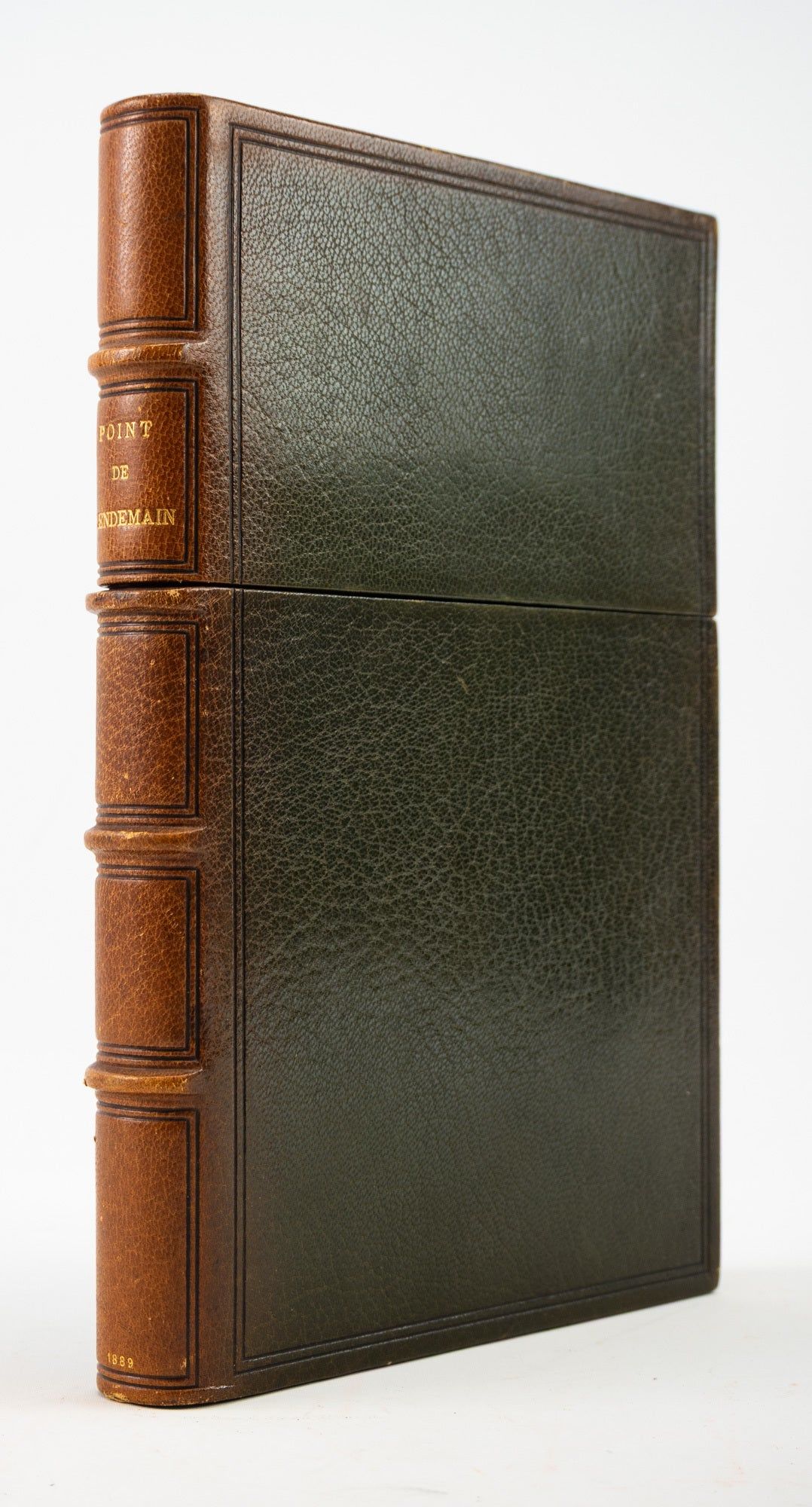
LOVELY CELADON GREEN MOROCCO, GILT AND ONLAID TO A ROCOCO DESIGN, BY CHARLES MEUNIER (stamp-signed in gilt and dated 1908 on front doublure), covers with ornate frame featuring onlaid gray-blue morocco compartments diapered with dotted gilt lines and many gilt volutes, acanthus leaves, turtle doves, and other tools, raised bands, spine compartments with onlaid gray-blue mandorla centerpieces, similarly gilt and framed by volutes, gilt lettering, CELADON GREEN MOROCCO DOUBLURES, lavishly gilt with repeating rows of flower baskets, iridescent green silk endleaves, marbled flyleaves, all edges gilt. Original pink printed wrappers of each work bound in. Housed in a fine (just slightly rubbed) chamois-lined olive green morocco pull-off box resembling a book (thick raised bands, blind ruling, gilt lettering), the spine of the box evenly sunned. With etched frontispiece portrait of the author and 13 illustrations by Paul Avril, most half-page, all in a second state before letters. Faint foxing to half title, otherwise AN IMMACULATE COPY, the binding gleaming and the text untouched.
Handsomely printed and illustrated, this libertine tale of seduction and deception in Louis XV's France was lavishly bound in the Rococo style by the master Flety describes as "the apostle of emblematic bookbinding." Legendary among French binders of the late 19th and early 20th centuries for his energy and imagination, Charles Meunier (1865-1940) was apprenticed to Gustave Bénard at the age of 11, worked for a time in the atelier of Marius Michel, and then set up his own studio when he was 20. According to Duncan & De Bartha, he drew "on both traditional and modern techniques and forms of decoration, [mixing] classical punches . . . with newly fashionable incised and modelled leather panels." He was especially adept at creating bindings that were not merely apt for the contents of the book, but that embodied in their design the themes of the work. His Rococo pattern here is extravagant even for that over-the-top style, the decoration as unrestrained as the amoral aristocrats whose exploits Denon exposes here. First printed anonymously in 1777, "No Tomorrow" is narrated by a callow youth who falls under the spell of Madame de T***, a brilliant manipulator who uses his infatuation with her to draw her husband's attention away from her long-term affair with a marquis. Her plan is so successful that she succeeds in enjoying a dalliance with our narrator, convinces both her husband and her lover that she is faithful to them, and keeps all three men on good terms with each other. At the end of his adventure, our hero searches for a moral to the story, but finds none. Like the anti-heroine of his work, our author, diplomat, courtier, and polymath Dominique Vivant, Baron Denon (1747-1825), had the wit and the talent to thrive during a tumultuous period in France, managing to stay in the good graces, successively, of Louis XV, Louis XVI, Robespierre, and Napoleon. He had met the last of these rulers at the salon of future empress Josephine de Beauharnais, and was invited by Napoleon to join the Egypt expeditionary force as an arts and culture observer. Earning the moniker "Napoleon's Eye," he made sketches of the remarkable monuments--sometimes while under enemy fire--as well as of the ports, the cities, the inhabitants, and the art, particularly ancient hieroglyphics. When the illustrated account of his journey was published, Russell tells us that Denon became "the first to present to Europe a true and honest image of ancient Egypt" after being "the first European traveller to spend months exploring the desert and recording the monuments he found there." He was "the primary force behind revealing Egypt's civilisation to an astonished Europe." The graceful etchings in the present volume are by the celebrated illustrator Paul Avril (1849-1928), who studied art in various Paris salons, including the École des Beaux Arts. According to Ray, Avril "was a witty and ingenious artist," and a prolific one as well, illustrating a number of bibliophile's editions, as well as classics of erotica. His illustrations here bring to mind work of the Rococo artists Watteau, Boucher, and Fragonard. Our edition benefits from the addition of a second work, containing notes on the life of the author by prominent man of letters Anatole France (1844-1924), who would win the 1921 Nobel Prize for literature "in recognition of his brilliant literary achievements, characterized as they are by a nobility of style, a profound human sympathy, grace, and a true Gallic temperament." The beauty of our item was clearly treasured and protected by previous owners, as it is virtually unchanged from the day it left Meunier's workshop..
LOVELY CELADON GREEN MOROCCO, GILT AND ONLAID TO A ROCOCO DESIGN, BY CHARLES MEUNIER (stamp-signed in gilt and dated 1908 on front doublure), covers with ornate frame featuring onlaid gray-blue morocco compartments diapered with dotted gilt lines and many gilt volutes, acanthus leaves, turtle doves, and other tools, raised bands, spine compartments with onlaid gray-blue mandorla centerpieces, similarly gilt and framed by volutes, gilt lettering, CELADON GREEN MOROCCO DOUBLURES, lavishly gilt with repeating rows of flower baskets, iridescent green silk endleaves, marbled flyleaves, all edges gilt. Original pink printed wrappers of each work bound in. Housed in a fine (just slightly rubbed) chamois-lined olive green morocco pull-off box resembling a book (thick raised bands, blind ruling, gilt lettering), the spine of the box evenly sunned. With etched frontispiece portrait of the author and 13 illustrations by Paul Avril, most half-page, all in a second state before letters. Faint foxing to half title, otherwise AN IMMACULATE COPY, the binding gleaming and the text untouched.
Handsomely printed and illustrated, this libertine tale of seduction and deception in Louis XV's France was lavishly bound in the Rococo style by the master Flety describes as "the apostle of emblematic bookbinding." Legendary among French binders of the late 19th and early 20th centuries for his energy and imagination, Charles Meunier (1865-1940) was apprenticed to Gustave Bénard at the age of 11, worked for a time in the atelier of Marius Michel, and then set up his own studio when he was 20. According to Duncan & De Bartha, he drew "on both traditional and modern techniques and forms of decoration, [mixing] classical punches . . . with newly fashionable incised and modelled leather panels." He was especially adept at creating bindings that were not merely apt for the contents of the book, but that embodied in their design the themes of the work. His Rococo pattern here is extravagant even for that over-the-top style, the decoration as unrestrained as the amoral aristocrats whose exploits Denon exposes here. First printed anonymously in 1777, "No Tomorrow" is narrated by a callow youth who falls under the spell of Madame de T***, a brilliant manipulator who uses his infatuation with her to draw her husband's attention away from her long-term affair with a marquis. Her plan is so successful that she succeeds in enjoying a dalliance with our narrator, convinces both her husband and her lover that she is faithful to them, and keeps all three men on good terms with each other. At the end of his adventure, our hero searches for a moral to the story, but finds none. Like the anti-heroine of his work, our author, diplomat, courtier, and polymath Dominique Vivant, Baron Denon (1747-1825), had the wit and the talent to thrive during a tumultuous period in France, managing to stay in the good graces, successively, of Louis XV, Louis XVI, Robespierre, and Napoleon. He had met the last of these rulers at the salon of future empress Josephine de Beauharnais, and was invited by Napoleon to join the Egypt expeditionary force as an arts and culture observer. Earning the moniker "Napoleon's Eye," he made sketches of the remarkable monuments--sometimes while under enemy fire--as well as of the ports, the cities, the inhabitants, and the art, particularly ancient hieroglyphics. When the illustrated account of his journey was published, Russell tells us that Denon became "the first to present to Europe a true and honest image of ancient Egypt" after being "the first European traveller to spend months exploring the desert and recording the monuments he found there." He was "the primary force behind revealing Egypt's civilisation to an astonished Europe." The graceful etchings in the present volume are by the celebrated illustrator Paul Avril (1849-1928), who studied art in various Paris salons, including the École des Beaux Arts. According to Ray, Avril "was a witty and ingenious artist," and a prolific one as well, illustrating a number of bibliophile's editions, as well as classics of erotica. His illustrations here bring to mind work of the Rococo artists Watteau, Boucher, and Fragonard. Our edition benefits from the addition of a second work, containing notes on the life of the author by prominent man of letters Anatole France (1844-1924), who would win the 1921 Nobel Prize for literature "in recognition of his brilliant literary achievements, characterized as they are by a nobility of style, a profound human sympathy, grace, and a true Gallic temperament." The beauty of our item was clearly treasured and protected by previous owners, as it is virtually unchanged from the day it left Meunier's workshop..
Details
Title
POINT DE LENDEMAIN. [bound with] FRANCE, ANATOLE. NOTICE HISTORIQUE SUR VIVANT DENON
Author
(BINDINGS - MEUNIER). DENON, DOMINQUE VIVANT, BARON
Condition
Unknown
Publisher
P. Rouquette: Paris
Date
1889,1890
Edition
First work: ONE OF 75 COPIES on Japon, and No. 98 of a total edi