

In-flight autograph record of the bombing of Hiroshima, written by the co-pilot of the 'Enola Gay'
- SIGNED
- 1945
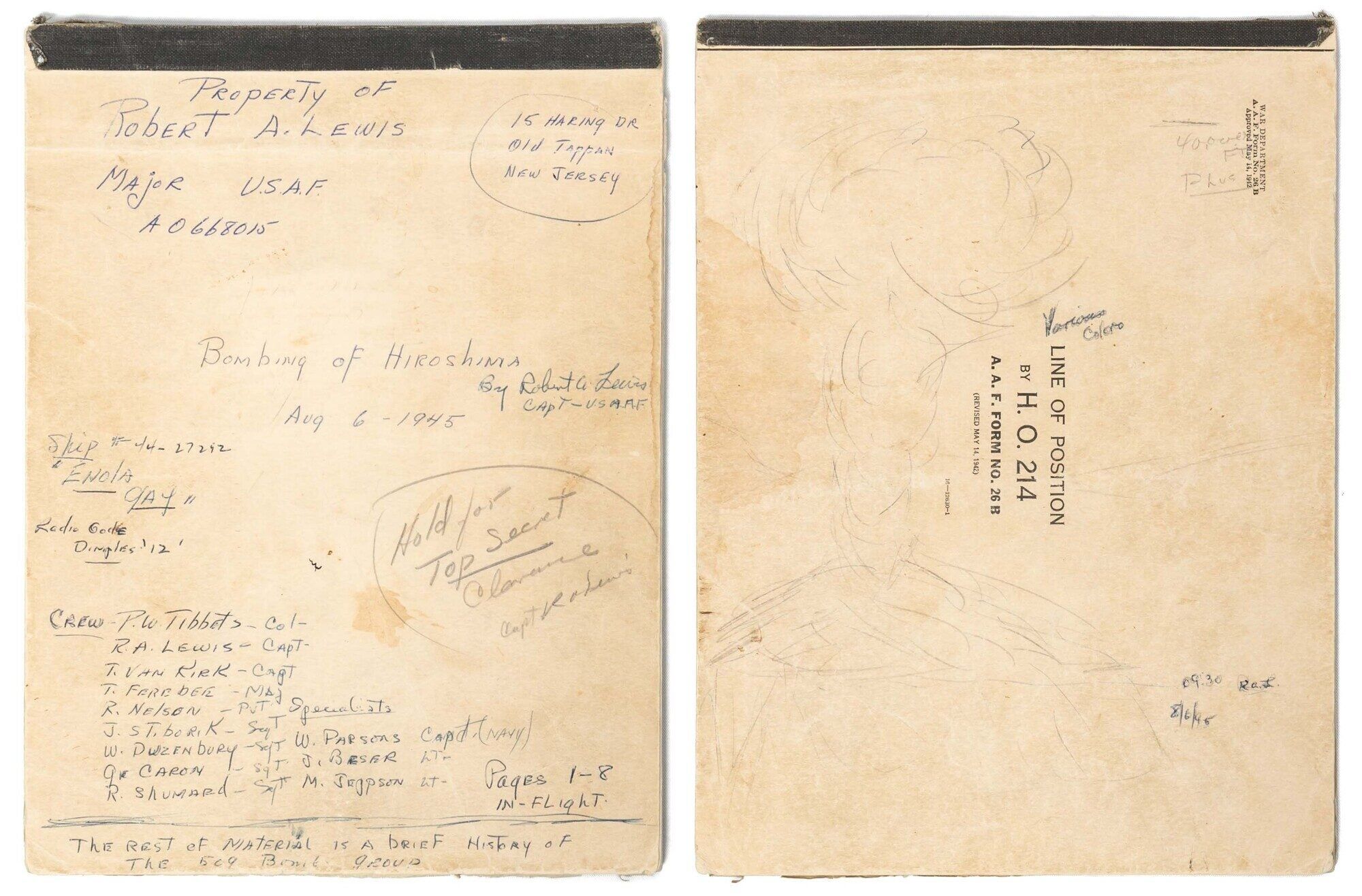
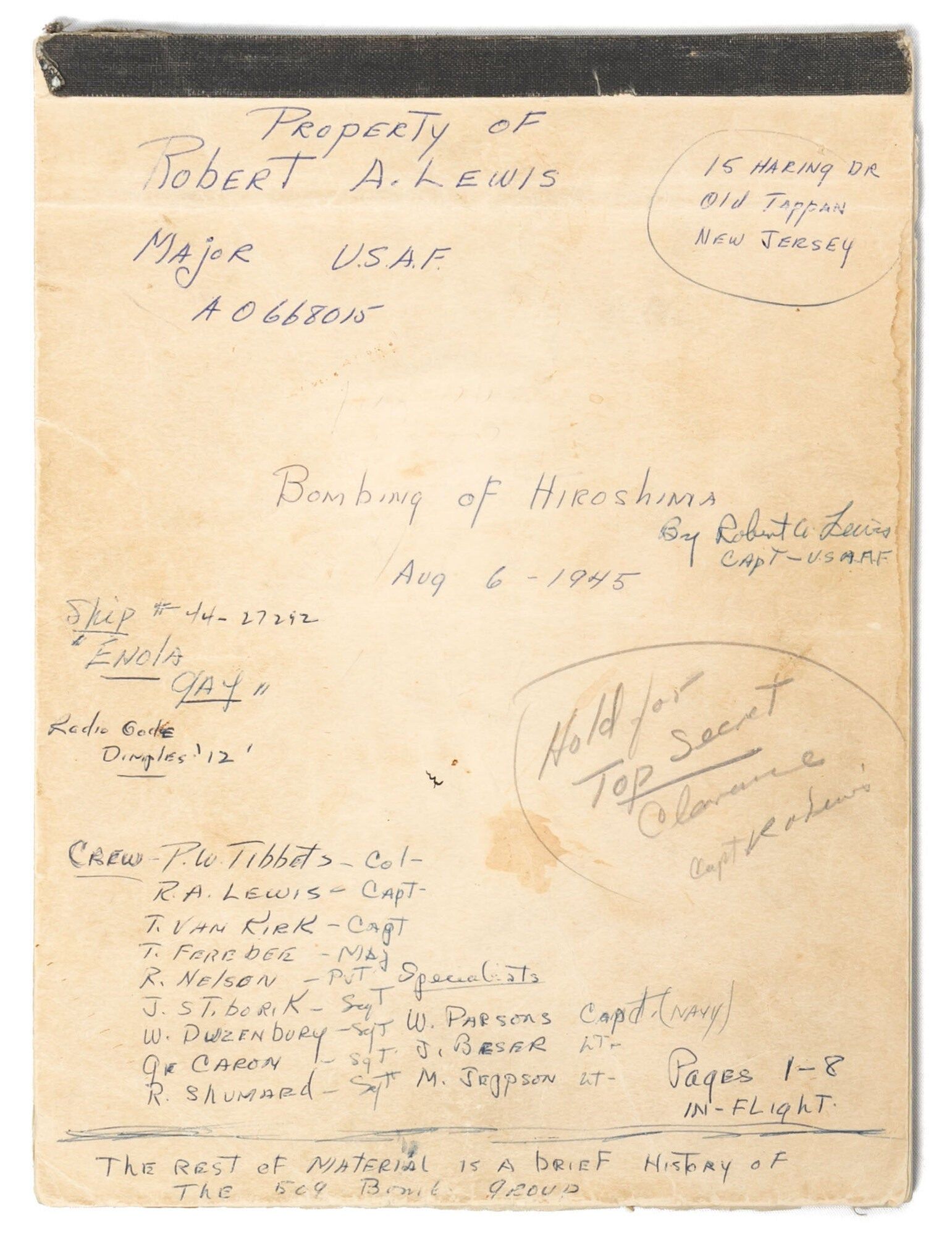
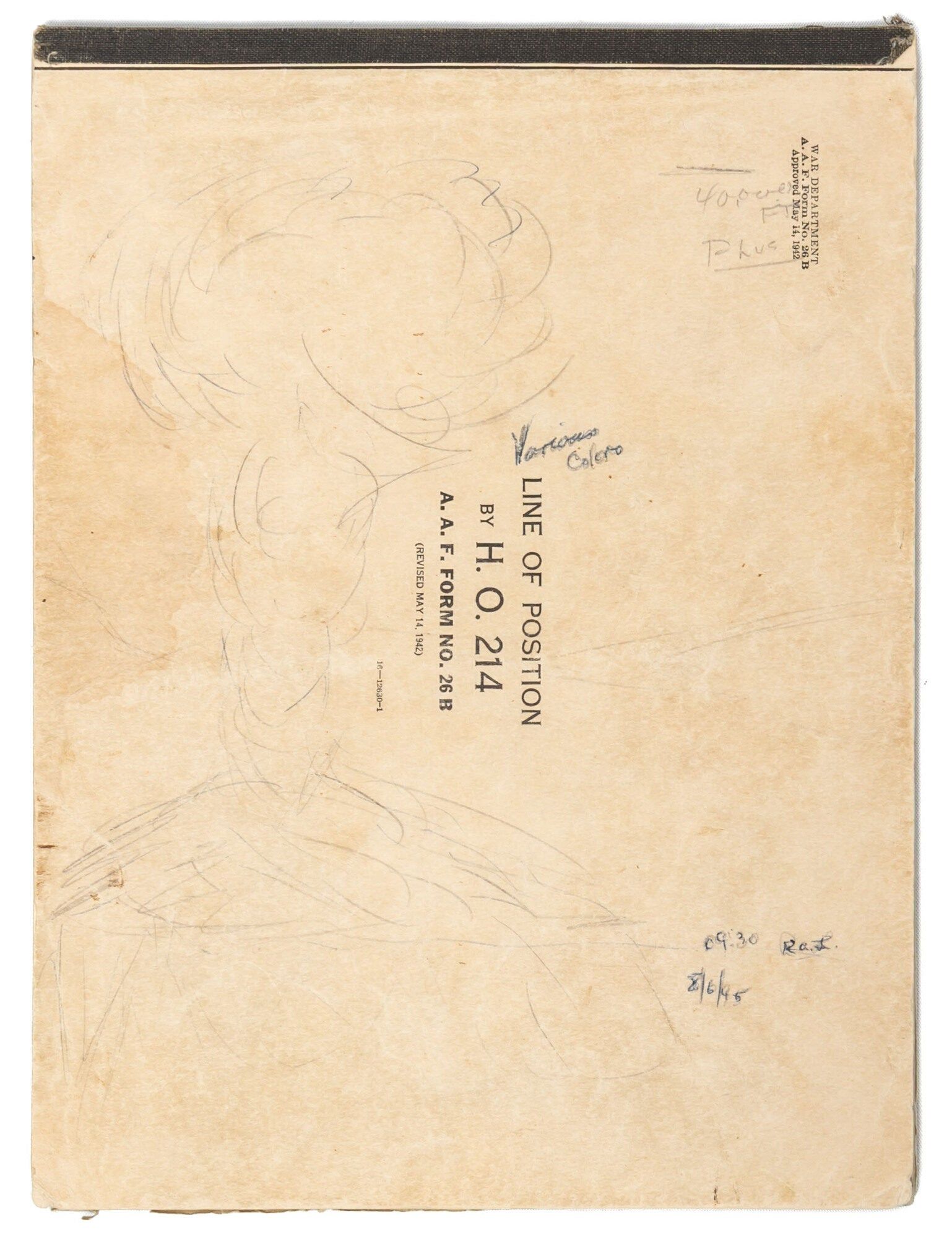
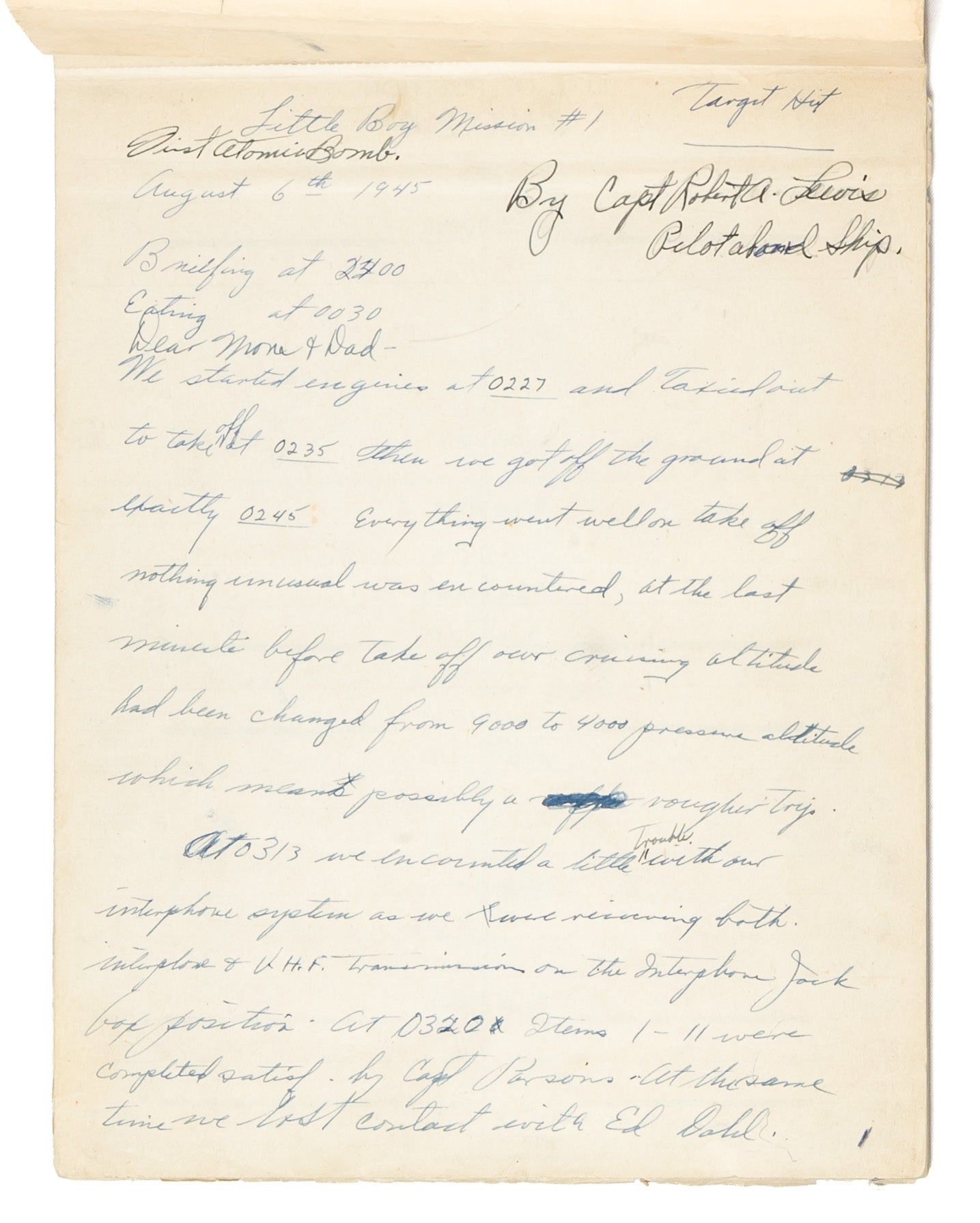
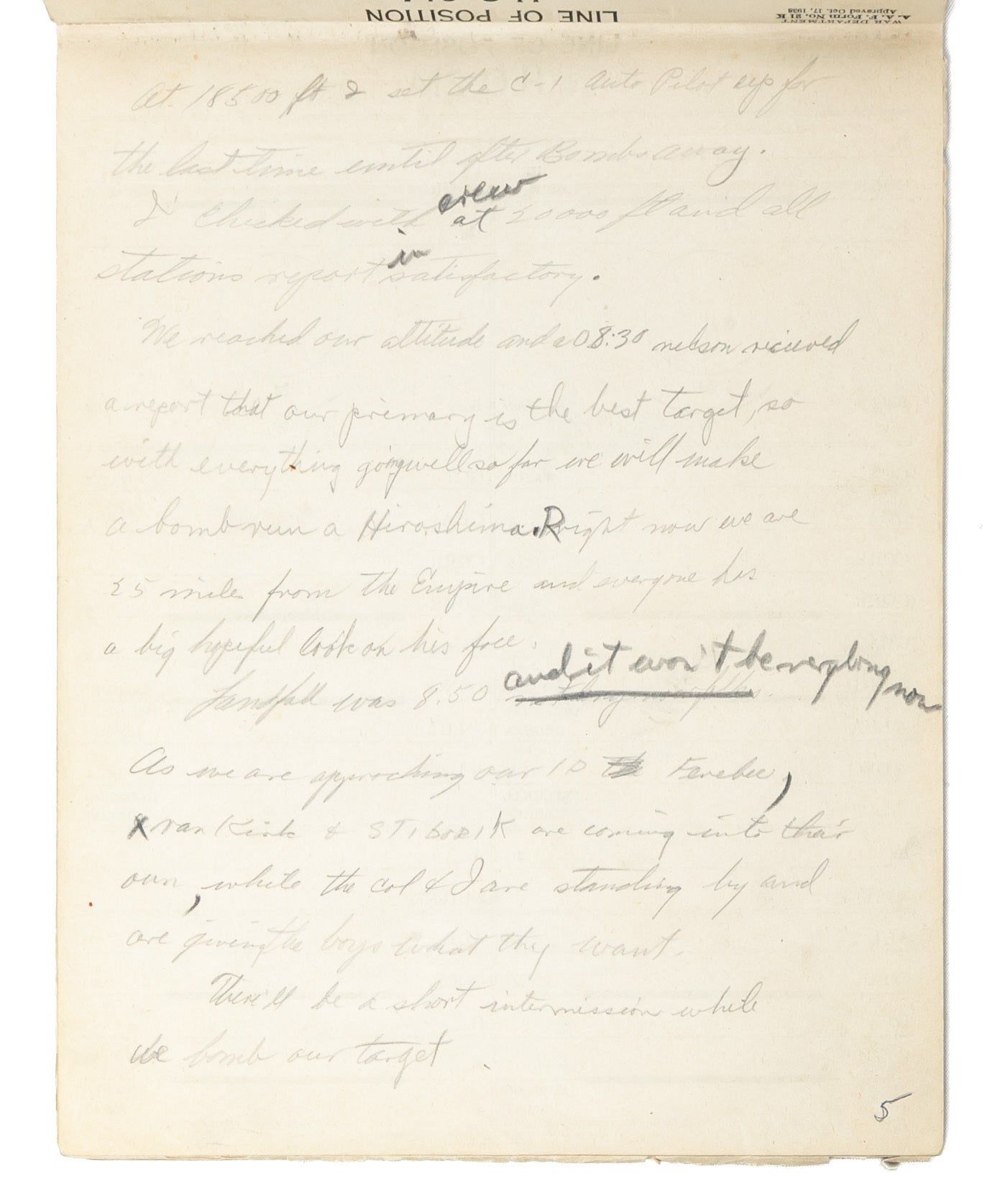
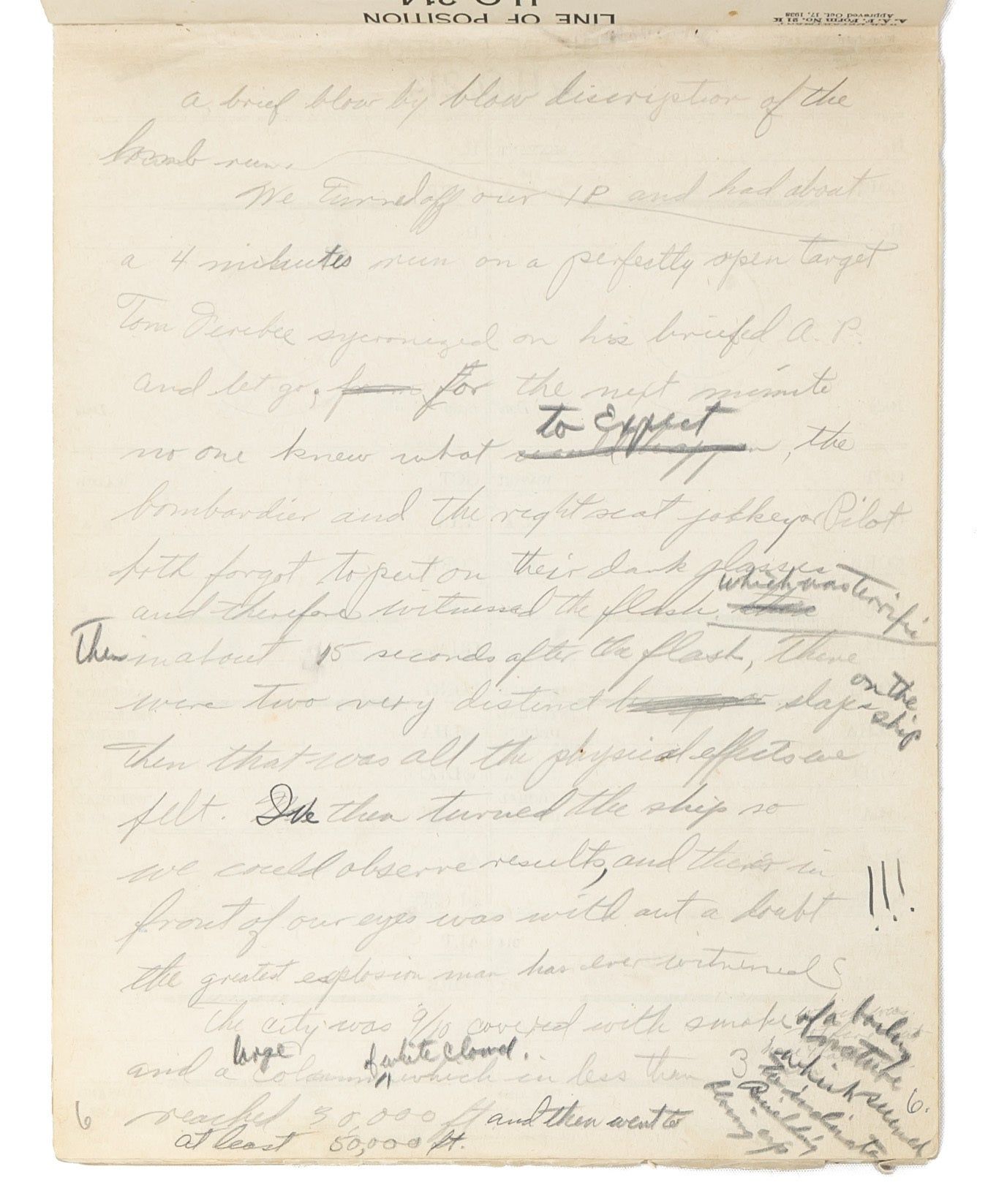
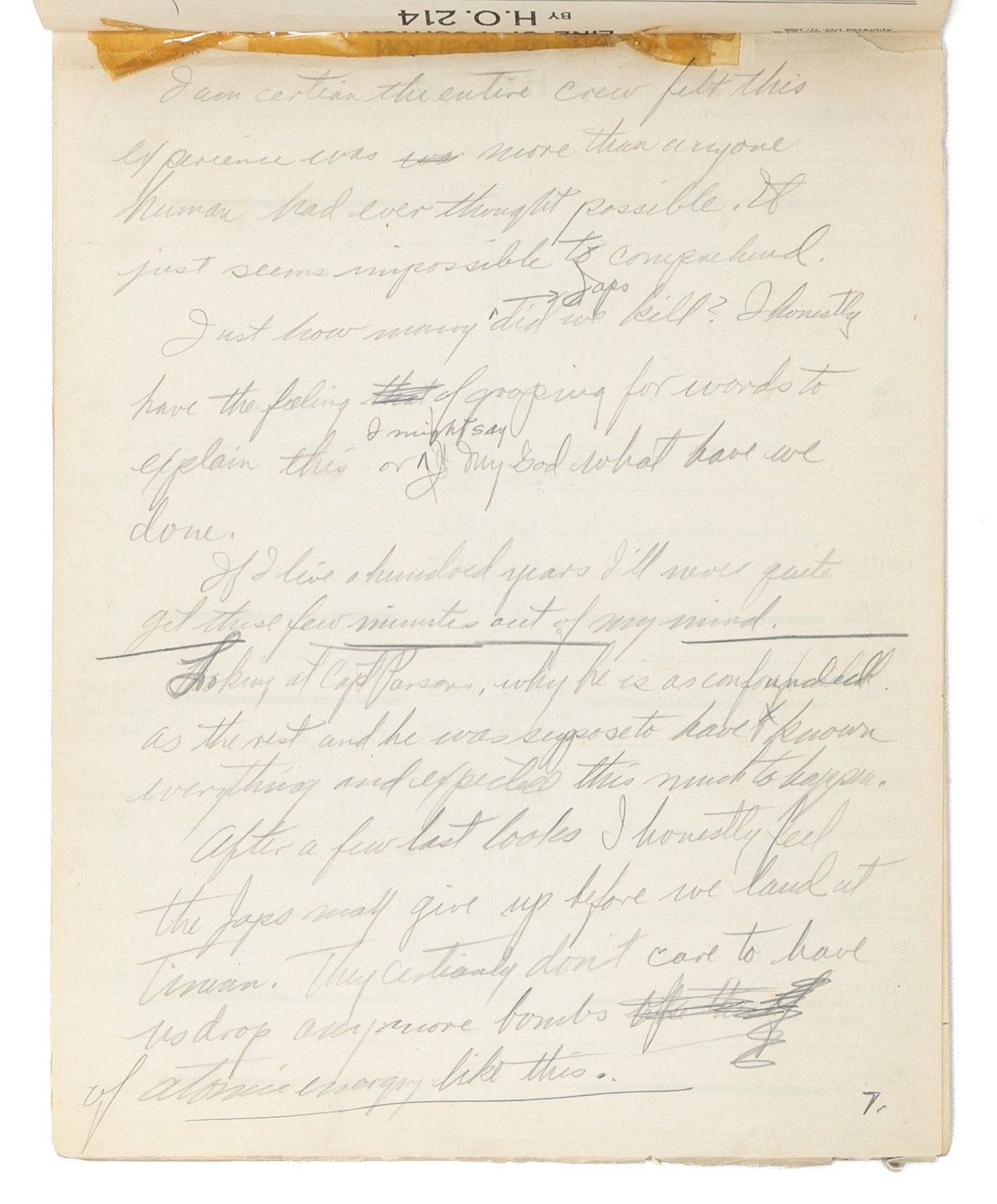
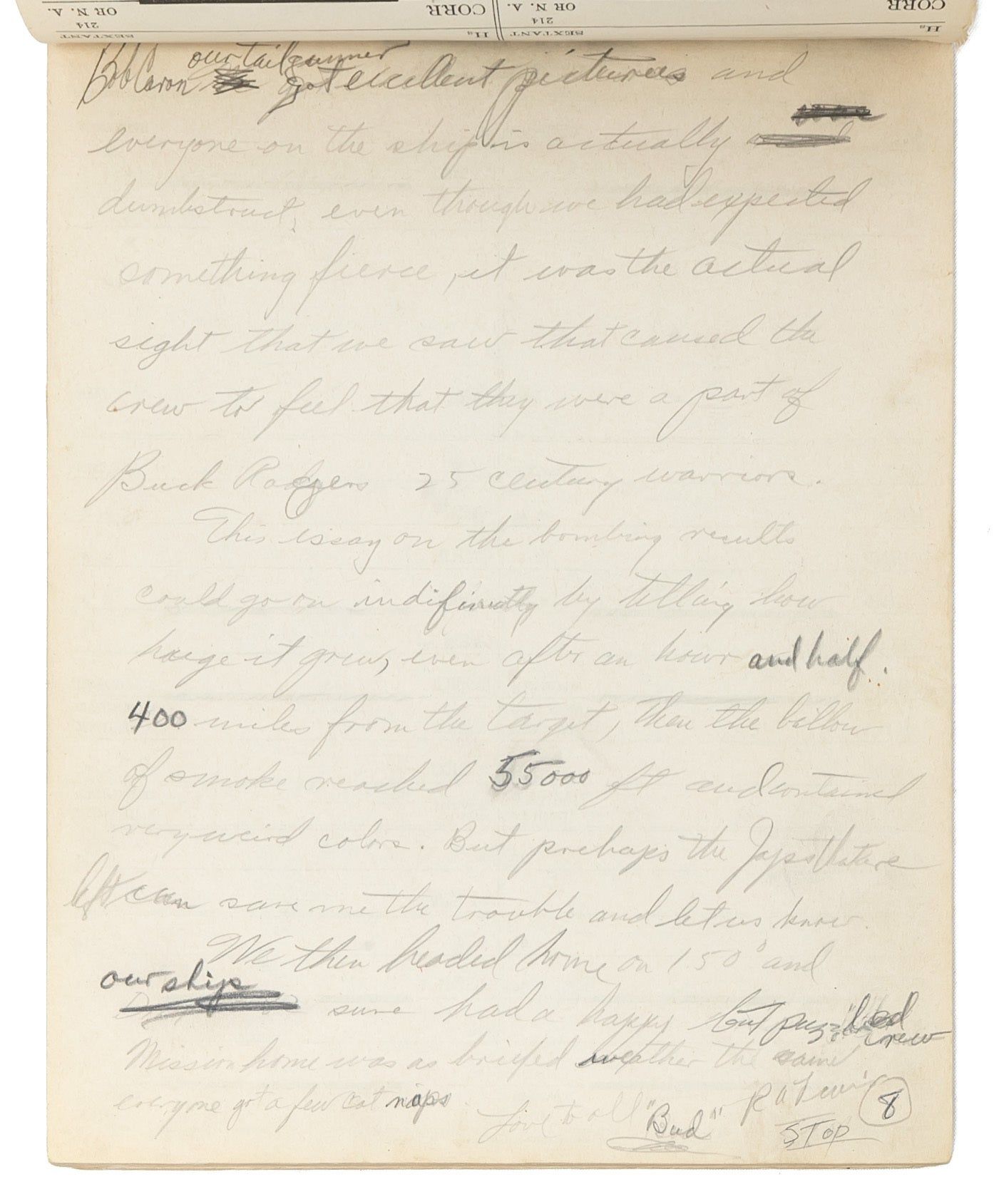
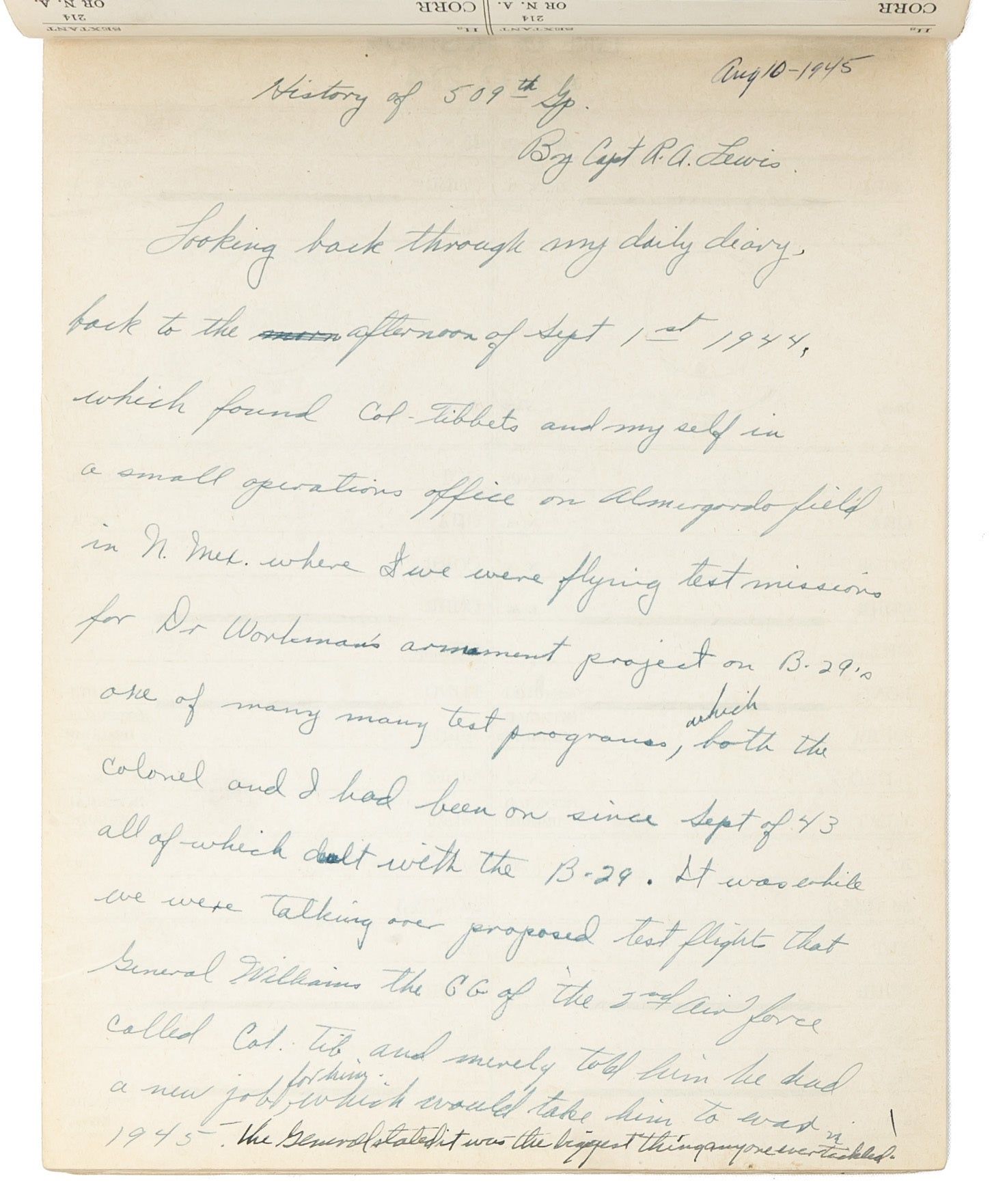
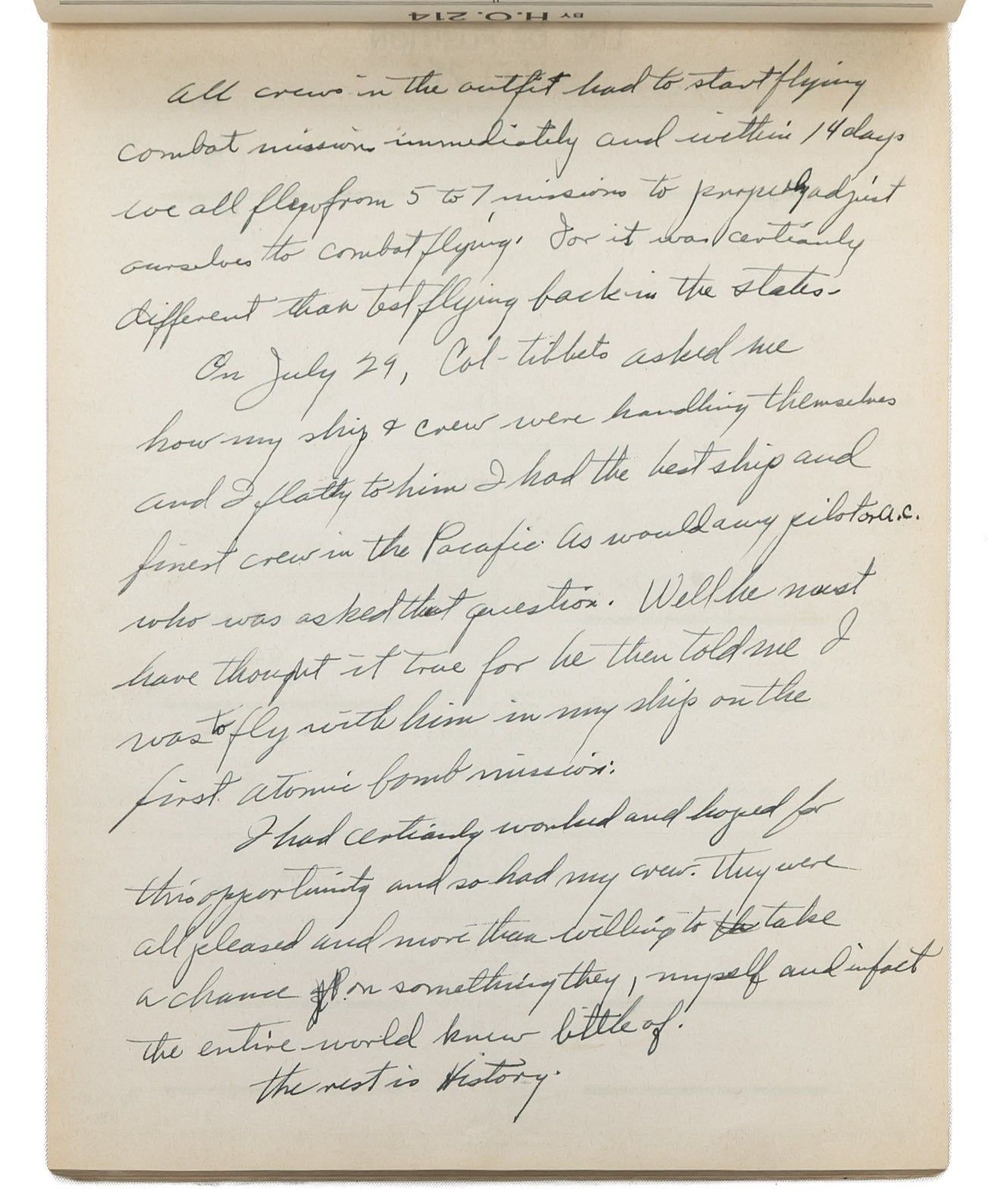
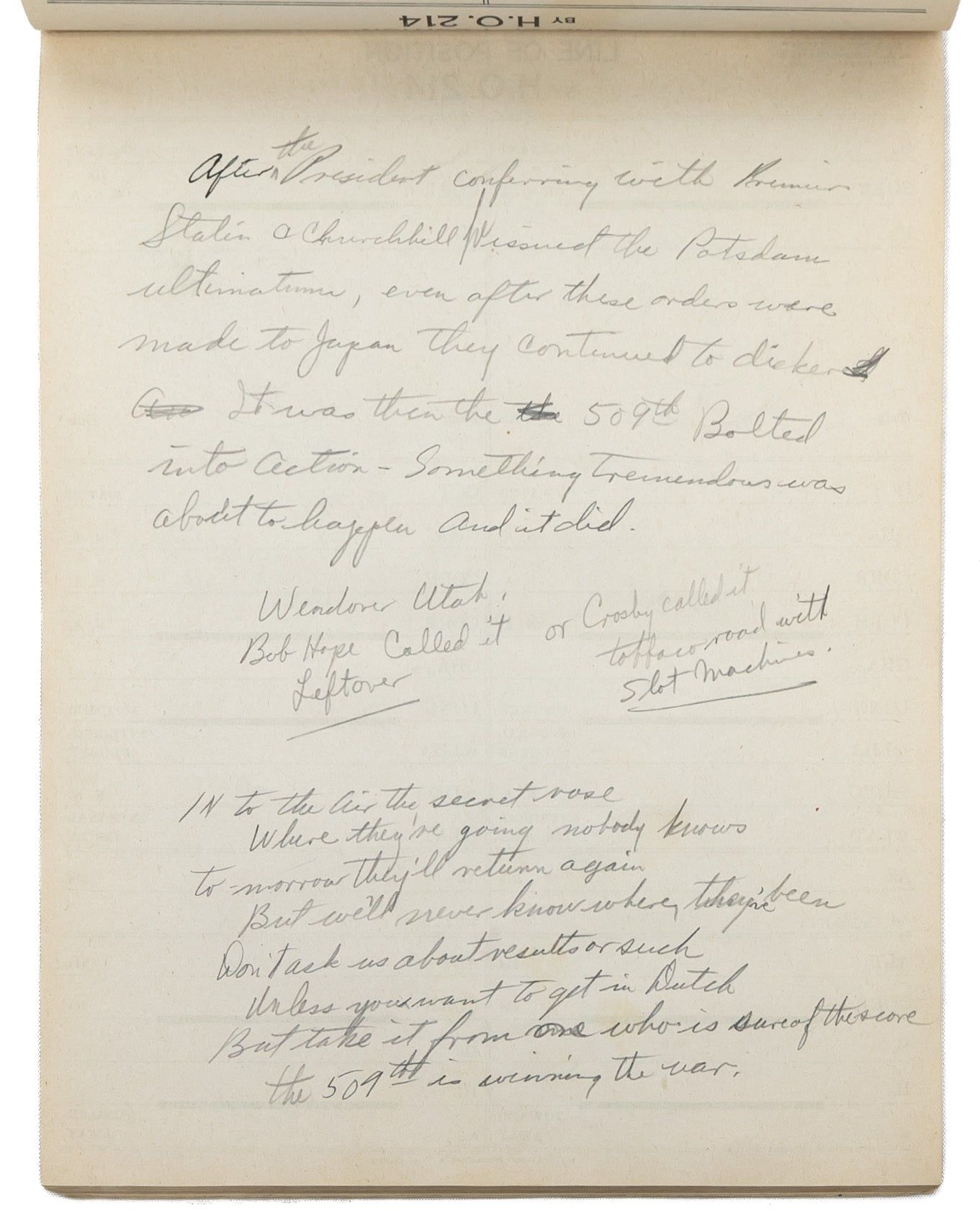
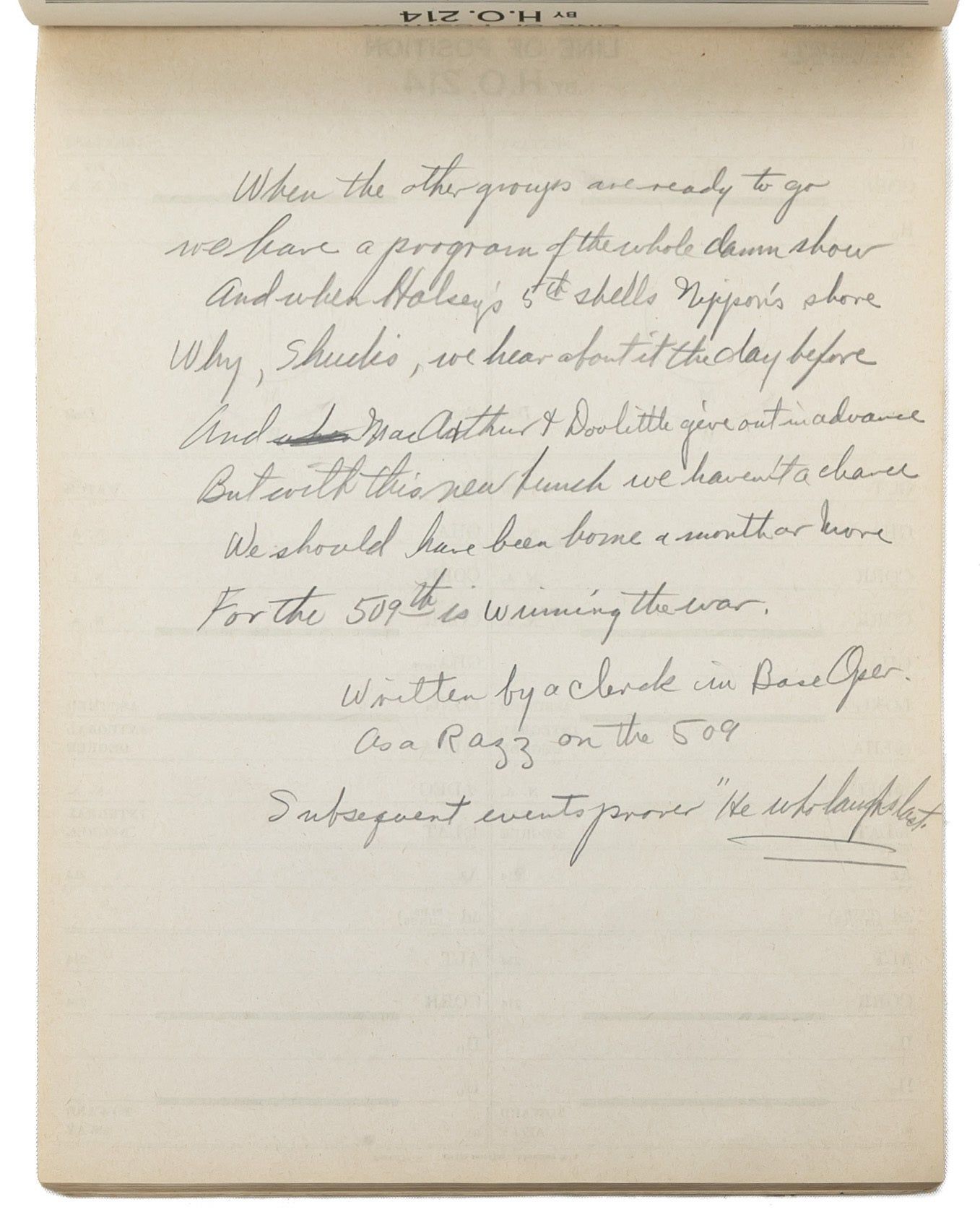
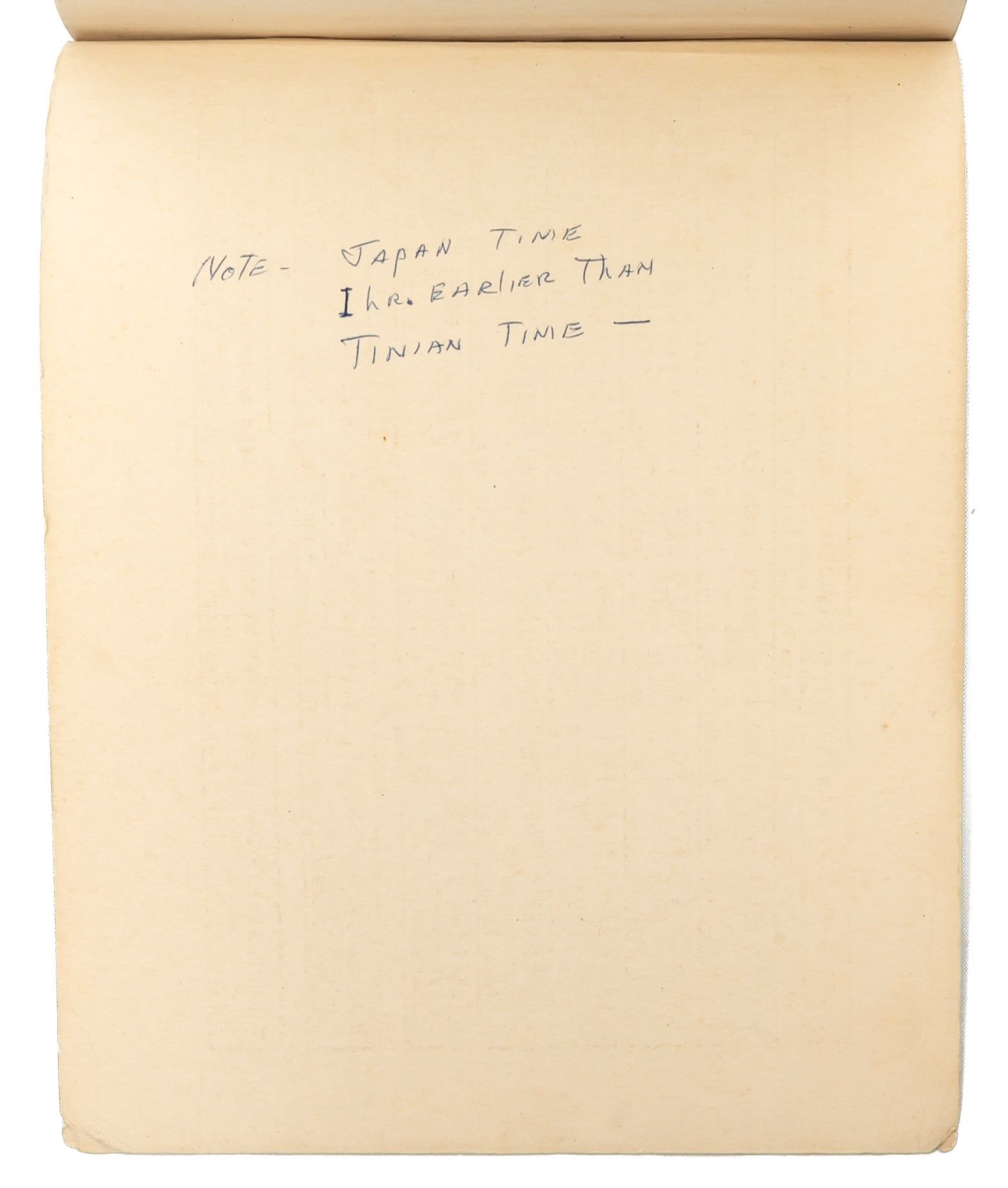
1945. United States War Department-issued "Line of Position" notebook (203 x 270 mm). 27 pp. of autograph text in ink and pencil, including covers. The account of Captain Robert A. Lewis (1917 - 1983) occupies the first 8 pp., followed by his 14-pp. history of the 509th Composite Group written by him, 1 p. additional notes, and a 2-pp. song about the 509th. Lewis also filled out both covers of the record book with notes: on the front cover, the title "Bombing of Hiroshima," a list of the crew aboard the Enola Gay, and several other notes; and on the back cover, a sketch of the Hiroshima mushroom cloud as observed by Lewis from the plane (dated and initialed "09:30 8/6/45 R.A.L."). The pages were later numbered, and the pencil emendations, visible across all eight pages, were made by New York Times editor William L. Laurence (1888 - 1977).
Drab paper boards top bound in black cloth. Some light soiling to boards and a bit of wear to cloth binding. One leaf (p. 7 of the account) was torn from later in the notebook and taped in by Lewis at its current position (see below for a timeline of Lewis' account). In Very Good condition overall.
This in-flight record documents the bombing of Hiroshima from the perspective of Captain Robert A. Lewis, co-pilot of the Enola Gay, on the journey to drop the "Little Boy" bomb. Over the course of the twelve-hour flight from Tinian, Northern Mariana Islands to Hiroshima and back again, Lewis recorded both what he saw - including a sketch of the mushroom cloud over the city - and what he felt - apprehension, confusion, shock, awe - as he and his crew entered history. Though Lewis' record is one of two firsthand accounts of the Hiroshima bombing written aboard the Enola Gay, it is the only account that documents the personal observations and emotional response of one of the crewmembers. The other documentation of the flight, the navigator's log of Theodore "Dutch" Van Kirk, is a purely technical account, recording data like timing and flight position but not including the historically valuable and emotionally impactful commentary present here. Lewis' record, then, provides an unequalled firsthand account of the flight of the Enola Gay.
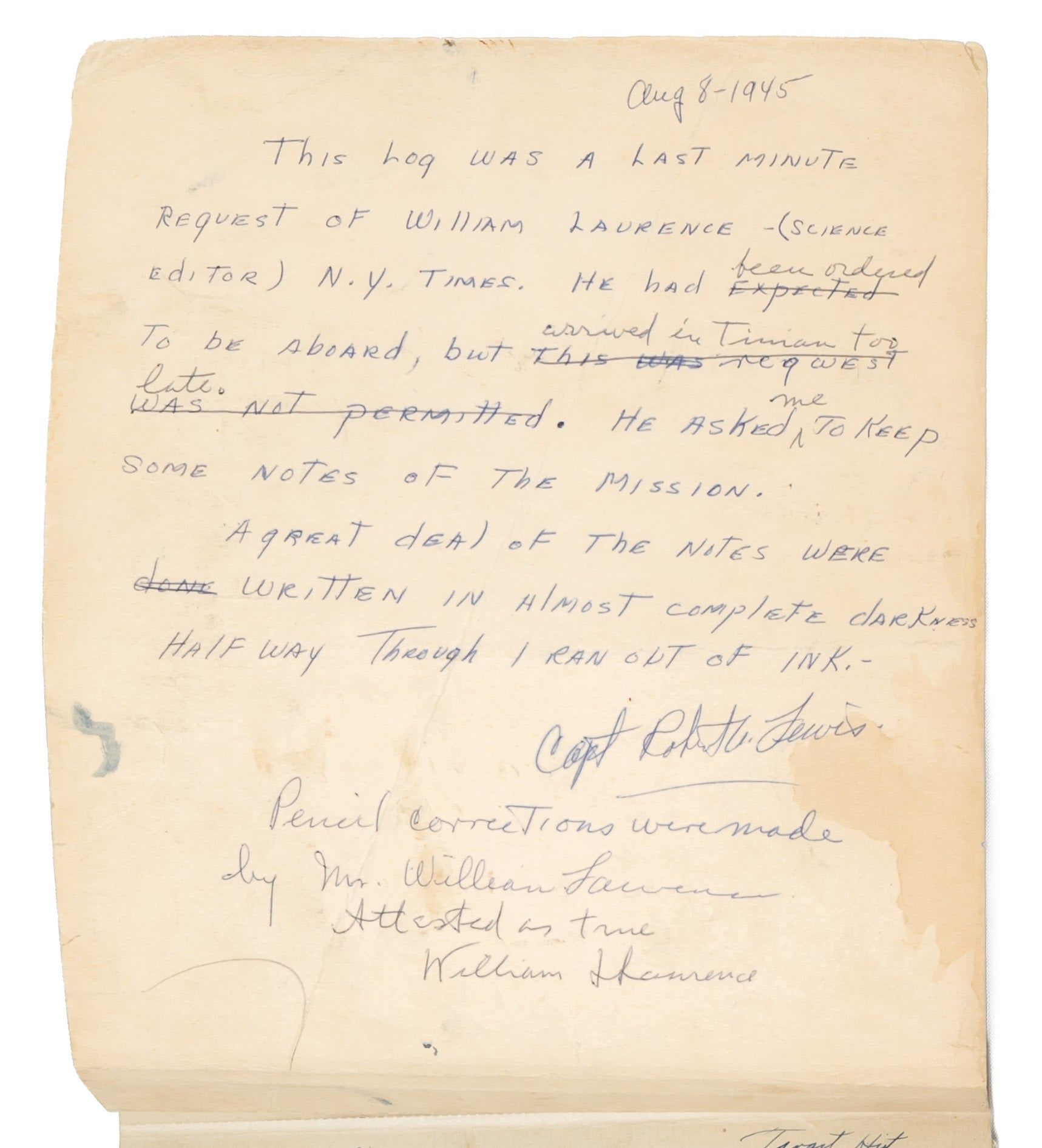
Lewis wrote this account at the request of New York Times science editor William "Atomic Bill" Laurence, who had been given permission to document the mission aboard the Enola Gay. At the last minute, however, Laurence was barred from the flight (he was ultimately allowed aboard the plane that bombed Nagasaki). Laurence asked Lewis to record the Enola Gay mission in his stead, and Lewis took this notebook aboard to document his experiences: "A great deal of the notes were written in almost complete darkness. Half way through I ran out of ink," Lewis wrote.
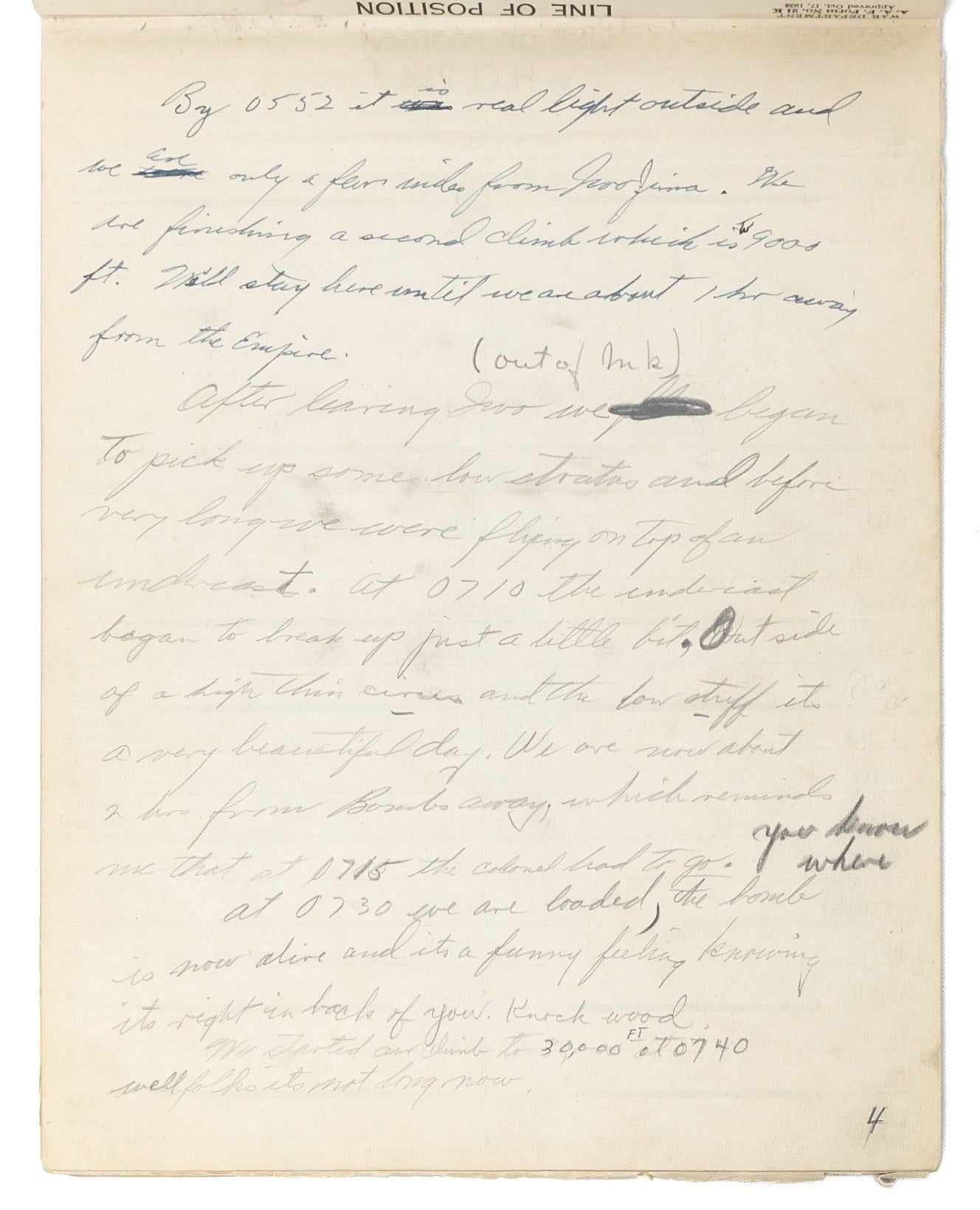
On August 6, 1945, the Enola Gay left Tinian at 2:25am. The plane passed over Iwo Jima within three hours, and, by 7:30, Lewis wrote: "we are loaded, the bomb is now alive and it's a funny feeling knowing its right in back of you. Knock wood. We started out climb to 30,000ft...well folks its not long now." At 8:15, the Enola Gay dropped the bomb. The "Little Boy" fell for forty-four seconds before detonating over a Hiroshima hospital, instantly killing tens of thousands of people and destroying nearly four square miles of the city.
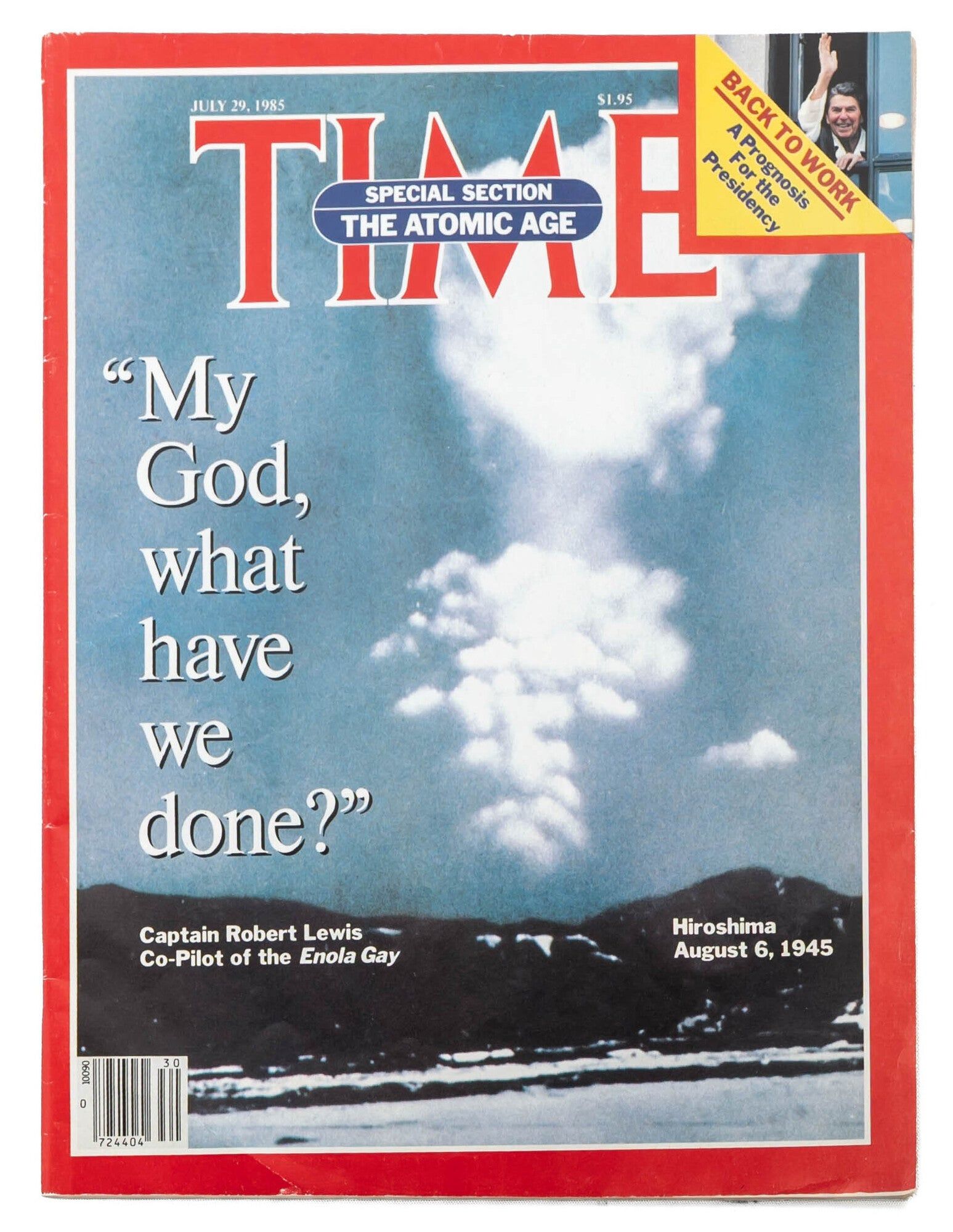
Of the moment the bomb struck Hiroshima, Lewis wrote: "We then turned the ship so we could observe results and there in front of our eyes was with out a doubt the greatest explosion man has ever witnessed. The city was 9/10 covered with smoke...and a column which...reached 30,000 ft." In his later reflections, likely recorded within a few days, he added: "I am certain the entire crew felt this experience was more than anyone human had ever thought possible. It just seems impossible to comprehend. Just how many did we kill? I honestly have the feeling of groping for words to explain this...My God what have we done. If I live a hundred years I'll never quite get these few minutes out of my mind."
We now know that, by the end of 1945, the bomb had killed between 90,000 and 160,000 people, mostly Japanese civilians; another 60,000 to 80,000 people were killed after the "Fat Man" bomb was dropped on Nagasaki. The bombings also marked the end of World War II and concluded a period of hostilities between the United States and Japan sparked by the Japanese strike on Pearl Harbor four years earlier. Lewis' record, then, not only documents the flight of the Enola Gay but the last gasp of World War II, a years-long conflict that claimed millions of lives and culminated in the largest single moment of violence in human history, with tens of thousands killed in an instant. It also marks the advent of the Atomic Age, a period of unprecedented technological advancement and political upheaval; and the first moments of the Cold War. Lewis' record is a unique and invaluable document of a technological, political, and social turning point, not just one of the defining moments of the twentieth century but one of the most consequential moments in human history.
A note on the timeline of this account: Lewis' writing in this notebook spans several days, dated from August 6 to August 10 but probably extending a few days beyond. His account of the Enola Gay flight, dated August 6, comprises the pages later numbered 1-6 and 8. The sketch of the mushroom cloud over Hiroshima on the back cover is also dated August 6. Lewis' notes on the inside front cover are dated August 8. His "History of the 509th" is dated August 10 but appears in multiple colors of ink and may have been written over the course of multiple days. Lewis' reflection on the bombing, taped-in and numbered as p. 7, is on a leaf torn from later in the notebook, just after his "History of the 509th" but before the song that concludes his writing. It seems that Lewis reflected on his experience of the bombing some days later - possibly at Laurence's prompting - once news of the devastation in Hiroshima had reached the world and Lewis was beginning to grasp the historical significance of his own actions. It was in those reflections that Lewis arrived at one of the most affecting portions of his account: "My God what have we done. If I live a hundred years I'll never quite get these few minutes out of my mind." Laurence's autograph emendations appear throughout the eight pages of Lewis' account (though not in the rest of the writing), indicating that Laurence had prepared the account for publication in the weeks following the bombing. However, it seems that Laurence's article on the Hiroshima bombing using Lewis' account was never published, likely because Laurence had the opportunity to publish his personal account of the Nagasaki bombing in the Times on September 9, 1945.
Lewis' record has appeared at auction four times: it made $37,000 at Sotheby's in 1971; $85,000 at Sotheby's in 1978; $391,000 at Christie's in 2002 (as part of the Malcolm Forbes sale); and $543,000 at Heritage in 2022. Theodore Van Kirk's navigator's log made $358,500 at Heritage in 2007 and $372,500 at Sotheby's in 2016.
Transcript: Below is a full transcript of Lewis' in-flight account (pp. 1-6, 8), plus p. 7, which was likely written a few days after the flight, added at the end. [Single brackets] indicate corrections seemingly made by Robert A. Lewis. [[Double brackets]] indicate emendations seemingly made by William Laurence. Text in {curly brackets} is added for the sake of description and is not present in the original record.
{FRONT COVER INTERIOR:}
Aug 8 - 1945
This Log WAS A LAST MINUTE REQUEST OF WILLIAM LAURENCE - (SCIENCE EDITOR) N.Y. TIMES. HE HAD EXPECTED [[been ordered]] TO BE ABOARD, BUT THIS REQUEST WAS NOT PERMITTED [[arrived in Tinian too late]]. HE ASKED [[me]] TO KEEP SOME NOTES OF THE MISSION. A GREAT DEAL OF THE NOTES WERE DONE WRITTEN IN ALMOST COMPLETE DARKNESS HALF WAY THROUGH I RAN OUT OF INK. -
Capt Robert A. Lewis
[[Pencil corrections were made by Mr. William Laurence
Attested as true William Laurence]]
{IN-FLIGHT ACCOUNT BEGINS HERE.}
{PAGE 1.}
Little Boy Mission #1
[First Atomic Bomb.]
August 6th 1945
Target Hit
[By Capt Robert Lewis
Pilot aboard Ship.]
Briefing at 1200 2400
Eating at 0030
[Dear Mom + Dad -]
We started engines at [0227] and taxied out to take off at [0235] then we got off the ground at exactly [0245] Everything went well on take off nothing unusual was encountered, at the last minute before takeoff over cruising altitude had been change from 9000 to 4000 pressure altitude which means possibly a crossed out rougher try. At 0313 we encountered a little [trouble] with our interphone system as we were receiving both interphone + V.H.F. transmission on the interphone jack box position. At 0320 items 1-11 were completed satis. by Capt Parsons. At the same time we lost contact with Ed Dahl.
[[1]]
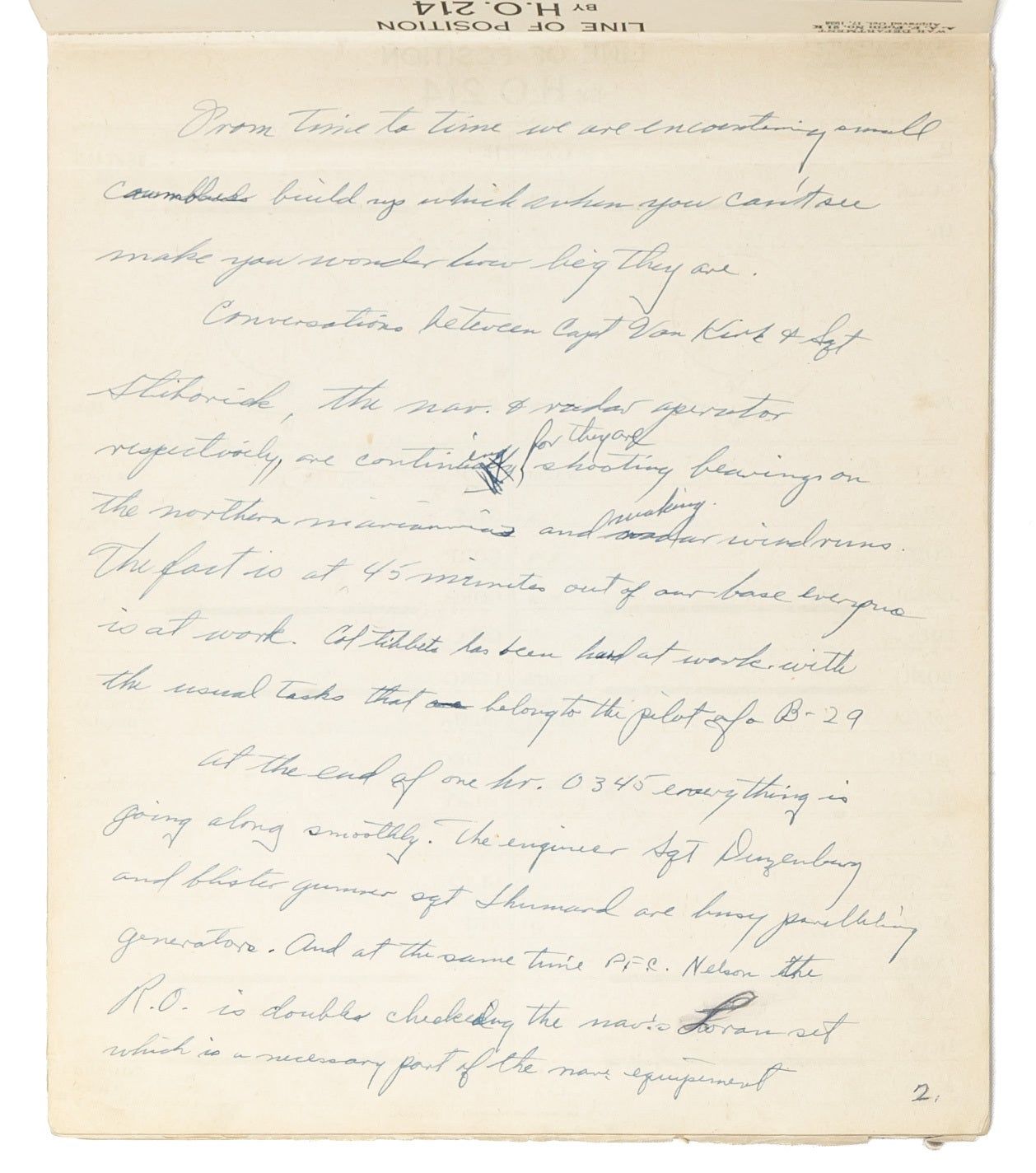
{PAGE 2:}
From time to time we are encountering small cumulus build ups which when you can't see make you wonder how big things are. Conversations between Capt Van Kirk + Sgt Stiborik, the nav. + radio operator respectively, are continu[ing for they are] shooting bearings on the Northern Marianas and [working] radar wind runs. The fact is at 45 minutes out of our base everyone is at work. Col Tibbets has been hard at work with the usual tasks that are belong to the pilot of a B-29. At the end of one hr. 0345 everything is going along smoothly. The engineer Sgt Duzenbury and blaster gunner Sgt Shumard are busy panelling generators. And at the same time P.F.C. Nelson the R.O. is double checking the nav's [[L]]oran set which is a necessary part of the nav equipment.
[[2]]
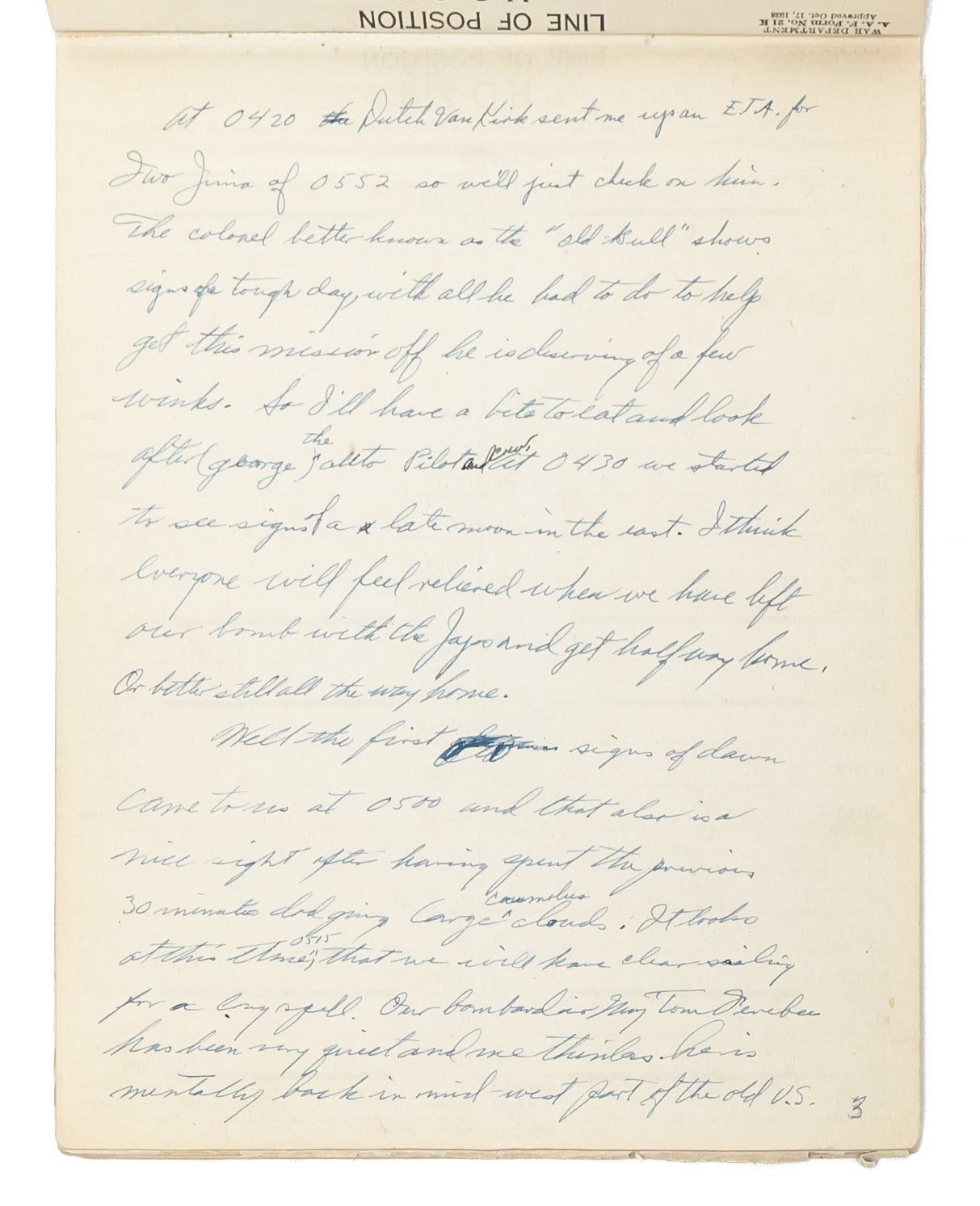
{PAGE 3:}
At 0420 the Dutch Van Kirk sent me up an ETA. For Iwo Jima of 0552 so we'll just check on him. The colonel better known as the "Old Bull" shows signs of a tough day, with all he had to do to help get this mission off he is deserving of a few winks. So I'll have a bite to eat and look after (george)[the] auto Pilot [and crew]. At 0430 we started to see signs of a late moon in the east. I think everyone will feel relieved when we have left our bomb with the Japs and get halfway home. Or better still all the way home. Well at first crossed out signs of dawn came to us at 0500 and that also is a nice sight after having spent the previous30 minutes dodging large [cumulus] clouds. It looks at this time [0515] that we will have clear sailing for a long spell. Our bombardier Maj Tom Ferebee has been very quiet and methinks he is mentally back in mid-west part of the U.S.
[[3]]
{PAGE 4:}
By 0552 it crossed out [is] real light outside and we crossed out are only a few miles from Iwo Jima. We are finishing a second climb which is [to] 9000 ft. Will stay here until we are about 1 hr away
from the Empire. (out of ink) After leaving Iwo we crossed out began to pick up some low stratus and before very long we were flying on top of an undercast. At 0710 the undercast began to break up just a little bit[. O]utside of a high this cirrus and the low stuff its a very beautiful day. We are now about 2 hrs from Bombs away, which reminds me that at 07[15] the colonial had to go. [[You know where.]] At 0730 we are loaded[,] the bomb is now alive and it's a funny feeling knowing its right in back of you. Knock wood. We started our climb to [30,000 FT at 0740] Well folks its not long now.
[[4]]
{PAGE 5:}
At 18500 ft I set the C-1 Auto Pilot up for the last time until after Bombs away. I checked with [[crew at]] 2000 ft and all stations report [[in]] satisfactory. We reached our altitude and a 08:30 Nelson received a report that our primary is the best target, so with everything going well so far we will make a bomb run a Hiroshima[[. R]]ight now we are 15 miles from the Empire and everyone has a big hopeful look on his face. Landfall was 8:50 crossed out [[and it won't be long now]]. As we are approaching our IP crossed out Farebee[,] Van Kirk + Stiborik are coming into their run[,] while the Col + I are standing by and are giving the boys what they want. There will be a short intermission while we bomb our target.
[[5]]
{PAGE 6:}
A brief blow by blow description of the bomb run.
We turned off our IP and had about a 4 minutes run on a perfectly open target Tom Ferebee synchronized on his briefed A.P. and let go, from for the next minute no one knew what would happen [[to expect]], the bombardier and the right seat jockey or Pilot both forgot to put on their dark glasses and therefore witnessed the flash [crossed out] [[which was terrific.]] [[Then]] in about 15 seconds after the flash, there were two very distinct bumps or slaps [[on the ship]] Then that was all the physical effects we felt. [[We]] then turned the ship so we could observe the results[[,]] and there in front of our eyes was with out a doubt [[!!!]] the greatest explosion man has ever witnessed. The city was 9/10 covered with smoke crossed out [of a boiling texture which seemed to indicate buildings blowing up] and a [huge] column [of white cloud] which in less that 3 crossed out reached 30,000 ft [and then went to at least 50,000 ft]
[[6]]
{PAGE 8:}
We [[Bob Caron our tail gunner]] got excellent pictures and everyone on the shop is actually crossed out dumbstruck even though we had expected something fierce, it was the actual sight that we saw that caused the crew to feel that they were a part of Buck Rogers 25 century warriors. This essay on the bombing results could go on indefinitely by telling how huge it grew, even after an hour [[and half.]] [[400]] miles from the target, then the billow of smoke reached [[5500]] ft and contained very weird colors. But perhaps the Japs that are left can save me the trouble and let us know. We then headed hope on 150° and [[our ship]] sure had a happy [[but puzzled crew]] Mission home was as briefed weather the same everyone got a few cat naps
Love to all "Bud" R.A. Lewis
STOP
[[8]]
{PAGE 7, LIKELY WRITTEN A FEW DAYS LATER:}
I am certain the entire crew felt this experience was crossed out more than anyone human had ever thought possible. It just seems impossible to comprehend. Just how many [[Japs]] did we kill? I honestly have the feeling that of groping for words to explain this or [[I might say] My God what have we done. If I live a hundred years I'll never quite get these few minutes out my mind. Looking at Capt Parsons, why he is as confounded as the rest and he was suppose to have known everything and expected this much to happen. After a few last looks I honestly feel the Japs may give up before we land at Tinian. They certainly don't care to have us drop any more bombs like that of atomic energy like this.
[[7]].
Drab paper boards top bound in black cloth. Some light soiling to boards and a bit of wear to cloth binding. One leaf (p. 7 of the account) was torn from later in the notebook and taped in by Lewis at its current position (see below for a timeline of Lewis' account). In Very Good condition overall.
This in-flight record documents the bombing of Hiroshima from the perspective of Captain Robert A. Lewis, co-pilot of the Enola Gay, on the journey to drop the "Little Boy" bomb. Over the course of the twelve-hour flight from Tinian, Northern Mariana Islands to Hiroshima and back again, Lewis recorded both what he saw - including a sketch of the mushroom cloud over the city - and what he felt - apprehension, confusion, shock, awe - as he and his crew entered history. Though Lewis' record is one of two firsthand accounts of the Hiroshima bombing written aboard the Enola Gay, it is the only account that documents the personal observations and emotional response of one of the crewmembers. The other documentation of the flight, the navigator's log of Theodore "Dutch" Van Kirk, is a purely technical account, recording data like timing and flight position but not including the historically valuable and emotionally impactful commentary present here. Lewis' record, then, provides an unequalled firsthand account of the flight of the Enola Gay.
Lewis wrote this account at the request of New York Times science editor William "Atomic Bill" Laurence, who had been given permission to document the mission aboard the Enola Gay. At the last minute, however, Laurence was barred from the flight (he was ultimately allowed aboard the plane that bombed Nagasaki). Laurence asked Lewis to record the Enola Gay mission in his stead, and Lewis took this notebook aboard to document his experiences: "A great deal of the notes were written in almost complete darkness. Half way through I ran out of ink," Lewis wrote.
On August 6, 1945, the Enola Gay left Tinian at 2:25am. The plane passed over Iwo Jima within three hours, and, by 7:30, Lewis wrote: "we are loaded, the bomb is now alive and it's a funny feeling knowing its right in back of you. Knock wood. We started out climb to 30,000ft...well folks its not long now." At 8:15, the Enola Gay dropped the bomb. The "Little Boy" fell for forty-four seconds before detonating over a Hiroshima hospital, instantly killing tens of thousands of people and destroying nearly four square miles of the city.
Of the moment the bomb struck Hiroshima, Lewis wrote: "We then turned the ship so we could observe results and there in front of our eyes was with out a doubt the greatest explosion man has ever witnessed. The city was 9/10 covered with smoke...and a column which...reached 30,000 ft." In his later reflections, likely recorded within a few days, he added: "I am certain the entire crew felt this experience was more than anyone human had ever thought possible. It just seems impossible to comprehend. Just how many did we kill? I honestly have the feeling of groping for words to explain this...My God what have we done. If I live a hundred years I'll never quite get these few minutes out of my mind."
We now know that, by the end of 1945, the bomb had killed between 90,000 and 160,000 people, mostly Japanese civilians; another 60,000 to 80,000 people were killed after the "Fat Man" bomb was dropped on Nagasaki. The bombings also marked the end of World War II and concluded a period of hostilities between the United States and Japan sparked by the Japanese strike on Pearl Harbor four years earlier. Lewis' record, then, not only documents the flight of the Enola Gay but the last gasp of World War II, a years-long conflict that claimed millions of lives and culminated in the largest single moment of violence in human history, with tens of thousands killed in an instant. It also marks the advent of the Atomic Age, a period of unprecedented technological advancement and political upheaval; and the first moments of the Cold War. Lewis' record is a unique and invaluable document of a technological, political, and social turning point, not just one of the defining moments of the twentieth century but one of the most consequential moments in human history.
A note on the timeline of this account: Lewis' writing in this notebook spans several days, dated from August 6 to August 10 but probably extending a few days beyond. His account of the Enola Gay flight, dated August 6, comprises the pages later numbered 1-6 and 8. The sketch of the mushroom cloud over Hiroshima on the back cover is also dated August 6. Lewis' notes on the inside front cover are dated August 8. His "History of the 509th" is dated August 10 but appears in multiple colors of ink and may have been written over the course of multiple days. Lewis' reflection on the bombing, taped-in and numbered as p. 7, is on a leaf torn from later in the notebook, just after his "History of the 509th" but before the song that concludes his writing. It seems that Lewis reflected on his experience of the bombing some days later - possibly at Laurence's prompting - once news of the devastation in Hiroshima had reached the world and Lewis was beginning to grasp the historical significance of his own actions. It was in those reflections that Lewis arrived at one of the most affecting portions of his account: "My God what have we done. If I live a hundred years I'll never quite get these few minutes out of my mind." Laurence's autograph emendations appear throughout the eight pages of Lewis' account (though not in the rest of the writing), indicating that Laurence had prepared the account for publication in the weeks following the bombing. However, it seems that Laurence's article on the Hiroshima bombing using Lewis' account was never published, likely because Laurence had the opportunity to publish his personal account of the Nagasaki bombing in the Times on September 9, 1945.
Lewis' record has appeared at auction four times: it made $37,000 at Sotheby's in 1971; $85,000 at Sotheby's in 1978; $391,000 at Christie's in 2002 (as part of the Malcolm Forbes sale); and $543,000 at Heritage in 2022. Theodore Van Kirk's navigator's log made $358,500 at Heritage in 2007 and $372,500 at Sotheby's in 2016.
Transcript: Below is a full transcript of Lewis' in-flight account (pp. 1-6, 8), plus p. 7, which was likely written a few days after the flight, added at the end. [Single brackets] indicate corrections seemingly made by Robert A. Lewis. [[Double brackets]] indicate emendations seemingly made by William Laurence. Text in {curly brackets} is added for the sake of description and is not present in the original record.
{FRONT COVER INTERIOR:}
Aug 8 - 1945
This Log WAS A LAST MINUTE REQUEST OF WILLIAM LAURENCE - (SCIENCE EDITOR) N.Y. TIMES. HE HAD EXPECTED [[been ordered]] TO BE ABOARD, BUT THIS REQUEST WAS NOT PERMITTED [[arrived in Tinian too late]]. HE ASKED [[me]] TO KEEP SOME NOTES OF THE MISSION. A GREAT DEAL OF THE NOTES WERE DONE WRITTEN IN ALMOST COMPLETE DARKNESS HALF WAY THROUGH I RAN OUT OF INK. -
Capt Robert A. Lewis
[[Pencil corrections were made by Mr. William Laurence
Attested as true William Laurence]]
{IN-FLIGHT ACCOUNT BEGINS HERE.}
{PAGE 1.}
Little Boy Mission #1
[First Atomic Bomb.]
August 6th 1945
Target Hit
[By Capt Robert Lewis
Pilot aboard Ship.]
Briefing at 1200 2400
Eating at 0030
[Dear Mom + Dad -]
We started engines at [0227] and taxied out to take off at [0235] then we got off the ground at exactly [0245] Everything went well on take off nothing unusual was encountered, at the last minute before takeoff over cruising altitude had been change from 9000 to 4000 pressure altitude which means possibly a crossed out rougher try. At 0313 we encountered a little [trouble] with our interphone system as we were receiving both interphone + V.H.F. transmission on the interphone jack box position. At 0320 items 1-11 were completed satis. by Capt Parsons. At the same time we lost contact with Ed Dahl.
[[1]]
{PAGE 2:}
From time to time we are encountering small cumulus build ups which when you can't see make you wonder how big things are. Conversations between Capt Van Kirk + Sgt Stiborik, the nav. + radio operator respectively, are continu[ing for they are] shooting bearings on the Northern Marianas and [working] radar wind runs. The fact is at 45 minutes out of our base everyone is at work. Col Tibbets has been hard at work with the usual tasks that are belong to the pilot of a B-29. At the end of one hr. 0345 everything is going along smoothly. The engineer Sgt Duzenbury and blaster gunner Sgt Shumard are busy panelling generators. And at the same time P.F.C. Nelson the R.O. is double checking the nav's [[L]]oran set which is a necessary part of the nav equipment.
[[2]]
{PAGE 3:}
At 0420 the Dutch Van Kirk sent me up an ETA. For Iwo Jima of 0552 so we'll just check on him. The colonel better known as the "Old Bull" shows signs of a tough day, with all he had to do to help get this mission off he is deserving of a few winks. So I'll have a bite to eat and look after (george)[the] auto Pilot [and crew]. At 0430 we started to see signs of a late moon in the east. I think everyone will feel relieved when we have left our bomb with the Japs and get halfway home. Or better still all the way home. Well at first crossed out signs of dawn came to us at 0500 and that also is a nice sight after having spent the previous30 minutes dodging large [cumulus] clouds. It looks at this time [0515] that we will have clear sailing for a long spell. Our bombardier Maj Tom Ferebee has been very quiet and methinks he is mentally back in mid-west part of the U.S.
[[3]]
{PAGE 4:}
By 0552 it crossed out [is] real light outside and we crossed out are only a few miles from Iwo Jima. We are finishing a second climb which is [to] 9000 ft. Will stay here until we are about 1 hr away
from the Empire. (out of ink) After leaving Iwo we crossed out began to pick up some low stratus and before very long we were flying on top of an undercast. At 0710 the undercast began to break up just a little bit[. O]utside of a high this cirrus and the low stuff its a very beautiful day. We are now about 2 hrs from Bombs away, which reminds me that at 07[15] the colonial had to go. [[You know where.]] At 0730 we are loaded[,] the bomb is now alive and it's a funny feeling knowing its right in back of you. Knock wood. We started our climb to [30,000 FT at 0740] Well folks its not long now.
[[4]]
{PAGE 5:}
At 18500 ft I set the C-1 Auto Pilot up for the last time until after Bombs away. I checked with [[crew at]] 2000 ft and all stations report [[in]] satisfactory. We reached our altitude and a 08:30 Nelson received a report that our primary is the best target, so with everything going well so far we will make a bomb run a Hiroshima[[. R]]ight now we are 15 miles from the Empire and everyone has a big hopeful look on his face. Landfall was 8:50 crossed out [[and it won't be long now]]. As we are approaching our IP crossed out Farebee[,] Van Kirk + Stiborik are coming into their run[,] while the Col + I are standing by and are giving the boys what they want. There will be a short intermission while we bomb our target.
[[5]]
{PAGE 6:}
A brief blow by blow description of the bomb run.
We turned off our IP and had about a 4 minutes run on a perfectly open target Tom Ferebee synchronized on his briefed A.P. and let go, from for the next minute no one knew what would happen [[to expect]], the bombardier and the right seat jockey or Pilot both forgot to put on their dark glasses and therefore witnessed the flash [crossed out] [[which was terrific.]] [[Then]] in about 15 seconds after the flash, there were two very distinct bumps or slaps [[on the ship]] Then that was all the physical effects we felt. [[We]] then turned the ship so we could observe the results[[,]] and there in front of our eyes was with out a doubt [[!!!]] the greatest explosion man has ever witnessed. The city was 9/10 covered with smoke crossed out [of a boiling texture which seemed to indicate buildings blowing up] and a [huge] column [of white cloud] which in less that 3 crossed out reached 30,000 ft [and then went to at least 50,000 ft]
[[6]]
{PAGE 8:}
We [[Bob Caron our tail gunner]] got excellent pictures and everyone on the shop is actually crossed out dumbstruck even though we had expected something fierce, it was the actual sight that we saw that caused the crew to feel that they were a part of Buck Rogers 25 century warriors. This essay on the bombing results could go on indefinitely by telling how huge it grew, even after an hour [[and half.]] [[400]] miles from the target, then the billow of smoke reached [[5500]] ft and contained very weird colors. But perhaps the Japs that are left can save me the trouble and let us know. We then headed hope on 150° and [[our ship]] sure had a happy [[but puzzled crew]] Mission home was as briefed weather the same everyone got a few cat naps
Love to all "Bud" R.A. Lewis
STOP
[[8]]
{PAGE 7, LIKELY WRITTEN A FEW DAYS LATER:}
I am certain the entire crew felt this experience was crossed out more than anyone human had ever thought possible. It just seems impossible to comprehend. Just how many [[Japs]] did we kill? I honestly have the feeling that of groping for words to explain this or [[I might say] My God what have we done. If I live a hundred years I'll never quite get these few minutes out my mind. Looking at Capt Parsons, why he is as confounded as the rest and he was suppose to have known everything and expected this much to happen. After a few last looks I honestly feel the Japs may give up before we land at Tinian. They certainly don't care to have us drop any more bombs like that of atomic energy like this.
[[7]].
Details
Title
In-flight autograph record of the bombing of Hiroshima, written by the co-pilot of the 'Enola Gay'
Author
[World War II] [Bombing of Hiroshima] Lewis, Captain Robert A.
Condition
Unknown
Date
1945