

Trocha. A Cuban Dance
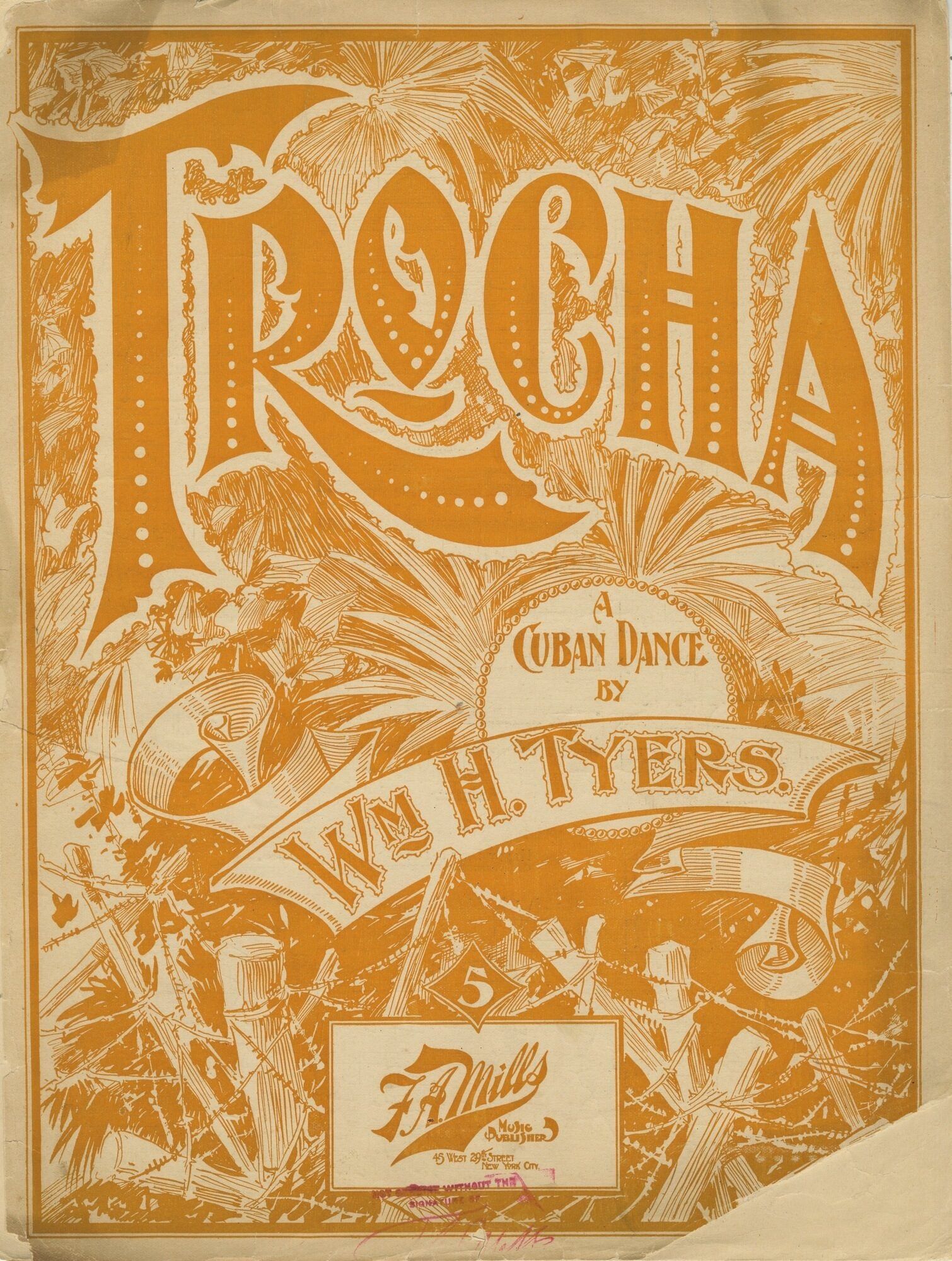
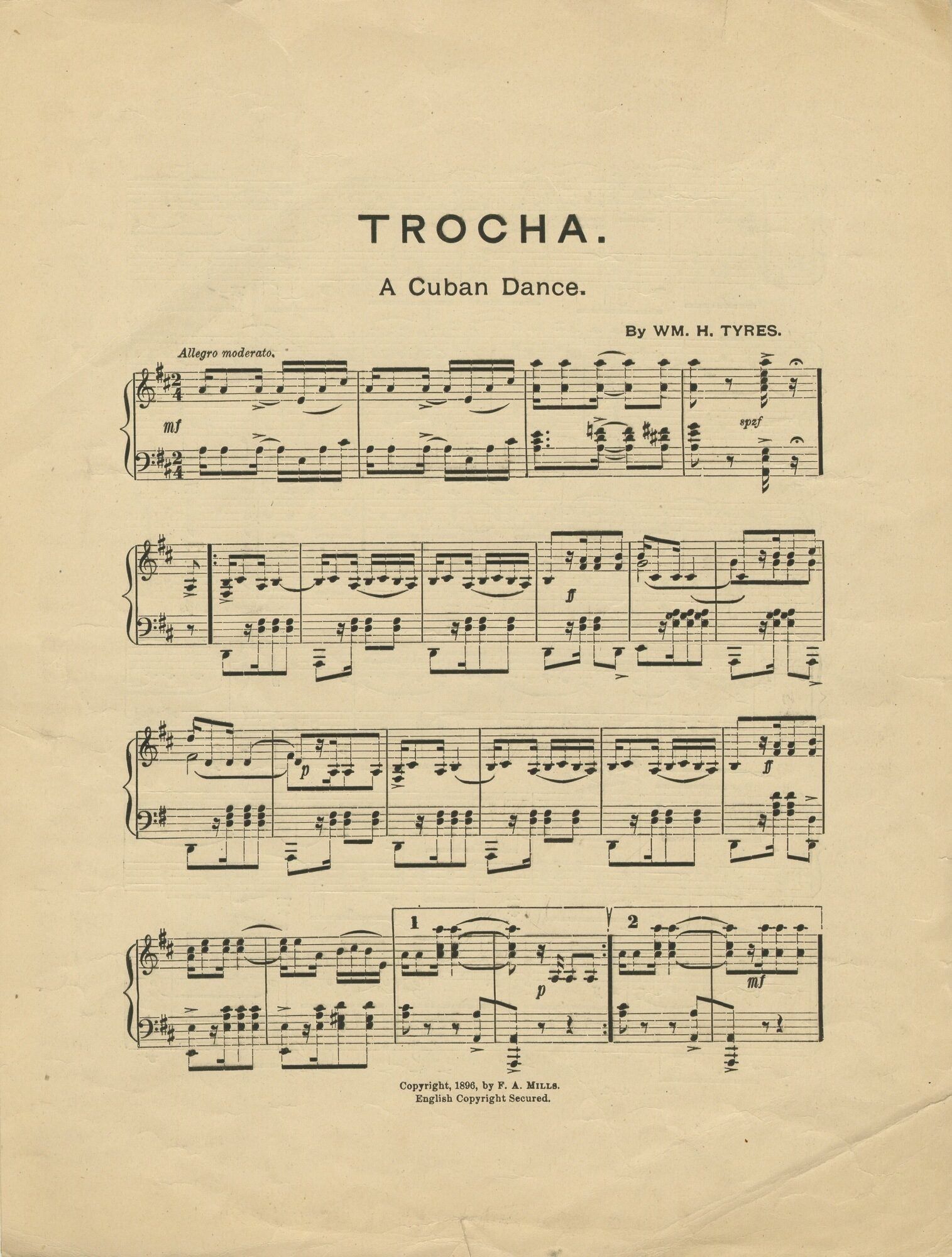
- Folio sheet music, illustrated pictorial cover printed in orange. 5 pp. (including cover). Approximately 13 ½ x 10 ½ inches
- New York: Jos. W. Stern & Co, 1890
New York: Jos. W. Stern & Co, 1890. Folio sheet music, illustrated pictorial cover printed in orange. 5 pp. (including cover). Approximately 13 ½ x 10 ½ inches. Covers detached, loss to front cover, contents complete, fair to good.. A decorative late nineteenth-century dance publication for “Trocha,” described on the cover as “A Cuban Dance,” composed by the African American composer and bandleader W. H. Tyers. The elaborate pictorial cover incorporates stylized tropical foliage and island scenery rendered in a bold single-color design, typical for the period’s fascination with exoticized musical forms.
William H. Tyers (1870–1924) was an African American composer, arranger, and bandleader active in New York during the ragtime era. Born in Petersburg, Virginia, to Henry Tyers and Jane “Jennie” Jones, both formerly enslaved, he spent part of his youth in Richmond before his family relocated to New York City, where he began studying piano. His early teachers recognized an aptitude for composition as well as performance, and by the mid-1880s he was writing dance pieces including polkas and waltzes. Around the age of twenty Tyers secured employment as a music librarian and arranger with a touring concert company, a position that brought him to Europe, where he studied orchestration and arranging with Professor Gaspari in Hamburg.
Returning to New York, Tyers became active in the city’s rapidly expanding popular music trade, working as an arranger and composer for publishers including F. A. Mills and Jos. W. Stern & Co. In 1896 he published “Sambo,” a syncopated march sometimes considered to be one of the first instrumental rags.[1] “Trocha”, also released in the 1980s, brought Tyers prominence for his ability to write Latin-style rhythms. It was re-issued in 1913 as a tango, and its success led Tyers to work as an arranger with Joseph W. Stern in 1897.
Tyers’ compositions blended contemporary American dance music with Caribbean and Latin themes, a style reflected in pieces such as Trocha and later in his well-known ragtime composition Panama (1911), which remained a staple of early jazz and dance orchestras. OCLC finds two copies with different entries, at the Cleveland Public Library and the British Museum Reference Collections.
[1] “William Tyers, Music Arranger,” African American Registry, https://aaregistry.org/story/william-tyers-born/, accessed March 10, 2026.
William H. Tyers (1870–1924) was an African American composer, arranger, and bandleader active in New York during the ragtime era. Born in Petersburg, Virginia, to Henry Tyers and Jane “Jennie” Jones, both formerly enslaved, he spent part of his youth in Richmond before his family relocated to New York City, where he began studying piano. His early teachers recognized an aptitude for composition as well as performance, and by the mid-1880s he was writing dance pieces including polkas and waltzes. Around the age of twenty Tyers secured employment as a music librarian and arranger with a touring concert company, a position that brought him to Europe, where he studied orchestration and arranging with Professor Gaspari in Hamburg.
Returning to New York, Tyers became active in the city’s rapidly expanding popular music trade, working as an arranger and composer for publishers including F. A. Mills and Jos. W. Stern & Co. In 1896 he published “Sambo,” a syncopated march sometimes considered to be one of the first instrumental rags.[1] “Trocha”, also released in the 1980s, brought Tyers prominence for his ability to write Latin-style rhythms. It was re-issued in 1913 as a tango, and its success led Tyers to work as an arranger with Joseph W. Stern in 1897.
Tyers’ compositions blended contemporary American dance music with Caribbean and Latin themes, a style reflected in pieces such as Trocha and later in his well-known ragtime composition Panama (1911), which remained a staple of early jazz and dance orchestras. OCLC finds two copies with different entries, at the Cleveland Public Library and the British Museum Reference Collections.
[1] “William Tyers, Music Arranger,” African American Registry, https://aaregistry.org/story/william-tyers-born/, accessed March 10, 2026.
Details
Title
Trocha. A Cuban Dance
Author
[Music – Dance – Cuba / Caribbean – African-Americana] Tyers, W. H.
Binding
Folio sheet music, illustrated pictorial cover printed in orange. 5 pp. (including cover). Approximately 13 ½ x 10 ½ inches
Condition
Good
Publisher
Jos. W. Stern & Co: New York
Date
1890