

Cakewalking Babies from Home. [Sheet Music]
![Cakewalking Babies from Home. [Sheet Music]](https://d3525k1ryd2155.cloudfront.net/h/361/311/1738311361.0.x.jpg)
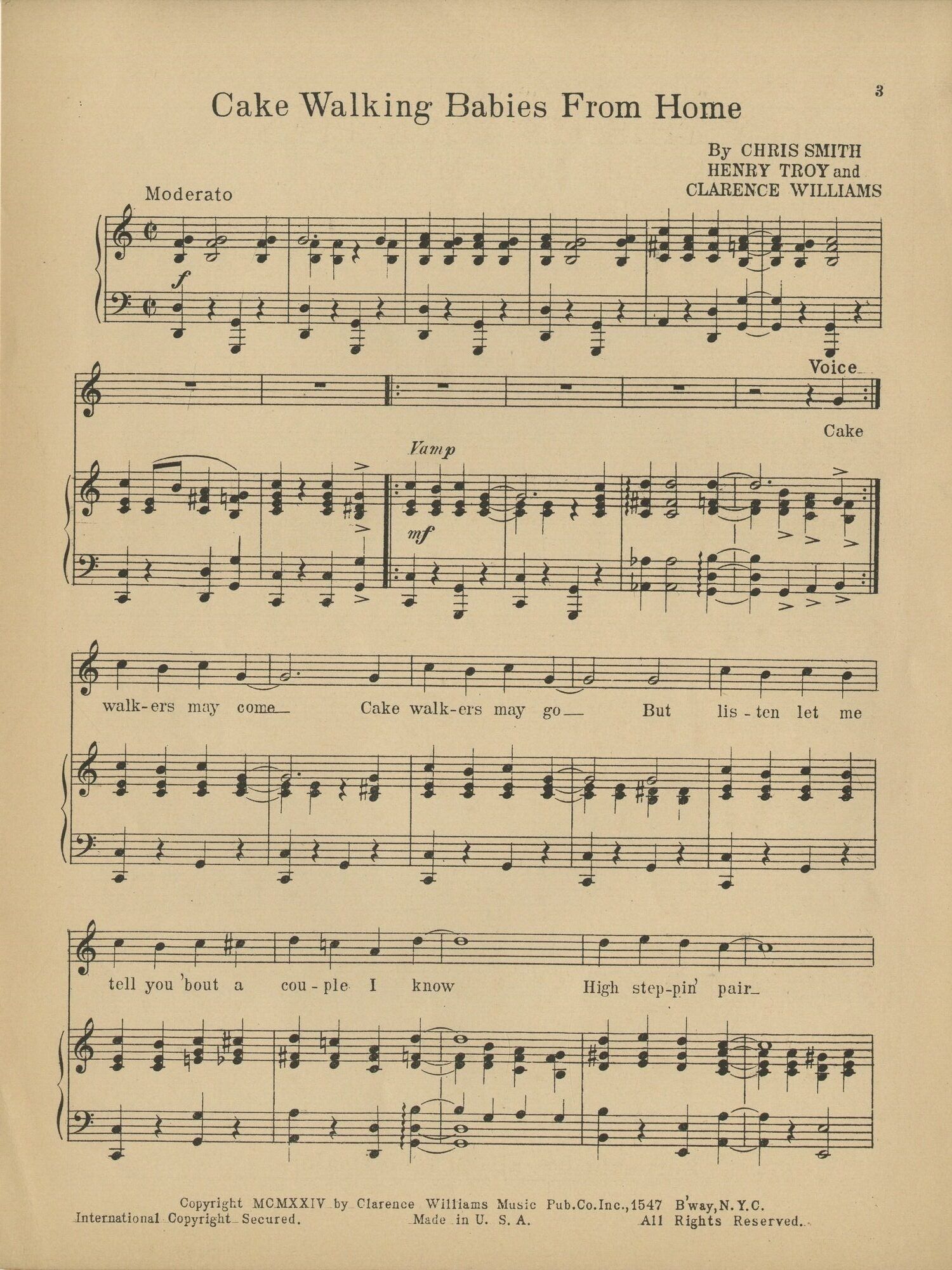
- Folio measuring 12 x 9 inches, 5 pp. With an attractive period style illustration by Sydney Leff, with his printed signature in
- New York City: Clarence Williams, 1924
New York City: Clarence Williams, 1924. Folio measuring 12 x 9 inches, 5 pp. With an attractive period style illustration by Sydney Leff, with his printed signature in the lower right corner. Fine condition.. A very scarce surviving example of the sheet music for "Cakewalking Babies from Home", a cornerstone early jazz-blues composition issued through Clarence Williams’s publishing enterprise at the moment when New Orleans–derived ensemble practice was reshaping American popular music. Written by Williams with Chris Smith and Henry Troy, the piece bridges late ragtime syncopation and emerging small-group jazz textures. Though widely disseminated through performance and recording, it appears to have circulated only sparingly as domestic sheet music.
The song achieved lasting fame through the celebrated 1924 New York recording sessions by the Clarence Williams Blue Five (Okeh 8256), featuring Eva Taylor (vocal), Louis Armstrong (cornet), Sidney Bechet (soprano saxophone), Clarence Williams (piano), and Buddy Christian (banjo); a landmark early small-ensemble performance often cited for its dynamic Armstrong–Bechet interplay and its role in defining early jazz ensemble language.[1,2] Circulating widely among classic blues singers, vaudeville performers, and musicians within Williams’s publishing network and the TOBA circuit, the composition reflects the porous boundary between theatrical blues, dance music, and emerging jazz repertory in mid-1920s Harlem and Chicago. As noted in Smithsonian jazz educational materials, “the roots of jazz are heard clearly… in ‘Cake Walking Babies from Home’”.[3]
Despite its well-documented performance and recording history, institutional holdings of the sheet music itself appear extremely limited. We locate a single copy at the Stanley King Jazz Collection at Oberlin, with none presently recorded in OCLC.
[1] Brian Rust, Jazz records, 1897–1942 (Arlington House Publishers, 1978).
[2] Tom Lord, Jazz Discography (Lord Music Reference Inc., 1992).
[3] “Act 3. New York Introduction: 1924–1925”, Smithsonian Louis Armstrong Education Kit, https://amhistory.si.edu/jazz/education/Act3.pdf.
The song achieved lasting fame through the celebrated 1924 New York recording sessions by the Clarence Williams Blue Five (Okeh 8256), featuring Eva Taylor (vocal), Louis Armstrong (cornet), Sidney Bechet (soprano saxophone), Clarence Williams (piano), and Buddy Christian (banjo); a landmark early small-ensemble performance often cited for its dynamic Armstrong–Bechet interplay and its role in defining early jazz ensemble language.[1,2] Circulating widely among classic blues singers, vaudeville performers, and musicians within Williams’s publishing network and the TOBA circuit, the composition reflects the porous boundary between theatrical blues, dance music, and emerging jazz repertory in mid-1920s Harlem and Chicago. As noted in Smithsonian jazz educational materials, “the roots of jazz are heard clearly… in ‘Cake Walking Babies from Home’”.[3]
Despite its well-documented performance and recording history, institutional holdings of the sheet music itself appear extremely limited. We locate a single copy at the Stanley King Jazz Collection at Oberlin, with none presently recorded in OCLC.
[1] Brian Rust, Jazz records, 1897–1942 (Arlington House Publishers, 1978).
[2] Tom Lord, Jazz Discography (Lord Music Reference Inc., 1992).
[3] “Act 3. New York Introduction: 1924–1925”, Smithsonian Louis Armstrong Education Kit, https://amhistory.si.edu/jazz/education/Act3.pdf.
Details
Title
Cakewalking Babies from Home. [Sheet Music]
Author
[Music – Jazz – Sheet Music] Williams, Clarence; Smith, Chris; Troy, Henry; Leff, Sydney [illustrator]
Binding
Folio measuring 12 x 9 inches, 5 pp. With an attractive period style illustration by Sydney Leff, with his printed signature in
Condition
Fine
Publisher
Clarence Williams: New York City
Date
1924