

Relation des missions des PP. de la Compagnie de Iesus dans les isles, & dans la terre ferme de l'Amerique Meridionale. Divisée en deux parties. Avec une introduction à la langue des Galibis Sauvages de la terre ferme de l'Amerique




- Hardcover
- Paris: Chez S. Cramoisy & G. Cramoisy, 1655
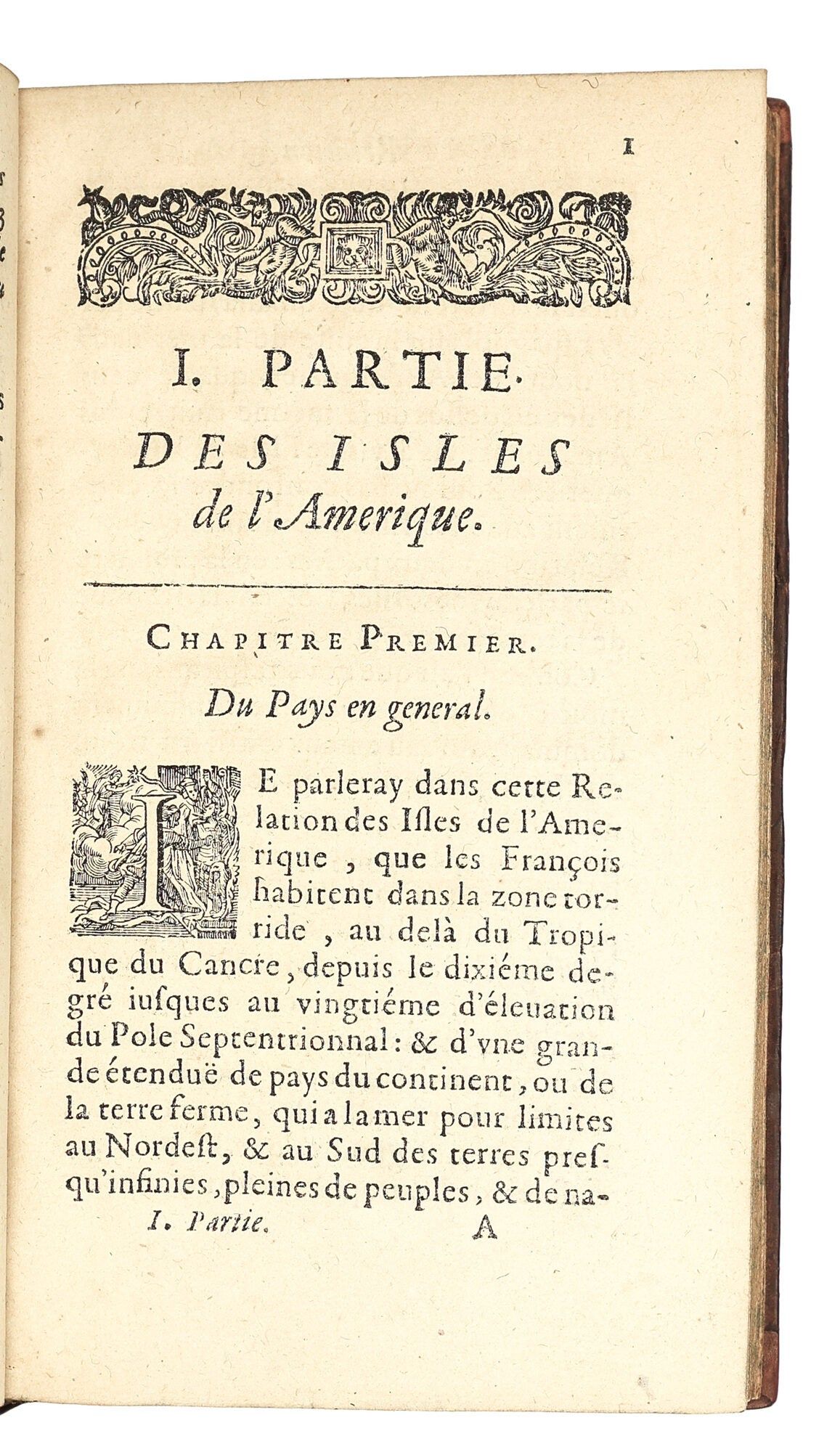
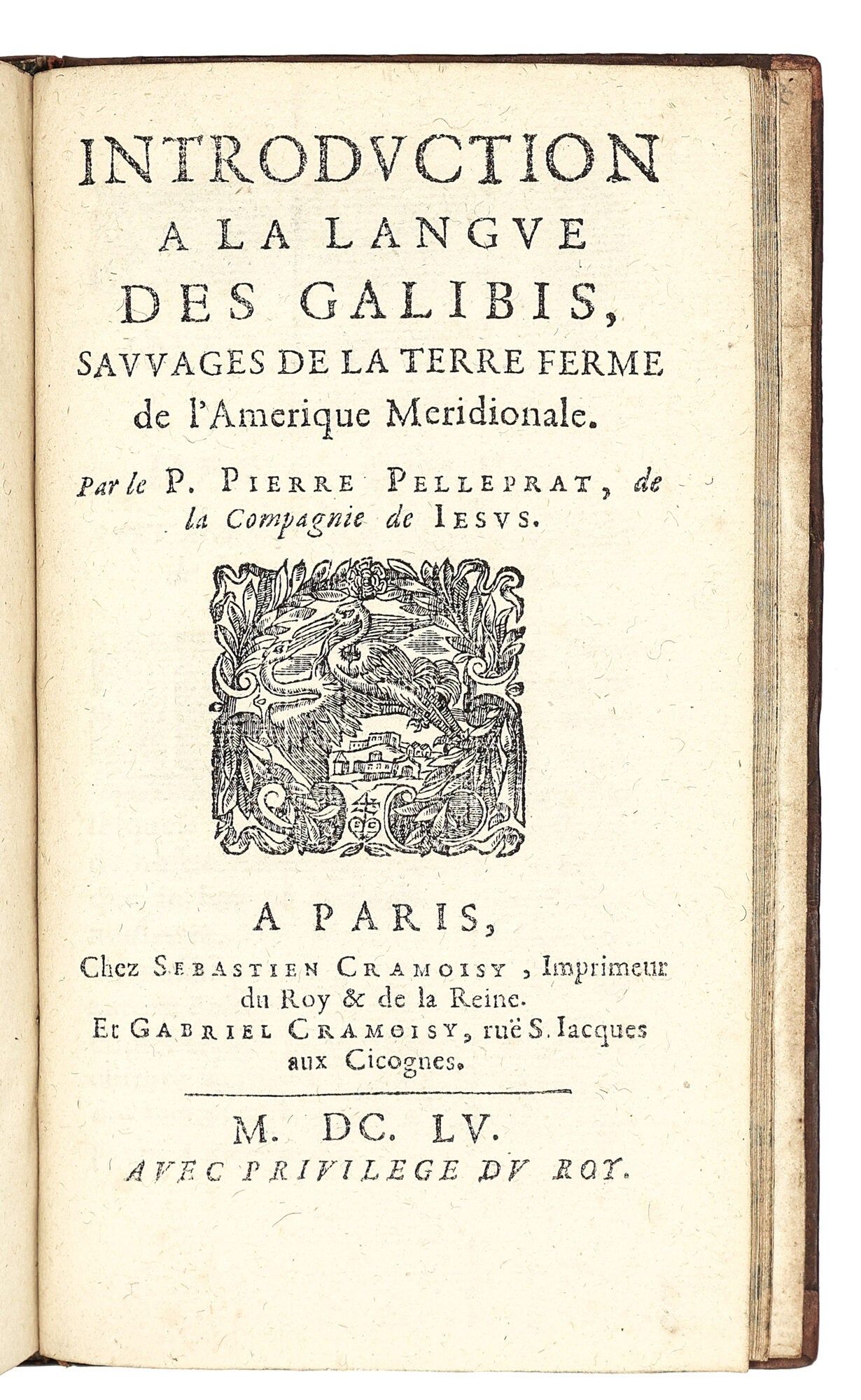
Paris: Chez S. Cramoisy & G. Cramoisy, 1655. SOLE EDITION. Hardcover. Fine. A fine copy in its original binding of 17th c. mottled French calf, spine gilt and with red morocco label (minor wear to the spine.) Fine and fresh with just the occasional small rust spot. Engraved arms of the dedicatee, Nicolas Fouquet, on the second leaf. First edition of this rare relation describing the Jesuit missions in the Caribbean and on the South American mainland, providing one of the earliest systematic accounts of the Lesser Antilles and Guiana. Much of the book is based on the author's firsthand experiences. He describes the foundation of churches, the conversion of enslaved Africans and Indigenous nations, Indigenous culture, the moral and physical trials of evangelization, and the natural history of the islands and mainland.
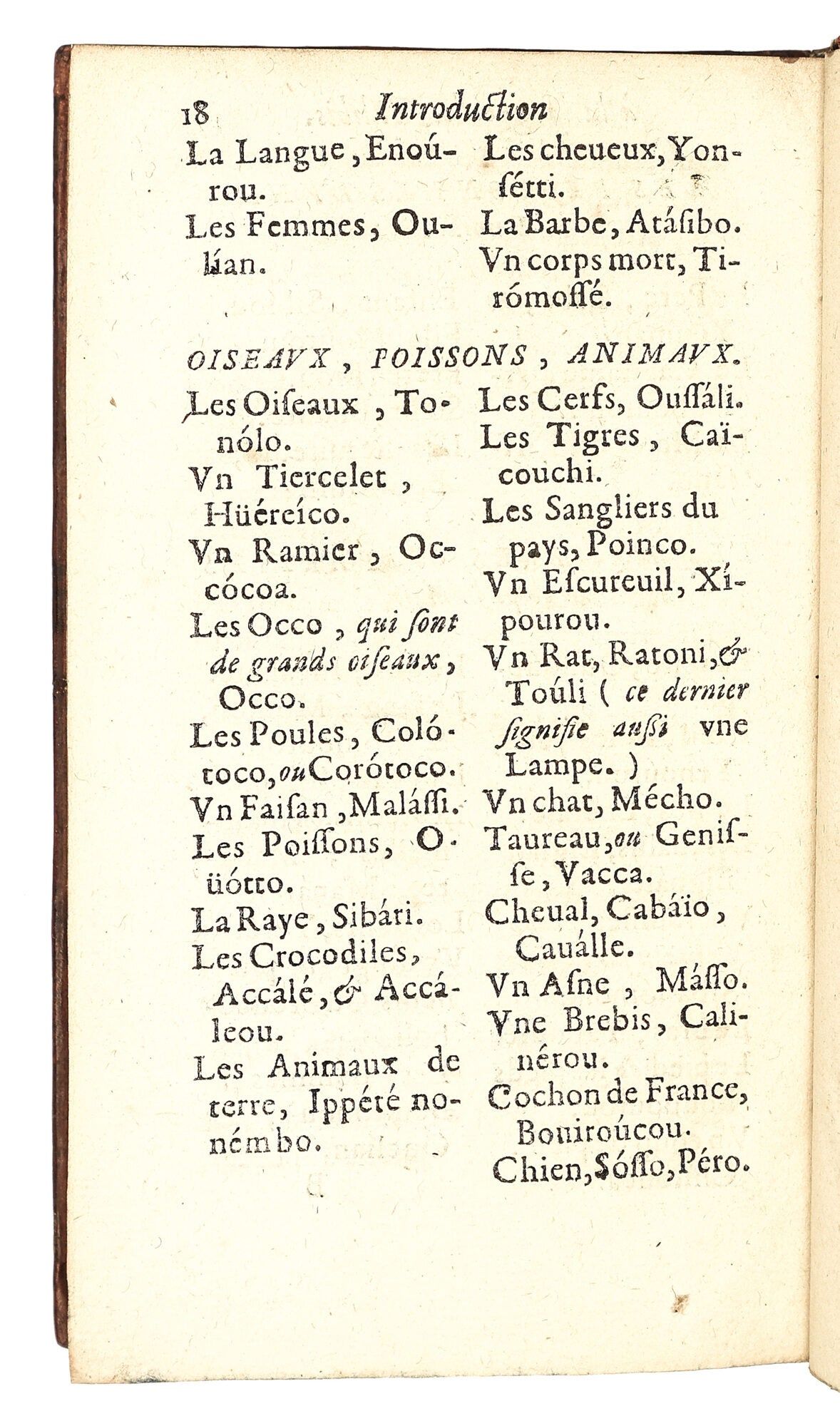
Of special importance is the third part of the work: the author's grammar and vocabulary of the Galibi language, one of the earliest printed studies of a South American Indigenous language. Pelleprat explains the purpose of understanding Galibi: "I have composed a small grammar and vocabulary of the Galibi language, so that our Fathers who shall come after me may speak to these peoples in their own words and more easily win their souls to God."
In 1651, Pierre Pelleprat was sent from France to the Antilles, joining Fathers Denys Mesland, François Gueymeu, and Guillaume Aubergeon. The Jesuits served the indigenous Amerindians, enslaved Africans, and Irish and French settlers. Two years later, Pelleprat and Mesland sailed for the mainland, where they established a mission on the Guarapiche River near the Gulf of Paria. After Mesland's departure was, Pelleprat remained alone, continuing his missionary work and studying the local language. Illness forced him to return to the islands in 1654. He petitioned to return to Europe but was denied and instead lived out the remainder of his life in Mexico, dying at Puebla de los Angeles in 1667.
The preface outlines the establishment of the Jesuit mission in the French Caribbean following the founding of Martinique and Guadeloupe in 1635. Pelleprat recounts the arrival of the Jesuits and their efforts to learn the native languages in order to communicate doctrine, record confessions, and translate prayers. His descriptions of the climate, geography, and local governance of the islands are accompanied by remarks on Indigenous customs, domestic life, and religious beliefs.
Pelleprat portrays the Indigenous inhabitants with clarity and sympathy. They are "without guile or malice... and capable of every good doctrine... They are neither cruel nor treacherous, as some have claimed; rather they are generous and easily moved to affection when treated with kindness." He notes the Galibis skill in painting and weaving: "They take great care in painting their bodies and in making their cotton cloths, which they dye with beautiful colors."
The author records local fishing and hunting practices, the use of pirogues (canoes) along the coasts, and the construction of dwellings raised above ground: "They live by fish and roots, in houses built upon poles to guard against the waters and the reptiles."
He marvels at the beauty and richness of South America: its landscape, flora and fauna: "the trees of these islands bear fruit twice a year, and the soil is so rich that it needs only to be turned over to yield harvests beyond expectation".
The Galibi Language
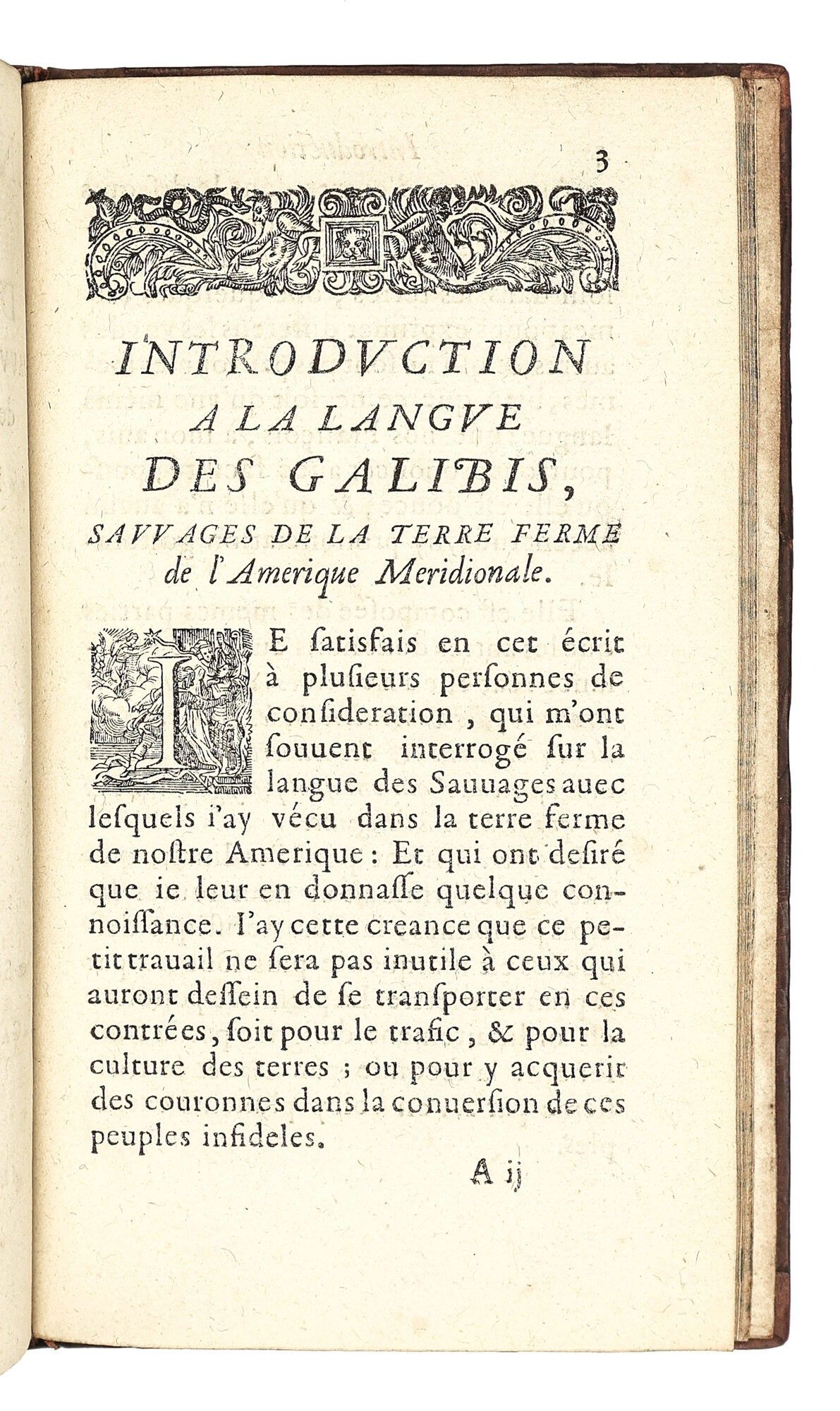
Pelleprat's introduction to the Galibi language is one of the earliest printed attempts to describe and translate a South American Indigenous language. He explains the purpose of understanding Galibi: "I have composed a small grammar and vocabulary of the Galibi language, so that our Fathers who shall come after me may speak to these peoples in their own words and more easily win their souls to God."
Pelleprat opens by justifying his study as a means to conversion, writing that "the barbarous nations... are so docile and so well disposed to receive the Gospel that they await only its preaching." His goal is not philological in the modern sense but practical: to prepare future missionaries to communicate Christian doctrine. Even so, his careful observations show an emerging recognition of linguistic structure. He notes that "this language has its own rules, its order, and its way of composing words," an acknowledgment that Amerindian languages were coherent systems rather than the "corrupted" or "primitive" speech often imagined by Europeans.
The Introduction proceeds systematically, identifying letters, pronunciation, and basic grammar before offering a brief bilingual vocabulary. Pelleprat outlines nouns, pronouns, and verb forms, and includes everyday expressions drawn from conversation. The vocabulary reveals the priorities of the missionary encounter, pairing religious and material terms: "God" and "Devil," "soul," "heaven," and "earth," alongside "river," "house," and "friend." Through such juxtapositions, the work translates the Christian world into the idiom of local experience. Pelleprat also recognizes the limits of his own learning, admitting that he "has gathered what he could learn from the natives themselves" and that the book is only a "first attempt."
The Islands of America
Pelleprat opens with the Jesuits' first arrival at Martinique and he describes the founding of chapels, the teaching of catechism, and the first baptisms. When the mission expanded to Guadeloupe and Saint Christopher (St Kitts), he wrote: "we carried with us neither gold nor silver, but the Cross of Christ and a heart desirous only to win souls. With this we founded our first church on the edge of the sea, the waves serving us for organ and bells." (p. 17)
Pelleprat relates the successful conversion of enslaved Africans: "for although they have been reared in brutishness, many become so chaste and honest when they are Christians that they would rather die than commit the least indecency." (p. 33)
Irish Catholics who had been exiled by the English sought out the Jesuits for Mass and confession, and Pelleprat recounts the secret ministry carried out among them and the extraordinary virtue of an Irish girl raised in disguise to preserve her chastity. "I cannot omit the victory that a young Irish girl won over the weakness of her sex... This girl had come very young to America, and her father, to protect her, had disguised her and raised her in the dress of a boy." (pp. 49-50)
Pelleprat explains how conversion altered conduct during epidemics and famine, and the devoutness of the newly converted: "In the time of pestilence, when even the air seemed to breathe death, our new Christians came in great numbers to confession and communion, choosing rather to die reconciled to God than to live without His grace." (p. 47)
The Mainland of South America
The second section records numerous observations on the geography and natural history of Guiana: "I saw serpents with wings like bats, and fish that fly above the water; trees whose leaves close at night as if they slept, and others that exude milk when cut." (p. 88) "The rivers here are broader than many seas, their waters dark as ink under the forest's shadow. The land breathes a perpetual spring; trees bear fruit without ceasing, and the air is so temperate that one would think Nature had chosen this region for her rest." (p. 60)
Pelleprat records the manners, dwellings, and ceremonies of the Guianese nations:
"They are of good stature, well-formed, their countenance open and agreeable. Their huts are made of palm leaves, their hammocks of woven cotton, their vessels of baked clay painted with strange figures . . . When we entered their villages, they offered us cassava bread and the drink of their country, pressing us to sit in their hammocks, which they esteem as the greatest courtesy." (p. 67-69)
Chapter VI outlines the political and moral order of Indigenous societies. Government, Pelleprat notes, is communal and tempered by reason: "Their government is gentle; they obey the oldest or the bravest, and all decisions are taken in council, with much shouting but little injustice." (p. 92) "When one dies, they burn his hammock and his weapons, believing that he will find them again beyond the river of souls." (p. 93).
Of special importance is the third part of the work: the author's grammar and vocabulary of the Galibi language, one of the earliest printed studies of a South American Indigenous language. Pelleprat explains the purpose of understanding Galibi: "I have composed a small grammar and vocabulary of the Galibi language, so that our Fathers who shall come after me may speak to these peoples in their own words and more easily win their souls to God."
In 1651, Pierre Pelleprat was sent from France to the Antilles, joining Fathers Denys Mesland, François Gueymeu, and Guillaume Aubergeon. The Jesuits served the indigenous Amerindians, enslaved Africans, and Irish and French settlers. Two years later, Pelleprat and Mesland sailed for the mainland, where they established a mission on the Guarapiche River near the Gulf of Paria. After Mesland's departure was, Pelleprat remained alone, continuing his missionary work and studying the local language. Illness forced him to return to the islands in 1654. He petitioned to return to Europe but was denied and instead lived out the remainder of his life in Mexico, dying at Puebla de los Angeles in 1667.
The preface outlines the establishment of the Jesuit mission in the French Caribbean following the founding of Martinique and Guadeloupe in 1635. Pelleprat recounts the arrival of the Jesuits and their efforts to learn the native languages in order to communicate doctrine, record confessions, and translate prayers. His descriptions of the climate, geography, and local governance of the islands are accompanied by remarks on Indigenous customs, domestic life, and religious beliefs.
Pelleprat portrays the Indigenous inhabitants with clarity and sympathy. They are "without guile or malice... and capable of every good doctrine... They are neither cruel nor treacherous, as some have claimed; rather they are generous and easily moved to affection when treated with kindness." He notes the Galibis skill in painting and weaving: "They take great care in painting their bodies and in making their cotton cloths, which they dye with beautiful colors."
The author records local fishing and hunting practices, the use of pirogues (canoes) along the coasts, and the construction of dwellings raised above ground: "They live by fish and roots, in houses built upon poles to guard against the waters and the reptiles."
He marvels at the beauty and richness of South America: its landscape, flora and fauna: "the trees of these islands bear fruit twice a year, and the soil is so rich that it needs only to be turned over to yield harvests beyond expectation".
The Galibi Language
Pelleprat's introduction to the Galibi language is one of the earliest printed attempts to describe and translate a South American Indigenous language. He explains the purpose of understanding Galibi: "I have composed a small grammar and vocabulary of the Galibi language, so that our Fathers who shall come after me may speak to these peoples in their own words and more easily win their souls to God."
Pelleprat opens by justifying his study as a means to conversion, writing that "the barbarous nations... are so docile and so well disposed to receive the Gospel that they await only its preaching." His goal is not philological in the modern sense but practical: to prepare future missionaries to communicate Christian doctrine. Even so, his careful observations show an emerging recognition of linguistic structure. He notes that "this language has its own rules, its order, and its way of composing words," an acknowledgment that Amerindian languages were coherent systems rather than the "corrupted" or "primitive" speech often imagined by Europeans.
The Introduction proceeds systematically, identifying letters, pronunciation, and basic grammar before offering a brief bilingual vocabulary. Pelleprat outlines nouns, pronouns, and verb forms, and includes everyday expressions drawn from conversation. The vocabulary reveals the priorities of the missionary encounter, pairing religious and material terms: "God" and "Devil," "soul," "heaven," and "earth," alongside "river," "house," and "friend." Through such juxtapositions, the work translates the Christian world into the idiom of local experience. Pelleprat also recognizes the limits of his own learning, admitting that he "has gathered what he could learn from the natives themselves" and that the book is only a "first attempt."
The Islands of America
Pelleprat opens with the Jesuits' first arrival at Martinique and he describes the founding of chapels, the teaching of catechism, and the first baptisms. When the mission expanded to Guadeloupe and Saint Christopher (St Kitts), he wrote: "we carried with us neither gold nor silver, but the Cross of Christ and a heart desirous only to win souls. With this we founded our first church on the edge of the sea, the waves serving us for organ and bells." (p. 17)
Pelleprat relates the successful conversion of enslaved Africans: "for although they have been reared in brutishness, many become so chaste and honest when they are Christians that they would rather die than commit the least indecency." (p. 33)
Irish Catholics who had been exiled by the English sought out the Jesuits for Mass and confession, and Pelleprat recounts the secret ministry carried out among them and the extraordinary virtue of an Irish girl raised in disguise to preserve her chastity. "I cannot omit the victory that a young Irish girl won over the weakness of her sex... This girl had come very young to America, and her father, to protect her, had disguised her and raised her in the dress of a boy." (pp. 49-50)
Pelleprat explains how conversion altered conduct during epidemics and famine, and the devoutness of the newly converted: "In the time of pestilence, when even the air seemed to breathe death, our new Christians came in great numbers to confession and communion, choosing rather to die reconciled to God than to live without His grace." (p. 47)
The Mainland of South America
The second section records numerous observations on the geography and natural history of Guiana: "I saw serpents with wings like bats, and fish that fly above the water; trees whose leaves close at night as if they slept, and others that exude milk when cut." (p. 88) "The rivers here are broader than many seas, their waters dark as ink under the forest's shadow. The land breathes a perpetual spring; trees bear fruit without ceasing, and the air is so temperate that one would think Nature had chosen this region for her rest." (p. 60)
Pelleprat records the manners, dwellings, and ceremonies of the Guianese nations:
"They are of good stature, well-formed, their countenance open and agreeable. Their huts are made of palm leaves, their hammocks of woven cotton, their vessels of baked clay painted with strange figures . . . When we entered their villages, they offered us cassava bread and the drink of their country, pressing us to sit in their hammocks, which they esteem as the greatest courtesy." (p. 67-69)
Chapter VI outlines the political and moral order of Indigenous societies. Government, Pelleprat notes, is communal and tempered by reason: "Their government is gentle; they obey the oldest or the bravest, and all decisions are taken in council, with much shouting but little injustice." (p. 92) "When one dies, they burn his hammock and his weapons, believing that he will find them again beyond the river of souls." (p. 93).
Details
Title
Relation des missions des PP. de la Compagnie de Iesus dans les isles, & dans la terre ferme de l'Amerique Meridionale. Divisée en deux parties. Avec une introduction à la langue des Galibis Sauvages de la terre ferme de l'Amerique
Author
SOUTH AMERICA CARIBBEAN. Pelleprat, Pierre, S.J. (1606-1667)
Binding
Hardcover
Condition
Fine
Publisher
Chez S. Cramoisy & G. Cramoisy: Paris
Date
1655
Edition
SOLE EDITION