

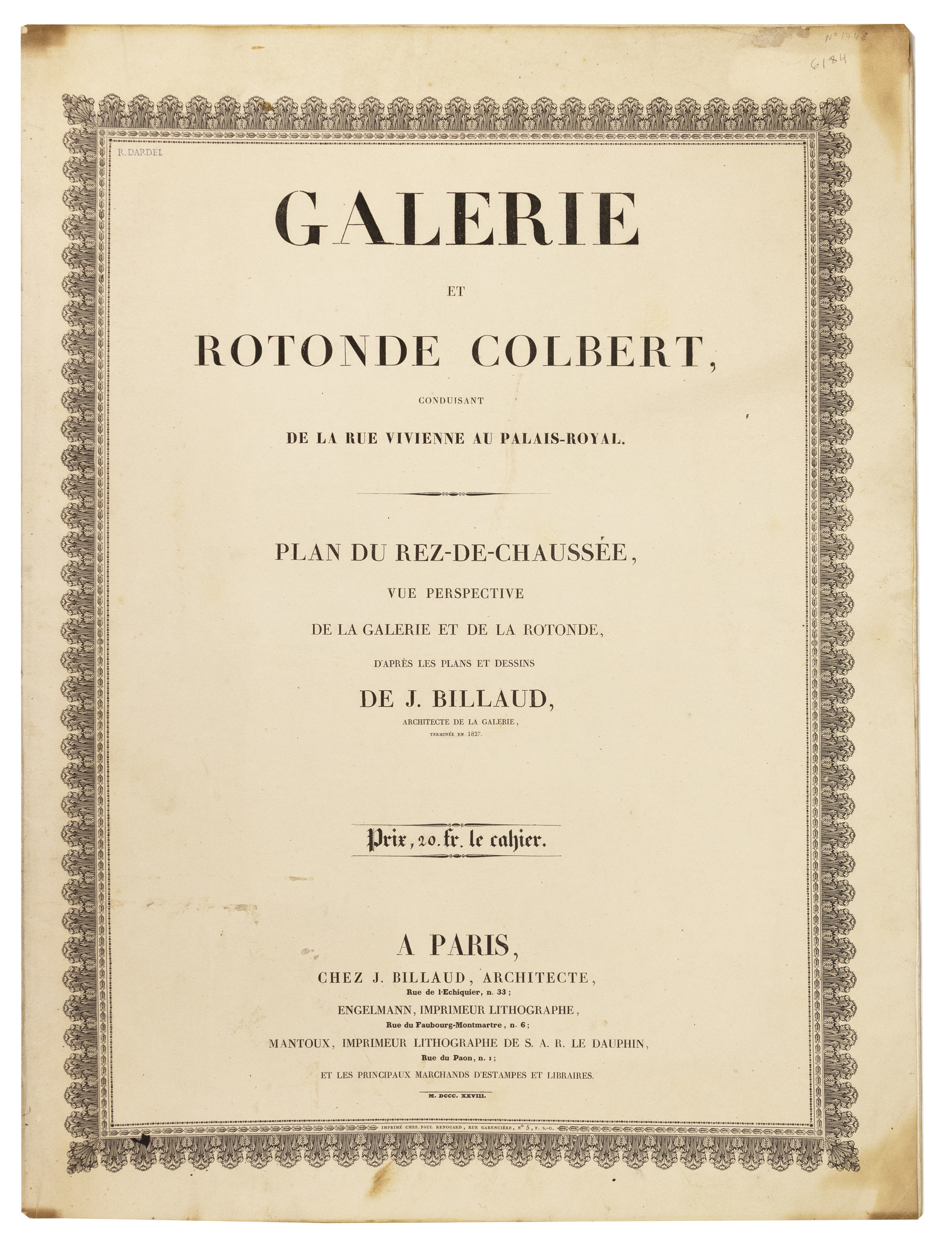
Galerie et Rotonde Colbert conduisant de la rue Vivienne au Palais-Royal. Plan du rez-de-chaussée, vue perspective de la galerie et de la rotonde, d’après les plans et dessins de J. Billaud, architecte de la Galerie, terminée en 1827
- Paris: Chez J. Billaud [et al.], 1828
GALERIE COLBERT, PARIS, NOW PART OF BnF
NO U.S. COPIES
Paris, Chez J. Billaud; Engelmann & Mantoux, Imprimeurs Lithographes; Imprimé chez Paul Renouard, 1828.
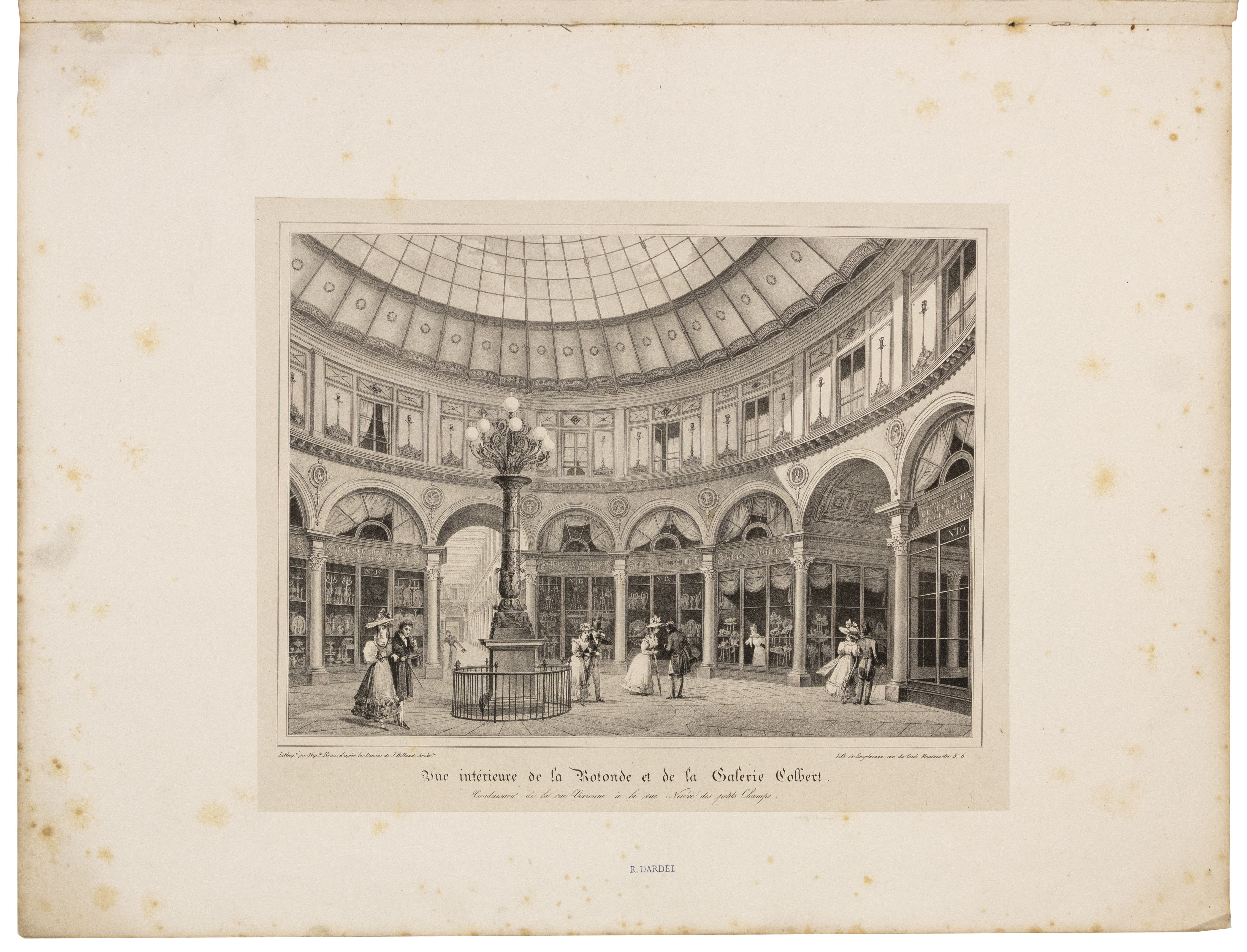
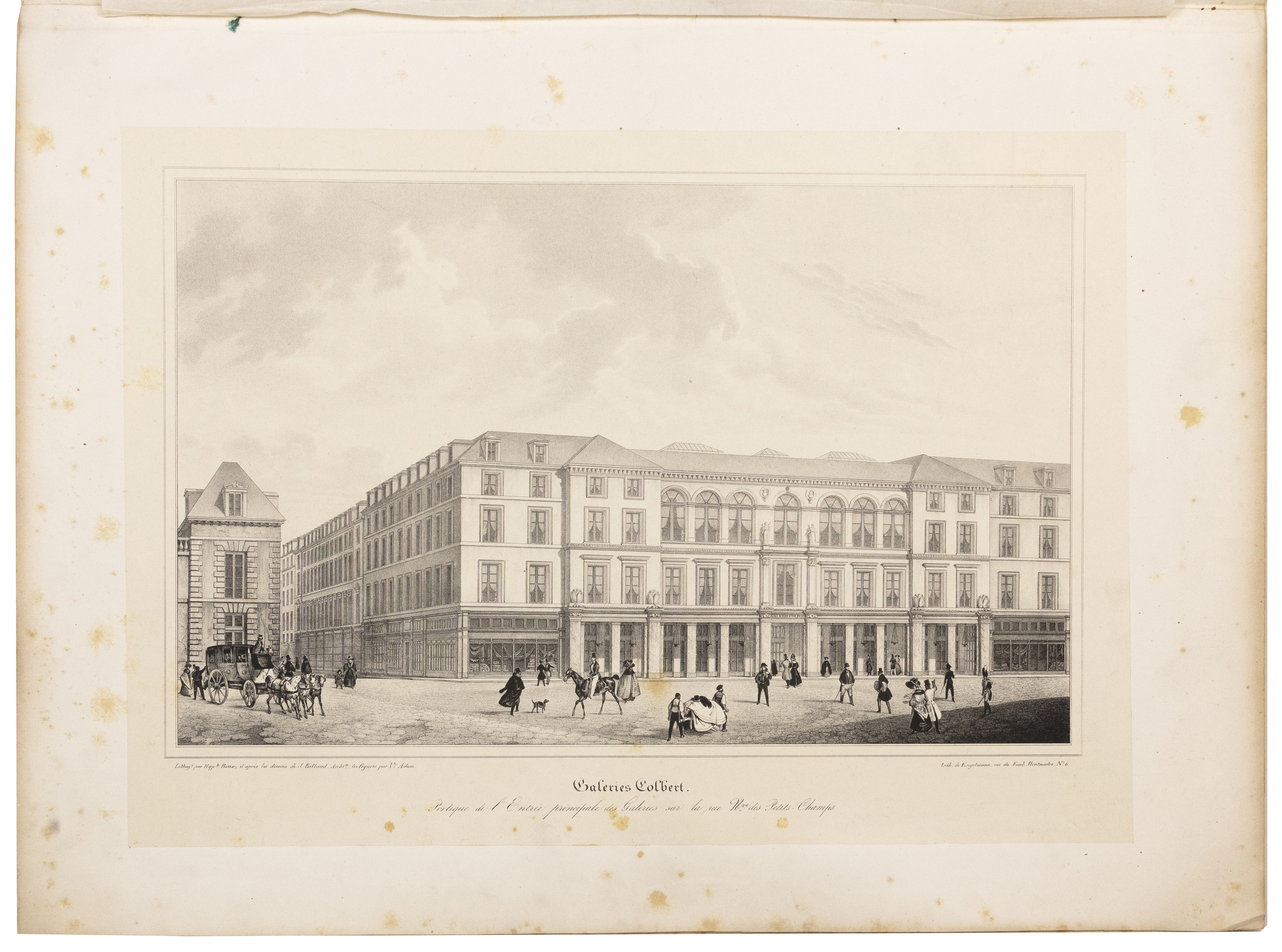
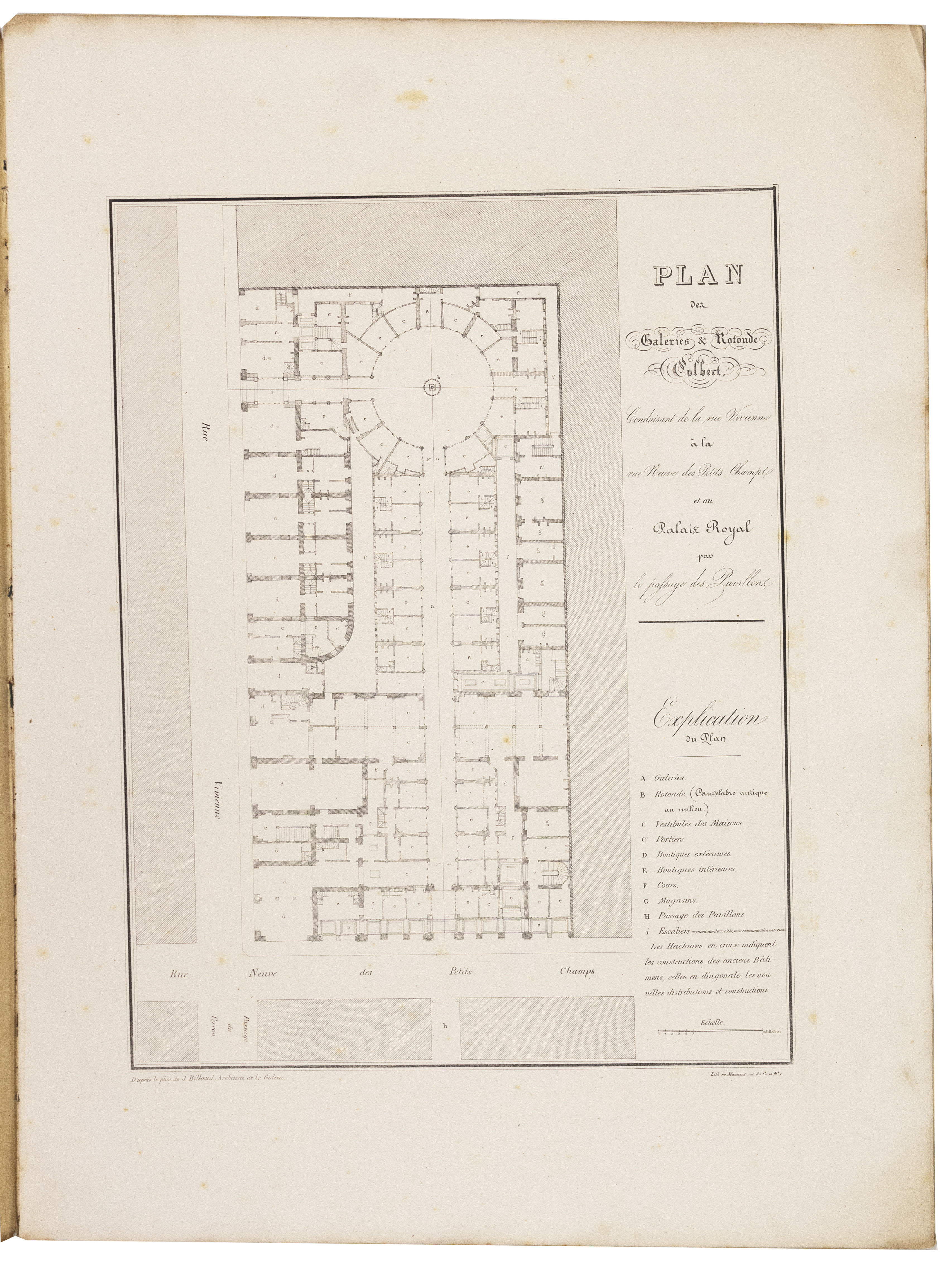
Folio (60.5 x 45.4 cm, 44.5 x 34 cm and smaller at platemark). Letterpress title and four lithographed plates after drawings by Billaud, the first ("Plan des Galeries & Rotonde Colbert…Explication du plan") lithographed by Mantoux, the second ("Vue intérieure de la Galerie et Rotonde Colbert, Prise du passage des Pavillons descendant au Palais Royale") by Levelly and Engelman, the third ("Galeries Colbert, Portique de l'entrée principale des galeries sur sur la rue Nve. des Petits-Champs") by Hyppolite Roux and Engelmann, and the fourth ("Vue intérieure de la Rotonde et de la Galerie Colbert, Conduisant de la rue Vivienne à la rue Neuve des Petits Champs") also by Roux and Engelmann. Plates two through four are printed chine-collé and mounted on heavy paper. Browning and soiling on title, and some spotting to plates, mostly marginal but affecting the image area in the second and third plates. Stitched and housed in a contemporary portfolio of red embossed paper over boards, leather corners; covers soiled and worn, spine renewed in grey cloth. Discreet blue stamp of "R. Dardel" (René Dardel, 1796-1871) on upper corner of title and lower margin of fourth plate.
Rare publication (no U.S. copy) illustrating the newly built glass-covered shopping arcade, Galerie Colbert, linking the Palais Royal to the Galerie Vivienne and now part of the BNF in Paris.
Originally a private residence designed by Louis Le Vau in 1634, the site of the Galerie and Rotonde Colbert has a rich history. Acquired by Jean-Baptiste Colbert in 1665, it was later transformed into stables for the Regent Philippe d'Orléans in the 18th century. After the French Revolution, the building served as a public debt fund.
The 1820s marked a turning point for the site, as the speculator company Adam et Cie purchased it with the ambitious goal of creating a covered shopping arcade to rival the prestigious Galerie Vivienne arcade located nearby. Architect Jacques Billaud realized this vision in 1826, preserving the Rue des Petits-Champs façade and constructing a glass-covered passageway. The Galerie Colbert spanned 83 meters in length and connected no. 6 Rue des Petits Champs to nos. 204 Rue Vivienne. Its original interior featured a large and magnificent rotunda topped with a glass dome, with polychrome decor reminiscent of Pompeian houses that exuded a sense of ancient grandeur. A striking painting of Colbert promoting trade graced the front porch. Soon after the opening of the Galerie Colbert, in 1830, Berlioz performed "La Marseillaise" from one of its windows.
According to the 1833 edition of the Almanach du Commerce de Paris, an eclectic collection of traders soon occupied the Galerie Colbert, including a bookseller (at no. 3), a shoemaker and Chinese sock manufacturer (no. 6), an umbrella maker (no. 13), a gunsmith (nos. 16-18), the Gabriel Pleyel piano store (nos. 23-25), and a hernia truss supplier and manufacturer of belts for children for the prevention of masturbation (no. 28). To attract customers and amuse youngsters, a Géorama—an aerial trompe l'oeil—was installed at the main entrance. Later in the 19th century, the Galerie Colbert also housed a literary cabinet with a 15,000-volume library.
Covered passages like the Galerie Colbert were precursors to modern-day shopping malls. These elegant thoroughfares, built to shelter wealthy Parisians from inclement weather, housed a diverse array of shops and businesses. They were not only for shopping, but also for "flaneries" ( strolling) and were such a cultural phenomenon that they inspired the philosopher Walter Benjamin to write his monumental opus " the Arcade project" representing and critiquing this Parisian bourgeois experience.
The first such covered passage, the Passage du Caire, completed in 1799, was the brainchild of American inventor Robert Fulton, who came to Paris to showcase his steamboat and submarine. Most of these passages were constructed during the first half of the 19th century on the Right Bank of the Seine. The covered passages typically connected two streets, were enclosed with glass ceilings, and were pedestrian-only thoroughfares. They were privately owned and lavishly decorated with ornate details. Shops lined the ground floor, while the upper levels often housed apartments. Initially lit by gas lamps, these passages were hubs of social activity and commerce. By 1867, Paris boasted approximately 183 covered passages. However, many were demolished during Baron Haussmann's extensive urban renewal projects. Additionally, the rise of the grand department stores, or grands magasins, in the 1850s gradually led to their decline.
After a long period of abandonment, the Galerie Colbert was destroyed in 1975 and rebuilt identically by the architect Louis Blanchet (1927-2010), recipient of the Prix de Rome in 1952, for the needs of the National Library of France, which took over the premises in 1985. In 2004, architects Dominique Pinon and Pascale Kaparis transformed the space into a hub for teaching and research for the Institut National d'Histoire de l'Art (INHA). Their renovation project carefully preserved the gallery's iconic Pompeian decor while highlighting the historic elements of the original building. At the entrance to the present-day arcade is the art nouveau style brasserie, Le Grand Colbert, which is listed as a historical monument.
Unfortunately, little can be established regarding Jacques Billaud, the original architect of the Galerie Colbert. One of the lithographers, Godefroy Engelmann (1799-1839), born in Mulhouse, experimented with lithography in the early 1810s and relocated to Paris in 1816. "Engelmann was concerned with lithography throughout his life and at his death left a flourishing press to his son. For twenty years he was responsible for most of the major technical developments of the process… Already by 1820 his was probably the leading press in Europe, and certainly so for that branch of lithography in which France has ever since led the work, the production of artists' prints. More than anyone else in Europe it was Engelmann who, by virtue of his technical improvements, clear descriptions, and skillful printing, encouraged artists to draw on stone; and the real growth of lithography as far as the artist was concerned really dates from the establishment of his press in Paris" (Twyman, pp. 52-55). Engelmann is also remembered for his innovations in chromolithography. The identities of the three other lithographers (Mantoux, Levelly and Roux) involved in the creation of this work remain shrouded in mystery.
René Dardel (1796-1871), whose ownership stamp appears on the title and the fourth plate, was an architect active in the city of Lyon and responsible for several of the city's major monuments, including the Sainte-Blandine church, the fountain of Saint-Jean, and the Palais de la Bourse et du Commerce, inaugurated in 1860 by Napoleon III.
One copy at the Musée de Carnavalet in Paris; no copies traced on OCLC in the U.S.
* Michael Twyman, Lithography 1800-1850, pp. 52-55.
Details
Title
Galerie et Rotonde Colbert conduisant de la rue Vivienne au Palais-Royal. Plan du rez-de-chaussée, vue perspective de la galerie et de la rotonde, d’après les plans et dessins de J. Billaud, architecte de la Galerie, terminée en 1827
Author
BILLAUD, Jacques
Condition
Good
Publisher
Chez J. Billaud [et al.]: Paris
Date
1828