

Autograph Letter Signed, Washington, D.C. Wednesday 23 April 1862, likely sent to an unidentified American Naval Commodore on James’ Rifled Shot and which had just been successfully used at the Battle of Fort Pulaski
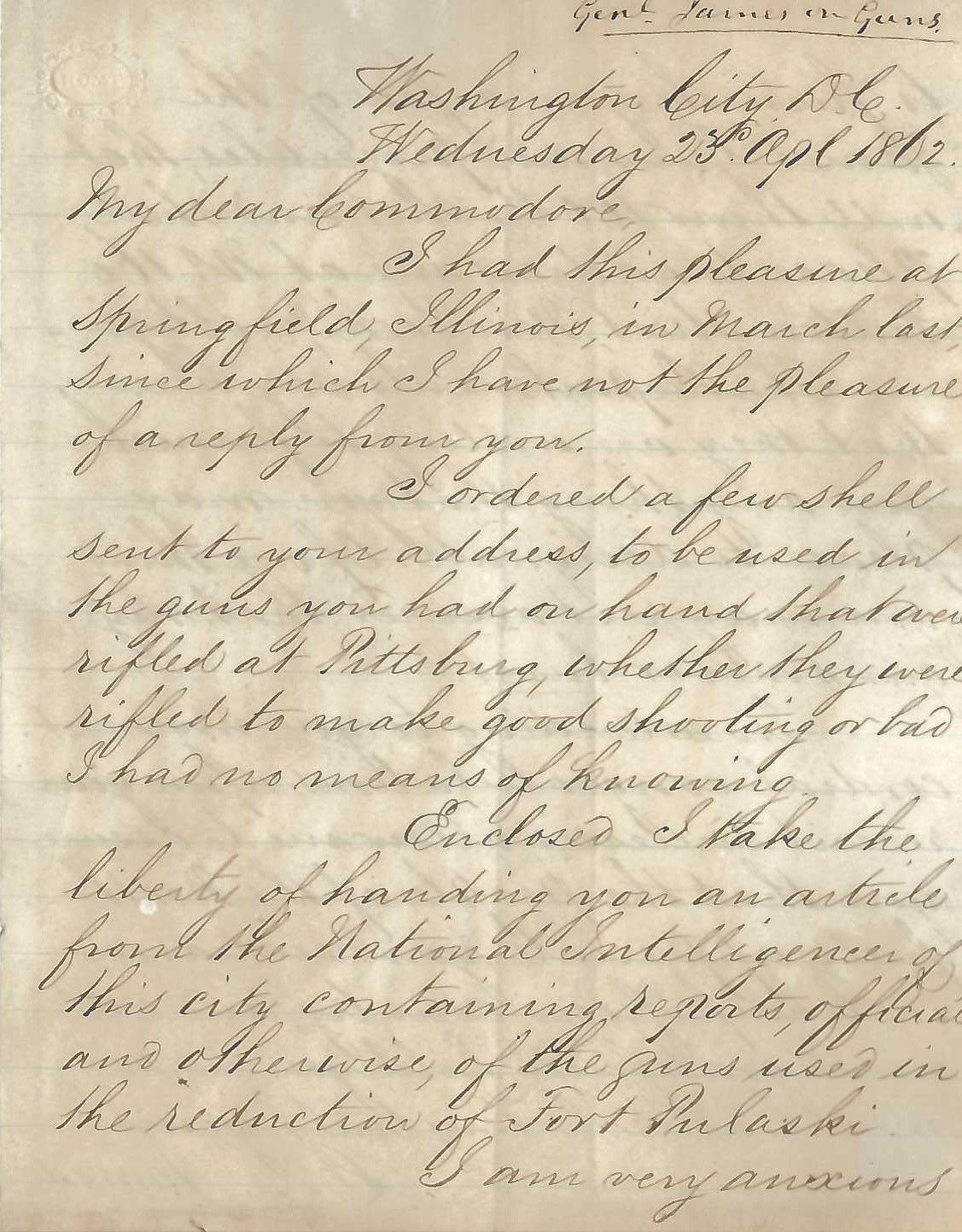
small quarto, two pages, in very good, clean and legible condition.
"My dear Commodore,
I had this pleasure at Springfield, Illinois in March last, since which I have not the pleasure of a reply from you.
I ordered a few shell sent to your address, to be used in the guns you had on hand that were rifled at Pittsburg, whether they were rifled to make good shooting or bad I had no means of knowing.
Enclosed I take the liberty of handing you an article from the National Intelligencer of this city containing reports, official and otherwise, of the guns used in the reduction of Fort Pulaski.
I am very anxious to furnish you a few of the James Guns and projectiles, that will throw 100 lbs shot and shell, please to address me at No 160 Fulton Street, New York and oblige.
In extending to you my most cordial congratulations upon your resent successes, allow me to assure you that the people of the north fully appreciate your endeavors in behalf of our country, and will most gratefully hold you in remembrance. … C. T. James"
James was an expert in textile machinery, construction, an advocate of steam power for cotton mills, U.S. senator, Democrat, from Rhode Island, 1851-1857.
After his retirement from the Senate he devoted himself to the improvement of firearms. James developed a family of early rifled projectiles and a rifling system for artillery that saw use by the Union Army in the American Civil War. He perfected a rifled cannon, a cylindrical bullet with a conical head, and an explosive projectile. The weapon most correctly called a James rifle is a 3.8 in (97 mm) weapon commonly called a 14-pounder James rifle, usually made of bronze; this was the only gun designed entirely by James that saw extensive service. Except for the material, it closely resembles the wrought iron 3-inch Ordnance rifle that saw more widespread use. His rifling system was used to convert pre-war smoothbore M1841 6-pounder field guns,32 -pounder, 42-pounder, and other weapons to rifles firing his projectiles; in some Civil War-era documents these are also called "James rifles". Large-caliber guns with his rifling system and projectiles, along with Parrott rifles, were used in the breaching of Fort Pulaski, near the mouth of the Savannah River, in Georgia, in April 1862; this was probably James' most significant contribution to the war. After the war, the rapid reduction of Fort Pulaski was used to justify stopping work on masonry forts and led to a brief period of new construction of earthwork forts.
On October 16, 1862, during the demonstration of a projectile at Sag Harbor, Long Island, New York, a worker attempted to remove a cap from a shell. It exploded, killing the man and mortally wounding James, who died the next day.
Dictionary of American Biography, vol. v, pp., 572-573
Details
Title
Autograph Letter Signed, Washington, D.C. Wednesday 23 April 1862, likely sent to an unidentified American Naval Commodore on James’ Rifled Shot and which had just been successfully used at the Battle of Fort Pulaski
Author
James, Charles Tillinghast (1805-1862)
Condition
Unknown