

Autograph Letter Signed, New York, December 20, 1845, to his uncle, Luther Jewett, and Aunt, Portland, Maine
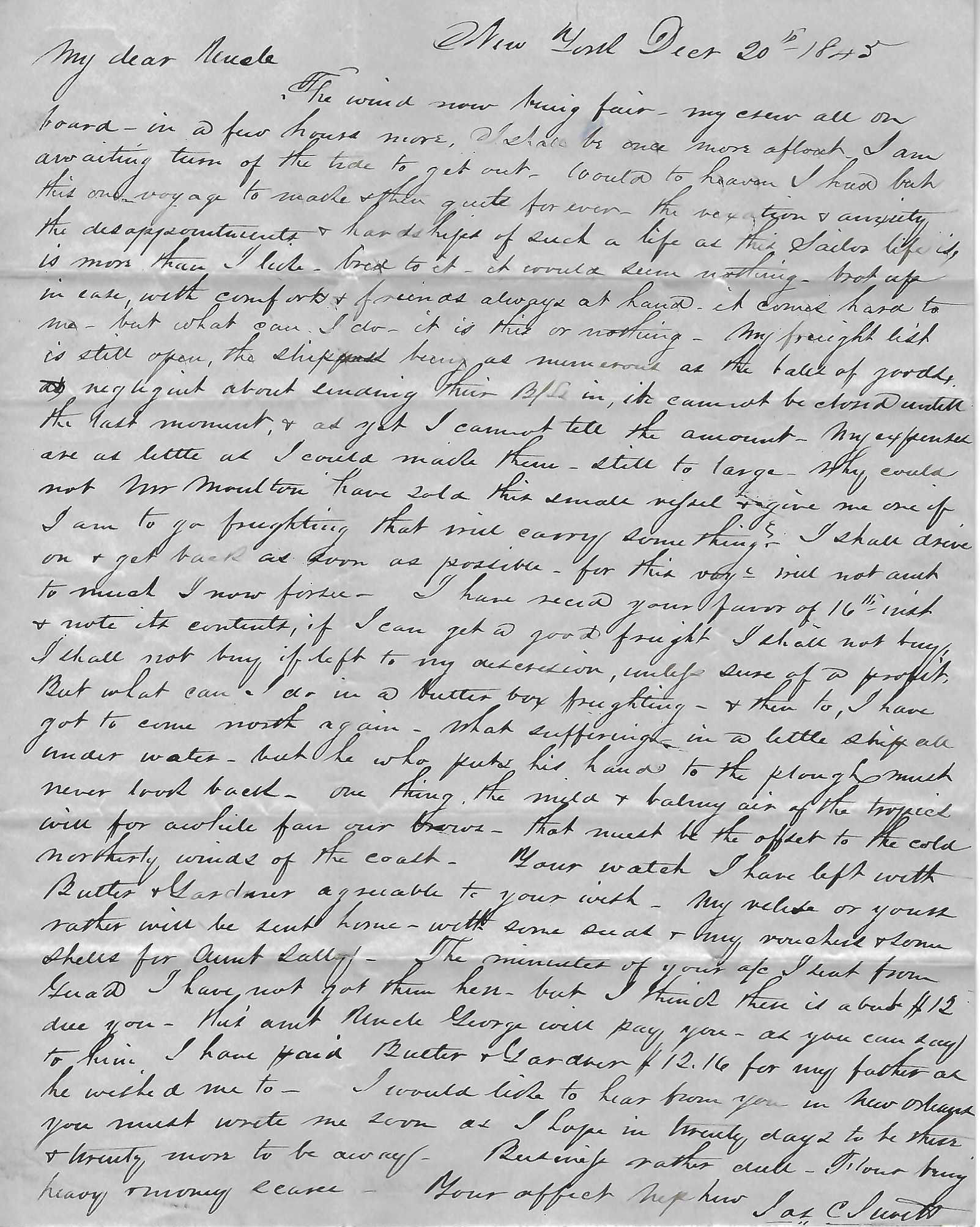
Quarto, 2 ½ pages, plus stamp less address leaf, formerly folded, in very good, clean and legible condition. Jointly written to his uncle and aunt in Portland. Letter from young Maine sea captain who became a "salor of fortune" ad nearly drove Daniel Webster into War.
"My dear Uncle,
The wind now being fair, my crew all on board, in a few hours more, I shall be once more afloat. I am awaiting turn of the tide to get out. Would to heaven I have but this one voyage to make and then quite for ever the vexation and anxiety, the disappointments and hardships of such a life as this Sailors life…it comes hard to me but what can I do. It is this or nothing. My freight list is still open, the shippers being…numerous… negligent … it cannot be closed until the last moment and as yet I cannot tall the amount. My expenses are as little as I could make them, still too large, why could not Mr. Moulton have sold this small vessel and give me one if I am to go freighting…I shall drive on and get back as soon as possible for this voyage will not amount to much I now foresee…But what can I do in a butter box freighting…what suffering in a little ship all under water but he who puts his hand to the plough must never look back. one thing the mild and balmy air of the tropics will fan our brows, that must be the offset to the cold northerly winds of the coast…I would like to hear from you in New Orleans you must write me soon as I hope in twenty days to be there and twenty more to be away. Business rather dull… and money scarce… [To his aunt:] I am now ready for sea. I feel low spirited as I suppose all do who are about to go where they cannot foresee what the day or the hour may bring forth. This the time of year is that when I should have good weather but I am a Jonah on the deep, or the [ship] Floyd is, I can't tell which. I must now forewarn you that you must expect to hear on my arrival the old story of Gales and Storms…You ask how I have spent my evenings? [in New York]… I have been sick…I some time wobbled into Broadway and looked into the windows and walked for miles, tired I went to bed and read myself to sleep…I never have felt so homesick since I first left Portland, mind to turn back and stay longer. I am tired of going to sea, the novelty has worn away and now I only think when will I be able to stay at home again. That will be a long day to that time I fear…. I hope my present voyage will soon be ended. I shall try hard to be back here…I may possibly go to Cuba before I return but I shall come north if possible as I want to go home again very much. I want another vessel and must try and get one under way then, to be ready for me in the fall. I shall write Mr. [Albert?] Averill what I want perhaps I may succeed in buying the one he speaks of…"
Jewett did sail to Cuba in the ship Floyd, but it was only the beginning of his seafaring career. He found a bigger vessel, the Bark Philomela, began making regular runs from Mobile to Cuba and the West Indies during the Mexican-American War – and soon ran afoul of US authorities, being indicted in Boston in 1849 for having one of his sailors jailed for a week in Curacao "without cause". He may have escaped punishment because he was soon busy ferrying adventurers "around the Horn" from Maine to San Francisco during the California Gold Rush. Then, two years later, he began an escapade that nearly caused a war. It began when Jewett, captain of the Bark Philomela, wrote to Secretary of State Daniel Webster, asking if some tiny islands, small barren rocks in the ocean lying off Peru's coastline, were open to "exploitation" by US citizens. The islands were rich with guano – the nitrogen-rich dung of sea birds used extensively as fertilizer by American farmers, especially southern cotton growers. Peru had a treaty agreement with the US guaranteeing its monopoly of the guano exports to America, worth more than their weight in gold. Thousands of American farmers had vocally complained to Washington about the monopolistic cost of the fertilizer, but Peru had refused to budge on lowering the price. That was when Jewett, in partnership with a New York entrepreneur, made his inquiry, which seemed innocent enough, merely asking if American citizens had a right to take guano from the few "uninhabited and unoccupied" islands which were not the principal source of Peruvian guano - but held the potential of many millions of dollars for anyone who could exploit the resource.
Webster, misinformed, believing that those islands had originally been "discovered" long before by an American sea captain, and were not, therefore, Peruvian territory, decided that it was the "duty" of the Government to use US Naval force to protect American citizens who wanted to exploit the islands. With the approval of President Fillmore, he so informed Jewett. With Webster's official assurances in hand, Jewett and his partner assembled a flotilla of forty ships, armed with cannon, to take possession of the islands, land a work party of a hundred men, and, if necessary, solicit US Naval support. The President, informed of these plans, remarked that it would take a "miracle" to avoid war with Peru. Webster, alarmed, quickly countermanded orders to the Navy to support Jewett's filibustering expedition, and, through slow diplomacy, eventually contradicted his own letter to Jewett, officially conceding Peru's sovereignty over the islands. Meanwhile, he informed Jewett (who, he insisted, had misled him) that he would receive no US military support for any adventure he might launch off the Peruvian coast. The crisis ended, with Webster later confiding to a friend that no other diplomatic snafu, during his years at the State Department, had given him so much trouble.
There is no historical record of the personal consequences of this crisis for Jewett or the fate of his maritime expedition, but it was not his last appearance on the historical stage. In 1858, Mexico, being quietly eyed by France's Napoleon III for future conquest, was thrown into a three- year civil war. Jewett was hired by the Mexican Government to help suppress a conservative insurrection, using a steamer he owned to convey troops to Vera Cruz, in return for the opportunity to buy thousands of tons of scrap iron from the Government at bargain prices. He carried out his mission, capturing two rebel vessels and the noblemen who had led the revolt. But when he came to take the iron, he had been promised it had already been sold. Not until thirty years later did Jewett receive recompense after filing a court suit.
Meanwhile, he had other plans. When the American Civil War began, he sold some of the ships he owned, which had been carrying cargoes to China, to the US Navy. As he also owned a New York shipyard, he then contracted with the Imperial Chinese Government to build gunboats, on the American model, for the Chinese Navy – the first Chinese warships ever constructed on American soil Some of these actually made it to China; others were snapped up by the US Navy to use in battle with the Confederacy. After the War ended, Jewett had enough wealth to form a Steamship Navigation Company which intended building vessels to sail the world over – to China, Egypt and Africa.
There is no record of whether Jewett died a rich man in 1900. But it was certainly clear that the young Captain who had complained to his uncle fifty years earlier that he had tired of going to sea, overcame those youthful reservations.
Details
Title
Autograph Letter Signed, New York, December 20, 1845, to his uncle, Luther Jewett, and Aunt, Portland, Maine
Author
Jewett, James C.
Condition
Unknown