

Autograph Letter Signed, Middle Haddam, Connecticut, November 19, 1813, to his son, David Selden, Liverpool, England, c/o Ogden, Richards and Selden
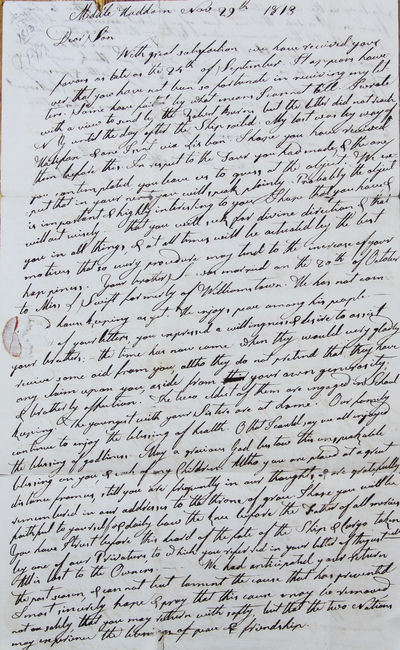
folio, 2 pages, plus stamp less address leaf, separated along several folds, repaired at some point with non-archival tape, otherwise in good, clean, legible condition. 1813 letter describing the Personal and business problems of an Anglo-American family in the second year of the War of 1812.
"Dear Son,
...you have not been so fortunate in receiving my letters. Some have failed by what means I cannot tell. I wrote with a view to send by the Robert Burton but the letter did not reach NY until the day after the Ship sailed. My last was by way of Halifax and one I sent via Lisbon. I hope you have received them before this. ...In respect to the Tour you had made and the one you contemplated you leave us to guess at the object. We expect that in your next you will speak plainly. Probably the object is important and highly interesting to you. I hope that you have and will act wisely, that you will seek for divine direction and that you in all things and at all times will be activated by the best motives that so every procedure may tend to the increase of your happiness. Your brother was married on the 20th of October to Miss L. Swift formerly of Williamstown. He has not [commenced?] housekeeping as yet. He enjoys peace among his people... you expressed a willingness and desire to assist your brothers - the time has now come when they could very gladly receive some aid from you, altho they do not pretend that they have any claim upon you, aside from your own generosity and brotherly affection...Our family continue to enjoy the blessing of health. O that I could say we all enjoyed the blessing of godliness. May a gracious God bestow this unspeakable blessing on you and each of my children. Altho you are placed at a great distance from us, still you are frequently in our thoughts….
You have I trust before this heard of the fate of the Ship and Cargo taken by one of our Privateers… It is lost to the Owners. We had anticipated your return the past season and cannot but lament the cause that has prevented and most sincerely hope and pray that this cause may be removed not solely that you may return with safety but that the two Nations may experience the blessings of peace and friendship. So long as the war continues you cannot expect very often to hear from us. It is rare that we [hear?] of any direct conveyance and I think it probable that the communication between the two Nations will be more and more interrupted. I hope you will improve all opportunities to write to us and communicate whatever you think may be useful. The circle of our friends continue to enjoy health and prosperity...."
The writer, Rev. David Selden, was the long-time Pastor of a Congregational Church in Connecticut. His son, David, born in 1785, became confidential clerk to a New York City merchant. He travelled a good deal and on a visit to Charleston at the age of 23, he wrote his father (in a letter now held by the Smithsonian) of "the most distressing sight I ever beheld" – 4000 African slaves, "naked and lous'y", offered for sale at auction, "to him who will give the most." Selden was also sent to Europe several times to buy goods, and it may be that he found England more humane in its distaste for the slave trade. For whatever reason, after marrying an American girl, he decided to settle in Britain and form a shipping firm based in Liverpool, with one American and one British partner. His father's letter suggests that the son was somewhat prosperous – at least until the 1812 War proved hazardous to transatlantic commerce. Eventually, he and his family – he had 11 children, five of them born in England – returned to America, where he died, one month before the start of the Civil War.
The ill-fated ship mentioned by the father was probably the St. Lawrence, which sailed from Liverpool with a cargo of iron and was captured in June 1813 by the "private armed vessel" (privateer) America. As the owners were Americans, while the ship was British, the fate of the cargo and the vessel itself became the subject of a protracted lawsuit that was eventually resolved by a decision of a US District Court. It was symbolic of the complications, both commercial and personal, that faced an American expatriate with one foot in the US and another in England during the long war between the two nations to which he might owe divided allegiance.
Beyond the letter on slavery at the Smithsonian, other Selden papers are held by the Vermont Historical Society.
Details
Title
Autograph Letter Signed, Middle Haddam, Connecticut, November 19, 1813, to his son, David Selden, Liverpool, England, c/o Ogden, Richards and Selden
Author
Selden, David
Condition
Unknown