

Wissenschaftliche Ergebnisse der Deutschen Tiefsee-Expedition auf dem Dampfer "Valdivia" 1898–1899
[Scientific results of the German deep-sea expedition on the steamer "Valdivia" 1898–1899]
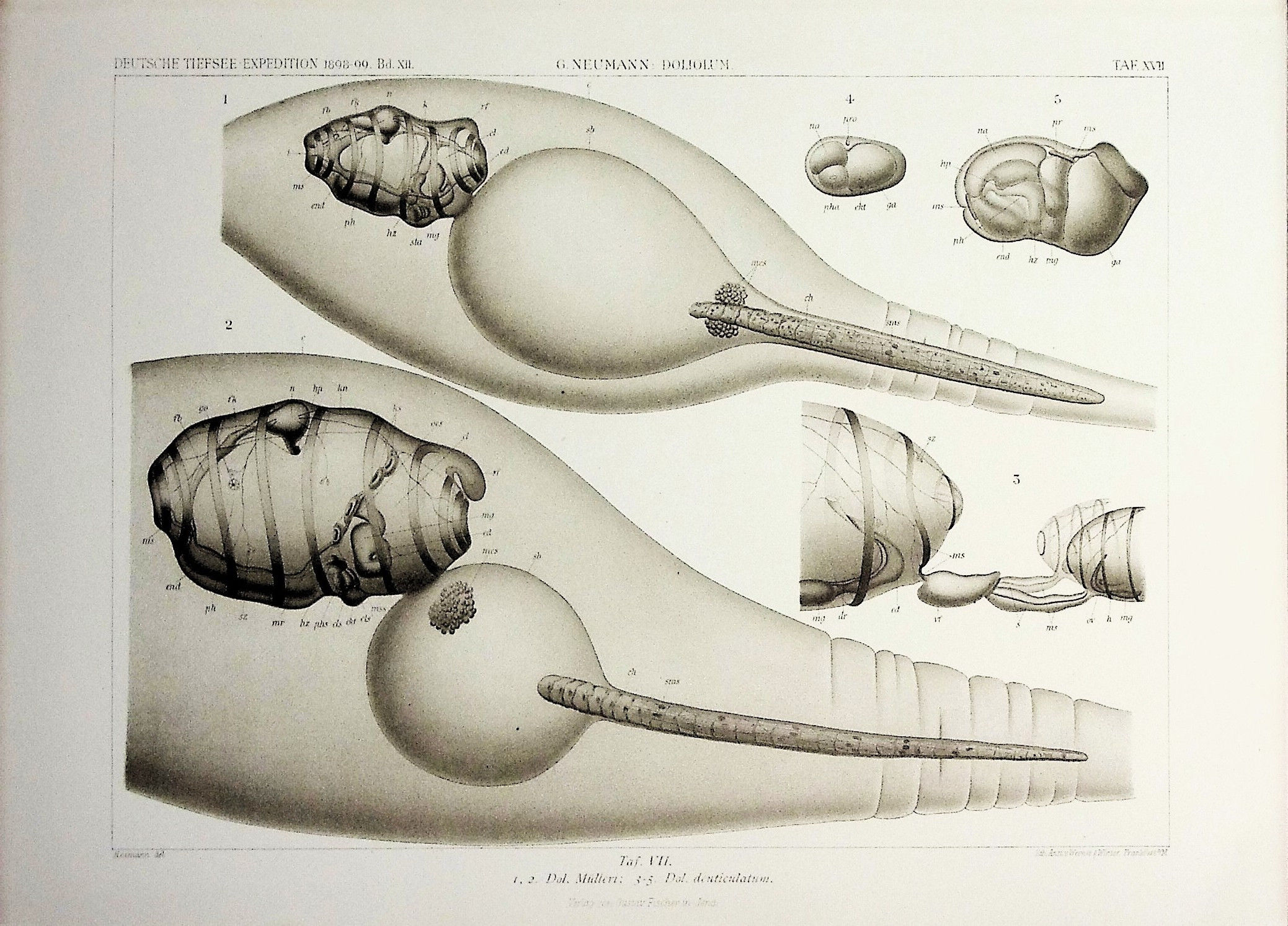
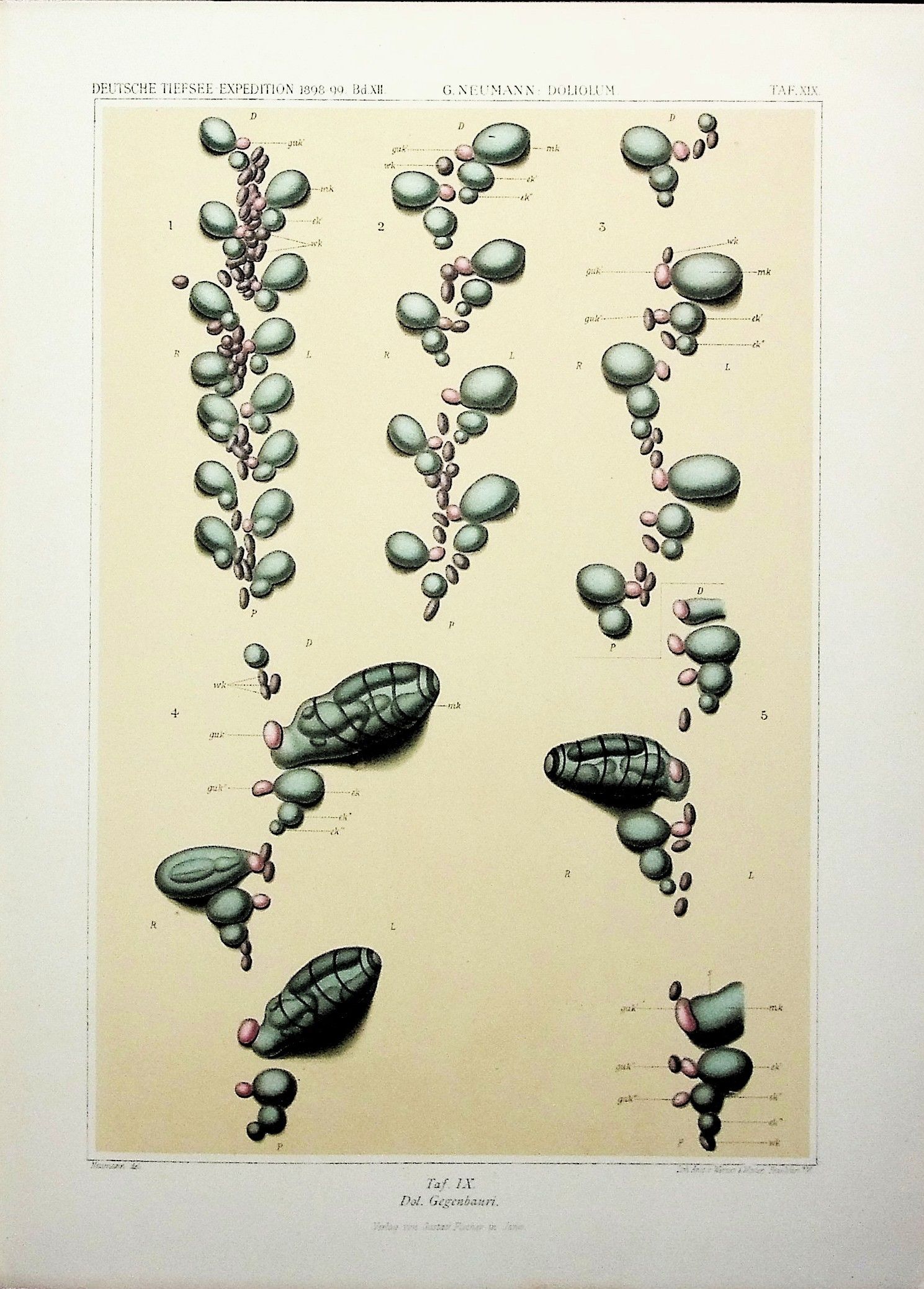
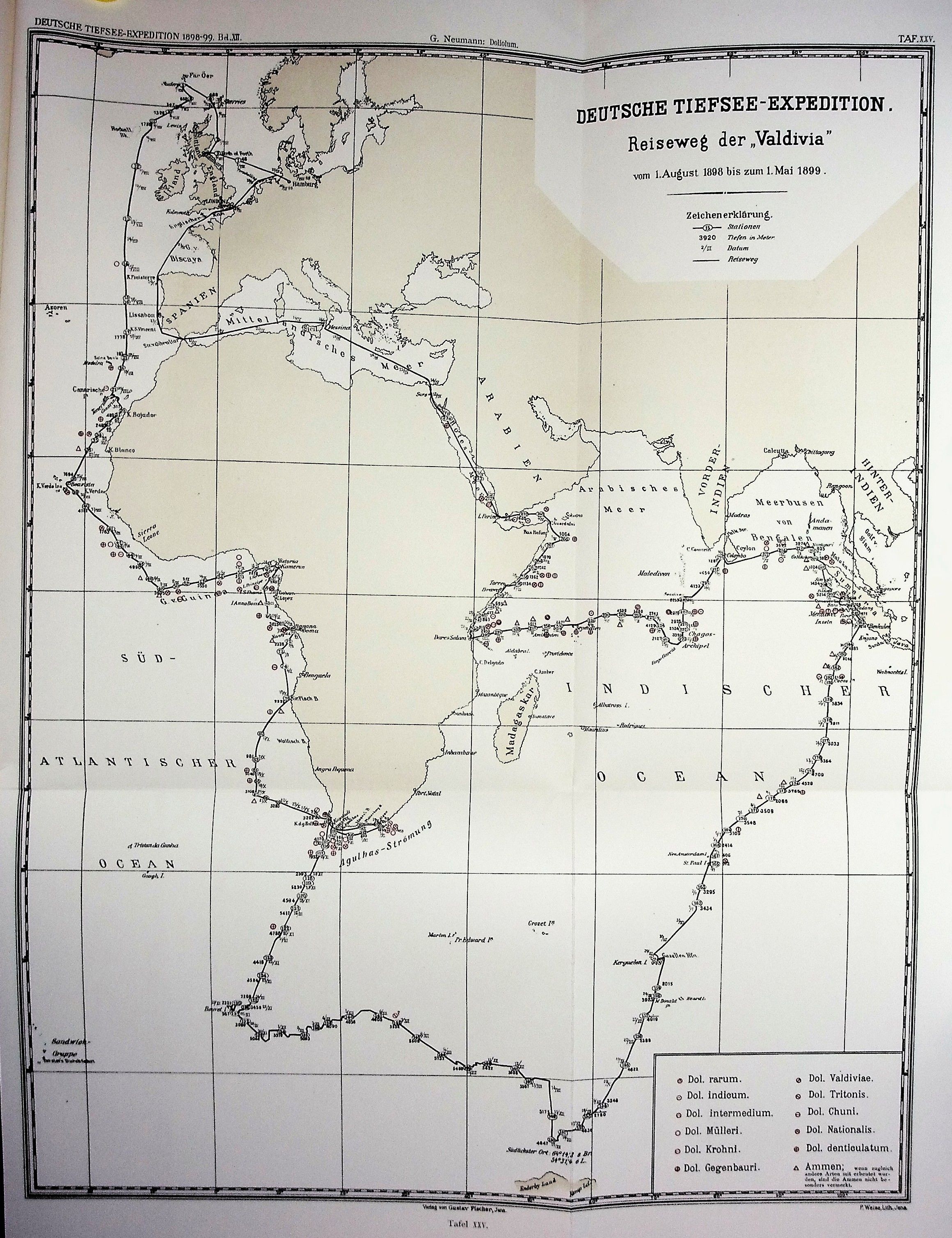
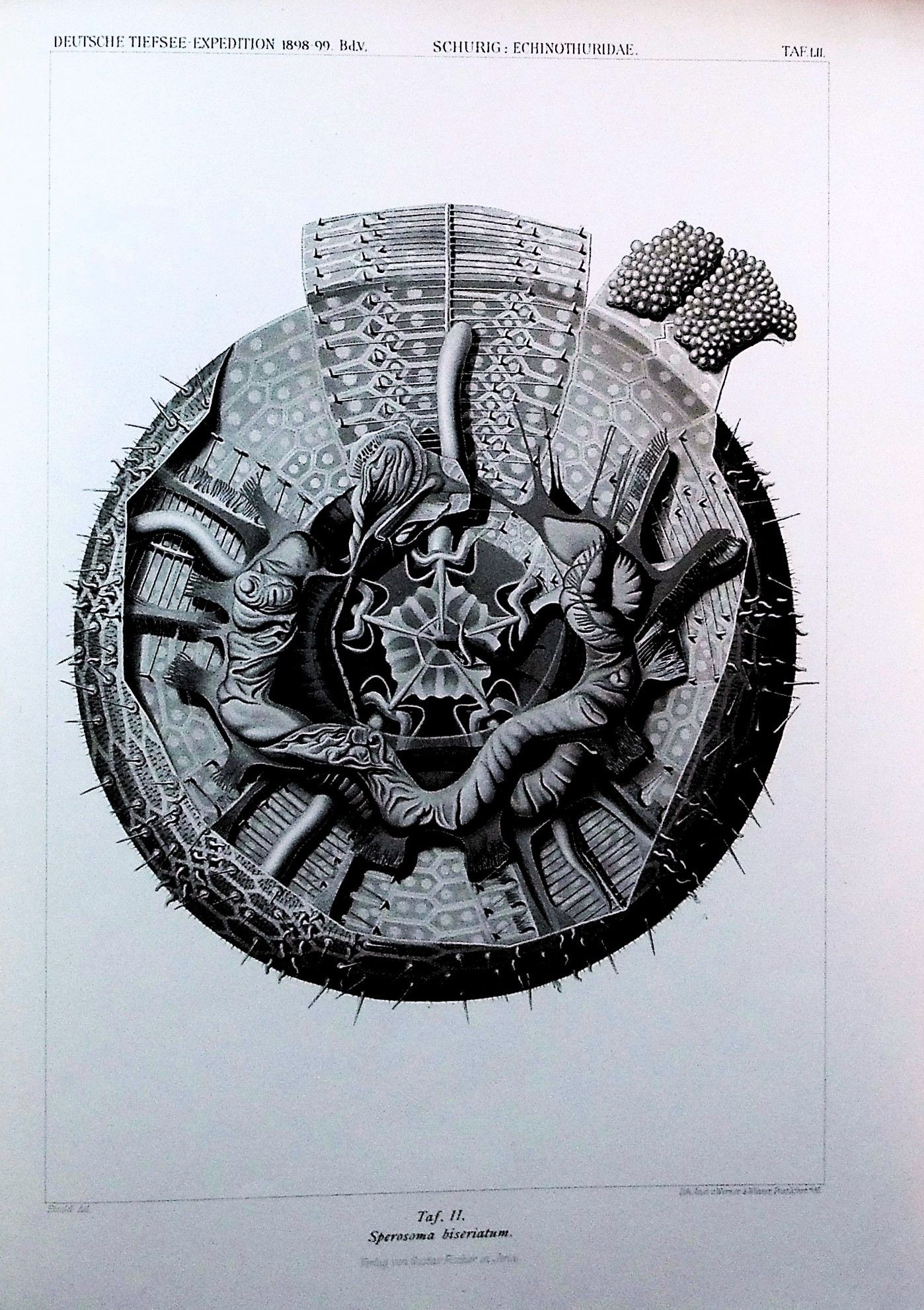
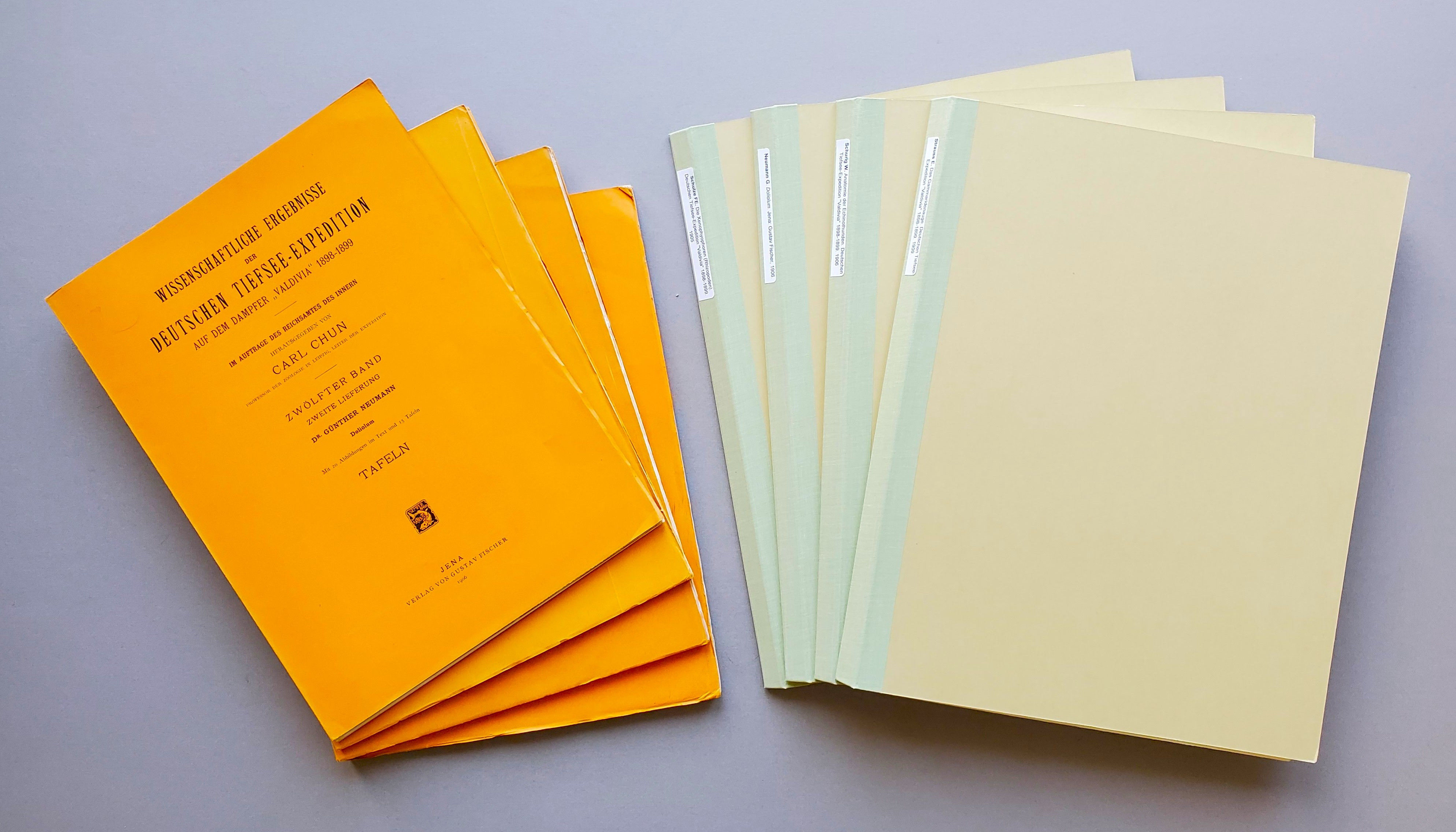
- Printed paper wraps in archival folders
- Jena: Gustav Fischer, 1905, 1906, 1909
Jena: Gustav Fischer, 1905, 1906, 1909. First edition, first printing.
4 ORIGINAL MONOGRAPHS FROM THE VALDAVIA EXPEDITION OF 1898-1899 WITH FINE LITHOGRAPHIC PLATES AND MAPS.
The Valdivia Expedition, or Deutsche Tiefsee-Expedition (German Deep Sea Expedition), was a scientific expedition organized and funded by the German Empire under Kaiser Wilhelm II and was named after the ship which was bought and outfitted for the expedition, the SS Valdivia. It was led by the marine biologist Carl Chun and the expedition ran from 1898-1899 with the purpose of exploring the depths of the oceans below 500 fathoms, which had not been explored by the earlier Challenger Expedition. In the mid-19th century most scientists adhered to the Abyssus theory which posited that it was not possible for life to exist below 300 fathoms depth.
CARL CHUN (1852 – 1914) was a German marine biologist and a pioneer of oceanographic research. He held a deep conviction that there must be abundant life in the unknown abyssal regions of the oceans and he proposed that the German Empire organize its own expedition which was to be nationally funded with the approval of the Kaiser. The Valdivia set sail from Hamburg on 1 August 1898 and made its first call at Edinburgh, where the scientists visited the offices of The Challenger Expedition Commission. The expedition then sailed north, entering the Atlantic between the Faroe Islands and the Shetland Islands and then turning south towards the Canary Islands and the west coast of Africa, reaching Cape Town on 26 August. They then explored a major part of the Indian Ocean and the Antarctic Ocean, covering a total of 32,000 nautical miles. The main aims of the expedition were to collect as many biological specimens as they could while focusing on how organisms adapted to the extreme conditions of the environment of the deep oceans. After organizing the first deep-sea expedition aboard the Valdivia he spent his life studying the collections made during the expedition, and was responsible for discovering many marine organisms. These were published over the ensuing 40 years in 24 volumes as Wissenschaftliche Ergebnisse der Deutschen Tiefsee-Expedition auf dem Dampfer "Valdivia" 1898–1899 (Scientific results of the German deep-sea expedition on the steamer "Valdivia" 1898–1899). Offered here are 4 slim folio volumes, 34.5 x 25.5 x 0.5 cm, in orange printed paper wraps: the installments as originally published. The large folio format accommodates the fine color lithographs and maps that were printed by Werner and Winter of Frankfurt, specialists in scientific illustration, and by Giltsch Lithographische Anstalt, the lithographers in Jena who produced the illustrations for Kunstformen der Natur after drawings by Ernst Haeckel. Light soiling to covers, some chipping to paper spine ends, small Aquatic Institute handstamp to bottom of each title page—no other marks. Very good with each volume encased in an archival 4-flap folder with stiff card covers and cloth spine.
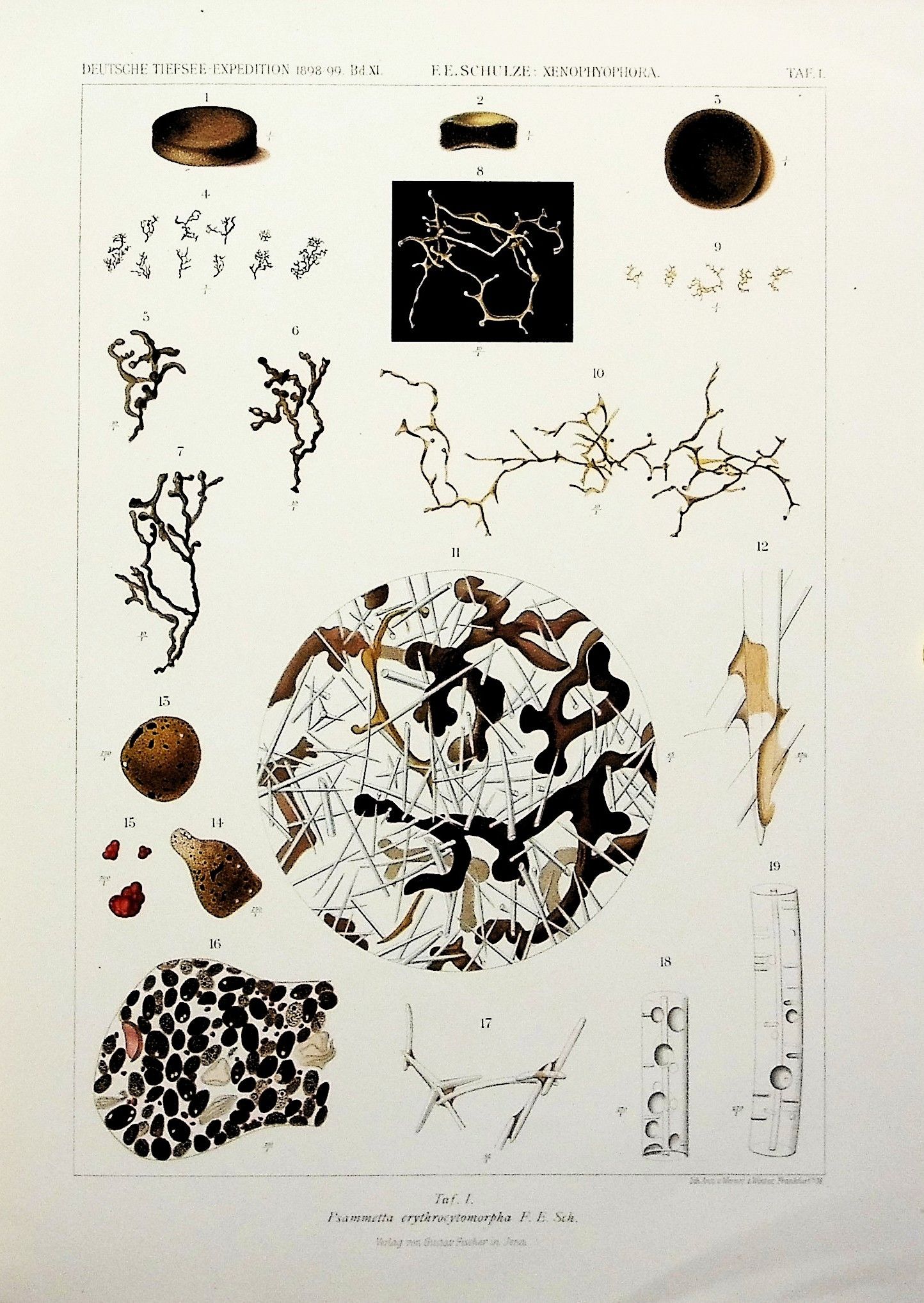
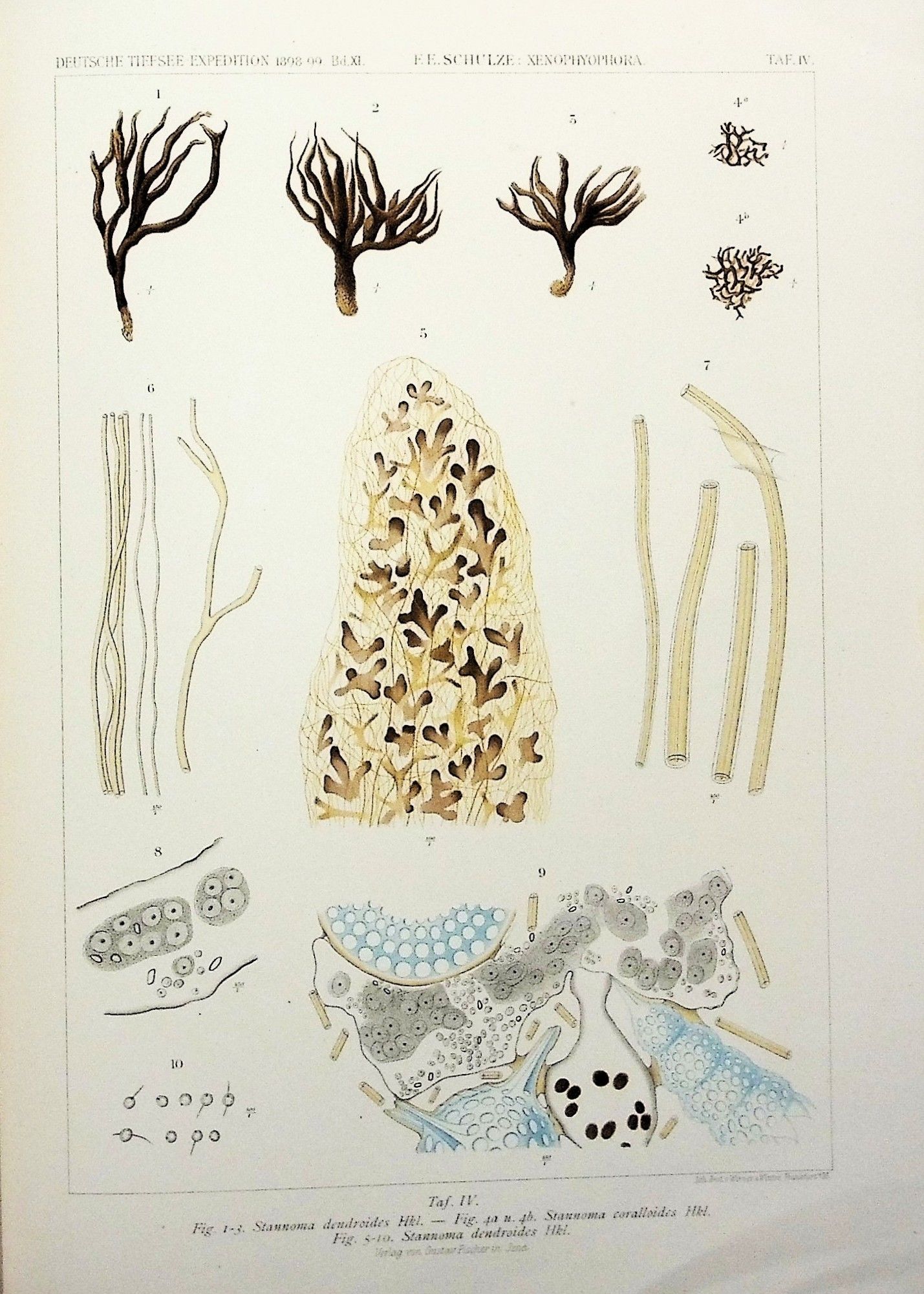
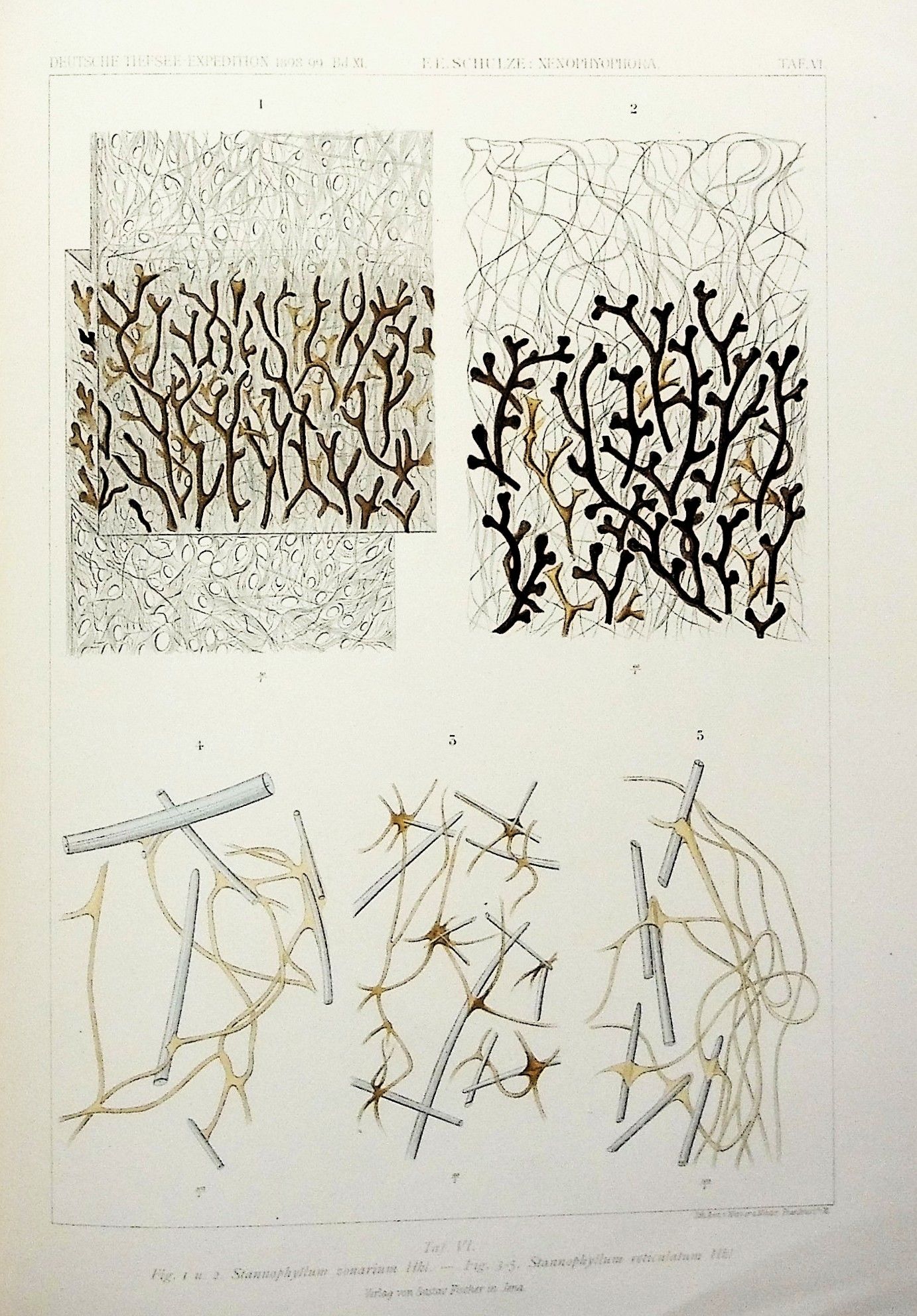
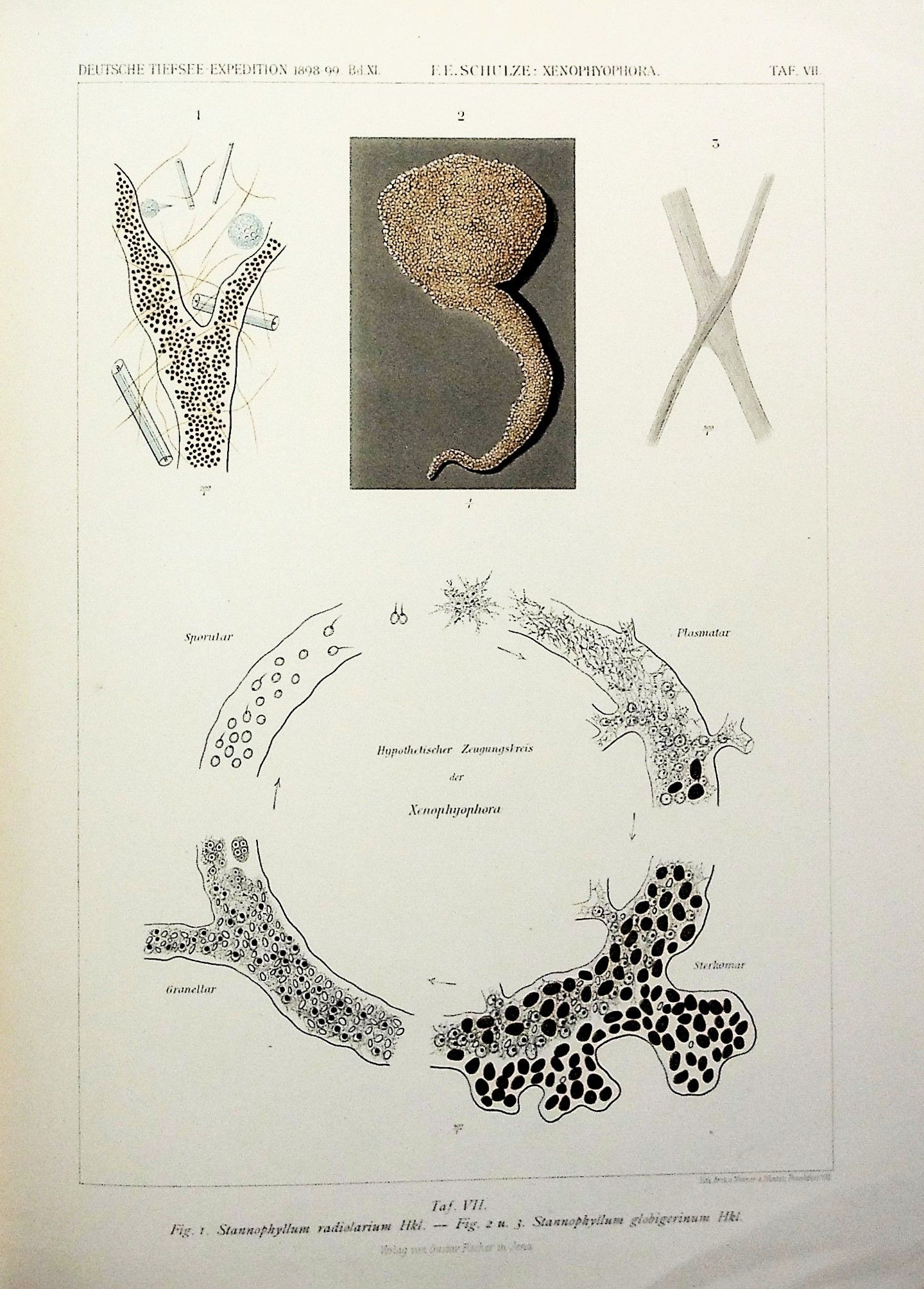
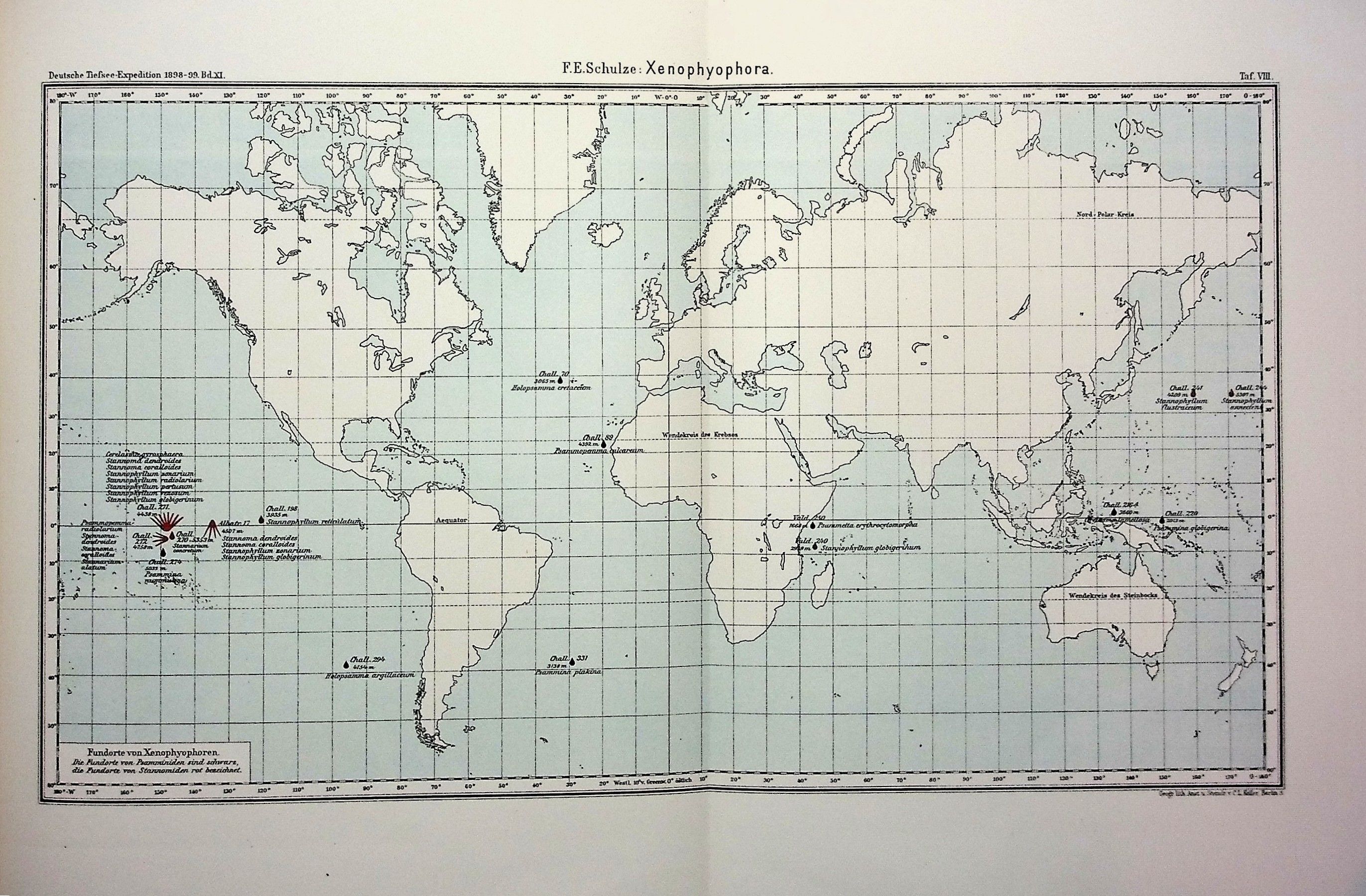
1) 1905 Die Xenophyophoren, eine besondere Gruppe der Rhizopoden [The Xenophyophores, a distinct group of rhizopods] by Franz Eilhard Schulze (1840-1921). Text 55 pp, 7 color plates with facing descriptive text, 46 x 31 cm color folding map of the world showing the location of collected xenophyophores. Recent molecular analysis has confirmed that Xenophyophores belong to the phylum Foraminifera, although they have previously been classified as sponges, rhizopods and even a completely new phylum. They live exclusively in the deep-sea and use their amoeba-like pseudopodia to build elaborate houses from the surrounding sediment and other materials (one species builds exclusively from glass sponge spicules) – an amazing feat for a single cell! These 'tests' include a range of structures including fans, globules, and brain-like masses. The tests are premium real estate in the muddy expanses of the deep-sea, often supporting other animals such as brittlestars, isopods, and polychaete worms. Perhaps unsurprisingly, environments with xenophyophores have higher biodiversity than similar environments without them. Most xenophyophores are epibenthic, living on the surface of the seafloor, but some may extend their cytoplasm beneath the sediment. Xenophyophores are incredibly fragile and difficult to collect from their deep-sea habitats, and this is one of the reasons we know so little about their life history or ecosystem function.
2) 1906 Doliolum by Gunther Neumann. 14 plates with facing descriptive text (11 color, 2 uncolored, 1 white on black background), 38.5 x 52.5 cm color folding map tracing the voyage of the Valdivia. The Doliolida are an order of Tunicates, small marine chordates 1–2 mm long and barrel-shaped. Most are filter-feeding free-swimming plankton; cilia pump water through the body which drives them forward. As the water passes through, small particles and plankton on which the animal feeds are strained from the water by the gill slits. Doliolids can also move by contracting the muscular bands around the body creating a temporary water jet that thrusts them forward or backward. Doliolids alternate through sexual and asexual generations. The sexual generation consists of individuals featuring eight muscle bands, each having male or female gonads. Asexual individuals produce mature progeny asexually. The "nurse" produces buds (which grow into new zooids) in its ventral stalk, but the buds grow and mature on its dorsal stalk. Each bud is an aggregate of a few dozen cells. Buds are immobile, but are actively carried by phorocytes--mobile cells. They develop into spoon-shaped zooids that supply food for the whole colony via a common blood circulation. Finally, when the two phorozooid rows on the nurse's stalk are filled up and the first phorozooids grow big enough, the phorocytes begin to plant subsequent buds on the stalks of phorozooids, which are still attached to the main colony at this point. Only this third batch of buds eventually grows into gonozooids - the sexual generation. Gonozooids detached from the phorozooid swim free, mate, and produce fertilized eggs - from which spring the next generation of asexual zooid "factories", and the cycle repeats. The total number of zooids produced by a single nurse colony can reach tens of thousands - explosive growth unusual in the animal kingdom.
3) 1906 Anatomie der Echinothuriden [Anatomy of the Echinothurioids] by Walther Schurig. [1], 293-350 pp, 22 figures in text, 2 Lithographic plates with transparent overlays by Werner & Winter, 2 lithographic plates (1 color) by Giltsch Lithographische Anstalt. Unopened. Echinothurioids are distinguished from other sea urchins by the combination of a flexible test and hollow spines. The membrane around the mouth contains only simple plates, in contrast to the more complex mouth parts of their close relatives, the Diadematoida. They are nearly all deep sea dwellers. Echinothurioids are nearly all found on the seabed at abyssal depths. For many years, echinothurioids were believed to be extinct, being only known from fossils. Their fossils are rare because the test tends to disintegrate after the echinoderm dies, and the only parts to be preserved are detached plates and spines.
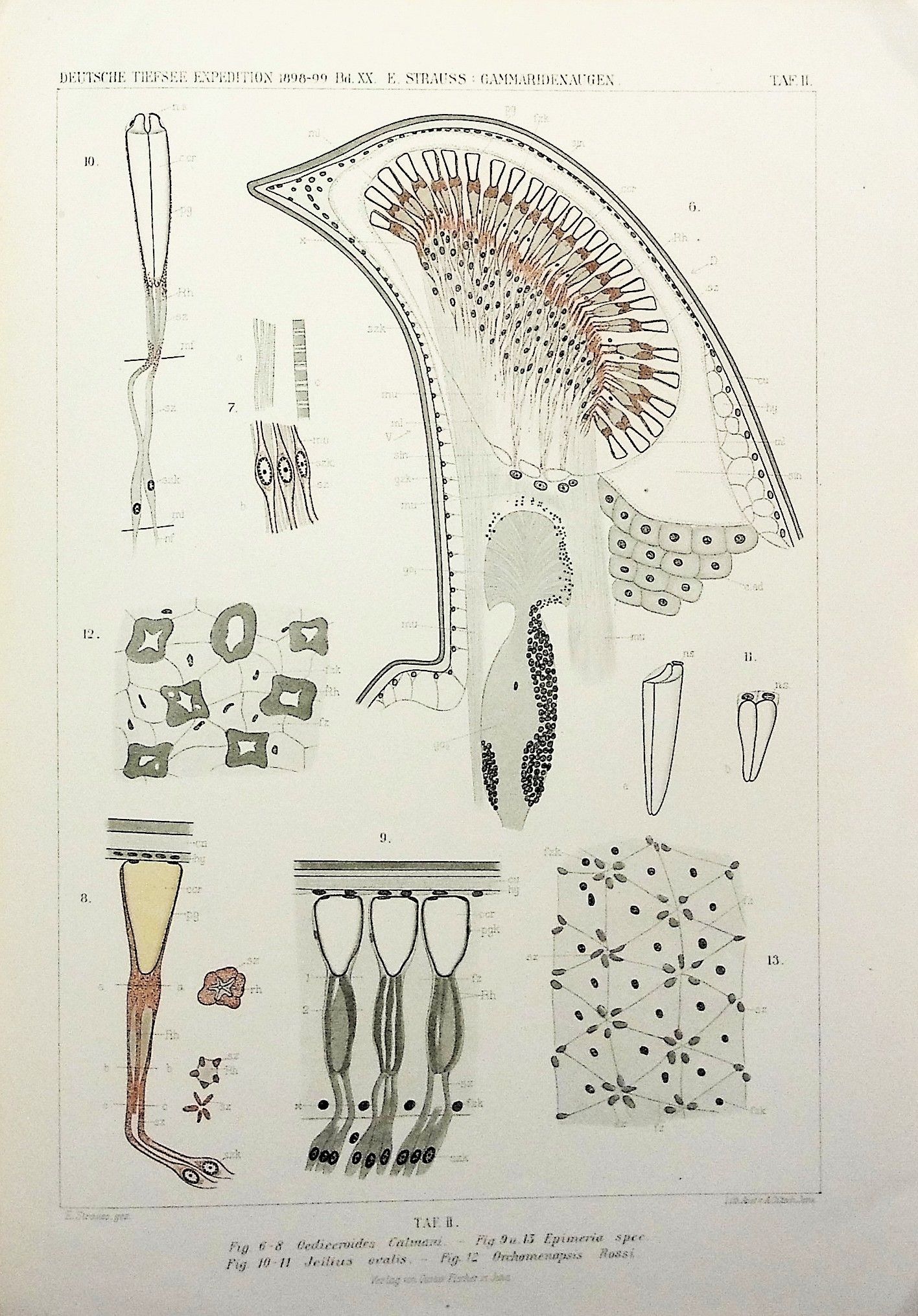
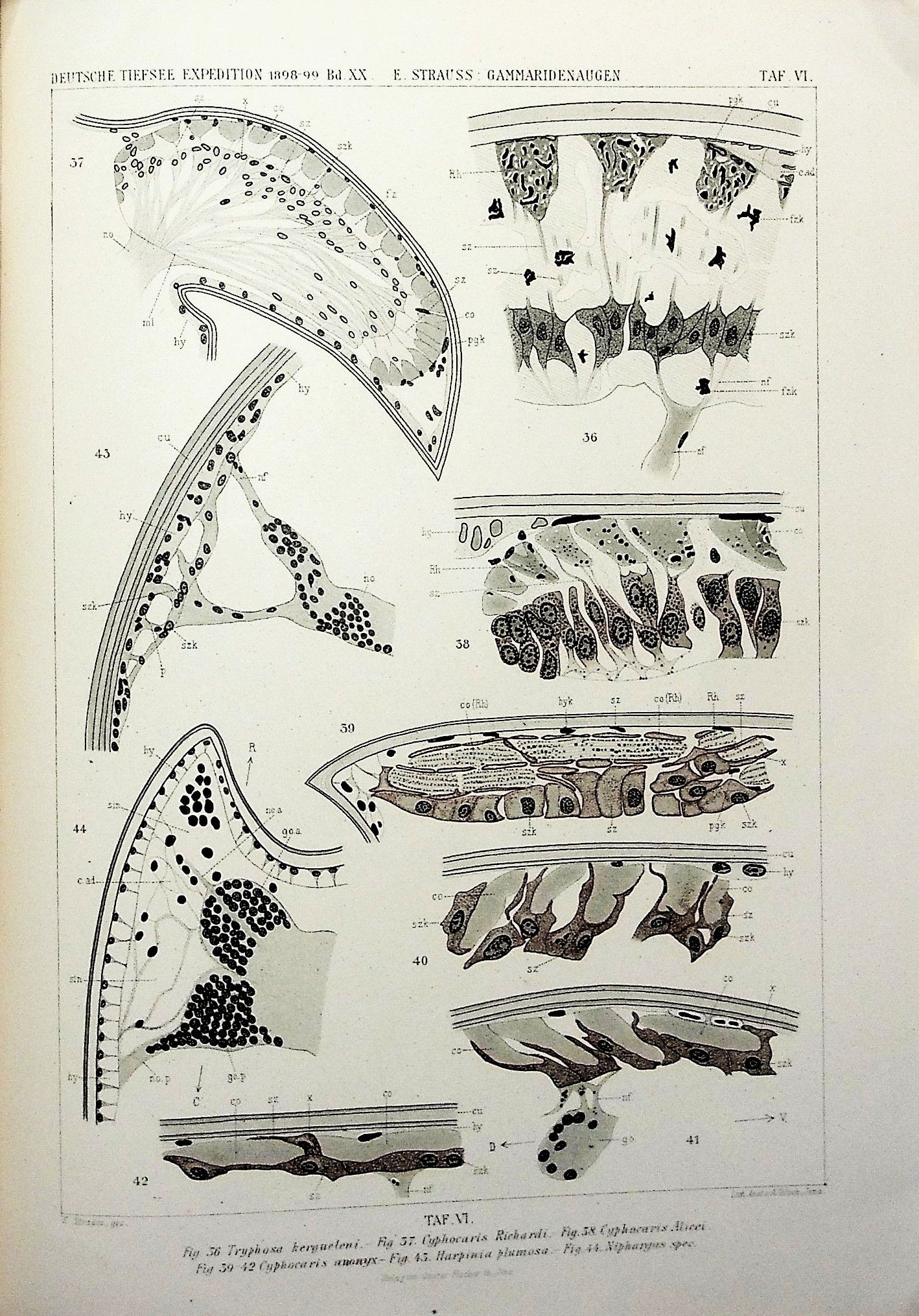
4) 1909 Das Gammaridenauge [Gammaridae] by Erich Strauss. [1], 84 pp, 47 figures in text, 6 lithographic plates (4 partly colored), unopened. The Gammaridea was one of the suborders of the order Amphipoda, comprising small, shrimp-like crustaceans. They were for a long time used as a "wastebin taxon", which included numerous genera of gammaridean amphipods that since then have been removed to their own families, such as the Anisogammaridae, Melitidae and Niphargidae. This report is a study of innervation and optical organs of the head.
Details
Title
Wissenschaftliche Ergebnisse der Deutschen Tiefsee-Expedition auf dem Dampfer "Valdivia" 1898–1899
Author
Chun, Carl; Schulz, Franz Eilhard; Neumann, Gunther; Schurig, Walther; Strauss, Erich
Binding
Printed paper wraps in archival folders
Condition
Unknown
Publisher
Gustav Fischer: Jena
Date
1905, 1906, 1909
Edition
First edition, first printing