

Freedom Schools [caption title]
![Freedom Schools [caption title]](https://d3525k1ryd2155.cloudfront.net/h/480/675/1740675480.0.x.jpg)
- [Los Angeles: LA Friends of SNCC, 1965
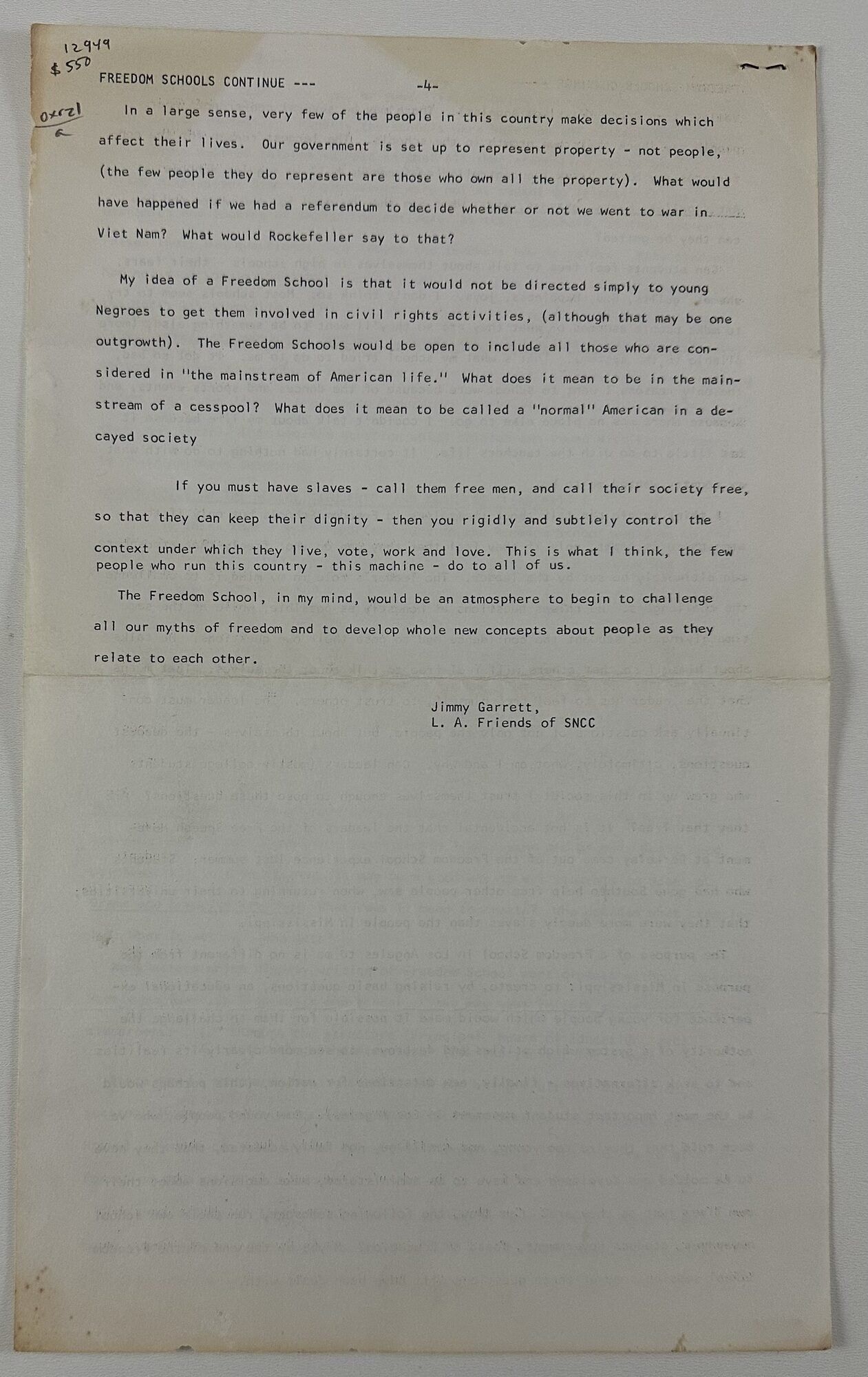
[Los Angeles: LA Friends of SNCC, 1965. 4pp. of mimeographed text on 8.5-x-14-inch sheets, stapled at top left corner. Minor toning and edge wear, folded once horizontally. Very good. An unrecorded document written by a Los Angeles-area "friend" of the Student Nonviolent Coordinating Committee named Jimmy Garrett, containing his ruminations on ideal schools, based on impressions of the successes and failures of the 1964 Mississippi Freedom School experience. The LA Friends of SNCC was one of several regional groups that supported the national efforts of SNCC and often organized its own local protests and sit-ins. According to newspaper records in 1965, Garrett was the "Los Angeles coordinator of SNCC," a "leader of the protest" at the Los Angeles Federal Building on March 10 in which ninety-eight members of SNCC, CORE, and other groups were arrested, and was a regular speaker in front of community groups. In the present work, Garrett expounds both philosophically and in specifics about his idea of Freedom Schools:
"My idea of a Freedom School is an area, atmosphere, situation -- any place where young people, whether black or white, rich or poor, can come to deal with real questions as they relate to their lives. The aim of this part of the Freedom School would be to let young people challenge not only the authority which stifles them, but also to challenge themselves, to bring about basic changes within the system so that the stifling ends. The center of the Freedom Schools would be the students and their freedom of expression would be the life of the school. They and their teacher (or more closely, leaders) would have equal parts in determining curriculum. Perhaps, even the student may rotate as leaders of the schools. This possibility of challenge, no matter what the level or what the issue, through questions, was a vital force in last summer's project. The only failure of the Mississippi Freedom Schools was its teachers. No one in this country has been trained in raising those necessary, fundamental and challenging questions. Most of the Freedom School teachers were college students who were taught that the only way to learn was to have information poured into their heads -- mostly dates, places, events, names -- most of which is lost and cannot be used in their lives."
Garrett then goes on to present two pages of "Random Notes on the School, Students, and Teachers (Leaders)" in Freedom Schools, in which he discusses and asks leading questions about the roles of music, drama and creative writing, art, "interschool conferences," and other aspects of the schools. He proposes that it might be beneficial to construct Freedom Schools in "different areas within Southern California (Watts, East Los Angeles, San Fernando Valley, Long Beach, West Los Angeles)." He concludes the work, which may have been the text of a speech or public talk, as follows: "My idea of a Freedom School is that it would not be directed simply to young Negroes to get them involved in civil rights activities (although that may be one outgrowth). The Freedom Schools would be open to to include all those who are considered in 'the mainstream of American life.' What does it mean to be in the mainstream of a cesspool? What does it mean to be called a 'normal' American in a decayed society? If you must have slaves -- call them free men, and call their society free, so that they can keep their dignity -- then you rigidly and subtlely control the context under which they live, vote, work, and love. This is what I think, the few people who run this country -- this machine -- do to all of us. The Freedom School, in my mind, would be an atmosphere to begin to challenge all our myths of freedom and to develop whole new concepts about people as they relate to each other."
We could locate no other copies of this impassioned reaction to and proposal for Freedom Schools in California..
"My idea of a Freedom School is an area, atmosphere, situation -- any place where young people, whether black or white, rich or poor, can come to deal with real questions as they relate to their lives. The aim of this part of the Freedom School would be to let young people challenge not only the authority which stifles them, but also to challenge themselves, to bring about basic changes within the system so that the stifling ends. The center of the Freedom Schools would be the students and their freedom of expression would be the life of the school. They and their teacher (or more closely, leaders) would have equal parts in determining curriculum. Perhaps, even the student may rotate as leaders of the schools. This possibility of challenge, no matter what the level or what the issue, through questions, was a vital force in last summer's project. The only failure of the Mississippi Freedom Schools was its teachers. No one in this country has been trained in raising those necessary, fundamental and challenging questions. Most of the Freedom School teachers were college students who were taught that the only way to learn was to have information poured into their heads -- mostly dates, places, events, names -- most of which is lost and cannot be used in their lives."
Garrett then goes on to present two pages of "Random Notes on the School, Students, and Teachers (Leaders)" in Freedom Schools, in which he discusses and asks leading questions about the roles of music, drama and creative writing, art, "interschool conferences," and other aspects of the schools. He proposes that it might be beneficial to construct Freedom Schools in "different areas within Southern California (Watts, East Los Angeles, San Fernando Valley, Long Beach, West Los Angeles)." He concludes the work, which may have been the text of a speech or public talk, as follows: "My idea of a Freedom School is that it would not be directed simply to young Negroes to get them involved in civil rights activities (although that may be one outgrowth). The Freedom Schools would be open to to include all those who are considered in 'the mainstream of American life.' What does it mean to be in the mainstream of a cesspool? What does it mean to be called a 'normal' American in a decayed society? If you must have slaves -- call them free men, and call their society free, so that they can keep their dignity -- then you rigidly and subtlely control the context under which they live, vote, work, and love. This is what I think, the few people who run this country -- this machine -- do to all of us. The Freedom School, in my mind, would be an atmosphere to begin to challenge all our myths of freedom and to develop whole new concepts about people as they relate to each other."
We could locate no other copies of this impassioned reaction to and proposal for Freedom Schools in California..
Details
Title
Freedom Schools [caption title]
Author
[African Americana]: [Los Angeles Friends of SNCC]: Garrett, Jimmy
Condition
Unknown
Publisher
LA Friends of SNCC: [Los Angeles
Date
1965