

Autograph Letter Signed. Vernon, New York. Feb. 4-5, 1844, To his son-in-law Wait Talcott and daughter Elizabeth Anna Talcott, Pecatonica, Illinois
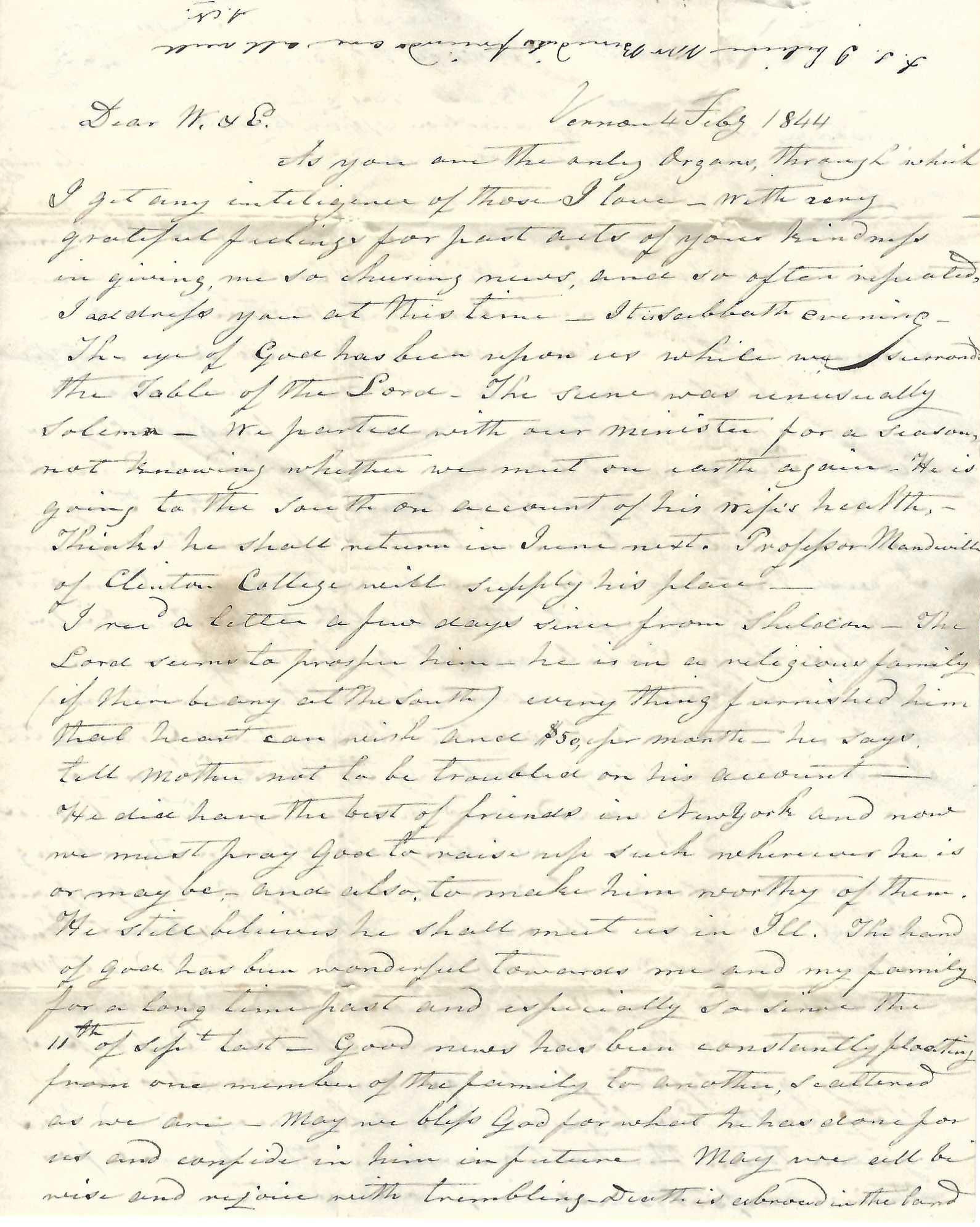
Quarto, 4 pages, plus stampless address leaf, few holes in least leaf, affecting text slightly, otherwise very good.
1844 Father-in-law of the Illinois emigrant who would become Abraham Lincoln's anti-slavery conscience
"….The eye of God has been upon us while we surrounded the Table of the Lord…We parted with our minister for a season, not knowing whether we meet on earth again. He is going to the South on account of his wife's health….Professor Mandeville of Clinton College will supply his place….I received a letter…from Sheldon…He is in a religious family (if there be any at the South)…He still believes he shall meet us in Illinois…The hand of God has been wonderful towards me and my family for a long time past…May we bless God for what he has done for us and confide in him in future. May we all be wise and rejoice with trembling. Death is abroad in the land…I wish they would go west with me… Hatt…don't want to go with me but she wants to go to Albany and Graduate…The times are so hard I almost despair of even thinking upon the subject much less of acting upon it…The good book says 'Jealousy is cruel as the Grave', therefore to put mine to rest, I would like to know whether there was any deception used to bring about so long a separation between me and my wife. I would not complain without cause, surely, but the time does seem long positively, comparatively and superlatively. Does Mother say she is glad of it? I don't believe it – but if she does, no matter. Good may grow out of it…better affections of the heart, in lively exercise, will richly compensate us and render us more happy. I have not been burdened with many cares the season past – my condition more tolerable on account of it. Tell mother I have thought some of selling myself, if she will do so too, for life, and go to work for them – for whom? Whoever will take the responsibility upon them of providing for us for a few days during life. You all know I am naturally lazy and too much inclined to throw off responsibility upon some one and if I did not believe this course would induce me to become more active, I would not suggest it. Do you think I'm crazy?...I should like to see….all your faces and hear your voice and…set at your table if your food be plain and simple, with thanksgiving to God…fearful that sickness may enter your family on account of high living. I hope not….If anything should happen to prevent my coming west – what then? The Lord will direct. I may go in my own wagon to Brother Isaac's…" …
Ten years had passed since Wait Talcott had married Dr. Ariel Norton's 20 year-old daughter Elizabeth in upstate New York. Four years after their marriage, Talcott had loaded his wife and children (and also, apparently, his mother-in-law, Mrs. Norton) onto a covered wagon and set off from New York for a new life in frontier Illinois. Dr. Norton did join the Talcotts in Rockford, Illinois, where he would die in 1855 –living long enough to see his son-in-law become a wealthy farm implement manufacturer as well as a successful politician, being elected in 1854 to the Illinois State Senate and becoming good friends at the time with Springfield lawyer Abraham Lincoln, who was also elected to the Senate, in which he had formerly served, but declined to take his seat.
During that campaign, Lincoln first publicly declared his opposition to the "monstrous injustice" of slavery, later crediting the deeply religious Talcott, long a militant abolitionist who favored immediate emancipation, with influencing his thinking on that burning subject. Lincoln later confided to Talcott that his anti-slavery passion had "produced a much stronger impression on my mind than you may think."
Talcott also played a more concrete role in Lincoln's rise to national prominence, when he fought off a patent infringement suit by wealthy industrialist Cyrus McCormick, a high-stakes lawsuit which has been called "the patent case that lifted Lincoln into a Presidential candidate". Lincoln was involved at the start, when McCormick sued Talcott and his partner, alleging patent violation of his reaping machine and asking $400,000 in damages. Talcott engaged Lincoln as courtroom advocate for a two thousand dollar legal retainer – the largest Lincoln had ever received. But after the trial was moved from Chicago to Cincinnati and McCormick hired a former Attorney General of the United States to represent him, Talcott, facing financial ruin, added more experienced attorneys – notably including Edwin Stanton, who sidestepped, and then humiliated, Lincoln. First catching sight of the gangly, shabbily-dressed country lawyer, Stanton called him a "long-armed ape who knows nothing" and refused to allow Lincoln to speak in the courtroom. A "sad and gloomy" Lincoln sat silently through the proceedings until the judges handed down their decision against McCormick, who filed an appeal with the US Supreme Court. Lincoln, deeply insulted, had nothing more to do with the case. He even offered to return the retainer he had received, an offer refused with the only politeness he was shown by Stanton. Still, the case gave Lincoln a new perspective on his strengths and weaknesses in both law and politics – and, incidentally, introduced him to the contentious man who would later become his Secretary of War. When the case came before the Supreme Court, Talcott traveled to Washington for the trial, his first visit to the national capital, where he was put off by all the "glitter and show…temptations and remissness in Christian duty." The Court ruled against McCormick who was ordered to pay the defendant's $75,000 in legal fees. Lincoln received only a small fraction of that, but he would long remember it as a significant boon to his political career - enough to give him the financial freedom that year to mount his historic 1858 campaign for US Senator against Stephen Douglas, his last stepping-stone to the Presidency.
When Lincoln entered the White House, Talcott might have assumed an influential position in Washington had it not been for his refusal to leave his Illinois home for the distasteful capital. Still, the President wrote Talcott that he was at least "determined" to give him a modest federal appointment in the Treasury Department, recommending Talcott to the Secretary of the Treasury as "one of the best men there is." When Talcott next visited Washington, it was sadly to attend his old friend's funeral.
Details
Title
Autograph Letter Signed. Vernon, New York. Feb. 4-5, 1844, To his son-in-law Wait Talcott and daughter Elizabeth Anna Talcott, Pecatonica, Illinois
Author
Norton, Dr. Ariel,
Condition
Unknown