

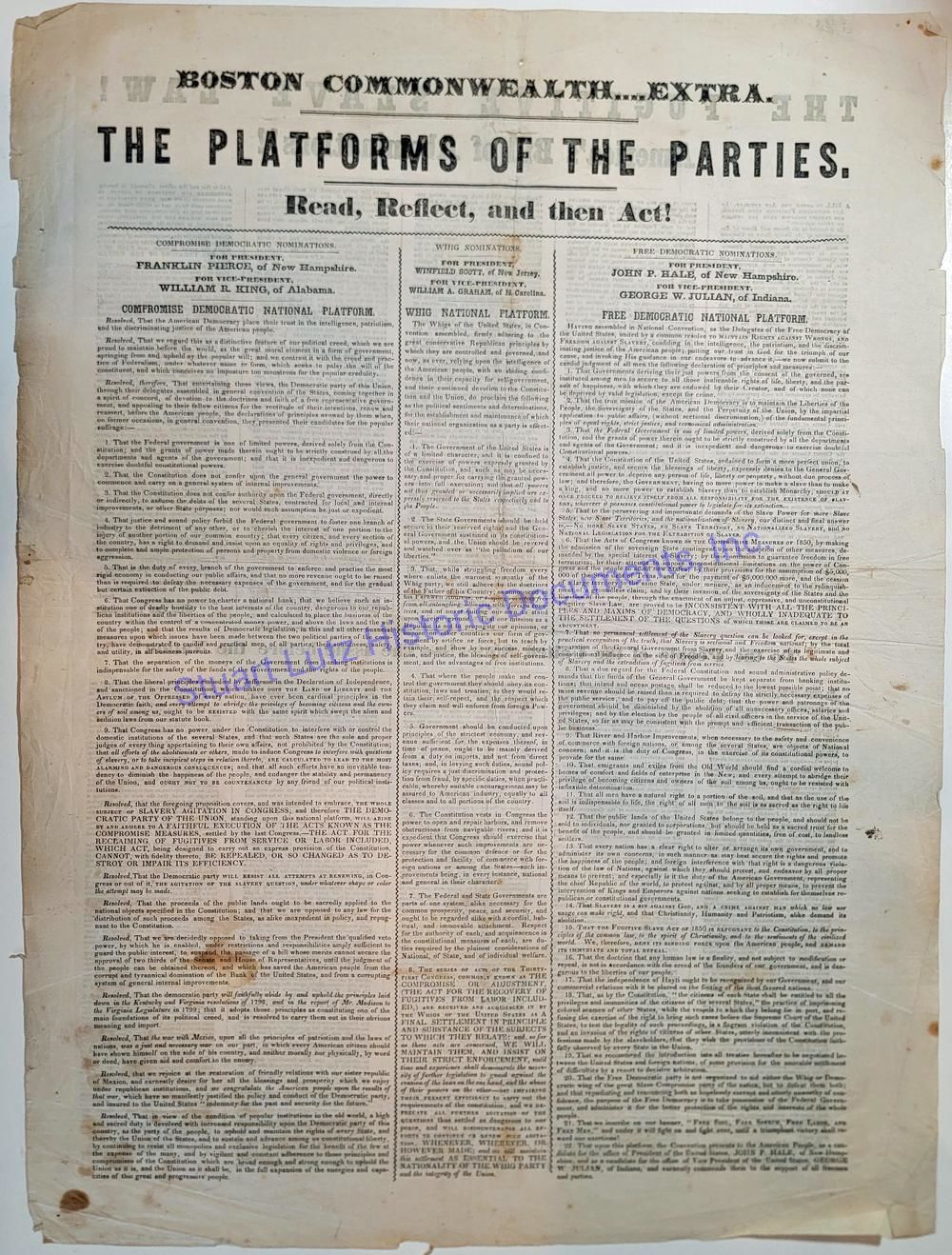
A Free Soil Broadsheet From Boston At The Time Of The 1852 Presidential Election; It Denounces The Fugitive Slave Law! America's Bill Of Abominations!! And Examines The Positions Of The Candidates Franklin Pierce, Winfield Scott And John P. Hale
- SIGNED
(FUGITIVE SLAVE ACT BROADSIDE). The controversial Fugitive Slave Act became law in 1850 when it was signed by Millard Fillmore. It authorized that all escaped slaves be returned to their owners and required that the citizens in the non-slave holding states assist in their capture. It denied the arrested slaves a day in court, and it fueled the abolitionist movement.Broadsheet. 2pg. 16 x 22. 1852. Boston. A broadsheet published in Boston shortly before the 1852 Presidential election concerning the Fugitive Slave Act. This was published by the Free Soil newspaper Boston Commonwealth and headlined The Platforms Of The Parties. Read, Reflect, and then Act! The three columns are headed with the names of the Presidential candidates (Franklin Pierce and William King of the Democrats, Winfield Scott and William Graham of the Whigs, and John Hale and George Julian of the Free Soilers) and their position on slavery, the most important national issue of the era. The Hale portion explicitly denounces slavery as a sin against God and a crime against man, calling for its immediate sectionalization and eventual end. At this time, Boston was the hotbed of abolitionist sentiment. This was published by the daily Free Soil newspaper The Commonwealth or The Commonwealth & Emancipator. The back of the broadsheet is headlined The Fugitive Slave Law! America's Bill of Abominations!!. The top half quotes the bill to Amend the Act Entitled An Act Respecting Fugitives From Justice, And Persons Escaping From The Service Of Their Masters. It then quotes the entire controversial law, concluding with the printed signatures of President Millard Fillmore and William King of Alabama, President of the Senate (he was also Pierces running mate and then elected as Vice President in 1853; he died six weeks after his inauguration). The bottom half of the broadsheet is entitled To The People of the United States! The Issue Before The Nation! The essay was an argument for the Free Soil Party that tried to prevent the spread of slavery westward into newly acquired territories. It is signed at the conclusion by Alexander, who could have been the Massachusetts politician Alexander De Witt who was a Free Soiler. The editorial states in part: We present you this Document for the Campaign in order that its distributor may be placed before the minds of men who have never yet studied the power of past history, the inheritance and future destiny of the country which we call our own. In simple and earnest appeal to the reason, the conscience, and the common sense of the people, we desire to do with the passionate and fiery denunciations of partisans. It has been said that the political parties have marshalled their forces, promulgated their principles, and nominated their candidates. The Democratic and Whig National Conventions at Baltimore have demonstrated to all looking on, that the Democratic party led by Franklin Pierce, and the Whigs led by Winfield Scott, are alike in one thing: Both parties, at their national conventions, surrendered to a trinity of measures, for which they ask the support of the people, and for which they claim the merit of having saved the Union...But there is a third party - the Free Democracy - representing a principle that cannot be compromised. They have nominated John P. Hale of New Hampshire...This party stands upon the eternal truth that all men are created equal, and that the Great Creator has never given to one man the right to property in another. They hold that the FUGITIVE SLAVE LAW is a violation of the Constitution, a disgrace to our age, and a daring an insult to the Spirit of ChristianityIn 1852, the slavery-sympathetic Franklin Pierce (from New Hampshire, of all places) won the Presidential election, and the Free Soil Party quickly fizzled, and many members joined the new Republican Party. The broadsheet has light wrinkling, chips and minor faults to the edges, and a few spots and small stains. A fine remembrance of a most difficult time in American history.
Details
Title
A Free Soil Broadsheet From Boston At The Time Of The 1852 Presidential Election; It Denounces The Fugitive Slave Law! America's Bill Of Abominations!! And Examines The Positions Of The Candidates Franklin Pierce, Winfield Scott And John P. Hale
Author
(FUGITIVE SLAVE ACT BROADSHEET)
Condition
Unknown
Pages
0