

Three Signed Offprints on Nerve Fiber Classification
- SIGNED
- 1941
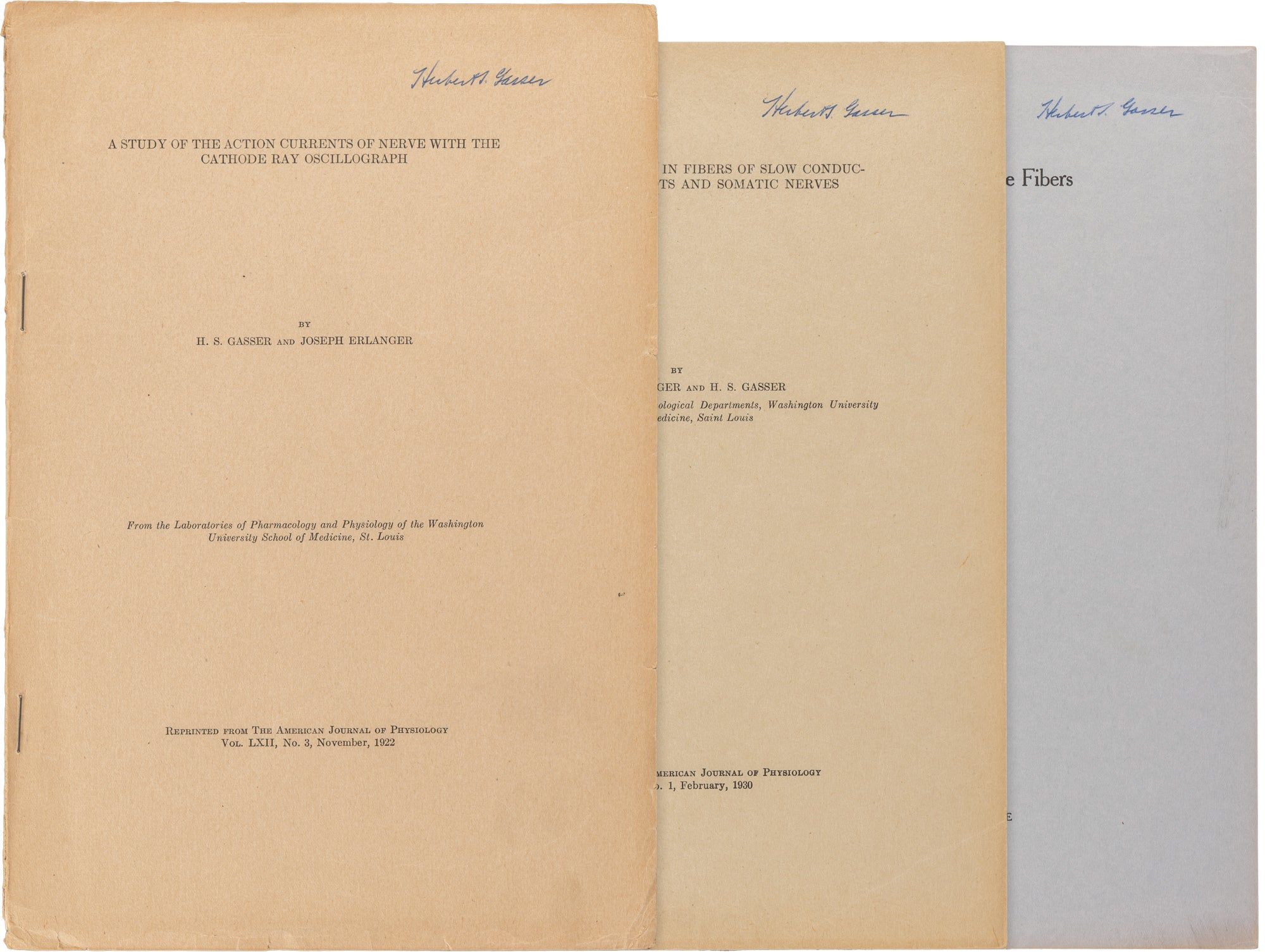
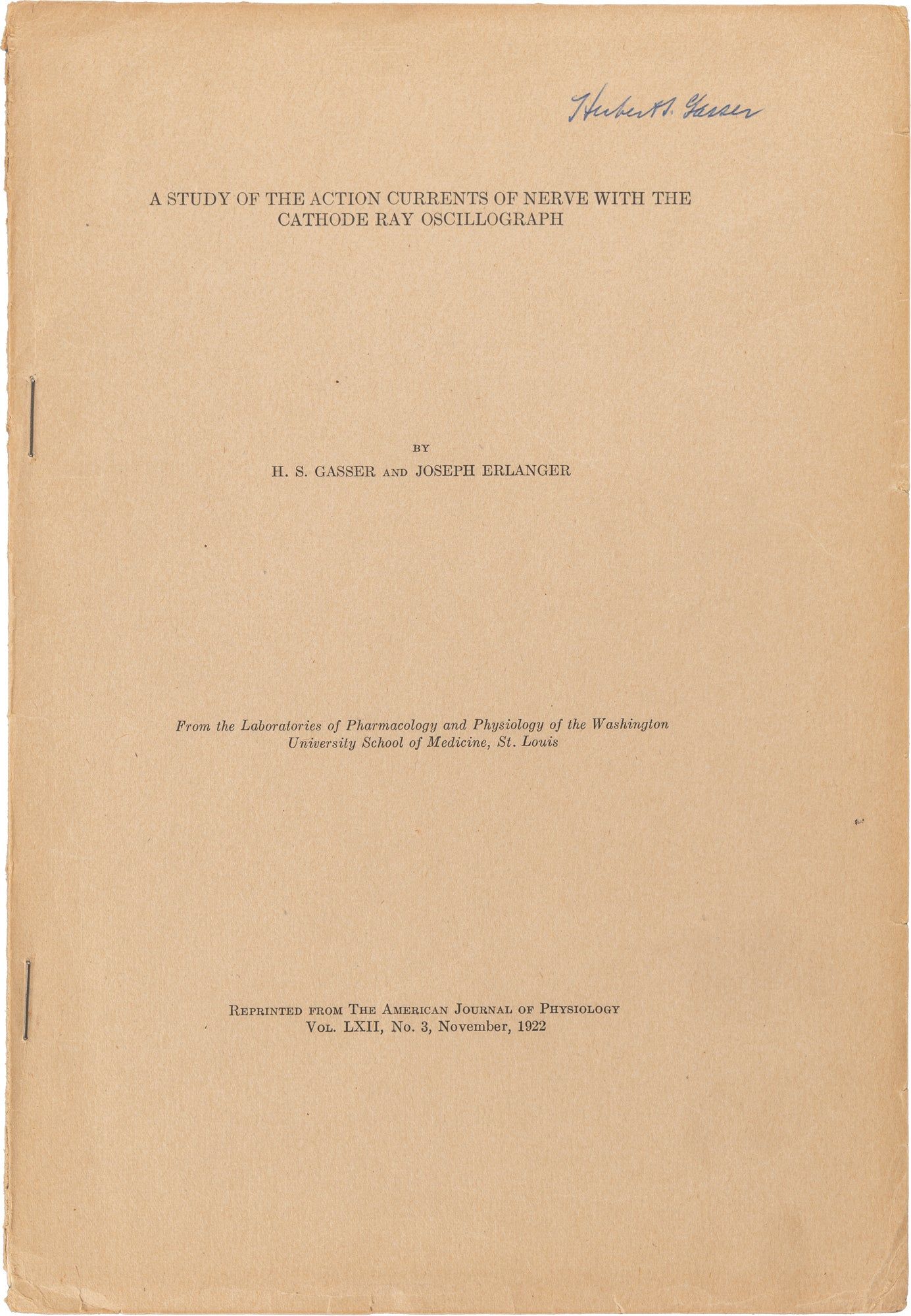
1941. First Edition. Gasser and Joseph Erlanger received the Nobel Prize in Physiology or Medicine in 1944 for their discoveries relating to the highly differentiated functions of single nerve fibers. The work recognized by Stockholm had its origin in a single instrumental decision: in 1922, working together at Washington University School of Medicine, Gasser and Erlanger adapted the cathode ray oscillograph (then a novelty in physical laboratories) to the recording of nerve action potentials, producing for the first time electrical records whose time resolution was equal to the speed of the events they were measuring. What that instrument revealed was that the nerve trunk, previously treated as a functionally uniform conductor, was in fact a bundle of distinct fiber populations each with its own conduction velocity, diameter, and physiological role. The classification of those populations (into the fast-conducting myelinated A fibers, the intermediate B fibers, and the slow unmyelinated C fibers) occupied the next two decades of Gasser's career and transformed neurophysiology's understanding of how the nervous system encodes and transmits information. The clinical applications of that classification remain in daily use: the differential susceptibility of fiber classes to local anesthetics underlies selective neuraxial blockade, eliminating nociceptive transmission (e.g. pain) while preserving motor function; nerve conduction studies, which diagnose carpal tunnel syndrome, peripheral neuropathy, and demyelinating disease in hundreds of thousands of patients annually, measure the fiber properties Gasser and Erlanger quantified; and the identification of C fibers as the carriers of slow pain has informed the development of targeted analgesic therapies, from capsaicin-based preparations to ion channel blockers, that remain active areas of clinical research. The three offprints offered here trace that program from its instrumental foundation to its synthetic consolidation: the 1922 paper establishing the method and the compound nature of the action potential; the 1930 paper providing the definitive quantitative characterization of the slow-conducting fiber populations; and the 1941 classification lecture in which Gasser draws the full program together and articulates its implications for the timing and integration of nerve impulse transmission. All three are signed. [with] Joseph Erlanger. "A Study of the Action Currents of Nerve with the Cathode Ray Oscillograph; Reprinted from the American Journal of Physiology. Vol. 62, No. 3, pp. 496-524." Bethesda, MD: American Physiological Society, 1922. Offprint, 8vo (267 × 184mm), pp. 29. From the Laboratory of Pharmacology and Physiology, Washington University School of Medicine. Wrappers, staple-bound, wear to the extremities, light toning, else very good. Signed by Gasser on the front wrapper.
The founding paper of Gasser and Erlanger's Nobel Prize-winning research program, in which they establish the cathode ray oscillograph as a practical instrument for recording nerve action potentials and demonstrate for the first time the compound nature of the nerve action current. Previous galvanometric methods were too slow and too subject to mechanical inertia to resolve the millisecond-scale electrical events of nerve conduction. Gasser and Erlanger's adaptation of the cathode ray oscillograph, whose electron beam responds to electrical changes without mechanical lag, overcame this limitation entirely. The paper describes the instrument and its calibration in detail, illustrated by diagrams of the apparatus and photographic plates of oscillograph traces, and presents action potential curves from frog and mammalian nerve trunks showing that what had previously appeared to be a single wave was in fact a compound event composed of multiple overlapping components traveling at different velocities. This observation (that a single nerve trunk conducts impulses at multiple velocities corresponding to distinct fiber populations) was the central discovery that the Nobel Committee recognized in 1944, and every subsequent paper in Gasser's career, including the fiber classification work and the pain studies, is a development of the question this paper first made it possible to ask.
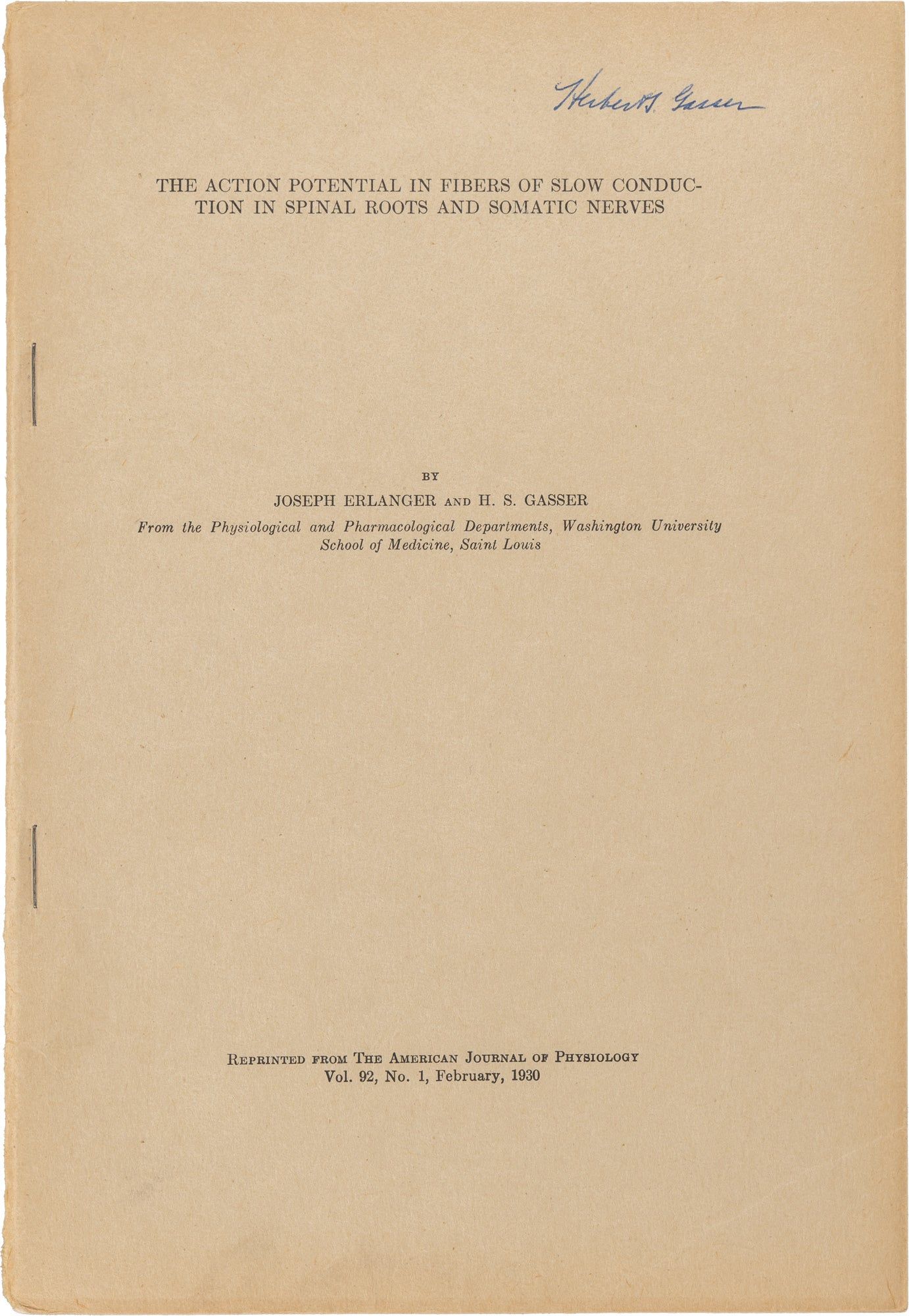
[with] Joseph Erlanger. "The Action Potential in Fibers of Slow Conduction in Spinal Roots and Somatic
Nerves; reprinted from the American Journal of Physiology, Vol. 92, No. 1, pp, pp. 43-82." Baltimore: American Physiological Society, 1930. Offprint, 8vo (256 × 176mm), pp. 40. From the Physiological and Pharmacological Department, Washington University School of Medicine, Saint Louis. Wrappers, toned, spine rubbed, soiling to the wrappers, else very good. Signed by Gasser on the front wrapper.
The most substantial single paper in Gasser and Erlanger's research program, providing a detailed characterization of the slowly conducting fiber populations whose existence the 1922 cathode ray oscillograph paper had first made it possible to detect. Using high amplification to resolve the small, slow waves that follow the large initial deflection of the compound action potential, Erlanger and Gasser identify and characterize the B and C wave components, demonstrating that they represent the activity of distinct fiber populations conducting at velocities far below those of the A fibers. The paper presents extensive quantitative data on conduction velocities, stimulation thresholds, and the areas of the component waves, and includes a detailed analysis of the relationship between fiber diameter, myelin status, and conduction velocity that would become the foundation of the Erlanger-Gasser fiber classification. The reconstruction of fiber populations from their action potentials and the tabulation of their properties across species constitutes the primary evidentiary basis for the work recognized by the Nobel Committee in 1944.
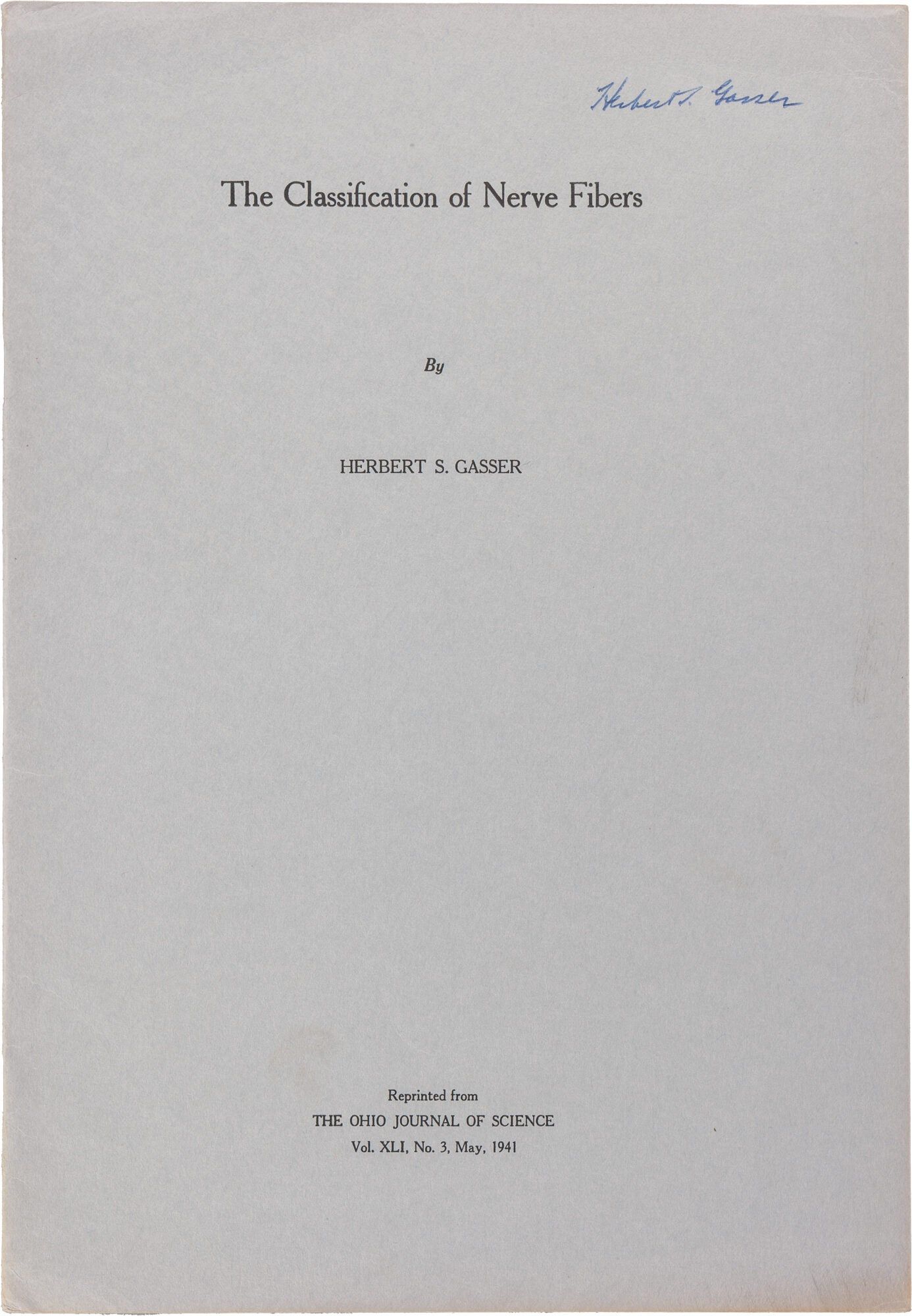
"The Classification of Nerve Fibers; reprinted from The Ohio Journal of Science. Vol. 66, No. 3, pp. 145-159." Columbus: The Ohio Journal of Science, 1941. Offprint, 8vo (254 x 176mm), pp. 15, [1]. Gray printed wrapper, staple -bound, some soft crease, light soiling and toning, else near fine. Signed by Gasser on the front wrapper.
A synthetic account of the nerve fiber classification program that Gasser and Erlanger had built over the preceding two decades, presented here as a formal lecture at a moment when the work was approaching its definitive formulation. Gasser reviews the relationship between fiber diameter, myelin status, and conduction velocity across the full range of somatic nerve fibers, presenting the velocity-diameter curve and its implications for understanding how the nervous system achieves the precise timing of impulse transmission on which synaptic integration depends. The paper situates fiber velocity in the context of neural function generally (noting that impulses carried in A fibers travel at up to 90 meters per second, those in B fibers at intermediate velocities, and those in the unmyelinated C fibers at approximately one meter per second) and develops the classification through oscillographic records and quantitative diameter measurements. The discussion of the C fiber population and its relationship to pain transmission gives the paper particular significance, anticipating the explicit treatment of pain-producing impulses that Gasser would take up in the 1943 paper. With its synthesis of two decades of experimental work and its clear articulation of the three-class fiber system, the paper represents the closest Gasser came, before the Nobel lecture itself, to a comprehensive public statement of the classification that Stockholm recognized three years later.
The founding paper of Gasser and Erlanger's Nobel Prize-winning research program, in which they establish the cathode ray oscillograph as a practical instrument for recording nerve action potentials and demonstrate for the first time the compound nature of the nerve action current. Previous galvanometric methods were too slow and too subject to mechanical inertia to resolve the millisecond-scale electrical events of nerve conduction. Gasser and Erlanger's adaptation of the cathode ray oscillograph, whose electron beam responds to electrical changes without mechanical lag, overcame this limitation entirely. The paper describes the instrument and its calibration in detail, illustrated by diagrams of the apparatus and photographic plates of oscillograph traces, and presents action potential curves from frog and mammalian nerve trunks showing that what had previously appeared to be a single wave was in fact a compound event composed of multiple overlapping components traveling at different velocities. This observation (that a single nerve trunk conducts impulses at multiple velocities corresponding to distinct fiber populations) was the central discovery that the Nobel Committee recognized in 1944, and every subsequent paper in Gasser's career, including the fiber classification work and the pain studies, is a development of the question this paper first made it possible to ask.
[with] Joseph Erlanger. "The Action Potential in Fibers of Slow Conduction in Spinal Roots and Somatic
Nerves; reprinted from the American Journal of Physiology, Vol. 92, No. 1, pp, pp. 43-82." Baltimore: American Physiological Society, 1930. Offprint, 8vo (256 × 176mm), pp. 40. From the Physiological and Pharmacological Department, Washington University School of Medicine, Saint Louis. Wrappers, toned, spine rubbed, soiling to the wrappers, else very good. Signed by Gasser on the front wrapper.
The most substantial single paper in Gasser and Erlanger's research program, providing a detailed characterization of the slowly conducting fiber populations whose existence the 1922 cathode ray oscillograph paper had first made it possible to detect. Using high amplification to resolve the small, slow waves that follow the large initial deflection of the compound action potential, Erlanger and Gasser identify and characterize the B and C wave components, demonstrating that they represent the activity of distinct fiber populations conducting at velocities far below those of the A fibers. The paper presents extensive quantitative data on conduction velocities, stimulation thresholds, and the areas of the component waves, and includes a detailed analysis of the relationship between fiber diameter, myelin status, and conduction velocity that would become the foundation of the Erlanger-Gasser fiber classification. The reconstruction of fiber populations from their action potentials and the tabulation of their properties across species constitutes the primary evidentiary basis for the work recognized by the Nobel Committee in 1944.
"The Classification of Nerve Fibers; reprinted from The Ohio Journal of Science. Vol. 66, No. 3, pp. 145-159." Columbus: The Ohio Journal of Science, 1941. Offprint, 8vo (254 x 176mm), pp. 15, [1]. Gray printed wrapper, staple -bound, some soft crease, light soiling and toning, else near fine. Signed by Gasser on the front wrapper.
A synthetic account of the nerve fiber classification program that Gasser and Erlanger had built over the preceding two decades, presented here as a formal lecture at a moment when the work was approaching its definitive formulation. Gasser reviews the relationship between fiber diameter, myelin status, and conduction velocity across the full range of somatic nerve fibers, presenting the velocity-diameter curve and its implications for understanding how the nervous system achieves the precise timing of impulse transmission on which synaptic integration depends. The paper situates fiber velocity in the context of neural function generally (noting that impulses carried in A fibers travel at up to 90 meters per second, those in B fibers at intermediate velocities, and those in the unmyelinated C fibers at approximately one meter per second) and develops the classification through oscillographic records and quantitative diameter measurements. The discussion of the C fiber population and its relationship to pain transmission gives the paper particular significance, anticipating the explicit treatment of pain-producing impulses that Gasser would take up in the 1943 paper. With its synthesis of two decades of experimental work and its clear articulation of the three-class fiber system, the paper represents the closest Gasser came, before the Nobel lecture itself, to a comprehensive public statement of the classification that Stockholm recognized three years later.
Details
Title
Three Signed Offprints on Nerve Fiber Classification
Author
Gasser, Herbert S.
Condition
Unknown
Date
1941
Edition
First Edition