

A Photographic Investigation of the Transmutation of Lithium and Boron by Protons and of Lithium by Ions of the Heavy Isotope of Hydrogen; From the Proceedings of the Royal Society, A. Vol. 141, pp. 733-742
- SIGNED
- London: Harrison & Sons, Ltd, 1933
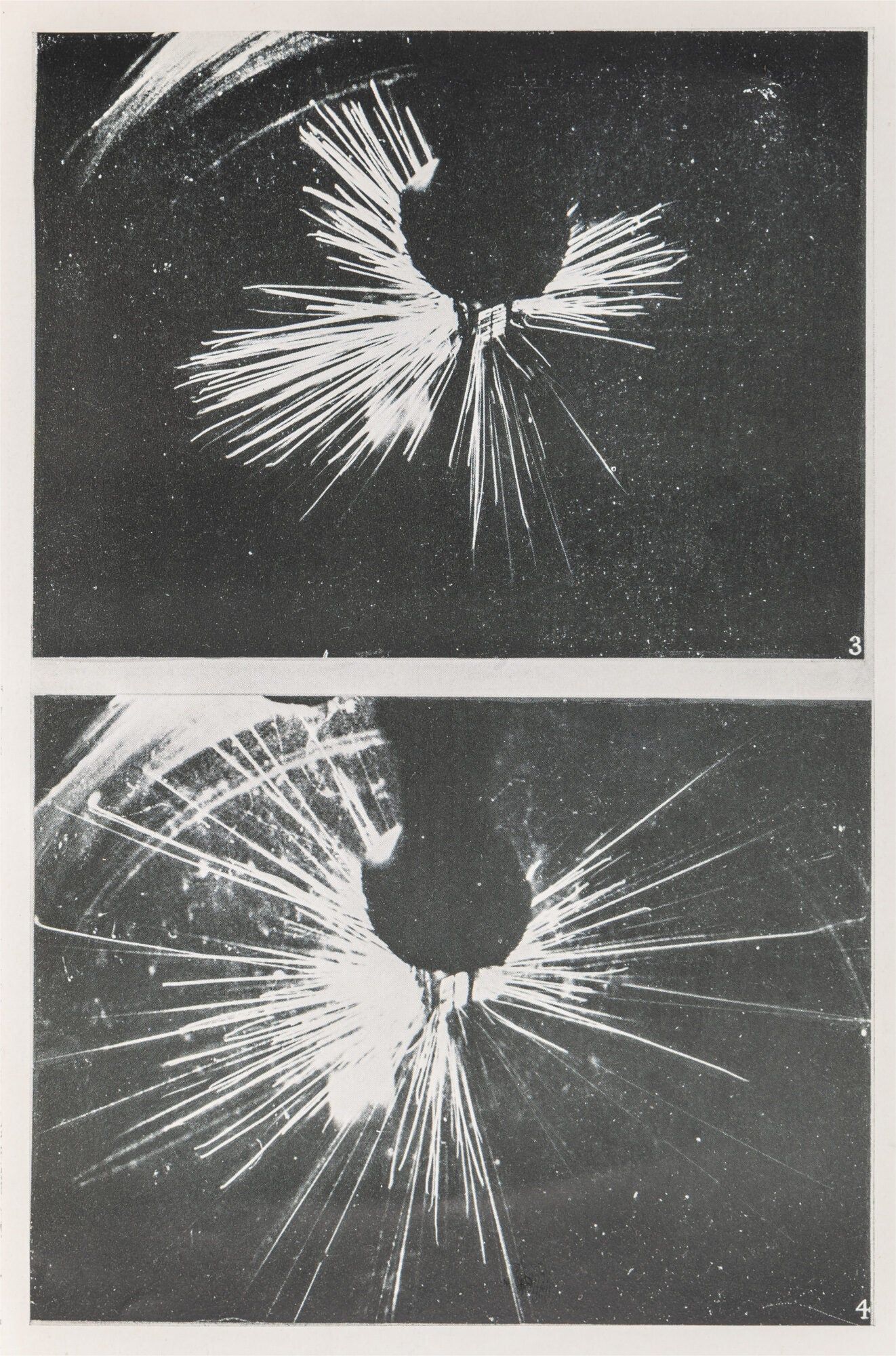
London: Harrison & Sons, Ltd, 1933. First Edition. Offprint, 8vo (251 x 176mm), pp. 10, plus 2 inserted plates. Original green printed wrappers, thread-bound, so light creasing, near fine. Signed by Walton on the front wrapper. Walton shared the Nobel Prize in Physics in 1951 with John Douglas Cockcroft for the first experimental splitting of an atomic nucleus by artificially accelerated particles; the moment at which humanity first demonstrated that the atomic nucleus was not merely observable but manipulable by means entirely under human control. This paper, received at the Cavendish Laboratory on August 1, 1933, belongs to the immediate and decisive sequel to that achievement. Where the original Cockcroft-Walton experiment established nuclear transmutation through ionization current measurements, this investigation provides its photographic proof: the tracks of the product nuclei made directly visible in a Wilson cloud chamber, their ranges measured, their kinematics checked against theory, and their identity placed beyond dispute. The reactions confirmed are the disintegration of lithium-7 by protons into two helium-4 nuclei, the disintegration of lithium-6 by deuterons into two helium-4 nuclei, and the disintegration of boron-11 by protons into three helium-4 nuclei, with observed particle ranges in close agreement with values calculated from the energy equation using the latest nuclear mass data. The two inserted plates reproduce the original cloud chamber photographs, providing the visual record on which the analysis rests. Nuclear physics is now the basis of every cancer radiotherapy treatment, every PET scan, and every nuclear power station; this paper is among the documents in which it became an experimental science rather than a theoretical one. The apparatus consisted of the Cockcroft-Walton high-voltage installation operating at potentials up to 400 kilovolts, combined with a standard Wilson expansion chamber 15 cm in diameter and 5 cm deep, photographed simultaneously by two cameras mounted at 30 degrees to the vertical and at 20 degrees to each other, with measurements made on images of the tracks reproduced in the relative positions in which they actually occurred. For the disintegration of lithium by protons, reaction (1), Li + H¹ yielding two He nuclei, four windows of 5 to 1 cm stopping power were mounted on grid (a) of Figure 2, giving a convenient length for track measurement; the mean value of the sum of the lengths of pairs of tracks taken from a number of photographs was 16.6 cm, and the average range of particles emitted in opposite directions was 8.3 cm, in good agreement with the theoretical value of 8.4 cm deduced from the absorption curves and with the value of 8.35 cm obtained by substituting the latest nuclear mass data into the energy relation; approximately 100 photographs were taken, and the number of opposite pairs far exceeds what chance could produce. For the disintegration of lithium by ions of the heavy isotope of hydrogen, reaction (2), Li + H² yielding two He nuclei, a sample of heavy hydrogen supplied by Lord Rutherford from Professor G. N. Lewis was passed into the discharge tube, and Figure 4 of Plate 14 shows the general character of the events; the value calculated from the energy equation is in very close agreement with the observed range of 13.2 cm previously reported by Oliphant, Kinsey and Rutherford. For the disintegration of boron by proton bombardment, reaction (3), B¹¹ + H¹ yielding three He nuclei, a piece of pyrex glass containing boron of 3 to 5 mm stopping power was used as target and over 100 photographs were taken; three-track events are reproduced on Plates 16 and 17, but because the majority of the measured three-track sets do not satisfy momentum conservation as accurately as expected, attributed to slight deflections in the mica windows of small residual range, the authors state that a full discussion of this disintegration is postponed to a later date. The two inserted plates, Plates 14 through 17 of the original volume, reproduce the cloud chamber photographs directly, providing the visual record on which the kinematic analysis rests.
Details
Title
A Photographic Investigation of the Transmutation of Lithium and Boron by Protons and of Lithium by Ions of the Heavy Isotope of Hydrogen; From the Proceedings of the Royal Society, A. Vol. 141, pp. 733-742
Author
Walton, Ernest T. and Dee, Philip I.
Condition
Unknown
Publisher
Harrison & Sons, Ltd: London
Date
1933
Edition
First Edition