

Two Signed Offprints on Streptomycin
- 1953
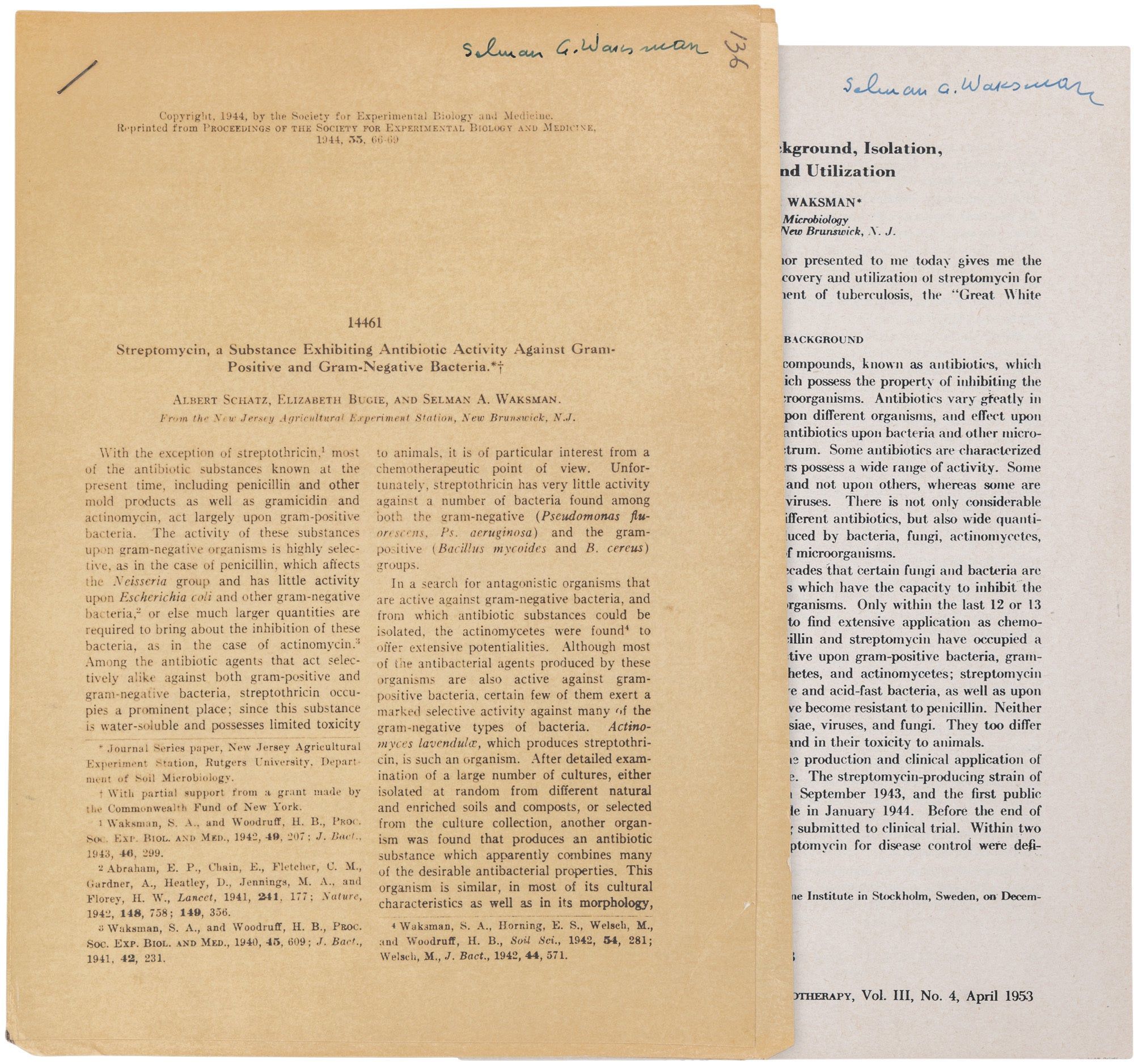
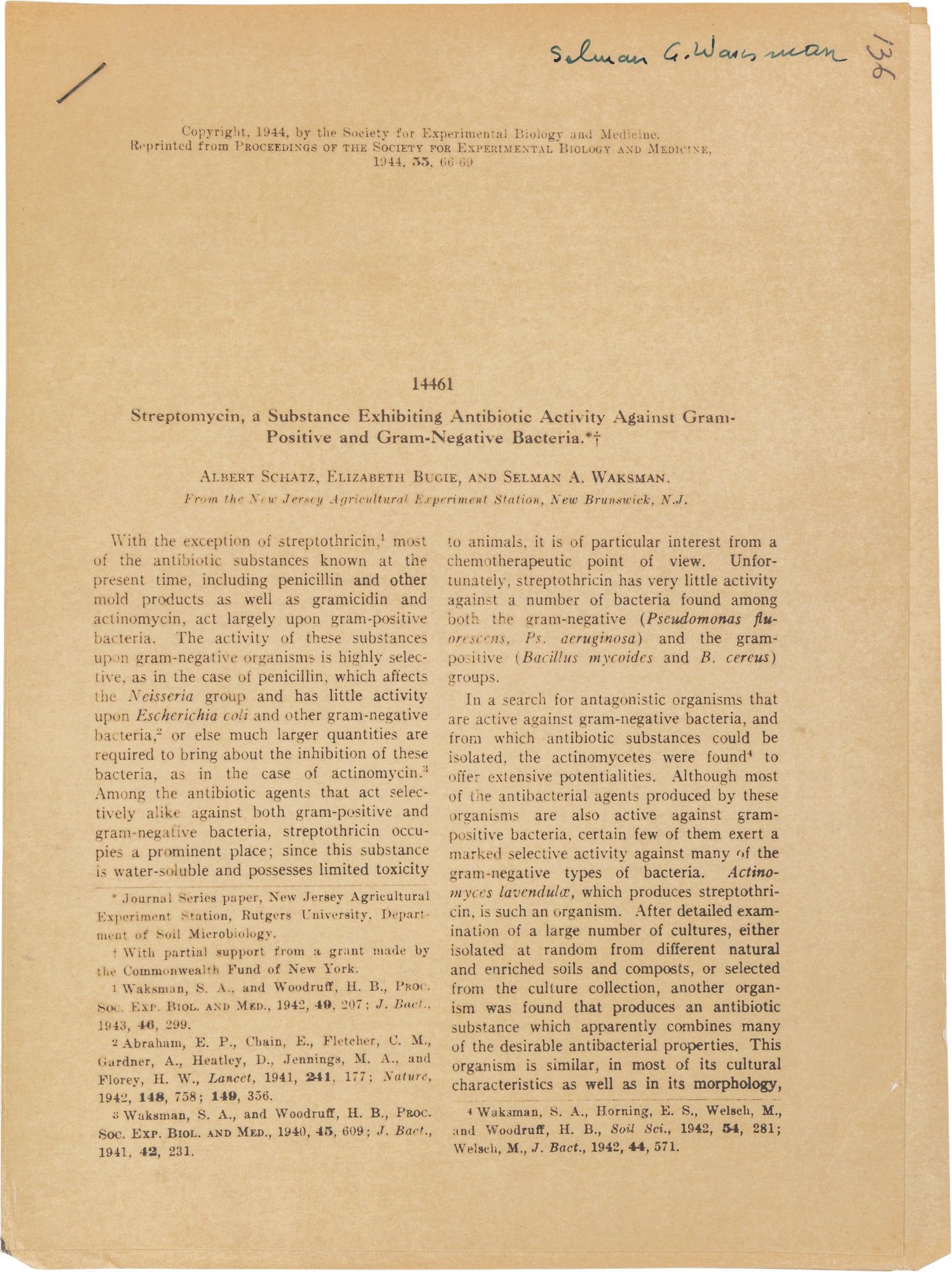
1953. First Edition. Waksman held the chair of microbiology at Rutgers University for the better part of three decades, presiding over a research program of unusual systematic rigor: the methodical screening of soil microorganisms for antibiotic activity, conducted at a scale and with a discipline that no laboratory had previously applied to the problem. That program, pursued in collaboration with his graduate students Albert Schatz and Elizabeth Bugie, yielded streptomycin in 1943; the first antibiotic effective against tuberculosis and a range of Gram-negative bacterial infections for which penicillin offered no remedy. The discovery addressed one of the most urgent therapeutic needs of the twentieth century and earned Waksman the Nobel Prize in Physiology or Medicine in 1952. These two offprints, both signed by Waksman, document the arc of that achievement: the original announcement of streptomycin's isolation and activity, published in 1944 as the work was still unfolding, and a comprehensive retrospective synthesis published nearly a decade later, when its clinical and industrial dimensions had been fully realized. Together they constitute primary documents of the antibiotic era. (1) [with] Albert Schatz and Elizabeth Bugie. Exhibiting Antibiotic Activity Against Gram-Positive and Gram–Negative Bacteria; Reprinted from Proceedings of the Society for Experimental Biology and Medicine. Utica: Society for Experimental Biology and Medicine, 1944. Photomechanical reproduction, stapled at the corner, 8vo (256 x 190mm), pp. 4, printed on rectos only. Some creasing, corner of last page chipped without loss to the text, very good. Signed and annotated by Waksman on the first page.
The first published announcement of streptomycin, reporting its isolation from two strains of an actinomycete identified as Actinomyces griseus (later reclassified as Streptomyces griseus) and demonstrating antibacterial activity against both Gram-positive and Gram-negative organisms. The paper's central significance lies in its differentiation of streptomycin from the related compound streptothricin, establishing that streptomycin possessed markedly greater activity against a range of Gram-negative bacteria, including organisms of the Pseudomonas aeruginosa group — a distinction with immediate therapeutic implications. Comparative production data from varied media and culture conditions are presented alongside a bacteriostatic spectrum determined by diffusion and dilution assays, providing the empirical foundation upon which all subsequent streptomycin research would be built.
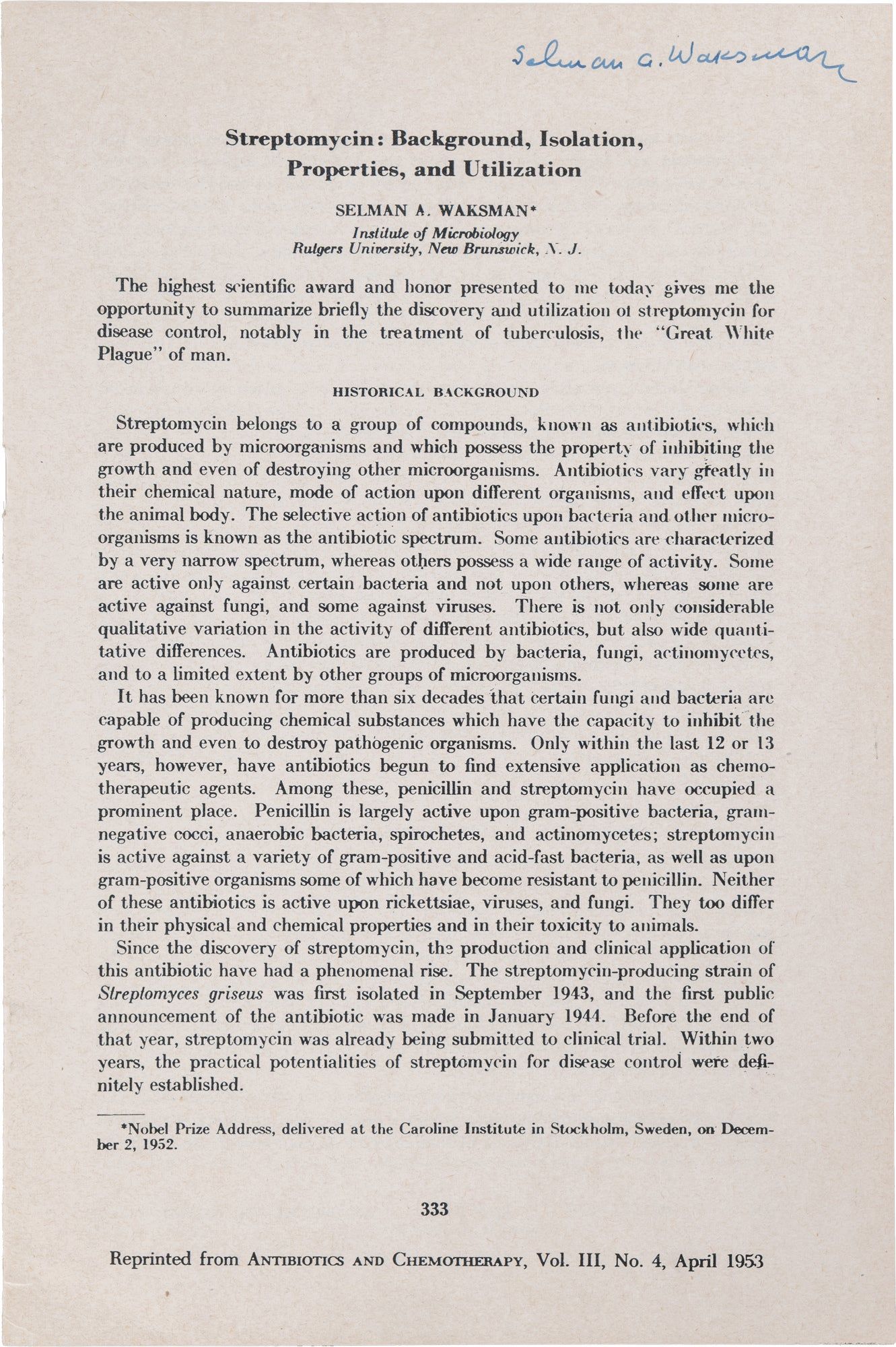
(2) Streptomycin: Background, Isolation, Properties, and Utilization, pp. 333-346; Reprinted from Antibiotics and Chemotherapy, Vol III, No. 4. Northfield, IL: Washington Institute of Medicine, April 1953. Offprint, 8vo (249 x 165mm), pp. 12. Stapled, self-wrappers, some soft creases at the staples, else fine and signed by Waksman on the first page.
A retrospective and synthetic account of streptomycin written nearly a decade after its discovery, reviewing the history of its isolation, its principal chemical and biological properties, and its clinical utilization in tuberculosis and other bacterial diseases. Significant less as a first announcement than as an authoritative summation by the drug's principal discoverer, the paper documents the full arc of streptomycin's passage from laboratory isolation to medical adoption; capturing, in a single account, what the scattered primary literature of the preceding decade had established piecemeal.
The first published announcement of streptomycin, reporting its isolation from two strains of an actinomycete identified as Actinomyces griseus (later reclassified as Streptomyces griseus) and demonstrating antibacterial activity against both Gram-positive and Gram-negative organisms. The paper's central significance lies in its differentiation of streptomycin from the related compound streptothricin, establishing that streptomycin possessed markedly greater activity against a range of Gram-negative bacteria, including organisms of the Pseudomonas aeruginosa group — a distinction with immediate therapeutic implications. Comparative production data from varied media and culture conditions are presented alongside a bacteriostatic spectrum determined by diffusion and dilution assays, providing the empirical foundation upon which all subsequent streptomycin research would be built.
(2) Streptomycin: Background, Isolation, Properties, and Utilization, pp. 333-346; Reprinted from Antibiotics and Chemotherapy, Vol III, No. 4. Northfield, IL: Washington Institute of Medicine, April 1953. Offprint, 8vo (249 x 165mm), pp. 12. Stapled, self-wrappers, some soft creases at the staples, else fine and signed by Waksman on the first page.
A retrospective and synthetic account of streptomycin written nearly a decade after its discovery, reviewing the history of its isolation, its principal chemical and biological properties, and its clinical utilization in tuberculosis and other bacterial diseases. Significant less as a first announcement than as an authoritative summation by the drug's principal discoverer, the paper documents the full arc of streptomycin's passage from laboratory isolation to medical adoption; capturing, in a single account, what the scattered primary literature of the preceding decade had established piecemeal.
Details
Title
Two Signed Offprints on Streptomycin
Author
Waksman, Selman
Condition
Unknown
Date
1953
Edition
First Edition