

Radioactive Recoils from Uranium Activated by Neutrons; from The Physical Review, Vol. 55, No. 5, p. 510
- SIGNED
- Lancaster, PA: American Institute of Physics, 1939
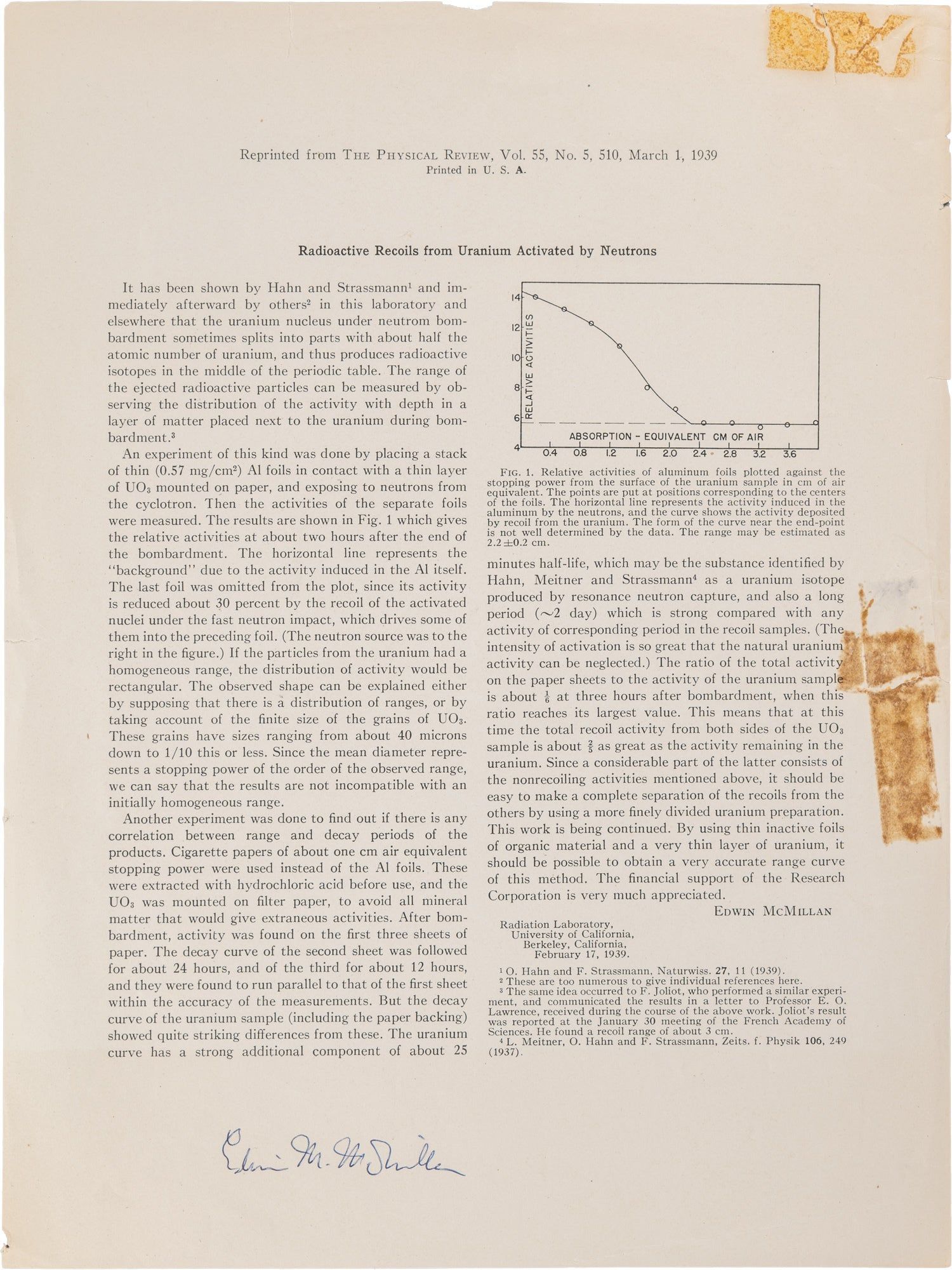
Lancaster, PA: American Institute of Physics, 1939. First Edition. Offprint, 8vo (267 × 200mm), p. 1, printed on the recto only. Some short marginal tears and old tape stains, else very good. Signed by McMillan. This single-page note, dated February 17, 1939, from Berkeley's Radiation Laboratory, was published within weeks of Hahn and Strassmann's announcement of uranium fission and belongs to the intense, disorienting period in which laboratories around the world were racing to characterize what neutron bombardment of uranium actually produced. The field had not yet stabilized: the identities, ranges, and decay properties of the activation products were still being sorted experimentally, and the theoretical framework for understanding fission was still being assembled. This paper is significant both as a primary document of that moment and as the opening move in the line of investigation that would lead McMillan, the following year, to the discovery of neptunium—the first transuranium element and the achievement for which he shared the Nobel Prize in Chemistry in 1951. Investigating the radioactive recoil products generated by cyclotron neutron irradiation of uranium oxide, McMillan stacks thin aluminum foils in contact with the target during bombardment and measures the distribution of induced activity across successive foils as a function of depth. The resulting absorption profile is interpreted as evidence for recoiling fission fragments with a finite range estimated at 2.2 ± 0.2 cm air-equivalent. Decay analysis resolves two principal components: a short-lived activity of approximately 25 minutes, tentatively associated with a uranium isotope produced by resonance neutron capture as identified by Hahn, Meitner, and Strassmann, and a longer-lived component of roughly two days. McMillan observes that the total recoil activity is comparable in magnitude to the residual activity remaining in the uranium sample itself, and argues that a sufficiently finely divided uranium preparation would permit physical separation of the recoiling fragments from the non-recoiling activation products; a methodological inference that points directly toward the experimental approach he would employ in isolating neptunium the following year.
Details
Title
Radioactive Recoils from Uranium Activated by Neutrons; from The Physical Review, Vol. 55, No. 5, p. 510
Author
McMillan, Edwin M.
Condition
Unknown
Publisher
American Institute of Physics: Lancaster, PA
Date
1939
Edition
First Edition