

Five Spectroheliograph Photographs of the Sun
- 1920
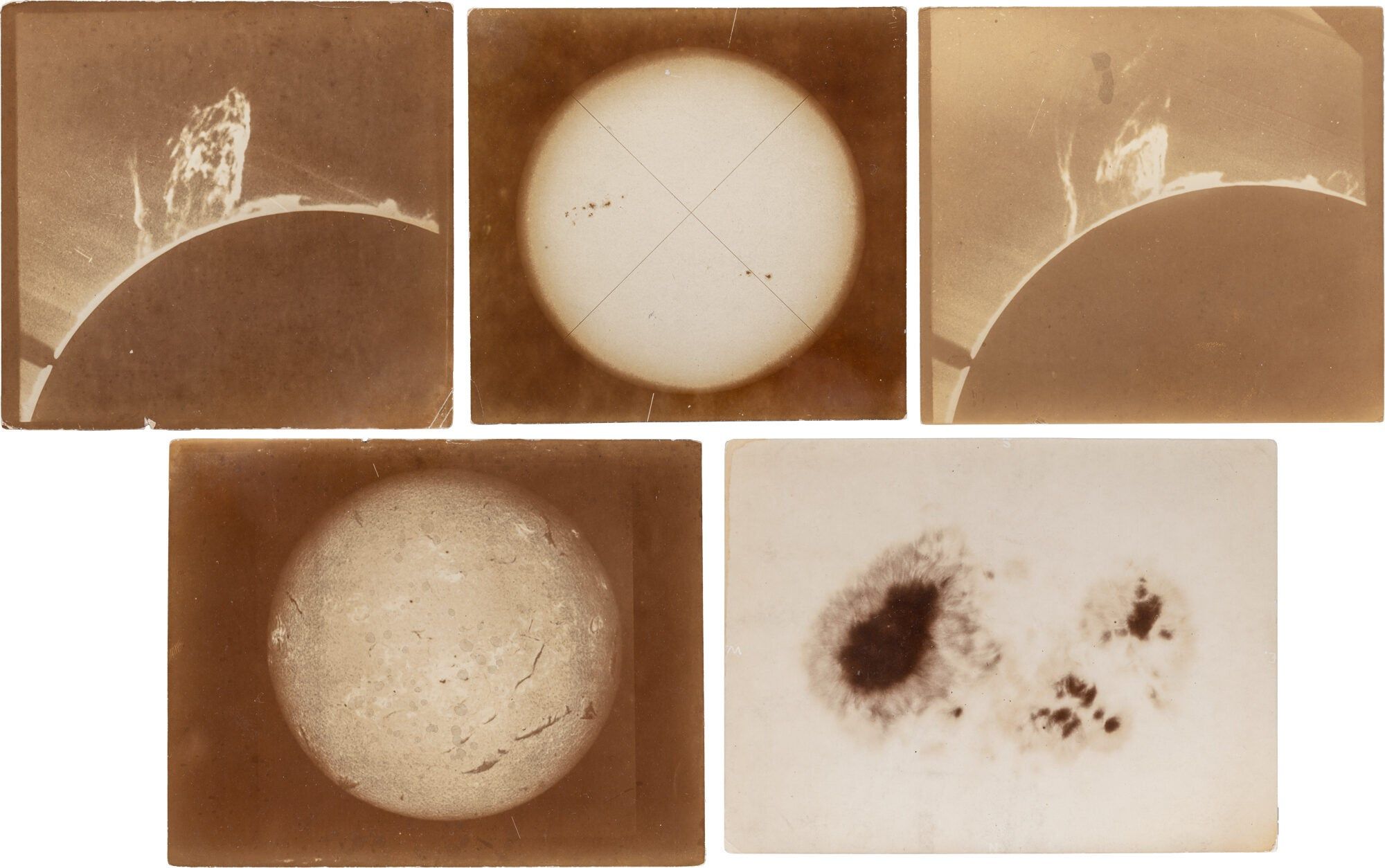
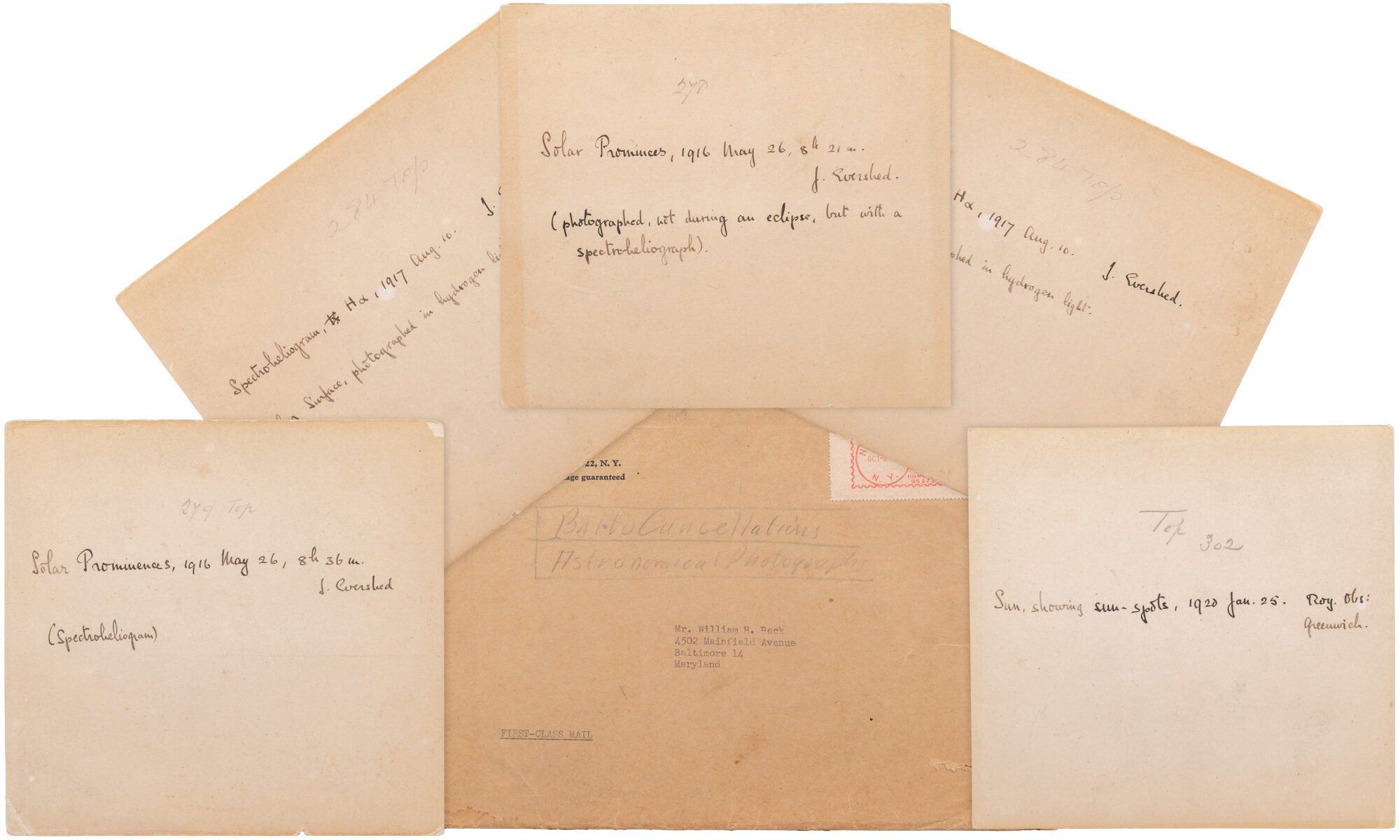
1920. A group of 5 spectroheliograph silver gelatin prints of the sun. Royal Observatory, Greenwich and Kodaikanal, India, 1906-1920. Printed c1920, mailed 1946. 2 prints approximately 7 ½" x 6", 3 prints approximately 6 1/2" x 5 ¾". All prints with manuscript captions on verso (in an unknown hand), 3 prints state that the photos were taken by J. Evershed, the others credited to the Royal Observatory. Some general edgewear, toning, prints lightly curled. Original envelope with a return address of the General Electric address in New York. The spectroheliograph is an instrument designed to photograph the sun in a single, precisely isolated wavelength of light, revealing solar features that are entirely invisible in broadband white-light photography. Invented independently by George Ellery Hale and Henri Deslandres in 1890–1891, it works by combining a spectroscope (which disperses sunlight into its component wavelengths) with a photographic apparatus arranged so that only a narrow band of the resulting spectrum falls on the photographic plate. By selecting the wavelength corresponding to a specific atomic transition, typically the hydrogen-alpha line at 656 nanometers or the calcium H and K lines, the instrument renders visible the chromosphere, the layer of the solar atmosphere lying above the photosphere, along with its associated structures: prominences, filaments, plages, and the magnetic network surrounding sunspot groups. A mechanical scanning mechanism moves both the entrance slit and the photographic plate in tandem across the solar disk, building up a complete image one narrow strip at a time. The result is a photograph of the sun as it exists at a single atmospheric depth defined by the chosen wavelength; a cross-section through the solar atmosphere unavailable by any other means, and the primary tool by which early twentieth-century solar physicists mapped the relationship between chromospheric structure and the magnetic activity cycles that govern solar behavior.
John Evershed (1864-1956) was an English astronomer who made pioneering observations of solar phenomena at the Kodaikanal Observatory in southern India. In 1909, he discovered radial motions in sunspots (gas flows moving outward from the center of sunspots along their surfaces) a phenomenon now known as the Evershed Effect. This discovery fundamentally advanced understanding of sunspot dynamics and solar magnetic fields. The spectroheliograph, invented by George Ellery Hale in 1890, allowed astronomers to photograph the sun in specific wavelengths of light, revealing features invisible to ordinary photography. These prints represent the golden age of solar observation, when British astronomers working at imperial observatories in India contributed significantly to heliophysics. The Kodaikanal Observatory, established in 1899, maintained one of the longest continuous records of solar observation in the world. One of the Royal Observatory photos depicts sunspots, those darker, cooler regions on the solar surface caused by intense magnetic activity.
John Evershed (1864-1956) was an English astronomer who made pioneering observations of solar phenomena at the Kodaikanal Observatory in southern India. In 1909, he discovered radial motions in sunspots (gas flows moving outward from the center of sunspots along their surfaces) a phenomenon now known as the Evershed Effect. This discovery fundamentally advanced understanding of sunspot dynamics and solar magnetic fields. The spectroheliograph, invented by George Ellery Hale in 1890, allowed astronomers to photograph the sun in specific wavelengths of light, revealing features invisible to ordinary photography. These prints represent the golden age of solar observation, when British astronomers working at imperial observatories in India contributed significantly to heliophysics. The Kodaikanal Observatory, established in 1899, maintained one of the longest continuous records of solar observation in the world. One of the Royal Observatory photos depicts sunspots, those darker, cooler regions on the solar surface caused by intense magnetic activity.
Details
Title
Five Spectroheliograph Photographs of the Sun
Author
[Evershed, John]
Condition
Unknown
Date
1920