

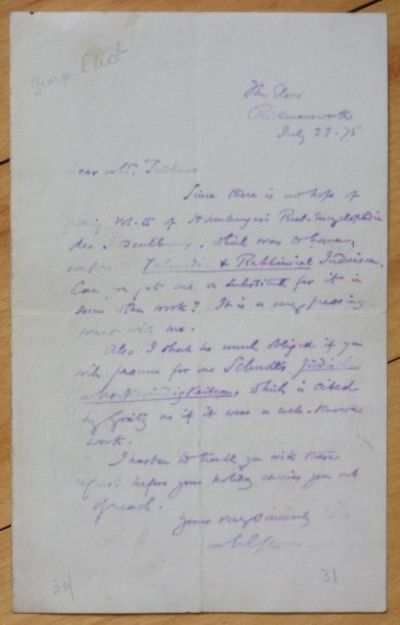
Autograph Letter Signed ("M E Lewes") to publisher [Nicholas] Trübner, asking for Jewish source books for writing DANIEL DERONDA
- 1875
1875. The Elms | Rickmansworth | July 23 - 75". In purple ink, one page of a bifolium.
In 1875, "George Eliot" was Marian (or Mary Ann) Evans Lewes -- Evans being her maiden last name, and Lewes being the last name of the married man she had been living with since 1854. That summer, the couple rented "The Elms," wanting seclusion -- specifically so that she could write her next (and final) novel, which would become DANIEL DERONDA, published in 1876. It would be a groundbreaking novel, in that it revolved around an English gentleman who discovers his Jewish roots. The novel tackles Jewish identity and culture with respect, avoiding stereotypes; it furthermore espouses the idea of a restored Jewish homeland. DANIEL DERONDA is often credited with playing a significant role in early Zionist thought, which 75 years later would result in the establishment of Israel. The text of the letter, in the author's hand, reads: Dear Mr. Trübner | Since there is no hope of getting [???] of Hamburger's Real-Encyclopädie des Judentums, which was to have [???] _Talmudic and Rabbinical_ Judaism, can you get me a substitute for it in some other work? It is a very pressing want for me. | Also I should be much obliged if you will procure for me Schudt's _Jüdische Merckwürdigkeiten_, which is cited by Grätz [Heinrich, author of the 11-volume Geschichte der Juden (History of the Jews)] as if it was a well-known work. | I hasten to trouble you with these requests before your holiday carries you out of reach. | Yours very sincerely | ME Lewes Nicholas Trübner (born Nikolaus in Heidelberg in 1817, died in 1884), was a German-English publisher, bookseller and linguist (he had studied Sanskrit and Hebrew in his younger years); in 1843 he emigrated to London, courtesy of William Longman, and by 1875 he was a well-established London publisher himself, specializing in philosophical works and imported books from the U.S. (which he visited), India and "the Orient." Notably, between 1874 and 1879 Trübner was publishing George Henry Lewes's major late-career work PROBLEMS OF LIFE AND MIND -- which connection undoubtedly prompted the writing of this letter from Lewes's common-law wife (though there ARE other letters from her to Trübner in, for example, 1865, 1871, 1878, and 1879). It is noteworthy that "Eliot" is requesting books in the original German -- a reminder that she was fluent in that language: Marian Evans's very first book, begun in her mid-twenties and published in 1846, was her uncredited translation of Strauss's DAS LEBEN JESU into THE LIFE OF JESUS. The letter is in near-fine condition -- the purple ink is a little faded in places (prompting those question marks above), but there is scarcely any wear or soil. "George Eliot was not Jewish, but Daniel Deronda was researched and published before the rise of Zionism as a philosophy and movement... She not only took on the “Jewish question” in the novel, she brought it to the forefront of minds throughout England and the world, tackling it gracefully and thoroughly. In 1920, Great Britain took ownership of Mandatory Palestine, the territory that Zionists looked to for their settlement. The United Nations, Great Britain included, voted to partition Israel in 1948. International and British sympathies made Israel possible, and Eliot helped foster those sympathies in the British populace" [P. Dutton].
In 1875, "George Eliot" was Marian (or Mary Ann) Evans Lewes -- Evans being her maiden last name, and Lewes being the last name of the married man she had been living with since 1854. That summer, the couple rented "The Elms," wanting seclusion -- specifically so that she could write her next (and final) novel, which would become DANIEL DERONDA, published in 1876. It would be a groundbreaking novel, in that it revolved around an English gentleman who discovers his Jewish roots. The novel tackles Jewish identity and culture with respect, avoiding stereotypes; it furthermore espouses the idea of a restored Jewish homeland. DANIEL DERONDA is often credited with playing a significant role in early Zionist thought, which 75 years later would result in the establishment of Israel. The text of the letter, in the author's hand, reads: Dear Mr. Trübner | Since there is no hope of getting [???] of Hamburger's Real-Encyclopädie des Judentums, which was to have [???] _Talmudic and Rabbinical_ Judaism, can you get me a substitute for it in some other work? It is a very pressing want for me. | Also I should be much obliged if you will procure for me Schudt's _Jüdische Merckwürdigkeiten_, which is cited by Grätz [Heinrich, author of the 11-volume Geschichte der Juden (History of the Jews)] as if it was a well-known work. | I hasten to trouble you with these requests before your holiday carries you out of reach. | Yours very sincerely | ME Lewes Nicholas Trübner (born Nikolaus in Heidelberg in 1817, died in 1884), was a German-English publisher, bookseller and linguist (he had studied Sanskrit and Hebrew in his younger years); in 1843 he emigrated to London, courtesy of William Longman, and by 1875 he was a well-established London publisher himself, specializing in philosophical works and imported books from the U.S. (which he visited), India and "the Orient." Notably, between 1874 and 1879 Trübner was publishing George Henry Lewes's major late-career work PROBLEMS OF LIFE AND MIND -- which connection undoubtedly prompted the writing of this letter from Lewes's common-law wife (though there ARE other letters from her to Trübner in, for example, 1865, 1871, 1878, and 1879). It is noteworthy that "Eliot" is requesting books in the original German -- a reminder that she was fluent in that language: Marian Evans's very first book, begun in her mid-twenties and published in 1846, was her uncredited translation of Strauss's DAS LEBEN JESU into THE LIFE OF JESUS. The letter is in near-fine condition -- the purple ink is a little faded in places (prompting those question marks above), but there is scarcely any wear or soil. "George Eliot was not Jewish, but Daniel Deronda was researched and published before the rise of Zionism as a philosophy and movement... She not only took on the “Jewish question” in the novel, she brought it to the forefront of minds throughout England and the world, tackling it gracefully and thoroughly. In 1920, Great Britain took ownership of Mandatory Palestine, the territory that Zionists looked to for their settlement. The United Nations, Great Britain included, voted to partition Israel in 1948. International and British sympathies made Israel possible, and Eliot helped foster those sympathies in the British populace" [P. Dutton].
Details
Title
Autograph Letter Signed ("M E Lewes") to publisher [Nicholas] Trübner, asking for Jewish source books for writing DANIEL DERONDA
Author
[Eliot, George]
Condition
Unknown
Date
1875